
Image by Bishnu Sarangi from Pixabay
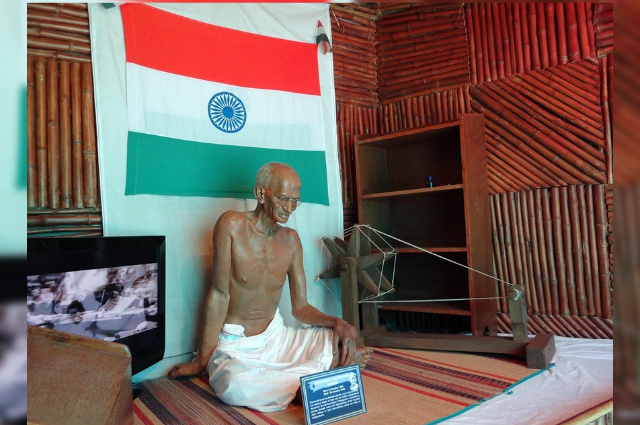
In the year 1922, Gandhi was put on trial for dissent and appeared before the court. When asked to present his side, he said a few things that must not be allowed to slip into oblivion. He said he was guilty before the law and will not ask for mercy. In his written statement, after listing the failures of the Raj and how it has wronged the Indian people, he went on to say, "I hold it to be a virtue to be disaffected towards a Government which in its totality has done more harm to India than any previous system... I am here, therefore, to invite and submit cheerfully to the highest penalty that can be inflicted upon me for what in law is a deliberate crime and what appears to me to be the highest duty of a citizen."
What was the highest duty of a citizen that Gandhi had in mind? It was to disobey the law that was not based on a fair foundation, to question it in the court of your own conscience and once found guilty, to rebel openly against it. Gandhi used the rhetoric of law that the British loved, and employed it masterfully for his own cause, which was always for him the cause of his people. He used these tactics even outside the court. On being asked once what he thought of the western civilization, he quipped, “I think it would be a very good idea.” He clearly was not taken in by the rhetoric through which the West expressed itself. In his reading of the Western authors, he chose to align himself with a tradition that critiqued its excesses and was clear-eyed as to its pretensions. He read and admired the works of Thoreau and Ruskin and Tolstoy, and critiqued the governing policies of the British Isles while staying true to a tradition it valued. This way of reading literature subversively will be the cornerstone of this terrible yet inspiring story of Robben Island.
Literature can be a lot of things to people, and when asked what use it is in a world so unfree and unkind as ours, it does not yield the easy answers we like to hear. It is reflexively imagined that the people involved deeply in the world of literature are exiles in the real world, and can only be found among their bookshelves, basking in irrelevance. How irresponsible and useless, goes the cry. Though when we look outside and see what other people are up to who believe more in the doing of deeds than in the steady acts of thinking and feeling - sizing up the world with their tools rather than taking its measure through the finer instruments of heart and mind - we find them even more distracted than those engaged in literary pursuits. As T.S. Eliot wrote in a letter during the height of the Second World War, while he was working on a poem:
“In the midst of what is going on now, it is hard, when you sit down at a desk, to feel confident that morning after morning spent fiddling with words and rhythms is justified activity – especially as there is never any certainty that the whole thing won’t have to be scrapped. And on the other hand, external or public activity is more of a drug than is this solitary toil which often seems so pointless.”
If questioning the point of literature and the service of selfhood it affords is justified, then surely the ones who question it are not getting a free pass either. The question must be raised: what are we doing in our active pursuits, our public activity that is greatly justified? Without the rope that bridges one person to another across the tides of loneliness, to say nothing of the whirlpools of violence, where will we be as a people?
This is a story about the time when literature served a role much more important than any other pursuit could. It is not the only story of its kind, but it does illustrate literature’s supreme role in interpreting life for us - its chaotic systems of oppression, its eloquent cries of freedom - and providing inner resources to both bear and change it.
During the years of apartheid, a lot of political prisoners were sent to Robben Island, where they were kept for most of their lives. Quite a few of them would go on to have a commanding influence on the shape of their country post-apartheid, Nelson Mandela being the most famous of them. Inside the walls of this island prison, they were treated in a manner that was meant to erode their dignity, erase their identity. The conditions were as dismal as they could be, and the most vivacious of spirits were made to bend, and preferably break, under the yoke of this immense impersonal system.
In his book, ‘Reading Revolution’, Ashwin Desai collects firsthand accounts of the prisoners who spent decades on the island without giving in to the physical assaults of prison authority, and narrates a story of how this island of misery and punishment turned into a place of education and a laboratory for spiritual, indeed political, liberation. He details the daily labour of the prisoners who were made to break stones all day under the sun, with severe punishments for infractions. And yet, for all the physical strain they had to live through, they kept their spirit alive through the exercise of their reason and imagination and, in fact, moved towards doing what Yeats called the “spiritual intellect’s great work.”
Ahmed Kathrada, a prisoner who spent 18 years on the island, talked about the relationship of his fellow prisoners with time in elegant words: “Ours is a very small world, and it is mostly the small things that help to fill the minutes and hours. Small talk, small events, small interests — these combine to make up a big share of our days and weeks and months.” Perhaps a faint echo of Shakespeare could be heard here. (“How shall we beguile / The lazy time, if not with some delight.”)
Kathrada educated himself during the time he remained behind bars. He ended up finishing 4 degrees in prison, and kept on reading books right to the day of his liberation. His most prized possessions were ‘The Complete Works of Shakespeare’ and ‘The Oxford Book of English Verse.’ He also maintained a habit of collecting quotes from the books he read, and by the end of his sentence, he had more than half a dozen notebooks full of such quotes and passages.
There was a book of Shakespeare’s collected works that did rounds around the prison, and it was originally owned by Sonny Venkatrathnam, who was put on the Island in the 1970s. It was confiscated originally by the prison authorities, but then, due to circumstances that demand retelling, he got his book back. As it happened, church services were held on the island, and Mr Venkatrathnam asked the warder to bring his Bible from the storeroom, as he needed it for attending the service. In his own words, “He [the warder] takes out his keys; opens the storeroom; and I pick out my book: The Complete Works of Shakespeare. I take it out and show it to him, ‘Look, there’s the Bible by William Shakespeare’. So he let me have it, I took it to my cell, and we were celebrating..” Just like that. Then, in order to retain it, he cut pictures of gods and goddesses from the Diwali postcards he possessed, and pasted them in front of his book as a cover, and whenever asked about it, he claimed that it was his Bible, and nobody dared to touch it.
This book of Shakespeare eventually became a symbol of the world resisting the pressures of the corrupted world. It was passed around the prison, secretly, of course, and most of the prisoners marked passages in it that spoke to them in their situation. These annotations give insight into the minds of each of these Robben Island inmates as they drew nourishment, and sometimes consolation, from the written word.
Nelson Mandela marked lines from ‘Julius Caesar’, and given the nature of his struggle and his unwavering response to the call of courage, it is not surprising:
“Cowards die many times before their deaths:
The valiant never taste of death but once.
Of all the wonders that I yet have heard,
It seems to be most strange that men should fear;
Seeing that death, a necessary end,
Will come, when it will come.”
Another prisoner, Justice Mpanza, chose the words of Edgar from ‘King Lear,’ and one does not need much thinking to assess the weight of these words even in our time:
“The weight of this sad time we must obey;
Speak what we feel, not what we ought to say.
The oldest hath borne most: we that are young
Shall never see so much, nor live so long.”
While doing hard labour in the quarries, lessons were conducted for the benefit of the unlettered, of whom there were quite a few. By the end of apartheid, even the warders were lining up to study and get literate, thereby attempting to eschew the burden of a system that did not just imprison the prisoners.
Mobbs Gqirana, another inmate from the island who disappeared after his release, had marked this passage from ‘As You Like It’:
“Sweet are the uses of adversity;
Which, like the toad, ugly and venomous,
Wears yet a precious jewel in his head;
And this our life, exempt from public haunt,
Finds tongues in trees, books in the running brooks,
Sermons in stones, and good in everything.”
Mac Maharaj, one of the foremost among the dissidents in the anti-apartheid struggle, chose the haunting words of Gaunt from ‘Richard II’:
“Where words are scarce, they are seldom spent in vain
For they breathe truth that breathe their words in pain.”
One wonders, perhaps at the cost of affronting the Bard-worshippers, why did Shakespeare attain such central importance on the island? Well, for one, Shakespeare is immense in his dimensions of moral imagination, and to these dimensions is added his unmatched flair for language. In an environment where suffering is as common as air, the need to see it contained in words that do not just give it shape but, in their soaring eloquence, dare suggest a victory over it, is life-saving. Secondly, he allows for complexity to take up space where only the simplified discourse of hate and prejudice might have ruled. There is hate in Shakespeare, but it is a human hate, and like most things human, it has roots that have to be reckoned with. He also encourages subversive readings because, in creating characters with so much life in them, he ensured against any attempt at sifting them neatly into airtight boxes. And finally, reading Shakespeare in prison must have provided the prisoners a ‘temporary stay against confusion.’ (Frost's phrase)
Almost all the prisoners came to the island with strong convictions, and they must have realised soon that the convictions they held were toothless as to their impact on the world outside, and it would have been understandable if that translated into a softening of their moral and political stands. It did not happen, and the primary reason why it didn’t was because of this urge to educate themselves and their peers. What they read solidified them into their own worldview, and wherever their view and vision got challenged, it provoked in them even deeper thinking about the ground on which they stood.
This small chapter in human history may not amount to much in the eyes of many, but it is still well worth preserving in our collective memory, which surely is starved of narratives of pushback that deal in ink instead of blood and whose power lies in delivering ourselves to us.
Sources:
- Transcript of Gandhi’s Trial of 1922, https://www.mkgandhi.org
- ‘Reading Revolution: Shakespeare on Robben Island’ by Ashwin Desai (2012)
- Collected Works of William Shakespeare