
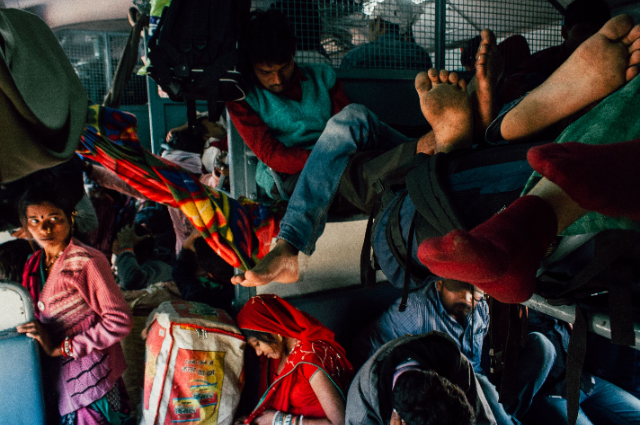
An incident took place years ago, when I was still a world complete within myself, and everything existed to serve my inner needs - I am talking about my late teens. One day, while my internal world was still under repair because of a personal calamity that was reshaping me in its reverberations, something brushed against the outer edges of my world, breaking it open. I wouldn't say there was an epiphany involved, but it did enlarge me a little from the inside, and the incident has stayed with me in the way parables or well-told stories do.
There is a concept in the field of psychology called the Solomon paradox, and it has to do with our long-standing mastery of self-deception. According to the studies, if I have a problem and I try telling it to you, it is highly likely that I will remain stuck in it because I won’t be able to see the problem clearly, in perspective. But if I tell my problem as if it were a problem of my friend, moving from the first-person perspective to the third, it will increase my chances of gaining insight into the problem, leading me closer to a potential solution. Suppose I tell you what happened to me in the manner I am doing right now, will I be deceiving myself more than when I narrate it to you as if it all happened to somebody else? Suppose this ‘somebody else’ is Prerit, a name I just invented, and he is travelling in a train just like I did all those years ago. Let’s see if the truth comes out better for it.
“Love, like a letter, unfolds smile by smile, tear by tear, until it reaches its sudden end,” wrote Prerit in his notebook, which he carried everywhere. He didn’t know many things, but he claimed to know love, in its deceptive simplicities of desire and its complexities of companionship - how it’s measured on the changing rhythms of the heartbeat, and how it fires itself into a heartbreak.
This is not a love story, nor is it about letters, though it does concern a young man of letters who was mourning the end of love as he boarded a train in Lucknow. Life was for him a tale legible only in words, and even if it was full of sound and fury, life did signify something. He was trying to give this something in words, to know life in its varying limits and possibilities. His youthful years may turn out to be a graveyard of ideals, but his spirit would remain unbroken.
"How many losses does it take to stop a heart, to lay waste to the vocabularies of desire?"
It was late afternoon when Prerit woke up from his nap, Allahabad still a few hours away. The train had just moved from a station he didn't bother noticing, and his coach was like a scene from the movie Godzilla. A rush of passengers had drowned his already drowsy senses, and only after a while could he register what was happening in his cabin. A young couple was standing near his seat on the aisle, talking in a hushed tone. Both of them were looking at the ticket they were holding between them, and then at the seat opposite Prerit, where a very loud old man was sitting and laughing and chatting with a fellow beside him. This man couldn't care less about his surroundings. He was one of those men who never seemed to register anything outside the neat perimeter of their whims and duties. The couple had a big sack with them, very unwieldy, and their faces looked tired and troubled. Prerit, with a troubled heart of his own, tried to listen in on their barely audible conversation, and this is what he heard:
"We are sure this is our seat, right?" whispered the woman, looking in her husband’s eyes.
"Yes, this is D5, yes, the coach is D5, and our seats are. . . 28, 29," answered the man in an even lower voice, not meeting her eyes.
"Then ask these people to get up, no? They are sitting on our seats," her voice an octave higher now, and slightly annoyed.
After a flutter of nerves passed through the man’s face as he looked at these old men, in neat yet bulging overalls, laughing and talking, he looked at his ticket again.
"Might there not be a mistake? They are sitting there as if the seats are theirs. . . Let me ask somebody," and he looked around hesitantly.
"Give me the ticket!"
A pause, as she got hold of the ticket. "No, there is no mistake. See, here it's written D5 and the seat numbers are clearly 28 and 29."
Meanwhile, the husband, who was wearing a red crumpled shirt, tried to keep the sack in front of Prerit, which he did not mind. There was hardly any space in the cabin, and the people running up and down the narrow walking corridor were making it difficult for the couple to keep standing there. It was clear that both of them were running a high heartbeat.
Now, after having moved the sack again to make room for a passenger, he spoke hesitantly to Prerit, “Can you look at this ticket, please? Are we in the right cabin?”
Prerit took the ticket, and read in it the obvious staring at him. “Yes, you’re in the right coach, and these are your seats,” he said, pointing with his eyes.
He took the ticket back, and met the eyes of his wife. There was impatience starting to bubble up in the pools of her eyes, and she took them away quickly. She was also dressed in red, a saree equally worn and crumpled, but which hinted at a desire for order. Prerit was trying to frame words in his head as he observed them in their thinking, uneasy silence.
She could see that her husband would do everything but speak to the people who were occupying their seats. He was delaying it, battling the curse of inferiority that comes with the social and economic position of a daily wage labourer. She could sense his eyes drifting around restlessly all over her to find her reassuring ones, to read in them, “It’s alright, I see you. Take your time.” No, she will not give her eyes for him to rest on; he must learn to fight his way out of such situations. She can’t be expected to be a mother to him all the time. And they will not be trod upon! Why should they? They have the ticket. They have a mind and a heart - one racing now - and skin and clothes like all of these people sitting here. In fact, this big old uncle is the one oblivious to the people around him, announcing to everyone his indifferent heart and a mind full only of himself, and that too without a ticket. Just because he has better clothes and a loud, assertive voice does not mean he gets to trample on people!
The expectations of being a man in this situation were paralysing this restless soul who was still trying to keep the heavy sack away from the onrush of passengers, vendors, and beggars storming through the aisle. Of course, he can’t let her wife think of him as an incompetent husband, as less of a man who can’t speak for what is right and just. But he was afraid of confronting these people, demanding the seats. What if he was wrong after all? What if there had been some sort of a mistake? What if this old man sitting there was a person of power who might take offence at being addressed like that? He must have enough means at his disposal to dismantle whatever little life people like him and his wife have gathered painstakingly.
Whatever the case, they were absolutely silent. The weight of this silence was dragging their souls down into the mire of anguish, and it kept them standing despite seats which were rightfully theirs.
Prerit was fully awake now, feeling his own heartbeat rise, something within him beginning to take concrete shape. He felt the weight of a choice. He could take these mutual silences to the court of his imagination and pass his own verdict from the novelist-bench. But then he thought that life was not a thing to be reported, not a catalogue of injustices duly noted in the ledger of literature. No use getting into the heads of the silent couple mowed under the burden of themselves, of the expectations of marriage, of gender, of class differences, of poverty. If literature introduces us into other territories of concern, tunes our ears to the voice of reality amid the clamour of a hundred illusions, moves us to speak for the true and the beautiful, then now is the time to stand up for what is right, and uphold the office of literature outside its native world of words.
Such were the thoughts of Prerit as he got on his feet with the nervous enthusiasm of somebody not used to standing up for strangers, not used to taking note of the moral dimensions of the world outside of himself and not in the best of places emotionally. He would talk to the people occupying the seats himself. His nascent sense of justice was beginning to assert itself when the old man and his mate got up and lined up near the door for the upcoming station.
Everything happened really quickly after their departure. The couple found themselves seated, their faces a harbinger of all that is expected of a young couple eager to reconcile, their eyes returning to speaking terms. The sack was finally in a place where it did not demand attention. And Prerit, amused at the way the situation turned out, gave himself up again to the luxury of sad eyes and aphoristic reflections, though not without an inner change that was barely perceptible. His eyes had now opened to a world with concerns more urgent than his.
I have travelled a lot since then, and most of it has been in the belly of trains. We might find it easy to ignore the uncountable ways injustice keeps on multiplying itself everywhere, but it’s hard to ignore when travelling with so many people crowding a train. I keep coming across these small occasions of injustice, too subtle to be noted by the desensitised eyes of the law, all the time. And I don’t use it as a figure of speech. I do see it all the time. To take a train in India is to come face to face with life strangled within the ‘social contract’. It is also to see within yourself a growing capacity for indifference, to feel the genial current of the soul freeze within you.
Since the time my eyes first opened to all this moral messiness, the world has spared no effort to get them shut again. There seems to be no way to go through a human life except by sleepwalking. There seems to be no other option but to wake up.