
On the morning of February 6, 2023, Shashikant Warishe, a 48-year-old journalist for the Marathi newspaper Mahanagari Times, published what would be his final article. It exposed a land dealer named Pandharinath Amberkar — a man who had been allegedly grabbing land from farmers in the Rajapur region of Ratnagiri district, Maharashtra, in connection with a proposed mega oil refinery. A few hours after the article went to print, Amberkar spotted Warishe riding his motorcycle on a highway near Rajapur. He deliberately steered his SUV off the road, rammed into the journalist, and drove on with Warishe trapped beneath the vehicle for several metres before fleeing. Warishe was rushed to the hospital in a coma. He never regained consciousness. He died the following morning, February 7, 2023.
Warishe was not killed over a personal dispute. He was killed because he had spent two years documenting one of the most consequential environmental battles in modern Indian history — the fight by ordinary people of the Konkan coast to stop the construction of the world's proposed largest single-location oil refinery on their land.
The Project That Divided a Coast
The Ratnagiri Refinery and Petrochemicals Limited, commonly known as RRPCL, is a joint venture formed on September 22, 2017. Its Indian partners — Indian Oil Corporation Limited (IOCL), Bharat Petroleum Corporation Limited (BPCL), and Hindustan Petroleum Corporation Limited (HPCL) — hold a combined 50% stake. The remaining 50% is held by two foreign oil giants: Saudi Aramco of Saudi Arabia and the Abu Dhabi National Oil Company (ADNOC) of the UAE. The projected cost of the refinery stands at approximately ₹3 lakh crore — or roughly US $44 billion — making it one of the largest industrial investments in Indian history.
The proposed refinery would have a processing capacity of 60 million tonnes of crude oil per annum. To put that in context, India's total oil refining capacity in 2022 stood at approximately 251 million metric tonnes per annum. This single project, therefore, would add nearly 24% to that capacity in one location.
The project was first proposed in 2014-2015, with Nanar village in Rajapur taluka, Ratnagiri district, identified as the site. It required approximately 14,000 acres of land across 14 villages in Ratnagiri and neighbouring Sindhudurg district. After intense protests forced the government to abandon the Nanar site, the project was relocated — just 20 kilometres away — to the Barsu-Solgaon area of the same Rajapur taluka. The new plan required 6,200 acres of agricultural land and an additional 2,144 acres for a crude oil terminal at Sakhari Nate on the coast.
What Makes Konkan Worth Fighting For
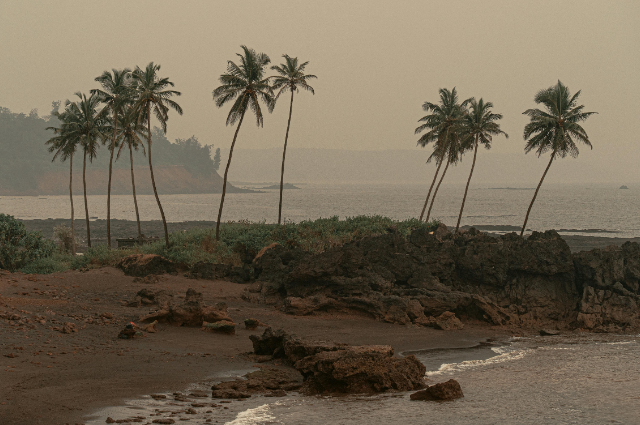
To understand why the people of Konkan refused to accept the refinery, one must first understand what Konkan is. The Konkan coast stretches along the western edge of Maharashtra, hemmed between the Sahyadri mountain range and the Arabian Sea. It is one of India's most biodiverse and ecologically sensitive regions. The Maharashtra government itself declared the Konkan region ecologically sensitive in 1997.
The Rajapur plateau, where the refinery was proposed — locally called the 'Sada' — is covered in laterite rock formations that burst into extraordinary colours during the monsoon. The Arjuna R flows nearby. The region is thick with mango orchards producing the famed Alphonso variety, cashew plantations, jackfruit groves, and paddy fields. The waters off the coast are a major breeding and mating habitat for fish, attracting trawlers from as far as Kerala and Gujarat.
The region also holds something remarkable and largely unknown outside Maharashtra: prehistoric geoglyphs on the laterite plateau. These ancient rock carvings are on UNESCO's tentative list of World Heritage Sites — among the oldest surviving human artworks on the subcontinent, potentially tens of thousands of years old.
For the communities of Barsu, Solgaon, Devache Gothane, Shivne, Goval, and Dhopeshwar, the land is not merely an asset — it is a living system. Farmers here own 100 to 150 mango trees each. A dozen Alphonso mangoes fetch ₹2,000 in the market. Fishing families have worked the same coastal waters for generations. The region provides its own employment. For them, the government's promise of jobs from the refinery rang hollow.
As farmer Kashinath Gorle of Shivne village told reporters: "We don't want such poisonous projects in Konkan. Nature comes first for us. Every year, we employ hundreds."
The Protest That Would Not Break
Opposition to the RRPCL project began almost as soon as it was announced. In Nanar, widespread protests forced the government to shelve the original plan. When it was quietly revived at Barsu-Solgaon, the resistance followed.
By April 2023, when the state government pushed ahead with a soil survey — the first concrete step toward land acquisition — the confrontation became impossible to ignore. The Maharashtra government deployed hundreds of police officers to the Barsu-Solgaon area ahead of the soil testing survey. When residents attempted to block the officials' vehicles, the police responded with lathi charges and tear gas. Over 150 people, including many women, were detained and released later that night. They were driven to different parts of Ratnagiri district to disperse the protest.
Women protesters lay down on the road in front of officials' vehicles. Gram Panchayats passed multiple resolutions condemning the government's conduct. Externment notices — legal orders banishing individuals from a region — were served to activists, including members of the Refinery Virodhi Sanghatana, the umbrella organisation leading the resistance. Section 144 of the Criminal Procedure Code was imposed. Yet the people did not leave.
The movement extended beyond the immediate villages. During the Ganpati festival of 2023, an unusual chant rang through every hamlet and lane in Rajapur taluka: "Refinery prakalp, yei Kokanat ho, kara virodh virodh, kara virodha" — 'The refinery project arriving in Konkan, let's oppose, oppose it.' Young people who had migrated to Mumbai for work returned home for the festival and joined the protests. Entire communities stood united.
A History of Resistance: Jaitapur to Barsu
The RRPCL battle is not an isolated incident. It is the latest chapter in a long history of the Konkan coast resisting large industrial projects that threaten its ecology and livelihoods.
Less than 20 kilometres from Barsu lies Jaitapur — the site of a proposed nuclear power plant that would be the world's largest if constructed. The fight against the Jaitapur plant spans over a decade. It left a permanent mark on the community: Tabriz Chowk in Sakhri Nate village is named after Tabriz, a young activist killed during the Jaitapur protests in April 2011.
The people of this coast have consistently argued that large industrial projects bring pollution, displacement, and destruction of their traditional livelihoods, while delivering far fewer local jobs than promised. They point to the Jamnagar Refinery as a cautionary example — where locals ended up with only tertiary, low-paying employment despite government promises.
Critics of the RRPCL have also questioned the project's classification. While the refinery falls under the Red Category in India's environmental classification system — meaning it is identified as highly environmentally harmful — government officials have repeatedly described it as a 'green refinery,' a description that activists have called an attempt to greenwash a deeply toxic project. Opponents have consistently called for the refinery to be relocated to drier, less ecologically sensitive regions like Marathwada or Vidarbha.
The Price of Speaking the Truth
Shashikant Warishe was, by many accounts, the movement's most consistent chronicler. For over two years, he documented farmers' voices, their letters to ministers, the government's silences, and the alleged corruption that was reshaping land ownership in the region. He was the first to report that large numbers of land transactions had taken place in the Barsu-Solgaon area from 2019 onwards — fuelling suspicions that well-connected buyers had advance knowledge of the project and were purchasing land to profit from acquisition.
Warishe had received threats. He knew the risks. His friend Babu Gowalkar recalled: "He used to tell me that he didn't think he would live very long, but that he would live like a lion for as long as he does." He was the sole earning member of his family, survived by his elderly mother and an 18-year-old son.
His final article was named Pandharinath Amberkar, a land dealer and pro-refinery lobbyist who had allegedly been involved in illegal land grabs and had a documented criminal history, including a prior attempt to run over a village leader's son. The article noted that Amberkar had been prominently displaying his photographs alongside the Prime Minister and the Chief Minister of Maharashtra on banners across Rajapur, claiming credit for bringing the refinery project to the region.
Within hours, Amberkar allegedly ran Warishe down on the Rajapur highway. Maharashtra Deputy Chief Minister Devendra Fadnavis later confirmed to the state legislative assembly that the killing was a "deliberately orchestrated accident" carried out in retaliation for Warishe's journalism. Murder charges were filed.
The Committee to Protect Journalists (CPJ), an international press freedom organisation, called for a full investigation and accountability. The People's Union for Civil Liberties stated that Warishe's killing was "designed to silence and intimidate all those who dare to speak up." The media fraternity in Maharashtra held silent protests in Mumbai.
What the Land Actually Means
The environmental and livelihood stakes of the RRPCL project are not abstract. Refineries of this scale generate significant air, water, and soil pollution. The proposed crude oil terminal at Sakhari Nate, on the coast, would directly affect the fishing grounds of thousands of fisherfolk from multiple states. The laterite plateau and its river systems — already ecologically fragile — would face permanent alteration.
Activist Hrishikesh, a lawyer from the region, made the broader point clearly: "This is not merely about the refinery but also about the petrochemical project that will come up there. There is an effort to greenwash the project by calling it a 'green project'. Even the claim that it will generate employment remains inflated and false."
The political dimension of the controversy has also remained active. In the 2024 Maharashtra Assembly elections, the refinery was still a live issue — with factions of Shiv Sena on opposite sides of the debate, reflecting deep divisions within Konkan's traditional political base.
A Real Story India Must Not Forget
The story of the Konkan refinery protests is, at its core, a story about the collision between two legitimate but competing visions of development. On one side stands India's pressing need for energy security — a country of 1.4 billion people that imports a significant share of its petroleum. On the other hand stands a community's right to protect land, water, ecology, and a way of life that has sustained them for generations.
What makes this story extraordinary is not just the scale of the battle, though the numbers are staggering. It is the nature of the resistance. No political party led this movement. No celebrity championed it in the early years. It was farmers, fisherwomen, village panchayats, and one journalist on a motorcycle who kept the story alive at enormous personal cost.
Shashikant Warishe left behind a son who was 18 when his father died. He left behind a community still fighting. And he left behind a record — article after article — of what it looks like when ordinary people refuse to be erased from their own land.
As of 2024, the Ratnagiri Refinery project remains mired in controversy, with no final resolution on land acquisition or construction. The resistance continues. Whether India ultimately chooses to build this refinery or find an alternative site, the people of Barsu-Solgaon have already demonstrated something the country rarely gets to witness: that when a community decides collectively that something is worth fighting for, even the world's largest industrial projects can be made to wait.
References
- Committee to Protect Journalists (CPJ) — Case of Shashikant Warishe, 2023
- The Quint — Konkan Refinery Protests, April 2023
- Newslaundry — 'The only journalist who cared', February 2023
- Centre for Financial Accountability — Ratnagiri Refinery Opposition, 2023
- Mongabay India — Oil refinery sparks protests in Ratnagiri, November 2022
- The Hindu — An oil refinery is dividing villages in the Konkan belt, May 2023