
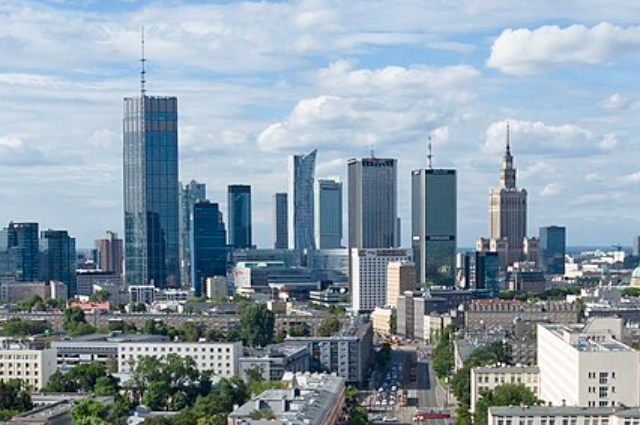
“One of the earliest things that I observed when I arrived in Warsaw was the reaction that drivers in crossing showed to people. When a pedestrian started to cross a zebra crossing, or even seemed to be about to cross, the next approaching vehicle would decelerate and stall regardless of the size, luxury and cost of the vehicle. At one instance, when I wanted to cross over a road (where no traffic lights existed), the occupant of a sedan car slowly stopped, nodded and smiled at me to enable me to pass. This was no one-time thing; it was an expectation. It was not a perfunctory smile or nod, but it was real, and the driver seemed to believe the pedestrian had a right of way. Even the thought that a pedestrian could not receive that courtesy was to me, weird, particularly when it comes to most intersections in Indian cities.”
Driving happens to be nothing more than a mode of transport, a daily commute, or an obligation. However, behind merely being on the road, there is a network of human behaviours, cultural practices, infrastructure decisions and regulation systems, which influence the safety, courtesy or aggressiveness of our roads. The concept of road rage has entered popular culture, and is used generally to signify the manifestations of anger, impatience or aggression in the car: honking, tail-gating, unsafe passing, verbal or physical confrontation.
The situation is depressing in India. Research has indicated that motorists in heavy traffic complain of anger, road rage, overtaking, unnecessary honking and high chances of accidents. Meanwhile, other countries in Europe, like Poland, have recorded meaningful gains in the reduction of road fatalities and driver behaviour. A recent trip to Warsaw to attend an academic conference made me realise such nuances that can not be detected by simply looking at the figures: the silence at zebra crossings, the corrective courtesy of drivers, even of luxury cars, the virtually total lack of honks in the normal traffic stream.
This article refers to the case of Poland, not as an ideal case example, but as a significant point of departure for India. It poses as follows: what is driver behaviour like, and what does it feel like in an environment where traffic norms and enforcement are taken seriously? What can India learn from that experience, namely in such areas as pedestrian rights, courtesy and traffic culture of the drivers? Although the task of India is enormous, it is finding solace in the fact that other nations that have much less to give than we have accomplished have been able to make massive progress.
In the following sections, I will introduce some critical statistics to create the safety situation in Poland and India; after which I will compare those numbers with my own experience in the streets of Warsaw; finally, I will comment on drivers of behaviour, institutional structures and cultural values that facilitate or act as obstacles on the way to traffic discipline. Finally, I will provide practical information and suggestions on how India can be more adaptive to what has proved to be successful in other countries, but still be aware of the socio-economic and infrastructural uniqueness of this situation.
Road Safety: A Statistical Overview
Poland’s Road Safety Landscape
In the period 2012-2021, Poland achieved a notable 37 % reduction in road fatality numbers (from 3,571 deaths in 2012 to 2,245 in 2021) — a sharper drop than the EU-average of 25 %. In 2021, the mortality rate was about 59 road fatalities per million inhabitants, which remains higher than the EU average of ~45 but demonstrates meaningful progress.
Further, between 2012 and 2022, Poland achieved a 47 % decline in road deaths — significantly better than the EU average decline of 22 %. These figures show that Poland has moved from a relatively higher-risk position to one of greater improvement among its peers. However, the country still ranks among the top performers in terms of fatalities per million within the EU, indicating that the problem is far from solved. What is also noteworthy is Poland’s data-driven policy environment: for example, what counts as “serious injuries” and systematic tracking of traffic performance indicators.
India’s Road Safety Situation
In contrast, India continues to struggle with very high numbers of traffic fatalities and injuries. According to the “India Status Report on Road Safety 2024”, road traffic injuries remain a “persistent public health challenge”. For example, pre-pandemic data show ~154,732 road-crash fatalities in 2019, dropping to ~133,201 in 2020 (partly due to the COVID-19 lockdown) and then rising again past 171,000 by 2022.
State-level data also underscore disparities: for instance, one source lists top Indian states by fatalities, with Uttar Pradesh recording 23,652 deaths, Tamil Nadu 18,347, Maharashtra 15,366, Madhya Pradesh 13,798. These numbers reflect several structural and behaviour-based challenges: mixed traffic (two-wheelers, pedestrians, cars), weak enforcement, infrastructure gaps, and high driver stress. Although India is launching improved frameworks and programmes to address road safety, the baseline remains much more challenging than that of Poland in both scale and complexity.
Comparative Summary & Reflection
When placed side by side, a few key contrasts emerge:
- Poland, despite being a higher-income European country with developed infrastructure controls, had a worse fatality rate per million in 2012, but has made gradual improvements.
- India still has one of the highest absolute numbers of road fatalities in the world, and a very mixed vehicle-road-user ecosystem, which complicates simple solutions.
- The rate of reduction in Poland is impressive (37-47 % over a decade), whereas India’s reductions have been modest and uneven, in part due to the vast scale and heterogeneity of its road-use context.
- While Poland’s mortality (59 per million) remains higher than the European average, it is moving in the right direction; India’s fatalities per million (though less often published in this framing) remain alarmingly high in absolute terms and growing in certain categories (e.g., two-wheelers, pedestrians).
These differences set up the subsequent sections: how behaviour, infrastructure, culture, and enforcement interplay differently in each context — and how India might draw targeted lessons from Poland’s trajectory.
Reflexive Notes: What I Saw in Warsaw
Some of these common interactions between the traffic in the everyday scenes during my recent visit to the Polish capital, Warsaw, during an international conference struck me hard, practices that sharply contrasted with the ones I happen to experience regularly in India. Below are my key reflections.
Pedestrian Rights and Respect
One of the earliest things that I observed when I arrived in Warsaw was the reaction that drivers in crossing showed to people. When a pedestrian started to cross a zebra crossing, or even seemed to be about to cross, the next approaching vehicle would decelerate and stall regardless of the size, luxury and cost of the vehicle. At one instance, when I wanted to cross over a road (where no traffic lights existed), the occupant of a sedan car slowly stopped, nodded and smiled at me to enable me to pass.
This was no one-time thing; it was an expectation. It was not a perfunctory smile or nod, but it was real, and the driver seemed to believe the pedestrian had a right of way. Even the thought that a pedestrian could not receive that courtesy was, to me, weird, particularly when it comes to most intersections in Indian cities.
In India, I am used to seeing people on the street forced to bob and weave around immobile and mobile cars, wait until there is a substantial opening in a traffic jam or use body language that is assertive to make motion. The readiness of Warsaw drivers to stop despite the presence of moderate traffic and the absence of any visible controlling camera and police officers seemed to me like a behavioural norm, not an exception.
Honking, Noise & Driving Culture
The most astonishing thing, perhaps, is the relative silence of the roads, even when they are active. I discovered a recent video of an Indian influencer, Kunal Dutt, who shot a few minutes at the intersection of an ordinary street in Poland and declared how these roads do not have a single honk. He stressed that the noise level was not loud despite buses, cars and tramlines.
I was able to attest to this as a walker and a rider: horns were very uncommon, and only in very pressing occasions were they sounded. Motion, speed adjustment and yield-behaviour appeared to be more helpful than an audible warning as it was used by motorists. The lack of honking excesses may indicate a feeling of trust among the users of the roads and a sense of order.
Compare that to most city roads in India: a lot of honking, which seems to be a poor alternative to disciplined driving or a reaction to impatience. Honking is actually the only form of communication between road-users in some cases. The Warsaw experience has given me some doubts regarding the extent of noise pollution and aggressive signalling on our roads, in the contribution to stress, impatience and misbehaviour.
Behaviour Beyond Infrastructure
Notably, the infrastructure that I observed was not only good. It had zebra-crossings, pedestrian lights and vehicle lanes, yes--but the traffic I observed indicated that a good many of the drivers preferred to halt and give way even if they technically had the right of passage. It was like a culture of consideration that was a natural way of life, and not just to be fined or to be under the camera.
As an example, there was no traffic light at a road I was on, and I saw a group of pedestrians start crossing. A big SUV coming our way decelerated prematurely, the driver looked directly at the pedestrian group, stopped and allowed them to move past him without honking, without manoeuvring to pass through them. The passers-by were not rushing along, but walked steadily and confidently. That is not the sort of atmosphere that one may find in many Indian cities, where people tend to walk out carefully, anticipating cars passing through them. Such a difference in behaviour gives an important though minor hint: infrastructure is important, but shared norms of road-users and the anticipation of mutual respect can be even more crucial.
The Silent Road: The Honking Contrast
Among the most striking perceptions I made during my stay in Warsaw was the fact that the roads were so quiet that they did not mean that there was none, but rather that there was hardly any honking at all, except in moderately busy times. There were cars, buses, trams and cyclists on the streets, but in crossroads or turning lanes, no horn went off in the soundscape at all. This silence was not due to any lack of reasons to honk, but it appeared that there was some kind of understanding between drivers and pedestrians: patience and waiting took priority over haste and irritating signalling.
This fact was well illustrated by the current Indian influencer Kunal Dutt, who posted a video in Poland that had gone viral among Indian viewers. He was standing at a crossroads in Warsaw and commented about the absolute silence in spite of the constant flow of vehicles. He said, Not a single honk, and it shows how traffic flow in Poland is not in a state of an unsynchronised mess, as many Indians have grown used to. Indian media extensively covered his video as an illustration of the opposite driving culture that values calm over aggression.
In addition to the anecdote, there is some evidence that honking is not a reflex only, but a larger pattern of behaviour that depends on the culture of the road, enforcement of the law, and expectations. Honking in Poland is usually employed in an emergency situation, a situation of last resort. This is a product of such restraint of driver education, increased efforts at enforcing noise laws, and social conventions that consider unnecessary honking to be inconsiderate.
However, in India, honking has become a common means of communication, so common that most vehicles now come with colour stickers such as Blow Horn Please or Use Horn, and so on, painted on the trucks and buses. There is usually more behind the popularity of horns: lack of discipline on the lanes, signal disregard, inappropriate junction design, and an overall belief that the rest of the road users or pedestrians will not obey the law; hence, the warning signal becomes the only mode of interaction. A study on driver behaviour in India also demonstrates that honking is associated with high levels of stress and aggressive behaviour whilst driving, and so a certain degree of tension is experienced between the driver and the road safety, not to mention the driver's mental health.
Nevertheless, what is really important about the comparison cannot be sound alone, but it indicates a primary cultural difference in the perception of rights and responsibilities on the road. Drivers in Warsaw have faith that other people will observe signals, space, and time. In most cities in India, such a trust is substituted by either a feeling of caution or assertion, hence honking, which becomes a form of control. So the quietness of the Polish roads is not simply a question of sound comfort, but it is also a more general adherence to collectiveness in the values of the road.
Against this background of noise pollution, road rage, and chaotic road conditions, the Polish case study presents a compelling image of how calmness is not only the by-product of stricter regulations or superior roads but rather the by-product of respect, taking decades to be achieved. This change can be initiated by the implementation and education of the road-users, but its complete revival is to alter the attitude of the road-users towards one another, not to see them as barriers to their path, but as companions in the same environment.
Policy, Enforcement, and Cultural Structures
The difference in road behaviour between Poland and India is not just the result of individual attitudes - it is founded on systems of policy, enforcement, education and cultural reinforcement. These systemic elements play a decisive role in how drivers interact with each other, treat pedestrians and perceive responsibility when on the road.
Poland’s Systemic Approach
Poland's path towards better road safety has been led by well-organised and national programmes, data-oriented interventions and a legislative readiness to change in accordance with obstinate challenges. Central to these is the National Road Safety Programme 2021-2030, known as Narodowy Program Bezpieczenstva Ruchu Drogowego, which sets out a vision for a reduction in road deaths of half by 2050, with no severe injuries at all by that time. The program focuses on principles of Vision Zero - viewing the deaths of all traffic accidents as preventable and the preservation of human life as a priority for road design and policy.
The program and its activities focus on a number of areas: reduction of vehicle speeds, removal of drink-driving, improvements of the road infrastructure for pedestrians and cyclists and the issue of safe vehicles, all with a strong basis in rigorous data collection and cross-sector coordination. One of the most important results has been a reduction of road fatalities of almost 47% between 2012 and 2022, a much higher figure than the EU average of 22%.
Further, Polish lawmakers have proposed tough legal reforms, such as the creation of a new offence termed "road homicide". This proposal is to impose harsh punishments on those who cause fatal accidents through careless behaviour, such as driving under the influence or without a licence to drive, to close loopholes in the accountability system.
These approaches have been shown to exhibit a strategic combination of legislative action, public education and enforcement, based around shaping a culture of respect and responsibility on the roads. The Polish model shows us that even a country with a high baseline in terms of injuries and fatalities can make significant progress in time with a policy focus.
India’s Limitations and Challenges
In contrast, India's road safety problems are exacerbated by the magnitude, diversity and inconsistency of its road network and enforcement systems. While there are policies and laws in place - for instance, the Motor Vehicles (Amendment) Act, 2019, increased the fines for violating the laws and also introduced stricter penalties for dangerous driving - their enforcement varies across states and cities. Resources for monitoring, policing and engaging the community are often scarce, and corruption or lax enforcement often defeats even well-intended regulations.
Moreover, there is a huge gap in driver education. Many drivers on Indian roads have not taken any rigorous training programmes and may not be fully aware of the rules on the roads, the rights of pedestrians or defensive driving techniques. Compounding this is the vehicle mix in India - over 70% of vehicles are two-wheelers, and roads are also shared with cyclists, pedestrians, auto-rickshaws, animal carts and street vendors. This diversity of users, lack of good lane discipline, and poor infrastructure are sufficient to make the traffic environment chaotic and unpredictable.
While India has started adopting some data-oriented approaches to road safety, like the World Bank-supported India Road Safety Facility, large-scale change will take not only statewide policy-level changes, but will also require a deeper cultural shift. Such changes will need to address everyday attitudes: attitudes about the mix of the rights of the driver himself and the rights of others on the road; the ability to enforce compliance without causing resentment and evasion.
Lessons from the Polish Experience
What Poland's example drives home to India is that even the high-risk environments are transformable through commitment, prioritisation and consistency. The three-pronged combination of interventions based on data, public campaigns and legal reform - in sync with civil behaviour - can provide the basis for safer and more humane urban mobility.
India has more than infrastructural challenges - it is also a behavioural challenge: creating empathy on the road, awareness of the rights of pedestrians, speed limitation and designing roads that enforce compliance. A long-term investment in education at the school level, public service campaigns and municipal accountability are no less important.
In sum, Poland's progress is evidence of the fact that policy and culture are a mirror image. Laws can affect behaviour and behaviour can reinforce laws - but when these elements work together, roads become not just safer, they also become more civil, compassionate spaces for all.
Road Rage and Human Emotions
The presence or absence of road rage is an indication of much more than momentary frustration - it is about the emotional balance of road users, their level of stress, and how infrastructure and culture fan the flames or calm the situation. While there are incidents of road rage both in Poland and India, the scale, triggers, and manifestations of road rage differ significantly and are useful to understand the emotional situation on the roads of the two countries.
A Psychological Perspective on Road Rage in India
In India, drivers are frequently subject to long commute times, choked roads, random movements of pedestrians and vehicles and the absence of clear and enforceable rules in many urban and semi-urban settings. These are the kind of conditions that provide a fertile ground for emotional agitation. A study entitled "Road Rage and Driver Anger - An Indian Perspective", published in the Archives of Mental Health, reveals the fact that Indian drivers tend to exhibit high levels of anger at times of traffic obstruction as compared to international drivers.
One consequence of this overload of emotions is the normalisation of aggressive driving behaviours -- frequent honking, sudden overtaking, verbally abusive language and even physical confrontation. Most Indian drivers, especially in major cities, have either seen or experienced road rage themselves to see how deeply it is embedded in the road culture of everyday life.
It is often not just an outburst in a particular case, but is the result of a collective way of thinking due to stress, frustration and lack of trust in other road users. The cacophony of horns, which are used to communicate dominance or annoyance instead of preventing collisions, is an example of expressive aggression - one in which the horn is also a tool of emotional release.
Poland’s Context: Control Over Emotion and Space
While Poland is not without road rage, the culture and environment go a long way in reducing the expression of it. The slower flow of traffic, obedience to lanes, and respect for pedestrian rights cause fewer points of frustration. As I saw during my visit, even in moderate traffic, drivers usually kept their cool when pedestrians were coming onto crossings or when vehicles were travelling in narrow streets. The lack of honking is a cause and effect of emotional balance on the roads.
This culture of courtesy, such as pulling over for pedestrians, making eye contact before proceeding, and yielding consistently, turns what could otherwise be spaces of conflict into cooperative spaces. Polish drivers seem to take to heart the idea that respecting the rights of others does not make them lose their own. Combined with effective enforcement of traffic laws and better road designs, drivers are less likely to think of road use as a conflict.
Comparative Insight: Emotional Architecture of Roads
The stark difference between India and Poland's road rage scenarios is not a difference that can be attributed to affluence or lack thereof, or infrastructure as such, but to emotional architecture - the psychological conditioning that comes with driving in each culture. An Indian driver, taught to believe that no one keeps rules unless he is forced, is likely to drive dangerously in a defensive and, by extension, in an aggressive manner. A Polish driver, accustomed to considering one another and expecting an order, reacts differently to the same stimuli.
This difference is to highlight that road rage is not an illness that needs to be cured but a symptom of systemic imbalance. While India's high-density and varied use of the road network creates challenges that Poland does not, the Polish example shows how calming the emotional environment of the road -- through driver education and enforcement, as well as giving priority to pedestrians and even reducing the noise level -- can pave the way for safer, more humane roads.
Lessons & Comparative Insights
The contrasting experiences of Poland and India do not simply provide a story of two systems - they create a schema for understanding the interaction of behaviour, infrastructure and culture that creates road safety outcomes. While aware of the massive contextual differences, a few lessons are learnt that India can adapt, but never replicate, to make its road environments safer and more humane.
What India Can Learn from Poland
- Pedestrian-Centric Road Design: Poland's commitment to pedestrian safety (marked zebra crossings, pedestrian islands, and traffic calming) shows that faith in a road system starts on two feet. The prioritisation of pedestrians, even in between without traffic lights, is a culture where human rights are above vehicular impatience. India, where pedestrian deaths make up a large percentage of road fatalities, could do a lot to benefit from infrastructure that has pedestrians at the centre of urban planning.
- Data-Driven Enforcement and Policy: Poland's frequent traffic data publishing, targeted interventions, and national integration, such as Narodowy Program Bezpieczenstva Ruchu Drogowego, make Poland's approach responsive instead of reactive. Indian cities do not have such coordinated sharing of data between departments, and thus there are gaps in enforcement, evaluation and continuity of policy.
- Behaviour-Based Campaigns and Driver Education: One of the important aspects of the transformation of Poland is not only the laws and the roads but the social messaging - through education, the media and driving schools. In India, where many drivers get very little formal training, introducing mandatory driver education programmes and public service campaigns, as well as traffic culture modules at the school level, could start to change norms.
- Strict but Meaningful Enforcement: The proposed "road homicide" law in Poland seeks to hold reckless drivers accountable if their behaviour leads to fatality, to make it clear that road violence is not just ordinary negligence - it is a grave offence. By rethinking punishments, which reflect the seriousness of threatening lives through endangering road speed, India could be more successful in combating its alarming rates of fatal road crashes.
Cultural Challenges and Contextual Adaptation
While the Polish model offers valuable insights, India’s complexities—from population density to economic inequality and the variety of road users—necessitate localised adaptation. For instance, enforcing pedestrian zones in cities like Kolkata or Delhi would require creative coordination between municipal authorities, traffic police, and community actors, especially in areas with high informal commerce or a lack of proper sidewalks.
There is also a cultural component: whereas Polish drivers are generally trusting of institutional enforcement and mutual courtesy, Indian drivers often operate in an environment where unpredictability is the norm. That makes the case for gradual change—building “trust infrastructure” through visible, reliable enforcement, public campaigns, and community participation.
Mutual Learning: What Poland Can Learn Too
It's important to note that Poland, despite being impressive in its progress, still has rates of road fatalities that are higher than the EU average and struggles with cases of rural road safety and drunken driving. Both countries could benefit from the exchange of knowledge concerning urban mobility, efficient integration of public transport and monitoring systems based on efficient use of technology.
The German experience with the widespread, diverse use of roads provides lessons in tolerance and flexibility that could be helpful to Poland's changing urban mobility environment, particularly as the cities become more complex in their form.
The Human Dimension
At the heart of this comparative study is an ethic of empathy — roads are shared spaces where safety and dignity must extend to all, not just the fastest vehicle. Whether in Warsaw or Bangalore, respecting a pedestrian, reducing noise, or yielding at a crossing is not merely a law — it is a moral act. By holding that principle as central to road culture, both countries can move toward safer and more civil urban life.
Concluding Remarks
Road safety is not a logistical issue; it is a deeply human issue. The contrast between India and Poland tells us that it is not just infrastructure that can create safe roads, but it is also culture, a culture of respect and a thoughtful policy and discipline that is empathy-based. In Poland, the quiet roads, polite drivers and prioritising of pedestrian rights didn't come by accident. They are the result of years of sustained effort: data-driven policies, consistent enforcement, education, and a social ethos of shared responsibility rather than individual urgency. The fact that the country has moved on over the years, from being one of the worst EU countries in terms of road fatalities to a model of steady improvement, is indicative of what is possible when safety is not seen as a technical goal but as a societal commitment.
India's roads, on the other hand, are often a reflection of the pressures of scale, socio-economic variety and infrastructural pressures. However, despite the chaos and the honking, there is the potential for transformation if behaviour and systems can be aligned. The Indian experience also contains examples of change: regulated zones in major cities, sharing bicycles or improving road safety campaigns are points towards change. But the journey requires something more than isolated interventions; it needs a reimagining of the way roads are shared and why lives on them matter.
From Warsaw, I came back with a profound understanding that the true soul of a city is shown not by its monuments, but also in the way the city treats its pedestrians and co-travellers. The nonstop crossing without even the slightest noise, the unintentional smile exchanged with a driver, the non-honking, small but powerful expressions of human dignity. In today's rapidly growing India, where road rage and road collisions too often kill people, this is a lesson that is of the utmost urgency. The path to reform, therefore, doesn't start with imported models but with a clear intent: to recognise the inherent value of every single life, to exercise patience behind the wheel and help to create a civic culture in which courtesy is not a luxury, but the norm.
As India paves its way to be a safer nation on the roll, the example of Poland is not there as a blueprint, but a possibility - a live reminder that safety, respect and civility can easily co-exist with modern mobility. What matters is not where we start, but by how strongly we dedicate ourselves to the journey, and if there is anything but movement on our roads, and that's the meaning.
References:
- Abdoli, Nasrin, et al. “Mental Health Status, Aggression, and Poor Driving Distinguish Male Traffic Offenders from Non-Offenders.” Neuropsychiatric Disease and Treatment 11 (2015): 1499–1506.
- Central Pollution Control Board (CPCB), Government of India. Noise Pollution (Regulation and Control) Rules. New Delhi: CPCB, various years. https://cpcb.nic.in/.
- European Commission. Road Safety Country Overview: Poland – 2024. Brussels: European Commission, 2024.
- European Commission — European Road Safety Observatory (ERSO). “Poland — Statistical Data and Country Profile.” Accessed 2025.
- https://road-safety.transport.ec.europa.eu
- European Transport Safety Council (ETSC). PIN Flash Report: Road Safety Performance Index (PIN). Brussels: ETSC, 2023.
- Indian Express. “Parliament Winter Session 2024: Nitin Gadkari Reveals Top Indian States with Highest Number of Road Accidents.” The Indian Express, December 2024.
- Kaur, Priyanka, and Neelu Chawla. “Road Rage and Driver Anger — An Indian Perspective.” Archives of Mental Health 22, no. 2 (2021): 61–66.
- Krajowa Rada BRD (National Road Safety Council, Poland). Narodowy Program Bezpieczeństwa Ruchu Drogowego 2021–2030. Warsaw: KRBRD, 2021.
- Livemint. “Man’s Viral Video Comparing India’s Noisy Roads to Poland’s Silent Streets Sparks Debate.” Livemint, October 14, 2025.
- Ministry of Road Transport & Highways (MoRTH), Government of India. Road Accidents in India 2021. New Delhi: Government of India, 2022.
- Ministry of Road Transport & Highways (MoRTH), Government of India. Road Accidents in India 2022. New Delhi: Government of India, 2023.
- Motor Vehicles (Amendment) Act, 2019. Government of India. Ministry of Road Transport & Highways.
- National Crime Records Bureau (NCRB). Accidental Deaths & Suicides in India. New Delhi: NCRB, annual.
- NDTV. “‘Not a Single Honk’: Indian Man Compares Poland’s Silent Roads to India’s Noisy Traffic Culture.” NDTV, October 15, 2025.
- Notes from Poland. “Poland Records EU’s Biggest Decline in Road Deaths.” Notes from Poland, October 21, 2025.
- Poland Daily 24. “Poland Proposes New ‘Road Homicide’ Offence to Enhance Road Safety.” Poland Daily 24, May 5, 2024.
- SaveLIFE Foundation. Road Crash Data and Analysis — India 2022. New Delhi: SaveLIFE Foundation, 2023.
- Times of India. “India Among the Worst Countries to Drive In — International Comparisons.” Times of India, 2024–2025.
- Transportation Research and Injury Prevention Centre (TRIPC), IIT Delhi. India Status Report on Road Safety 2024. New Delhi: IIT Delhi, 2024.
- Vijay, R., et al. “Characterisation of Traffic Noise and Honking Assessment.” Environmental Noise Journal / Related Publications. (Indian city case studies).
- Wikipedia. “‘Horn OK Please’ – Indian Truck Signage.” Accessed November 2025.
World Bank. “How Knowledge Exchange Can Reduce the Burden of Road Traffic Injuries in India.” World Bank Blogs, March 2023.