
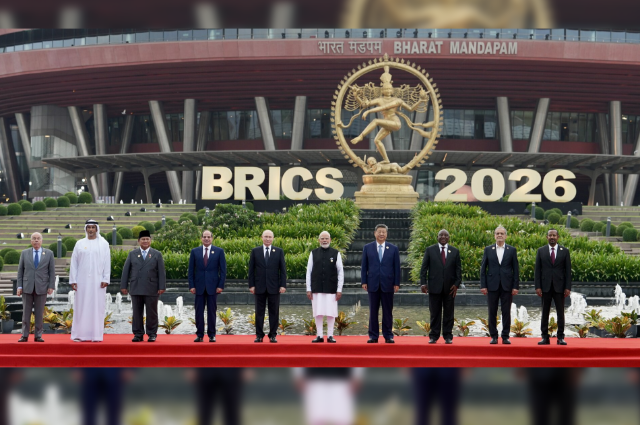
A Room Built for a Surprise
For two days in September 2026, New Delhi hosted something unusual: a room full of leaders who did not entirely trust each other, photographed as though they did. Under the lotus-shaped canopy of Bharat Mandapam, flags from eleven nations — India, Brazil, Russia, China, South Africa, Egypt, Ethiopia, Iran, Indonesia, Saudi Arabia and the United Arab Emirates — stood in a careful semicircle for the 18th BRICS Summit. It was India's fourth turn chairing the grouping, and Prime Minister Narendra Modi needed the two days to go well: a unified declaration, no walkouts, and a photograph that told the world the Global South could still speak with something resembling one voice.
Then, forty-eight hours before the summit opened, came the news that reorganised every other headline in the country: Chinese President Xi Jinping was coming.
It is worth sitting with how strange this was, rather than rushing past it. Xi had not set foot in India in seven years — not since an informal summit in Mamallapuram in 2019, months before a deadly clash on the Himalayan border froze the relationship for a generation. Beijing had said nothing definite for days beforehand, a silence that Indian television filled with speculation and Chinese state media left conspicuously unanswered — not out of hesitation, commentators later suggested, but because China has long preferred to confirm a leader's travel only at the last possible moment, treating the timing itself as part of the message. When the confirmation finally came, it produced a curious blend of relief, pride and unease: relief that the platform India had built its chairship around was significant enough to draw Beijing's most powerful figure; pride that a seven-year freeze might be thawing on India's own stage; and unease, quiet but persistent, at the memory of exactly how the last few thaws with China had ended.
That tension — between the genuine value of the gesture and the reasonable suspicion that gestures from Beijing have not historically outlasted the next border dispute — is the real subject of this reflection. Not whether the summit was good theatre. It plainly was. But whether a single handshake, however warm, tells us anything true about where the relationship is actually headed, and what any of it means for the two countries' billion-plus citizens who will never sit at that table.
What the Meeting Actually Said
When Modi and Xi sat down on the summit's sidelines for their first formal bilateral talks since the 2020 Galwan clash, the language that emerged was deliberately soft-edged. According to India's Ministry of External Affairs, the two leaders committed to a "fair, reasonable, and mutually acceptable" resolution of the boundary dispute and agreed that differences between the countries "should not become disputes" — a formulation careful enough to mean almost anything, which is usually the point of such formulations. Xi, for his part, framed the relationship in the language of shared stature: two of the world's most populous nations, both claiming leadership within the Global South, capable of complementing rather than merely competing with one another.
Underneath the diplomatic softness sat a harder number. China is now India's largest trading partner, with bilateral trade touching a record $151 billion over the past year — and India's trade deficit within that relationship has climbed to roughly $112 billion, the largest gap it runs with any country on earth. Modi and Xi reportedly agreed to address this imbalance directly, along with questions of market access and supply-chain dependency. It is the kind of commitment that costs nothing to make and everything to keep, and its value will be measured not in September 2026 but in whatever trade data emerges two or three years from now.
What strikes me more than the content of the meeting is the shape of it: a diplomatic register so practised, so evenly balanced between warmth and vagueness, that it could have been lifted from any of the previous Modi-Xi encounters over the past decade. That repetition is not necessarily evidence of insincerity. Diplomacy between wary powers often works precisely because it is scripted — because both sides know, going in, exactly how far the language can travel without committing either government to something costly to walk back later. But it is worth noticing what this kind of fluency actually signals. It is evidence that both governments have learned, through repeated cycles of thaw and rupture, exactly how much can safely be said in public. The words are not lies; they are closer to a shared script, rehearsed enough by now that neither leader needs to think hard about the next line. And a relationship that has had to develop this much practised vocabulary for managing disappointment is, almost by definition, a relationship that expects to be disappointed again.
There is a temptation, watching two leaders speak this fluently to each other, to read fluency itself as warmth. It rarely is. Fluency is what remains after warmth has been tested and found unreliable enough times that both sides have simply gotten efficient about managing its absence.
Why the Pattern Keeps Repeating
It is tempting to treat each Modi-Xi meeting as a fresh data point, unconnected to what came before. The more honest way to read it is as the latest beat in a rhythm that has now repeated itself often enough to have its own logic. A warm, photographed gesture — Ahmedabad in 2014, Mamallapuram in 2019, Delhi in 2026 — has tended to arrive every few years, and each time, within a relatively short window, has been followed by a serious flare-up along the disputed frontier, most notably Doklam in 2017 and the fatal Galwan clash in 2020. Whether the pattern continues from here is, deliberately, left as an open question rather than a prediction — but the pattern itself is not in dispute, and pretending otherwise would be its own kind of dishonesty.
What produces this rhythm is worth thinking through rather than simply noting. Part of it is structural: India and China are not choosing whether to have a relationship, only how to manage one that geography has already assigned them. Two nuclear-armed states sharing a long, undemarcated border cannot simply disengage from each other the way two more distant rivals might; every prolonged freeze eventually becomes expensive enough — economically, diplomatically, militarily — that both sides find reasons to thaw it, regardless of whether the underlying disputes have actually been resolved. That is not cynicism so much as geopolitical gravity. Large, adjacent, unequal powers tend to oscillate between engagement and confrontation precisely because neither state can afford permanent commitment to either extreme. Compare this to how the United States and China manage their own far more distant rivalry: two economies deeply entangled by trade yet separated by an ocean can afford sharper rhetoric and longer freezes, because neither has to worry about an actual soldier standing a few hundred metres from another on a disputed ridge. India and China do not have that luxury. Proximity forces conversation, whether or not trust exists to support it.
The other part of the pattern is more asymmetric, and less comfortable to say plainly: China has, over the past decade, shown a consistent willingness to pursue high-level diplomatic warmth and continued activity along the disputed frontier at the same time, rather than treating the two as contradictory. This is not a uniquely Chinese trait — most great powers separate their diplomatic and strategic tracks to some degree, and India itself pursues parallel tracks of its own, deepening ties with the United States even while participating enthusiastically in a grouping China treats as a vehicle for challenging American primacy. But the scale and persistence of China's dual-track approach specifically toward India is what has made "reset" such a loaded word in Delhi's political vocabulary. A reset, in this context, does not mean the underlying disagreement has been settled. It means both sides have decided, for their own separate reasons, that the costs of continued estrangement currently outweigh the costs of unresolved distrust. That is a genuinely useful thing for two nuclear powers to decide, and it should not be dismissed as empty theatre simply because it has happened before. But it is categorically a different thing from friendship, and conflating the two is where past optimism about the relationship has tended to go wrong — not because the optimism was foolish, but because it mistook a tactical pause for a strategic resolution.
There is also a psychological dimension to this cycle that rarely makes it into policy analysis but shapes public perception enormously: each reset is received in India not as a fresh beginning but as a test of a hypothesis that has already failed twice. That colours everything — the warmth is watched with one eye already looking for the crack. This is not paranoia; it is pattern recognition, and pattern recognition, however uncomfortable, is a rational response to a documented history rather than an emotional overreaction to it.
The Arithmetic Beneath the Rhetoric
The summit's other quiet undercurrent was money, specifically the question of what role Chinese currency and financial infrastructure should play inside BRICS. Beijing arrived wanting greater use of the yuan in intra-BRICS trade and closer integration of payment systems; India, as it has for several summits running, resisted any move toward a common BRICS currency. The official reasoning offered is that Washington has threatened tariffs against any bloc seen to be actively displacing the dollar. The more structural reasoning, less often said aloud, is simpler: any shared currency weighted by GDP, trade share or reserves would hand China the largest stake in it, for the same reason that China now dominates so much else inside the grouping.
This is worth pausing on, because it is the clearest illustration of something easy to miss amid all the language about Global South solidarity: BRICS is not the balanced coalition it was founded to be. When the original four countries met in 2009, China's economy was already the largest of the group, but the other three still added up to roughly its equal — a rough equilibrium that gave the grouping something like genuine multilateral character. That equilibrium is gone. China's economy today outweighs the combined output of every other BRICS member. A bloc built on the premise of amplifying the voices of several rising powers has, without any formal amendment to its charter, become a bloc in which one member is large enough to shape its direction largely on its own.
This is, in miniature, the central paradox of the entire "multipolar world" narrative that BRICS likes to project. The word implies several roughly comparable centres of power balancing one another, the way the term is used when describing a world moving past a single American-led order. But inside BRICS itself, that balance does not actually exist; one pole inside the anti-unipolar club has quietly become dominant enough to make the club's internal politics look almost unipolar in miniature. Multipolarity at the level of the international system and multipolarity at the level of any single institution meant to represent it are not the same claim, and BRICS is proof that an organisation can market the first while quietly failing to practise the second.
Understood this way, India's resistance to a common currency is not simply caution about American tariffs; it is a recognition that deeper financial integration within BRICS, as currently constituted, would mean deeper integration with China specifically — which is precisely the dependency India has spent the summit's other conversations trying to manage, not deepen. It is also, in a subtler sense, an assertion of India's own preferred role within the grouping: not as a junior partner inside a China-centred financial architecture, but as an independent voice that participates in BRICS' institutions selectively, on terms it can still control. Whether that balancing act remains sustainable as China's economic lead over the rest of the bloc continues to widen is one of the more interesting unresolved questions the summit leaves behind — interesting precisely because neither more integration nor continued caution is obviously the safer long-term choice for India.
What actually emerged from Delhi reflected that caution: no common currency, but continued, incremental work linking national payment systems, exploring central-bank digital currency interoperability, and building mechanisms to ease trade financing for smaller businesses. It is progress that will never make a dramatic headline, which is more or less the point — India seems to prefer a BRICS that is useful without being consequential enough to trigger confrontation, while China, holding the far larger hand, has less reason to be quite so cautious. Watching the two countries negotiate the pace of their own institution's integration is, in that sense, a more revealing window into the actual balance of power between them than anything said in the bilateral meeting.
A Closer Look: What a Currency Actually Reveals
It is worth going a layer deeper here, because the currency question is not really about currency at all. It is about what a shared currency has always been, in every era of history: a mirror held up to the actual distribution of power among the countries using it, whether or not those countries are comfortable with what the mirror shows.
Consider the precedent most often invoked, if rarely examined closely, whenever this debate comes up: the Eurozone. When a group of European economies agreed to share a single currency, they were not simply solving a technical problem of exchange-rate friction. They were accepting that monetary policy — interest rates, currency value, the tools that determine how expensive it is for a country to borrow or export — would henceforth be set collectively, in practice by whichever member's economy was large and stable enough to anchor the system. That member turned out to be Germany, and the decades since have produced a recurring argument, loudest during the eurozone debt crises of the 2010s, about whether smaller and weaker economies within the currency union were being disciplined by German-set monetary policy that served German interests first. A shared currency, in other words, does not dissolve power imbalances between its members. It relocates them from the visible terrain of exchange rates and tariffs to the much less visible terrain of interest-rate decisions and fiscal rules — arguably making the imbalance harder to see, and therefore harder to contest, not easier.
BRICS faces a starker version of the same arithmetic, because unlike the Eurozone, it has no pretence of shared democratic institutions overseeing a common currency, and no member remotely resembles the smaller European economies that could at least outvote Germany collectively even if they could not outweigh it economically. If BRICS ever did move toward a genuinely shared unit of account, there would be no equivalent of a European Central Bank answerable, however imperfectly, to a parliament with representatives from every member state. There would instead be a currency whose value and governance would inevitably gravitate toward whichever economy anchored it — and every plausible weighting formula, whether by GDP, trade share or reserves, currently points to the same answer. This is why India's caution reads less like reluctance to embrace multipolarity and more like a lesson already learned from watching how currency unions actually distribute power elsewhere: sharing a currency with a much larger neighbour is rarely an act of equality between partners. It is usually a slower, more technical way of formalising an inequality that already exists, dressed in the vocabulary of cooperation.
This is also where the word "multipolar" starts to strain under its own weight. The term is used by BRICS, and by commentators sympathetic to it, to describe a world moving away from a single dominant pole — the United States and the dollar — toward several roughly comparable centres of power that check and balance one another the way, in theory, poles are supposed to. But a currency union anchored by China would not create multipolarity inside BRICS. It would import a second unipolarity into a grouping that markets itself as the antidote to the first one. The practical effect, for smaller and mid-sized BRICS members, could end up resembling exactly the kind of dependency the bloc claims to be organised against — except with Beijing rather than Washington setting the terms, and with considerably less of the institutional transparency, however flawed, that decades of scrutiny have at least forced onto the dollar-based system. None of this means the dollar-centred order is beyond criticism, or that BRICS members are wrong to want more control over their own monetary destinies. It means only that replacing one asymmetric arrangement with another asymmetric arrangement is not, by itself, a step toward the more balanced world the word "multipolar" promises. Genuine multipolarity would require something BRICS has not yet built and may structurally struggle to build: a mechanism by which its smaller and mid-sized members retain real influence over decisions taken collectively, rather than a mechanism that simply changes which large economy they are influenced by.
Seen through this lens, India's actual strategy at the summit looks less like caution for its own sake and more like a coherent alternative theory of what a multipolar financial order should look like: not one common currency answering to one dominant anchor, but a patchwork of bilateral and plurilateral links — India's UPI connecting separately with Brazil's Pix, with the UAE's payment rails, with whichever central bank digital currency pilots prove workable — each negotiated on its own terms, none of them requiring any single country to become the system's centre of gravity. It is a messier, slower approach than a single currency would be, and it will never produce the kind of dramatic announcement that "a BRICS currency" would generate in global headlines. But it is arguably a more honest response to the underlying problem, because it does not pretend that combining five, or eleven, national currencies into one shared unit could somehow erase the fact that one of those economies is now larger than all the others combined. A world with several genuinely independent, interoperable payment systems, none of them subordinate to a single anchor, would look far more like the multipolar order BRICS claims to be building than a single shared currency ever could — even though it will generate far fewer headlines along the way. The unglamorous plumbing, in this instance, may be doing more honest work than the grand gesture it was designed to avoid.
A Declaration Built on What It Left Unsaid
The summit's other real achievement was not the Modi-Xi meeting at all, but the fact that all eleven members managed to sign a single joint declaration together — something that had failed to happen only four months earlier, when a May 2026 meeting of BRICS foreign ministers collapsed without any joint statement, undone by an unresolved dispute between two of the bloc's own members. That collapse is a useful corrective to any reading of BRICS as a coherent bloc marching in step. It is, more accurately, a coalition of convenience whose members sometimes cannot agree even among themselves, let alone against the outside world they are nominally organised to counterbalance.
That the leaders' summit still produced a wide-ranging declaration by September says something genuine about the diplomatic effort India invested as chair — but it is worth being precise about what kind of achievement that actually was. The declaration condemned unilateral tariffs and cross-border terrorism in unmistakable terms while naming no country responsible for either, a pattern that repeated across nearly every contentious issue it touched. This is not incompetence; it is the deliberate price of consensus among members who fundamentally disagree about what BRICS should even be. India wants a grouping that is non-Western without being anti-Western — useful leverage, not open confrontation. China and Russia have shown more appetite for something closer to an economic counterweight to Washington outright. A declaration vague enough to be signed by both visions is not a triumph of unity so much as a demonstration that unity, in this particular grouping, currently requires saying very little of consequence.
Whether that vagueness should be read as a wasted opportunity or as the necessary scaffolding for a still-fragile institution is, honestly, a matter of perspective rather than fact — and probably says more about how much one already expected from BRICS than about the summit itself. A reader who wanted BRICS to emerge as a genuine anti-Western pole will see the declaration's caution as failure. A reader who sees BRICS primarily as a slow-building forum for institutions that will matter more in a decade than they do today will see the same caution as prudence. Both readings are defensible, which is itself worth noting: it means the summit's real significance is still, quite literally, undetermined, and will be decided retroactively by whichever version of BRICS actually materialises in the years ahead.
One further detail from the summit's closing hours deserves attention precisely because it received so little at the time: before the leaders even departed, Xi announced that China would chair BRICS again in 2027 and host the next summit. The bloc's agenda-setting role, in other words, is about to pass directly to its largest and least evenly matched member. If the New Delhi summit was notable for how carefully India managed a divided room to produce consensus, the Chinese-hosted summit that follows it will be a genuine test of whether that same caution and vagueness survive contact with a chair that has considerably less incentive to keep the bloc's ambitions modest.
What Ordinary People Actually Get From This
It would be easy to conclude, after all this, that the summit changed nothing real — that the warmth was theatre and the substance was a wash. That conclusion is too tidy, and probably wrong. But the honest version of what changed is smaller and slower than the coverage suggested, and it is worth walking through concretely rather than gesturing at vaguely.
For the small manufacturer whose components still arrive from China, or the exporter whose payments still route inefficiently through the dollar, nothing shifted overnight in Delhi. What shifted, modestly, was direction: a bilateral commitment to address trade imbalance rather than ignore it, and continued technical work linking payment systems that could, over several years rather than several months, make cross-border transactions marginally cheaper and marginally less dependent on a single currency's infrastructure. That is nothing. It is also not the transformation the word "multipolar" tends to imply when used in a headline. A student choosing between a career in semiconductor design or pharmaceutical research in India today is, in a small but real way, participating in the same story this summit gestured toward: every engineer who helps close a domestic supply-chain gap is doing more to change the actual balance of dependency between India and China than any paragraph in a declaration can.
What may matter more, in the long run, is something harder to quantify: the accumulated fact of India hosting, negotiating with, and extracting a signature from nearly a quarter of humanity's political leadership, on a document that — however softened — reaffirms India's own claim to greater global standing. That claim does not change anything by itself. But claims repeated often enough, in enough rooms, over enough years, tend to eventually become facts on the ground in ways that are difficult to trace back to any single summit. This is the slow, unglamorous mechanism by which international standing is actually built, and it is easy to underrate precisely because no single instance of it looks like progress. Nobody remembers which specific summit first advanced the case for a reformed UN Security Council; what people remember, eventually, is simply that the reform happened, if it ever does, and forget the decade of repeated, patient, largely unrewarded advocacy that made it possible.
There is a version of this reflection that ends on pure optimism — multipolarity rising, old orders crumbling, new partnerships blooming — and a version that ends on pure suspicion — nothing has changed, the warmth was only strategy dressed up as friendship. Both versions flatter the writer more than they inform the reader. The truer picture sits, uncomfortably, in between: the relationship can be genuinely improving in some registers — trade dialogue, diplomatic tone, the sheer fact of Xi's presence after seven years — while remaining genuinely unresolved in others that neither leader chose to put in writing. Multipolarity, at ground level, looks less like a single dramatic shift in power and more like exactly this: two large, wary neighbours managing an uneven relationship one summit at a time, neither fully trusting nor fully abandoning the other, because geography has left them no better option and no easy exit.
Between the Swing and the Standoff
In 2014, Modi and Xi sat together on a swing on the banks of the Sabarmati, laughing for the cameras. In 2026, they sat across from each other at Bharat Mandapam, composed and careful, using almost the same words about long-term perspective and mutual respect that had been used a decade earlier. Twelve years, one deadly border clash and several standoffs separate those two images, and yet they could almost pass for the same photograph.
That is not, on its own, a reason for despair. It is a reason for precision. The question this summit leaves behind is not whether Delhi and Beijing will keep talking — they plainly will, because neither can afford not to, and because the alternative to talking, for two nuclear-armed neighbours, is a risk neither side has any real appetite to run. The question is whether India uses the space between this handshake and the next one to close the gaps that keep making each reset so fragile: the trade imbalance, the dependency on Chinese supply chains, the unresolved border. History suggests the answer will not be found in anything either leader said in New Delhi. It will be found, as it always has been, in what gets built quietly in the years nobody is photographing — the factories, the research labs, the border roads, the diversified trade routes — while the world's attention has already moved on to whichever summit comes next.
Multipolarity is not something a summit hands down from a stage. It is something a country builds, deliberately, in the years between the photographs — and the next photograph, whenever it comes, will only be worth more than the last one if that work actually gets done in between.
References
- CNBC. "Modi and Xi are set to meet at BRICS with trade and border issues in spotlight." cnbc.com, September 2026.
- CNBC. "Indian Prime Minister Modi says border peace is key to India-China ties." cnbc.com, September 2026.
- Business Standard. "BRICS Summit 2026: Xi Jinping leaves for New Delhi, set to meet PM Modi." business-standard.com, September 2026.
- BreezyScroll. "Why China Confirmed Xi Jinping's India Visit Just 48 Hours Before BRICS Summit." breezyscroll.com.
- Al Jazeera. "BRICS summit 2026: What are the key takeaways?" aljazeera.com, September 2026.
- Forbes India. "BRICS Summit 2026: 11 Key Takeaways From the New Delhi Declaration." forbesindia.com.
- The Print. "India's China trade deficit is now structural. Electronics goods deficit doubled to $43 bn since 2019." theprint.in.
- Business Standard. "China to host 2027 BRICS summit: Xi announces next year's presidency." business-standard.com.
- Eurasia Review. "BRICS Summit Boost Sino-Indian Normalisation." eurasiareview.com, September 2026.
- Rio Times Online. "BRICS Summit 2026: 11 Members, 10 Partners Explained." riotimesonline.com.
. . .