
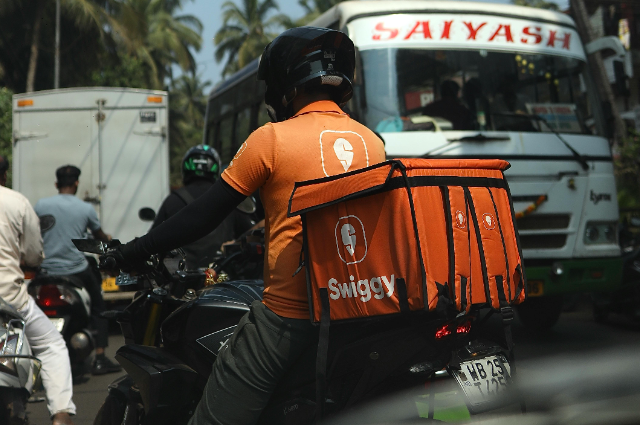
Source: Ritesh Mitha on Pexels.com
It is 2:15 PM in Vidarbha. The sun is merciless. The temperature has crossed 45°C, and the roads shimmer under waves of heat.
Ramesh, a 24-year-old graduate, rides through the burning streets with a food parcel strapped to his back. Sweat drips into his eyes, his throat is parched—, but his phone keeps buzzing—“Deliver within 10 minutes. Rating may drop.”
A red signal feels longer than usual. The heat burns through his skin. His head spins for a moment—but he cannot stop. One delay, one bad rating, and his entire day’s earnings could disappear.
Somewhere, in an air-conditioned room, a customer checks their phone impatiently.
To them, it is just a late order.
To Ramesh, it is survival.
This is the real price of 10-minute delivery.
Understanding the Gig Economy:
The term “gig”, originally associated with short-term artistic performances, has evolved to describe a broader transformation like work. In contemporary usage, it refers to temporary, flexible, and task-oriented employment, replacing the traditional model of stable, long-term jobs.
A gig worker, therefore, is not bound by a permanent employer-employee relationship. Instead, such workers:
- Engage in task-based or contractual assignments
- Operate without fixed wages or long-term job security
- Earn through digital platforms or short-term engagements
In the Indian context, gig work spans a wide spectrum—from food delivery and ride-hailing services to freelance digital work and informal domestic services. Platforms like Zomato, Swiggy, Uber, and Ola have institutionalised this model at scale.
What distinguishes gig work is its departure from traditional labour structures—workers are neither fully independent entrepreneurs nor protected employees, placing them in a grey zone of labour rights and accountability.
Types of Gig Workers:
To understand the gig economy more clearly, it is useful to distinguish between two broad categories:
- Platform Workers:
These workers are directly connected to digital platforms that act as intermediaries between service providers and consumers. Food delivery partners and ride-hailing drivers fall into this category. Their work is governed by algorithms, ratings, and app-based instructions, which significantly influence their income and working conditions.
- Non-Platform Workers:
This category includes freelancers, independent contractors, construction labourers, and other informal workers who operate outside app-based ecosystems. While they may not depend on algorithms, they still face income instability and a lack of formal protections.
This classification highlights an important reality: The gig economy is not limited to urban digital platforms but extends deeply into India’s informal and semi-formal labour markets, blurring the boundaries between modern employment and traditional casual labour.
Growth of the Gig Economy in India:
The rapid expansion of the gig economy reflects a structural shift in India’s labour market.
- Estimates suggest that India had approximately 7.7 million gig workers in 2020–21, a number projected to rise to 23.5 million by 2030.
- Current figures indicate that over 1.5 crore individuals are already engaged in gig or platform-based work.
These numbers are not merely indicators of growth—they signal the emergence of a parallel employment ecosystem.
This expansion is driven by:
- Increasing digital penetration
- Platform-based business models
- Limited absorption capacity of the formal sector
However, the growth also raises critical concerns. A significant proportion of gig workers are young and educated, indicating that gig work is often a fallback option rather than a preferred career path.
Thus, the rise of the gig economy represents a dual reality: It is both an engine of employment generation and a reflection of structural unemployment and underemployment in the economy.
Why Are People Entering Gig Work?
The rapid expansion of gig work in India is not merely a result of technological innovation, but a consequence of structural economic pressures. For many, gig work is less a choice and more a necessity.
A significant proportion of gig workers are:
- Educated youth with degrees or diplomas
- Unable to secure stable, formal employment
- Compelled to accept gig work due to immediate financial needs
This trend reflects a deeper systemic concern. India is not only grappling with unemployment, but increasingly with underemployment, where skilled individuals are engaged in work that does not match their qualifications or aspirations.
Thus, gig work often becomes a stopgap arrangement, masking the inadequacies of the formal job market.
The Reality Behind the Convenience Economy
Digital platforms project gig work as a model of empowerment—promising flexibility, autonomy, and quick earnings. However, the lived reality of workers reveals a stark contrast between perception and practice.
Key Structural Challenges
- Absence of Job Security
Gig workers lack formal contracts and can be removed from platforms without prior notice. This creates a condition of perpetual uncertainty, where continuity of income is never guaranteed.
- Lack of Social Security
Unlike formal employees, gig workers are excluded from essential benefits such as pension, paid leave, and comprehensive health insurance, leaving them vulnerable to economic shocks.
- Income Volatility
Earnings are neither fixed nor predictable. They depend heavily on customer ratings, incentives, and algorithmic allocation of tasks, resulting in fluctuating daily incomes.
- Algorithmic Control
While termed “independent,” workers function under the control of platform algorithms that determine:
- Work allocation
- Performance evaluation
- Penalties and incentives
This creates a system where control is centralised, but responsibility is individualised.
- Extreme Working Conditions
Gig workers operate under physically demanding conditions—braving heatwaves, heavy rainfall, and late-night shifts—often under pressure to meet unrealistic delivery timelines.
Concerns over such conditions have led authorities to flag safety risks associated with ultra-fast delivery models, highlighting the need for regulatory intervention.
Insurance and Social Security:
One of the most critical gaps in the gig economy lies in the domain of social security and insurance coverage. Despite being exposed to high occupational risks, a majority of gig workers remain outside formal protection systems.
Most workers lack:
- Comprehensive health insurance
- Accident and disability coverage
- Long-term financial security mechanisms
Recent policy initiatives have attempted to address this gap. The government has proposed:
- Mandatory registration of workers on the e-Shram portal to create a national database
- Introduction of social security schemes, including insurance and welfare benefits
However, the implementation remains uneven. Many workers are either unaware of these provisions or find them difficult to access in practice.
Thus, a significant disconnect persists between policy intent and ground reality, leaving gig workers vulnerable in times of crisis.
International Perspective:
The challenges posed by the gig economy are not unique to India. Across the world, governments are re-evaluating labour laws to adapt to platform-based work.
- In the United Kingdom, courts have recognised ride-hailing drivers as “workers,” entitling them to minimum wage and paid leave.
- The European Union has proposed regulations focusing on algorithmic transparency and accountability, aiming to reduce exploitation.
- In the United States, particularly in California, there has been an ongoing debate on whether gig workers should be classified as employees rather than independent contractors.
These developments indicate a global shift toward strengthening labour protections in the digital economy.
In comparison, India is still in a transitional phase, where recognition has begun, but enforcement mechanisms are yet to mature.
The Core Debate:
At its core, the gig economy embodies a fundamental contradiction. While it is presented as a model of flexibility and independence, its operational reality often reflects elements of control and precarity.
This duality raises an essential question: Are gig workers truly independent entrepreneurs, or do they constitute a new class of informal labour operating without adequate safeguards?
The gig economy is often presented as offering flexible working hours, independence, and easy entry. However, in practice, these translate into long and irregular shifts, control through algorithm-driven systems instead of a human employer, and very limited opportunities for long-term growth or career advancement.
The answer lies not in theory, but in the lived experiences of workers, where autonomy is often overshadowed by economic compulsion.
A Human Story Behind Every Order
The narrative of Ramesh is not an isolated case—it is representative of millions across the country.
In urban and semi-urban India:
- A graduate delivers food to sustain his family
- An engineer drives a cab to repay educational loans
- A skilled worker accepts precarious work to survive
These individuals are not lacking in effort or ambition. Rather, they are caught in a structural trap—a gap between aspiration and opportunity.
Their stories challenge the simplistic narrative of “flexible work” and reveal the deeper realities of dignity, survival, and resilience.
Reforming the System:
Addressing the challenges of the gig economy requires coordinated action across multiple levels.
- Role of Government
The state must ensure that recognition translates into tangible benefits by:
- Effectively implementing labour codes
- Establishing minimum wage frameworks
- Expanding access to universal social security systems
- Responsibility of Platforms
Digital platforms must move beyond profit-centric models and adopt worker-centric practices, including:
- Fair and transparent compensation structures
- Provision of insurance and welfare benefits
- Greater algorithmic transparency to ensure accountability
- Role of Society
Consumers also play a crucial role. Responsible behaviour includes:
- Respecting the dignity of gig workers
- Avoiding unrealistic delivery expectations
- Encouraging ethical practices such as fair tipping
A sustainable gig economy can only emerge when efficiency is balanced with empathy.
Conclusion:
The gig economy is often celebrated as a hallmark of modern, digital India. However, its true character can only be understood by examining the human conditions that sustain it.
Behind every fast delivery and affordable ride lies:
- Physical risk
- Economic uncertainty
- Silent endurance
Development cannot be measured solely in terms of speed, convenience, and technological advancement. It must also account for fairness, dignity, and social justice.
If growth comes at the cost of human well-being, it raises fundamental questions about the direction of progress itself.
Final Message
A nation does not become truly modern by accelerating services alone. It becomes modern when it ensures that those who power its progress are treated with dignity, security, and fairness.
References:
- Gig Economy Legal Analysis India
- Supreme Court on Gig Employment
- Rules Governing Gig Economy (IBA)
- Gig Workers & Labour Codes
- NITI Aayog Gig Economy Report
- Gig Workers & Social Security Debate