
The word
On 15 May 2026, in an open hearing of the Supreme Court of India, a sentence was spoken that nobody at the time recorded as historic.
The Chief Justice of India, Surya Kant, was hearing a contempt matter connected to senior advocate designations. He spoke of "parasites" attacking the system, and compared young people "who don't get any employment" and have no place in a profession to cockroaches.
Courtroom remarks of this kind usually die in the transcript. This one did not. Within hours the clip had left the legal internet and entered the ordinary one. The reaction was not outrage in the press-release sense; it was recognition. Many young Indians read the sentence and thought: so that is what we are.
Somewhere in that scroll was Abhijeet Dipke, thirty, a public-relations graduate of Boston University who had worked as a communications volunteer for the Aam Aadmi Party. On 16 May he posted a question on X.
What if all cockroaches come together?
It was a joke. He has never claimed otherwise. He set up a website and social handles for the Cockroach Janta Party — a straight parody of the Bharatiya Janata Party, with a slogan no serious outfit would touch: Voice of the Lazy & Unemployed. The hashtag was #MainBhiCockroach.
Within days, the movement crossed 350,000 sign-ups and twenty million followers on Instagram — more than most registered parties have ever managed, without an office, a donation drive, or registration with the Election Commission. CJP has never been a registered political party.
What Dipke had invented, without quite meaning to, was a container. Indian youth anger in 2026 was not scarce; it was abundant, atomised and unaddressable — a lakh separate humiliations with no common noun. He supplied one that could not be used against those who adopted it, because they had adopted it voluntarily. You cannot shame someone by calling them a cockroach if they have printed it on a T-shirt.
The movement did not begin with a demand. It began with an identity.
What was already broken
Twelve days before the Chief Justice spoke, on 3 May 2026, roughly 22.8 lakh young people sat down to write the National Eligibility cum Entrance Test.
NEET is not an exam in the ordinary sense. It is a single national funnel, the only legal route into an MBBS seat in India, and the number of aspirants — 22,79,743 registered for the 2026 cycle — is one of those Indian statistics so large it stops meaning anything. That is more people than the entire population of Latvia, most of them having given two to four years of their adolescence to it.
The paper leaked.
The National Testing Agency cancelled both the 3 May and 7 May sittings. Investigators have not published a full account of the route, but Indian paper leaks have repeatedly run through the same seam: a coaching economy that sells advance information, and an examination bureaucracy that cannot secure its logistics.
On 15 May — the same day as the courtroom remark, a coincidence a novelist would be told to remove — Education Minister Dharmendra Pradhan admitted the breach. Under the guise of a guess paper, he confirmed, actual questions had gone out. He put it more bluntly to NDTV in a phrase quoted back at him for two months: rakshak hi bhakshak ban gaye — the protectors had become the predators. The CBI began investigating. Arrests followed. A re-examination was set for 21 June.
Nor did the cancellation arrive as a communication. There was no letter, no notification, nothing from the agency that had set the paper to the people who had written it. Twenty-two lakh candidates learned their examination had been annulled the way the rest of the country learned it — from a television bulletin, at the same moment, in the same words on every channel. Before any minister spoke, the manner of the announcement had already indicated where the candidates stood in the order of things.
For anyone paying attention in 2024, all of this was a rerun. That year's leak produced Parliament walkouts, a Supreme Court hearing, and a six-day sit-in at Jantar Mantar under the banner "India Against NTA," demanding the abolition of the NTA and the resignation of Dharmendra Pradhan. It was called off on its sixth day without explanation and without result. In 2024 the government won by outlasting, and it had every reason to expect the same in 2026.
Jantar Mantar
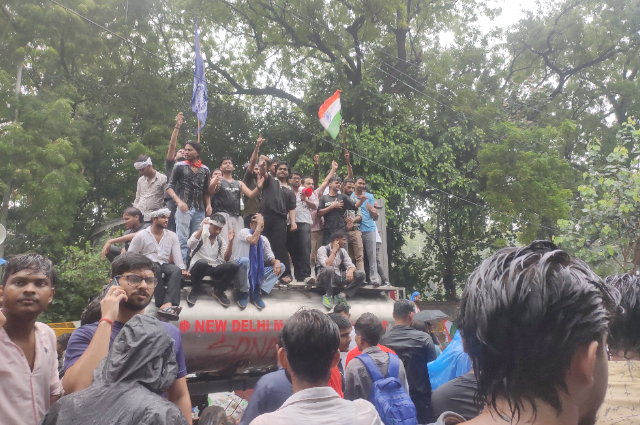
On 6 June 2026, protests began at Jantar Mantar in New Delhi.
The composition matters. The demonstrations were initiated by CJP together with three left-affiliated student organisations — AISF, AISA and SFI, the student wings of India's communist parties. These are not neutral bodies; they are aligned with the non-Congress opposition, and they brought what CJP did not have: people who know how to run a protest. Permissions, water, medical volunteers, night rosters — the unglamorous logistics that decide whether an agitation survives its second week.
CJP brought the opposite thing: legitimacy with young people who would not have gone within a hundred metres of an AISA banner. Reporting from the site described a crowd made up largely of NEET aspirants and their parents rather than student politicians, with a striking number of senior citizens travelling alongside their grandchildren.
So, the claim that the movement transcended caste, gender and party must be made carefully. It is true of the crowd, united by a category — examinee — that does cut across nearly every other Indian division, because the examination hall is one of the few rooms in India where everyone is nominally equal. It is not true of the organising, where the usual formations did the usual work. The interesting claim is not that politics was absent, but that for six weeks an identity Indian politics does not recognise — a person waiting for a result — became more mobilising than the identities it does.
On 28 June, Sonam Wangchuk began an indefinite hunger strike at the site.
This changed everything. Wangchuk is an education reformer and climate activist from Ladakh with a long history of fasts — twenty-one days in 2024 for Ladakhi statehood, thirty-five in Leh. He belongs to no party, which makes him the most difficult kind of opponent a government can face: a man with no ambition it can satisfy and no organisation it can pressure. His arrival converted a student agitation into a national moral question. It also, as became clear, handed the government its single point of leverage.
By mid-July the protest had a stable shape. Wangchuk fasting; three AISA activists and an independent student fasting alongside; Dipke fasting until Wangchuk asked him to conserve his strength; SFI's president and joint secretary announcing they would join. Delhi University, and then Jawaharlal Nehru University, advised their students to stay away from Jantar Mantar.
That last detail deserves its own sentence. Two central universities formally told their students not to attend a peaceful, permitted protest about the integrity of the examinations those students would sit. That is an institution telling the people it exists for to look away.
The result that settled nothing
The re-examination was held on 21 June. Results came on 16 July.
An official could be forgiven for expecting this to end matters. The paper had been cancelled, a fresh one set, everyone had written it; justice in the narrow procedural sense had been done. The protests intensified instead.
The reason sits in a second set of numbers. Of those who sat the re-examination, over 11.21 lakh candidates qualified. India has 1,36,939 MBBS seats for 2026–27 — the largest single-year expansion in its history, with 9,911 seats added.
Eleven lakh qualified. One lakh thirty-six thousand seats.
Read that slowly, because it is the true subject of this essay and everything else is commentary. Roughly one qualified candidate in eight will get a seat. The other seven will spend the next year in a coaching institute, or take a BSc they did not want, or go to a medical college abroad their family cannot afford, or quietly stop.
A clean examination distributes seats fairly. It does not create them. The re-exam gave 11.21 lakh people an honest ranking within a shortage — no small thing, since an honest shortage is far better than a corrupt one — but it explains exactly why 16 July ended nothing. The students had stopped arguing about the paper. They had started arguing about the shape of the country.
The lazy version of this essay says the system is broken. It is more useful to say what the system is doing. It is functioning as designed: built to allocate scarcity, and allocating it with tremendous efficiency. What it was never designed to do — what no examination anywhere can do — is manufacture the scarce thing.
The parallel state
Around that gap, an economy has grown.
India's private coaching industry was valued at over ₹58,000 crore — a figure the Ministry of Education itself acknowledged in Parliament — with independent projections above ₹1.33 lakh crore by 2028.
Set that against the state. The Union education allocation for 2026–27 was ₹1.39 lakh crore. Within two years, the private tutoring industry is on track to approach the size of the entire central education budget — and that budget has had a rough recent history, with PRS Legislative Research finding the 2024–25 allocation 7% below the previous year's revised estimate and the University Grants Commission's allocation estimated to fall by 61%. The National Education Policy target of 6% of GDP remains, as it has since 1966, unmet.
The figure that should actually stop the reader is smaller and closer to home. The NSS 80th Round survey on education, conducted across 52,085 households in 2025, found that an Indian household spends about ₹13,051 per student per year on school education, rising to ₹22,024 once coaching is included. That is to say: 40.7% of what a family spends educating a child goes to private coaching. Two rupees in five leave the school system entirely.
The same survey found only 30.1% of urban students in government schools, and coaching participation has risen from 19.8% in 2017–18. UDISE+ data for 2024–25 records that India still operates over one lakh single-teacher schools.
The mechanism follows. A single-teacher school cannot prepare a child for NEET, so a parallel system is purchased out of pocket by families, often borrowing to do it. The formal school becomes a place where attendance is registered and a certificate eventually issued; the real teaching happens in the evening, for a fee, somewhere else.
The state is not a bystander in this arrangement. It is a beneficiary. GST collections from coaching institutions rose from ₹2,240.73 crore in 2019–20 to ₹5,517.45 crore in 2023–24. Coaching is taxed at 18%. Formal education is exempt.
Read that sequence honestly, and it is uncomfortable. The state underfunds public provision; the shortfall generates demand for coaching; the state then taxes that coaching at 18% and books the proceeds as revenue. Money a family spends because the government school failed them comes back to the government as tax receipts. That is what "commercialisation of education" means concretely — not a slogan about greedy institutes, but a closed loop in which the failure of public provision has become a revenue stream, and in which no actor has a financial reason to break it.
What the arithmetic conceals is the sequencing. No family decides to spend a fifth of its income on a parallel education system. They arrive there one reasonable decision at a time. The school is not teaching the syllabus, so a tutor is arranged for two subjects. The tutor mentions that everyone serious does the test series. The test series produces a rank; the rank is low, and the residential year in the coaching town becomes unavoidable. Each step is defensible alone. Nobody chooses the destination, and by the time the family can see it, they have paid for most of the journey.
Thirteen thousand eight hundred and ninety-two
The National Crime Records Bureau's Accidental Deaths and Suicides in India report for 2023 was published on 29 September 2025, after a delay of nearly two years.
It records 13,892 student suicides — 8.1% of all 1,71,418 suicides that year. It is the highest absolute figure in a decade, 848 more than the year before. Since 2014, when the count was 8,032, student suicides have risen 72.9%, against a total suicide count that rose by roughly a third.
Students are dying faster than India as a whole is dying.
The state distribution does not say what most people assume. Maharashtra tops the list with 2,046 — 14.7% of the national total — followed by Madhya Pradesh (1,459), Uttar Pradesh (1,373) and Tamil Nadu (1,339). Rajasthan, home to Kota, ranks tenth. This is not a Kota problem that can be solved by regulating one city; it is spread across the largest states in the country, which is considerably harder to fix. And among children below eighteen, the NCRB names the leading recorded cause outright: failure in examination, 1,303 deaths.
Thirteen hundred children. Under eighteen. Because of an exam.
A word on what these numbers can bear. NCRB figures are police-recorded, and suicide is under-reported everywhere, so the true count is higher, and the attributed cause is a single field on a form filled in by an investigating officer. But the direction of travel is not ambiguous: the IC3 Institute's report — titled, without euphemism, Student Suicides: An Epidemic Sweeping India — found student suicides rising faster than both the national suicide rate and population growth.
There is a temptation here to reach for a story, to find one child and tell their life so the reader has somewhere to put the feeling. That would be a kind of lie, and the reason is part of the argument. The scale is the fact. Any individual account invites the reader to treat this as a tragedy — a particular child, terrible luck. A tragedy does not recur 13,892 times a year, with a 72.9% upward trend over a decade, across every large state in the country. That is not misfortune. It is an output.
The mechanism requires no psychologist to describe. A child is told at fourteen that one examination at seventeen will determine their entire adult life — framed not as pressure but as love — then placed in an institution whose business model depends on selecting the top few percent, ranked publicly every fortnight, separated from home. Then the funnel closes.
The cruelty is not the difficulty. It is the falseness of the promise. Children are told effort is sufficient. It is not and structurally cannot be, because the constraint is not effort but seats. Millions work extremely hard and fail anyway, and having been told the only variable was effort, they conclude the failure is moral. That is the engine underneath the number 13,892.
The government has acted, in a limited way — coaching-centre guidelines in January 2024 barring enrolment below sixteen, and the Public Examinations (Prevention of Unfair Means) Act, 2024. But guidelines are not law, and 2026's leak happened anyway.
Twentieth of July
On 20 July, the first day of Parliament's monsoon session, CJP launched its Chalo Sansad march.
Thousands walked from Jantar Mantar towards Parliament in heavy rain — students, parents and grandparents, many having travelled overnight from other states. The Delhi Metro closed five stations ahead of the march, including Rajiv Chowk; protests broke out inside the sealed stations, and internet services were suspended in parts of central Delhi.
Police blocked routes with barricades, then used tear gas and lathi charges. Protesters were injured; so were police. Demonstrators regrouped, climbed barricades, took alternate routes. Tear gas was fired near Parliament on Raisina Road, and around four in the afternoon police cleared Jantar Mantar itself. One of the AISA hunger strikers rejected the word the press was using: not a "clash," she said, but a lathi charge — and the government's only answer to youth protest had ever been violence.
Inside the House, opposition MPs raised the leak. Rahul Gandhi accused the Prime Minister of hostility to the young: students beaten, he said, while those responsible walked free.
And on the same day — the protest's thirtieth, and not one day earlier — the government finally opened talks. CJP spokespersons Saurav Das and Ashutosh Ranka went to meet Union Health Minister J.P. Nadda while the batons were still out on the street behind them.
The simultaneity is the point, and it should be stated plainly rather than angrily. For thirty days, a peaceful, permitted sit-in at the designated protest site of the national capital produced no engagement. Engagement began on the day the sit-in became a march on Parliament, and it began at the same hour as the tear gas. Whatever conclusion a young person draws from that sequence, they did not draw it carelessly.
The deal that broke the movement open
On 23 July, at Medanta Hospital in Gurugram, Sonam Wangchuk ended his fast on its twenty-sixth day.
The government had given him three assurances: no cases against students who protested peacefully at Jantar Mantar or joined the 20 July march; a full parliamentary discussion on the leak and on educational reform; and compensation for the families of students who had died by suicide over it. Wangchuk said sixty-five MPs had visited or written urging him to stop, and that he had weighed the growing possibility of violence. The Prime Minister thanked him within the hour.
The deal did not contain the one thing students had demanded since June: Pradhan's resignation.
CJP refused it, declared Jantar Mantar would continue until the Education Minister went, and escalated — its official account began calling for the Prime Minister's resignation too.
For forty-eight hours this was a genuine crisis for the agitation, and any honest account must sit with it rather than skip to the victory. Whether or not it was designed this way, the effect was surgical: the one participant with unimpeachable moral standing and no organisational stake had been offered three defensible concessions, and had accepted them. What that cost the protest was not numbers but legitimacy. Continued agitation could now be made to look like maximalism — people offered something reasonable who wanted more.
That CJP held anyway — young, unregistered, two months old, with no funding and no legal existence — is what will interest political historians most. It held because the demand was never really about a portfolio. Pradhan had become a proxy. The demand was that someone in power be made to pay a price for what had been done to them. There had been no such price in 2024, nor for anything else in the memory of most people standing in that crowd.
Twenty-fifth of July
On Saturday, 25 July 2026, Dharmendra Pradhan posted his resignation on social media.
His stated reasons were carefully assembled: the situation at Jantar Mantar and across the country, the risk that anti-national forces might take advantage, and the wish that no student's future be entangled in legal complications. Read it however you like. What was widely reported underneath it is that this was the first resignation under public pressure in Narendra Modi's premiership. Twelve years. The first.
At Jantar Mantar, where the internet had been blocked, Dipke took the microphone and shouted it twice. We have done it. We have done it.
Later that day, at the Constitution Club of India, a joint press conference: J.P. Nadda and Minister of State Jitendra Singh on one side, CJP's Saurav Das and Ashutosh Ranka on the other. Das announced the first demand met and the second — withdrawal of all FIRs against protesters — accepted, and the agitation withdrawn on agreed terms.
Not everything was in the settlement. There was no reference to the apology CJP had demanded from the police and the Rapid Action Force for 20 July. The people beaten on Raisina Road were not, in the end, part of the deal.
Within hours the vacancy was filled. Pralhad Joshi, the BJP's long-serving MP from Dharwad in Karnataka, was handed the Education Ministry — not as a fresh appointment but as additional charge, retained alongside Consumer Affairs, Food and Public Distribution, and New and Renewable Energy. He told reporters the next morning he would discharge the responsibility with complete humility.
It is worth pausing on the form of that decision rather than the man. A ministry responsible for the education of some 250 million school students, which had just cost a senior cabinet minister his job, was assigned to somebody already running two others — no restructuring, no new mandate, no signal the department would be treated differently than it had been on 24 July. And the substantive reform — the shift of NEET and other major examinations to computer-based testing from 2027, recommended by the Radhakrishnan Committee back in 2024 — now falls to a minister holding the file part-time.
So who is responsible?
The honest answer is unsatisfying: no single actor, and that is precisely the problem.
The examination bureaucracy built a national funnel with a security model that has failed repeatedly and was never rebuilt from first principles. Union governments across parties have declined for six decades to spend the 6% of GDP every education commission has recommended. State governments run over a lakh single-teacher schools and then express dismay that families buy coaching. The coaching industry did not create the scarcity but monetises the anxiety it produces. The judiciary built a protective body of law — capitation fees struck down, profiteering barred, the right to protest affirmed — and then, in one sentence on 15 May, supplied the insult that ignited the episode. Universities advised their own students to stay away.
And the rest of us — parents, relatives, everybody who has asked a fifteen-year-old their rank before asking how they are — supply the cultural demand that makes all of the above profitable. A system this large does not run on policy alone. It runs on a belief, held sincerely and lovingly by millions of families, that a child's worth is a number.
The useful move is not to hunt a villain. It is to notice that every actor in the chain behaves rationally within its own incentives, and the aggregate outcome is 13,892 dead students a year. That is what structural failure looks like from inside. It is why the resignation of one minister, however hard-won and however genuinely historic, changes the arithmetic not at all.
The constitutional argument
What rights do citizens actually have here? More than most people assume, and less than they need.
The right to be there at all. Article 19(1)(a) and 19(1)(b) protect free expression and peaceful assembly, subject to reasonable restrictions. This is not abstract at Jantar Mantar: in Mazdoor Kisan Shakti Sangathan (2018) the Supreme Court set aside a blanket ban on protests at that very site, and Ramlila Maidan (2012) held the midnight police action against sleeping protesters unconstitutional. Amit Sahni (2020), the Shaheen Bagh case, is the counterweight — the right exists, but not to occupy public ways indefinitely. On internet shutdowns, Anuradha Bhasin (2020) requires that suspension orders satisfy proportionality, be published, and be open to review; whether the 20 July suspension in central Delhi met that standard is a question a citizen is entitled to litigate.
The right to education itself. Article 21A, inserted by the 86th Amendment in 2002, makes free and compulsory education a fundamental right — but only from six to fourteen. The competitive-exam years lie entirely outside it. Articles 41, 45 and 46 place education among the Directive Principles, which are not directly enforceable. The architecture protects a child to Class VIII and then, at the exact age the funnel begins to close, largely lets go.
The law against commercialisation exists and has teeth. Mohini Jain (1992) struck down capitation fees under Articles 14 and 21. Unni Krishnan (1993) held education implicit in the right to life. T.M.A. Pai (2002) defined the autonomy of private institutions while barring profiteering, and Modern Dental College (2016) upheld regulation on that basis. That education in India may not be run for profit is settled law. Enforcement is the gap, not doctrine.
And the route to change is real. Education has sat on the Concurrent List since 1976, which is why Tamil Nadu could legislate for exemption from NEET in 2021, even though that Bill was held up. Articles 32 and 226 let any citizen move the Supreme Court or a High Court directly.
Which produces an uncomfortable conclusion. The Constitution gives Indian students a robust right to complain and a weak right to be educated. It protects the march to Parliament far better than the classroom the marchers came from.
Most of this generation could describe fairly precisely what happens at a barricade. Very few could say what Article 21A guarantees, or at what age it stops. You learn the law you need, and what this generation has needed is the right to stand outside a building and shout at it.
Each instrument does a different job. Public interest litigation works on a timescale of five to fifteen years — of use to somebody currently nine, of none to the person who did not qualify last week. Protest is how you make a government pay attention this month; litigation and legislation are how you change what it does over a decade. A movement that knows only the first win scalps and loses the argument.
Conclusion
Three important questions remained open throughout this exploration.
Did the seventy-one days change Indian politics? Not yet, and probably not as the celebratory coverage suggested on the evening of 25 July. The clearest measure is what happened before the crowd had finished dispersing: the ministry went to a man already holding two others. What the agitation established is narrower and still significant — that a government which had conceded no resignation to public pressure in twelve years could be made to concede one, by people with no party, no funding and no legal existence, in ten weeks. That is a demonstration, not a transformation, and its value depends on whether anybody repeats it. Demonstrations never repeated are remembered as anomalies, and anomalies change nothing.
Which leaves the arithmetic, unchanged by any of it. Eleven lakh twenty-one thousand qualified. One hundred and thirty-six thousand nine hundred and thirty-nine seats. Two of every five education rupees still leaving the school system. A lakh single-teacher schools still open on Monday morning.
An honest examination is a genuine achievement, and it is not a seat. A resignation is a genuine achievement, and it is not a college. The 2026 agitation won accountability — the necessary first thing and, on its own, close to the least important one. Nobody in India has ever resigned because there are not enough medical colleges. That is not a failure our politics knows how to attach to a name, and until it learns how, every future leak will end the same way, with the same crowd going home.
So, the question now is not whether the Cockroach Janta Party won. It won. The question is whether it can survive its own victory — whether an identity built out of an insult can become the slow, unglamorous, permanent kind of political interest that frightens governments in November as much as in July. Most movements fail that transition, and there is no evidence yet either way about this one.
What can be said is this. A generation was told from the highest bench in the country what it was worth, and instead of disputing the assessment it agreed, printed the word on a placard, and marched — and marching, it turned out, was the thing it was best at, because being spoken about that way was not new information to anybody in the crowd.
Eleven lakh of them qualified this month. One hundred and thirty-six thousand will get seats. The rest are already back at their desks, or on trains home, or filling out a form for a coaching year they cannot afford.
Somebody should ask them what they intend to do next. On the evidence of the last seventy-one days, it would be the first time anybody had.
References
- Al Jazeera, 20 May and 25 July 2026; Wikipedia, "Cockroach Janta Party" and "2026 Delhi Jantar Mantar protests" — origins and chronology.
- Outlook India, July 2026, "Dharmendra Pradhan and NEET Paper Leaks: A Timeline" — the 15 May admission, CBI probe, cancellations, re-examination.
- Newslaundry and The Federal, 20 July 2026 — the Chalo Sansad march and the opening of talks.
- Onmanorama and The Quint, 24 July 2026; The Wire, 25 July 2026 — Wangchuk's fast, the settlement, the Constitution Club press conference.
- PTI / ThePrint, 25 July 2026; The Week, 26 July 2026 — Pralhad Joshi's additional charge of the Education Ministry.
- Deccan Herald, 1 July 2024 — the 2024 sit-in.
- National Testing Agency, NEET UG 2026 registration statistics; National Medical Commission seat matrix 2026–27; Re-NEET 2026 qualification figures.
- National Crime Records Bureau, Accidental Deaths and Suicides in India 2023 (September 2025); IC3 Institute, Student Suicides: An Epidemic Sweeping India.
- National Statistical Office, Comprehensive Modular Survey: Education, NSS 80th Round, Report No. 595 (2025); UDISE+ 2024–25; National Education Policy 2020; Policy Circle, May 2026, on the coaching economy.
- Constitution of India, Articles 14, 19, 21, 21A, 32, 41, 45, 46, 226; Mohini Jain (1992); Unni Krishnan (1993); T.M.A. Pai Foundation (2002); Modern Dental College (2016); Ramlila Maidan (2012); Mazdoor Kisan Shakti Sangathan (2018); Anuradha Bhasin (2020); Amit Sahni (2020); Public Examinations (Prevention of Unfair Means) Act, 2024; K. Radhakrishnan Committee Report, October 2024.