
Image Source: pelexs.com by Rahul Sapra
The day in Bengaluru began ordinarily, with no hint of what was to come. The city hummed with the usual sounds of traffic, the familiar smell of dust, and the daily lives of its residents, all unaware of the historic event about to unfold.
In a simple home, Disha Annappa Ravi was on her phone, conversing with fellow climate activists and making final arrangements for their upcoming awareness campaign. At 22, her concerns were typical: deadlines, climate-related meetings, college life, and the constant effort to raise awareness about the escalating climate crisis.
Then came the knock.
It wasn't a casual tap; it was a forceful and deliberate rap, carrying an air of authority.
Upon opening the door, she found officers from the Delhi Police, operating outside their usual jurisdiction, holding files. Within minutes, her name, previously only known within climate activist circles, would be broadcast across national news channels.
"You are under arrest," they stated.
Arrested for what?
For changing a document. For sharing information. For standing in solidarity with others.
As neighbours looked on silently, a young woman dedicated to planting trees and discussing carbon emissions was being taken away as if she posed a threat to national security.
That moment sparked a crucial question that India couldn't ignore: When did expressing dissent become a dangerous act, and when did a digital voice become a criminal one?
To understand the significance of what happened, understanding Disha Ravi's true nature, beyond the headlines, is essential.
Disha Ravi didn't come from a privileged background. She wasn't a seasoned political figure or a professional protester. She was a young Indian woman deeply concerned about the planet's future.
Like many of her generation, she had witnessed the direct impact of climate change: floods, heatwaves, and climate-related disasters. What troubled her most was the lack of attention given to these events.
She found her purpose through Fridays for Future India, the Indian chapter of Greta Thunberg's global climate movement. The movement was built on straightforward principles:
1. Speak the truth about climate change
2. Demand accountability from governments
3. Employ peaceful, democratic methods
4. Educate, rather than encourage
Disha organised online campaigns, awareness drives, digital discussions, and youth meetings. Her activism relied on disseminating information rather than on loud slogans or violent actions.
She believed that if people understood the crisis, they would advocate for change.
For her generation, activism extended beyond physical streets and took place in shared Google documents, Twitter threads, Instagram stories, WhatsApp groups, and online petitions
This wasn't rebellion; it was active participation.
For Disha and others, democracy was something to be practised daily by raising questions, voicing concerns, and supporting those who felt unheard. She once said that young people could no longer afford to remain silent, because climate change doesn't wait for permission. Ironically, this belief—that it's a duty to speak up—would soon place her at the centre of a national controversy.
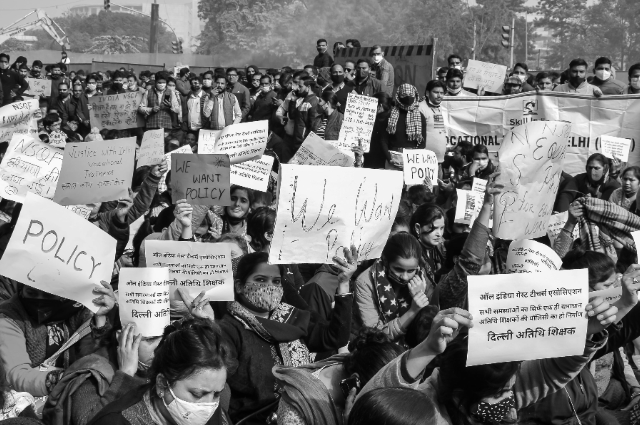
In 2020–21, India experienced one of the most extensive farmers' movements in its post-independence history. It wasn't sudden or violent but rooted in fear, uncertainty, and the lived experiences of those involved.
Thousands of farmers, later joined by lakhs, travelled from various states to the borders of Delhi. They lived on highways, cooked in makeshift kitchens, and endured challenging weather conditions. Many were elderly, and some were women who had never protested before.
At the core of the movement were three agricultural laws introduced by the government. The farmers believed these laws would:
- Weaken the Minimum Support Price (MSP) system
- Expose small farmers to exploitation by corporations
- Remove state protection in agricultural trade
- Increase long-term economic insecurity
For the farmers, this wasn't an abstract debate; it was a matter of survival. As the protests grew, images of tractors, tents, protest stages, and handwritten signs began circulating online. Social media served as a bridge between rural areas and urban screens. What started as a national movement quickly gained global attention.
Indian students studying abroad organised solidarity marches. Human rights organisations issued statements. Climate activists connected the farmers' struggle to food security and climate justice. Diaspora communities amplified voices that had previously gone unheard. Within this global attention, a digital toolkit was created.
It wasn't a manifesto or an instruction manual for chaos. It was a simple, collaborative Google Doc designed to explain the protest to those unfamiliar with the agricultural realities of India.
The toolkit included:
1. Background information on the farmers’ protest
2. Explanations of why farmers were opposing the laws
3. Suggestions for peaceful solidarity
4. Hashtags to spread awareness
5. Links to news articles and resources
There were no calls for violence, no instructions for disruption, and no secret codes. It was information intended for understanding. In the digital age, toolkits like these are common and are used for climate marches, women's rights campaigns, antiwar protests, and disaster relief efforts.
When Greta Thunberg shared the link on Twitter, she amplified the information, which is a common practice among digital activists. Within minutes, the document went viral. And with that, the narrative shifted. What had been a digital document designed for awareness was suddenly transformed into something far more dangerous.
The Delhi Police declared that the toolkit was part of an international conspiracy aimed at destabilising India. In official statements, the language changed:
Information was now termed "propaganda." Collaboration became "coordination." Solidarity was labelled "sedition."
Disha Ravi was accused of:
- Editing the document
- Sharing it with international activists
- Being part of a "global conspiracy"
She was arrested and charged under:
- Section 124A (Sedition)
- Sections related to criminal conspiracy
These charges are some of the most serious in Indian law, historically used against revolutionaries, freedom fighters, and armed insurgents. For a democracy, this moment demanded reflection. Can changing a document and sharing information be considered a crime against the nation?
In a constitutional democracy, disagreement is not equivalent to disloyalty. India's Constitution guarantees the right to freedom of speech and expression, including:
- The right to share opinions
- The right to circulate information
- The right to criticise policies
- The right to associate and collaborate
Digital documents, social media posts, and online campaigns are modern expressions of these rights. If changing a shared document is considered sedition, then:
- Teachers who edit lesson plans become suspects
- Journalists who share research become conspirators
- Students who circulate petitions become criminals
The line between national security and public expression becomes dangerously blurred. The allegation implied that interpretation was more important than intent, and interpretation was influenced by power. The transformation of a Google Doc into a "tool of conspiracy" exposed a deeper tension- A state uncomfortable with dissent and a generation unwilling to remain silent.
This was no longer about a single activist or a single document. It was about how far a democracy would go to redefine a crime in order to suppress disagreement. The arrest of Disha Ravi wasn't simply a legal process; it was a deeply human moment filled with fear, confusion, and an overwhelming imbalance of power.
She was taken from Bengaluru to Delhi, away from familiar faces and sources of support. For a young woman who had never been in a police station before, the experience was overwhelming. In custody, Disha was no longer an activist but an accused navigating a system designed for seasoned criminals.
During her initial court appearance, one fact stood out: she didn't have a lawyer of her choice present. In a country where legal representation is a fundamental right, this absence raised ethical and legal questions.
She reportedly told the court that she had only changed two lines of the toolkit, making minor changes that didn't alter its intent. Yet, these edits were presented as evidence of a conspiracy.
Outside the courtroom, the media storm had already begun. Television studios turned the case into a prime-time spectacle. Her photograph flashed repeatedly across screens. Phrases like "anti-national," "foreign influence," and "urban naxal" were casually used in debates.
In a later statement, Disha said:
"I was pronounced guilty not by a court of law, but by television studios chasing TRPs."
Her family, like countless other ordinary families suddenly thrust into the public eye, faced harassment, anxiety, and fear. Neighbours whispered. Phones rang endlessly. Silence became a coping mechanism.
The human cost of the arrest extended beyond one individual. It sent a clear message that activism carried consequences far greater than words.
The Disha Ravi case highlighted a key conflict: the clash between digital activism and state surveillance.
For today’s youth, digital platforms are not distractions; they are democratic spaces. Campaigns are organised through shared documents, group chats, hashtags, and online petitions. These tools enable young people to bypass traditional gatekeepers and communicate directly with the public.
However, digital expression leaves a permanent record: metadata, chat logs, edit histories, and IP addresses. What empowers voices also makes them vulnerable. The toolkit case showed how:
- Online collaboration can be reinterpreted as coordination
- Digital footprints can be reconstructed to reveal intent
- International communication can be framed as interference
According to data from civil liberties organisations, India has seen an increase in the use of sedition and national security laws against dissenters, including students, journalists, academics, and activists. Even when courts dismiss these cases, the damage is done. This phenomenon is known as the "process as punishment," where arrest, interrogation, legal battles, and public shaming become penalties in themselves. For young people watching this unfold, the lesson was unsettling:
Speak, and you may be watched. Organise, and you may be tracked. Question, and you may be charged. This creates a chilling effect. Participation drops. Self-censorship rises. Silence feels safer than speaking up. In a digital democracy, this is a concerning trend. If digital platforms become spaces of fear rather than freedom, democracy loses one of its most powerful tools.
The Disha Ravi case serves as a legal episode and a warning that, without safeguards, the very technologies that amplify voices can also silence them. After days of speculation, outrage, and fear, the story entered the courtroom, where reason prevailed.
When Disha Ravi’s bail application was heard, the court was faced with a constitutional question that extended beyond a single individual. The prosecution argued conspiracy, intent, and threats to national sovereignty, but the court examined the evidence, the proportionality of the actions, and the principles of democracy.
In granting bail, the court made observations that were widely shared. It noted that:
- Mere association with a cause does not establish criminal intent
- Sharing a document or engaging in digital communication does not constitute sedition
- Dissent, disagreement, and protest are essential to democracy
In its most emphatic statement, the court declared that citizens are the conscience-keepers of the government, and the state must not equate criticism with conspiracy. The court also acknowledged the realities of the digital age: that ideas travel across borders instantly, and such communication should not be seen as hostile or unlawful.
This was a critical moment. For the first time since the arrest, the language of the law replaced the language of accusation.
The bail order did not portray Disha Ravi as a hero or undermine the state's authority. It reaffirmed the constitutional balance.
The judgment reminded the nation that:
- Laws must be interpreted narrowly when liberty is at stake
- Sedition cannot be casually invoked
- Power must be justified by evidence, not fear
In that courtroom, a young woman was granted bail, and a larger idea was left with her:
That democracy still allows for reason.
While the legal battle continued in the courts, another battle took place across campuses, homes, and digital spaces. Young people were watching. Students hesitated before posting petitions. Climate activists archived their social media pages. Group chats fell silent. Questions were asked in whispers instead of hashtags.
The arrest of Disha Ravi became a cautionary tale.
Parents cautioned their children to "stay away from activism." Teachers avoided sensitive discussions. Organisers questioned whether their passion was worth the potential punishment.
This was the chilling effect in action, not just by law, but by fear itself. And yet, something else happened. Across India and beyond, students, lawyers, writers, and citizens spoke out. Letters were written. Petitions were circulated. Legal experts explained constitutional rights. International media questioned the arrest.
For many young people, the case became their first lesson in how democracy works, not as an ideal but as a contested space. They learned that:
- Rights exist, but must be defended
- Institutions matter, but are not infallible
- Silence protects comfort, not freedom
Disha Ravi became a reminder of vulnerability: anyone who speaks can be targeted, and anyone who remains silent becomes complicit. The case forced a generation to confront a truth:
Democracy doesn't collapse in a single moment; it erodes slowly when fear replaces participation.
Yet, the conversations sparked by this arrest demonstrated resilience. As long as young people continue to ask questions, organise peacefully, and demand accountability, the democratic spirit endures. The ripple effect of this case isn't just fear; it's awareness. And awareness, once awakened, is difficult to silence.
As time passed and headlines faded, one truth remained: the story of Disha Ravi was never solely about her. She became a symbol, not through choice or ambition, but by the circumstances she found herself in. Across India, there are thousands of young people like her:
- Students who speak out about climate change
- Volunteers who provide relief during floods and heatwaves
- Writers who question policy decisions
- Teachers who encourage critical thinking
- Citizens who utilise digital platforms to demand accountability
Most remain unnamed, unheard. What connected them to Disha Ravi wasn't a shared ideology but their shared vulnerability. Her arrest revealed that any citizen could be transformed into an accused simply by participating in public discourse. This is how symbols are born.
Not through speeches, but through lived experience. Disha Ravi came to represent the friction between:
- Youth and authority
- Speech and power
- Participation and punishment
- Democracy and discomfort
She didn't respond with anger or retaliation. Her statements were calm, measured, and rooted in her faith in the Constitution. She insisted that questioning policies doesn't equate to hating the nation. She reclaimed the narrative, not as an enemy of the state but as a citizen exercising her democratic right.
Every democracy is put to the test when faced with challenges. The Disha Ravi case revealed critical fault lines in contemporary India:
- The growing use of national security laws in cases of dissent
- The shrinking space for disagreement among the youth
- The power of media narratives to shape public perception
- The vulnerability of digital activism to misinterpretation
- Democracy is not just about elections or institutions.
It lives in everyday actions:
- The right to ask "why"
- The freedom to disagree
- The safety to organise peacefully
- The assurance that the law protects, not persecutes
When these freedoms feel fragile, democracy weakens, even if the constitution remains unchanged.
This story reminds us that laws are only as democratic as the intent behind their application. One of the most dangerous myths is that silence is safe. Silence doesn't protect democracy; it merely protects comfort. The arrest of a young activist forced many to confront this question:
If speaking out peacefully can lead to punishment, what does citizenship truly mean?
History demonstrates that:
- Rights once lost are rarely easily regained
- Freedoms erode gradually, not suddenly
- Democracies survive because people insist on participating
This does not imply reckless protesting or lawlessness. It means informed engagement, constitutional faith, and courage without resorting to violence.
Somewhere in Bengaluru, that door still exists. It opens and closes every day, quietly and ordinarily. But it carries memories. It remembers the knock and the moment when a young woman learned just how heavy the state can feel. Yet, it also remembers something else:
That she was released on bail, the court spoke, voices were raised, and questions were asked.
Democracy did not end on that day. It was tested. And tests, when faced honestly, can strengthen institutions. The real story isn't about fear. It's about resilience. Because when one voice is questioned, many learn to speak more carefully, but also more consciously. And as long as citizens believe their voices matter, no knock, however powerful, can silence the idea of freedom.