
The Camera That Does Not Blink
Picture a Delhi afternoon in July 2026.
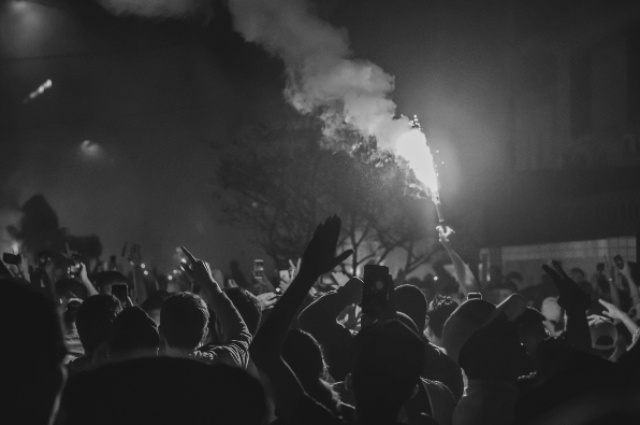
Rain on plastic sheets. Students sitting on a road that has hosted protests for longer than most of them have been alive. Placards going soft in the damp. Someone is arguing about the NEET-UG paper leak that brought them here; someone is singing, someone just wants to go home and can’t.
A little way off, a van is parked. Inside it, officers watch a wall of screens. On those screens, the crowd stops being a crowd. Every face gets a box drawn around it, and every box is quietly checked against a database that no one outside the van has been allowed to see.
I did not invent that scene. Its outline comes from what has been reported and argued in court, about the protests at Jantar Mantar that began on 20 June 2026. The Internet Freedom Foundation says that by late July, two police vehicles, one of them a van called Ikshana, were parked at the site with officers running the CCTV feed through facial recognition. The petitions before the Supreme Court add camera-fitted smart glasses worn by officers on the ground. And Delhi Police told the Court, on affidavit, that between 20 and 26 July the system picked out 2,873 people with criminal antecedents.
The police read that number as proof the technology works. The petitioners read it as proof of something else: that every face on that road was scanned, whether it belonged to a man wanted for murder or a second-year student holding a banner.
On 3 November 2026, a bench of the Chief Justice of India, Surya Kant, with Justices Joymalya Bagchi and V. Mohana, issued notice on a petition by the Software Freedom Law Centre against facial surveillance at protest sites. Justice Bagchi is reported to have asked whether the mere availability of footage, and the collection of data, could count as a legitimate state interest all by itself.
One question in one courtroom. I think it holds the whole dispute.
Because there is an old and comfortable argument that goes like this: you chose to stand in a public place, anyone could see you, so what is the harm if the police see you too?
This essay takes that argument seriously and then looks for the point where it breaks. The route runs through the Constitution, through cases from Delhi, Cardiff, Moscow and Brussels, and ends with a practical problem: if the State is going to use this technology at all, what would it take to make that use lawful?
If your face is visible to everyone, does that make your identity available to the State?
Being Seen Is Not the Same as Being Catalogued
Start with an ordinary evening.
You walk through a market. The tea-stall owner notices you. A neighbour’s cousin nods. A few hundred strangers register your face for a second and forget it. Nobody in that crowd knows your name, your Aadhaar number, your address, your employer or your parents. Your face was public, but you were still, in a very practical sense, anonymous.
Facial recognition closes that gap.
It does three separate things, and it helps to keep them apart. A camera sees. A storage system keeps. A recognition system matches, and the match is the real leap. Once a face is turned into a numerical template and compared against a database of named people, it stops being a face and becomes a key. The key opens a file: identity, address, family, previous cases. Standing on a road never gave a constable that power. And unlike a password, a face cannot be changed once it has leaked.
The Constitution already has language for this worry. In K.S. Puttaswamy v. Union of India (2017), a nine-judge bench of the Supreme Court held that privacy is a fundamental right rooted in Article 21. The plurality opinion also made a point that matters enormously here: privacy attaches to the person, not to the place. Walking out of your front door does not hand it over.
But Puttaswamy did not say the State can never intrude. It said any intrusion has to clear three hurdles. There must be a law behind it. It must serve a legitimate aim. And it must be proportionate, meaning the means should not stretch further than the aim requires.
Run facial recognition at a protest through those hurdles and the first one is where the trouble starts. The petitioners argue that no Indian statute authorises, regulates or limits police use of facial recognition at public assemblies. If that is right, the technology is running on an executive decision alone, and Puttaswamy asked for more than that.
The second and third hurdles are harder, and fairer to the State. Catching a wanted criminal is a legitimate aim. Whether scanning every face in a crowd of thousands is a proportionate way to catch a few depends on safeguards we have not yet been shown. We will come back to those.
When a camera can turn a passing face into a named person, is “it happened in public” still an answer?
What the Right to Protest Actually Protects
Protest in India is not a favour the State grants when it feels generous. In the Ramlila Maidan Incident, In re (2012), the Supreme Court held that the right to assemble peacefully and to protest cannot be taken away by arbitrary executive or legislative action.
Six years later, that principle was tested on the very road now in the news. After residents complained about noise and encampments, the National Green Tribunal ordered protests off Jantar Mantar in October 2017. Delhi Police had also been repeatedly invoking Section 144 to keep demonstrators out of central Delhi. In Mazdoor Kisan Shakti Sangathan v Union of India (23 July 2018), Justices A.K. Sikri and Ashok Bhushan set aside the blanket ban. A complete prohibition, the Court said, was not the answer. Regulation was: caps on numbers, designated areas, controls on loudspeakers, limits on long encampments.
The lesson is a balanced one. The State may regulate the time, place and manner of protest. It may not extinguish it.
A third case adds the missing piece. Anuradha Bhasin v. Union of India (2020) was about the internet shutdown in Jammu and Kashmir, not about protest, but the rule it laid down travels well. Any restriction on speech or movement must be necessary and proportionate, backed by reasons, published, and open to judicial review. A shutdown without end, the Court said, cannot stand.
Now hold surveillance up against that standard. Nobody was banned from Jantar Mantar in July. People were allowed to come. But a restriction does not need to be a prohibition to be a restriction. If attending a lawful protest means being scanned, matched and possibly filed, the cost of exercising the right has gone up, and the State should be able to say why, in writing, in public. Yet the Internet Freedom Foundation reports that the RTI applications it filed in July about the technology drew evasive replies, and says it will appeal. When a tool is turned on thousands of people, secrecy is not a side issue. It is the issue.
There is also a postscript, reported by PTI. On 11 October 2026, the Delhi Police Commissioner’s standing order removed Jantar Mantar Road from the list of designated protest sites, naming Ramlila Maidan, Burari Ground and CBD Ground instead, on the recommendation of a committee set up by the Home Ministry. Nothing I have read connects that order to the surveillance case, and I won’t pretend otherwise. It is still worth noticing that the place where this privacy question was raised has just stopped being an official protest address.
If the State can decide where we protest, can it also decide how much of ourselves we leave behind while we do?
Delhi, March 2020: The First Admission
The 2026 controversy did not appear from nowhere. Its roots are in the spring of 2020.
On 11 March 2020, during a Lok Sabha debate on the violence in north-east Delhi, which had killed more than fifty people the month before, Home Minister Amit Shah said something that was news to most of the country. Police were using facial recognition software. They had fed it voter ID and driving licence data along with other government records, and more than 1,100 people had already been identified. A day later in the Rajya Sabha, he put the figure above 1,900 and denied that Aadhaar data had been used.
It was the first open acknowledgement of this kind by a Union minister. Three things stand out when you read it again.
First, the system had been bought for something else. Reporting at the time noted that Delhi Police first acquired it to trace missing children. A tool procured for one purpose was now sorting suspects in a riot inquiry. There is a name for that drift: function creep, and it deserves the name.
Second, the databases had not been collected for this. People handed over a photograph for a voter card or a driving licence. Nobody ticking that box imagined becoming part of a police matching pool.
Third, there was no statute. There still isn’t one specifically governing police facial recognition. Shah’s answer to critics was that the software only sees faces and does not distinguish by religion. That tells us about the software’s indifference. It tells us nothing about accuracy, audit, or what happens to a person wrongly flagged.
I want to be fair here. A riot with dozens of deaths is about as strong a case for identifying suspects from footage as any court will hear, and nobody seriously argues that police must ignore video of arson. The worry is narrower. It is about the missing legal scaffolding, and about the fact that, according to The Wire, the same Delhi Police system had earlier been used to screen crowds at rallies against the Citizenship (Amendment) Act. Screening a protest and investigating a riot are not the same act, and the law has never been asked to tell them apart.
Jantar Mantar, 2026: When the Numbers Do Not Add Up
Six years on, the pieces came together in one place.
The protests that began on 20 June 2026 over the NEET-UG paper leak ran for weeks. According to the petitions, Delhi Police used the Ikshana surveillance vehicle, AjnaLens smart glasses made by Dimension NXG, and fingerprint collection through the National Crime Records Bureau’s Abhigyan application. On 28 July, CPI(M) Rajya Sabha member A.A. Rahim filed a public interest petition asking the Supreme Court to declare this surveillance unconstitutional and to halt facial recognition at peaceful protests until Parliament passes a law regulating it. It leans heavily on Puttaswamy and names the firms that supplied the equipment, alleging that no data-sharing or processing agreements have been disclosed.
On 13 August, the Court agreed to examine the challenge and tagged it with related matters. It had already ordered the material collected at the protest to be preserved and kept out of the public domain for the time being.
Delhi Police’s answer came by affidavit. It denied mass surveillance and said the system was used to identify people with prior criminal records, that a Special Investigation Team would look only at those with serious offences, and that 2,873 such people had been identified.
Then, on 4 September, The Indian Express published an investigation that changed how that number reads. Checking police, prison and court records, it found that at least 25 of the people the system flagged at Jantar Mantar were in prison at the time: in Tihar, Mandoli or Rohini. A person in a Tihar cell cannot be on a road in central Delhi. Either the match was wrong, or the record was stale, or “identified” meant something looser than “present.” The Internet Freedom Foundation called the whole sweep unreliable and demanded that the list be withdrawn.
The larger problem is the one the headline figure hides. A bare count of matches is not a measure of accuracy. To judge the system, you would need to know how many faces were scanned, how many alerts were raised, and how many of those alerts were wrong. None of that is in the public record.
A system that will not tell us whom it wrongly flagged cannot prove whom it rightly flagged.
There is also a human side that figures cannot capture. Women demonstrators told reporters from BOOM that officers filmed them at close range in the rain, and that some were told their photographs could be passed on to parents, universities and future employers. These are allegations, and I have not been able to verify them. But even as allegations, they point at the real mechanism of harm, which I turn to below.
What a Camera Does to a Crowd
Think about what makes a protest possible. It is rarely courage in the abstract. It is a string of small calculations. A first-year student wonders whether this will turn up when she applies for a job. A government employee wonders whether his department will hear about it. A parent with a court case pending wonders whether to bring the children.
Crowds protect people partly because they are crowds. Being one among thousands feels safe, and that feeling is part of how a peaceful assembly works at all.
Facial recognition takes it away without any noise. Nobody has to be arrested for the damage to happen; it is enough to suspect that a match is possible. Then the harm shows up as an absence, as the student who stayed in her hostel room and the clerk who sent his regards instead of turning up. Those people appear in no affidavit and no statistic, and they are exactly the people Article 19 exists for.
The State’s Side of the Argument
It would be dishonest to write this essay as if the police had no case.
Large protests can be hijacked. Reports from late July spoke of damage to property and fifteen FIRs. A person wanted for murder might well be standing in a crowd, and a police force that could find him and chose not to would be criticised, rightly. Delhi Police say that is precisely what their system did: it matched faces against records of people with prior cases, and it was never used to watch ordinary demonstrators. In Bridges, an English court accepted that live facial recognition could be proportionate in principle. And the Supreme Court has so far done nothing more than issue notice. It has not stayed the system or declared it unlawful, and Justice Bagchi’s questions from the bench could cut either way.
The difficulty is a plain one. You cannot search for one face without looking at all the others. A system that only “flags people with records” still has to scan everyone in order to find them, so the scan of the whole crowd is the search. Whether that is acceptable cannot be settled by pointing to how many dangerous people were found. It depends on who authorised the scan, what happened to the faces that did not match, and who checks the work.
Both sides agree on the aim. They disagree about the means, and above all about who gets to inspect them.
Four Systems, One Pattern
India is not the first country to face this. Other courts and regulators got there earlier, and their answers fit together better than one might expect.
Cardiff: R (Bridges) v Chief Constable of South Wales Police (2020)
Edward Bridges, a resident of Cardiff, challenged South Wales Police’s use of “AFR Locate,” a live system that compared faces from a camera feed against a watchlist and deleted images that did not match. It had been deployed about fifty times between May 2017 and April 2019.
In August 2020, the Court of Appeal found the deployment unlawful. Notice what it did and did not say. It did not outlaw the technology. It held that the rules left far too much to the discretion of individual officers, both over who could be placed on a watchlist and over where the cameras could be used, so the interference with privacy was not “in accordance with law.” The impact assessment was deficient, and the force had not taken enough steps to check whether the software performed differently across groups, which breached its equality duty. It is regarded as the first successful legal challenge to police facial recognition anywhere in the world.
The message was to write the rules before you switch the cameras on. In Delhi, so far as the public record shows, there is no equivalent policy, no published impact assessment and no equality check.
Moscow: Glukhin v Russia (2023)
The man at the centre of this case did something very small. He rode the Moscow metro alone, holding a life-size cardboard figure, to make a point. Police identified him with facial recognition, and he was fined for failing to give advance notice of a solo demonstration.
On 4 July 2023, the European Court of Human Rights found violations of both Article 10 (expression) and Article 8 (private life). It described facial recognition as highly intrusive, said that strong safeguards against abuse were needed, and said that the need is greater still when the technology is used live. Using it against a peaceful protester over a minor offence did not answer any “pressing social need.” Russia had by then left the Council of Europe, but the Court still ruled on the earlier events. It was the first international judgment on facial recognition.
The point for India is proportion. The more trivial the offence and the more peaceful the person, the harder it is to justify the technology. The Delhi Police answer, that those targeted were serious offenders, is a different argument, but it only works if the system is demonstrably aimed at them and no one else.
The regulators: Clearview AI
The third case is about where the faces come from. Clearview AI, a US company, scraped billions of photographs from the internet without asking anyone and sold police forces the ability to match a face against them. France’s CNIL, Italy’s Garante and Greece’s data protection authority each fined it €20 million in 2022. The UK’s Information Commissioner imposed £7.5 million. In September 2024, the Dutch authority fined it €30.5 million, banned its use in the Netherlands and warned that organisations using it could be fined too. Its reasoning was that the unique biometric codes attached to each image are biometric data, and Clearview could not bring itself within any of the legal exceptions for processing it.
India’s version of the same question looks different on the surface. Nobody is scraping Instagram. The faces came from voter cards and driving licences, handed over for an entirely different reason. But the principle is identical: an image given for one purpose does not become raw material for identification just because the State can reach it.
Brussels: the EU AI Act
The fourth system is written law. Regulation (EU) 2024/1689, the AI Act, bans real-time remote biometric identification in publicly accessible spaces for law enforcement, with three narrow exceptions: a targeted search for victims of abduction, trafficking or exploitation and for missing persons; the prevention of a specific and imminent threat to life or a terrorist attack; and the location of suspects in listed serious crimes. Each use needs prior authorisation from a judge or an independent authority, a fundamental rights impact assessment, and a rule that no decision with adverse legal effect may rest on the system’s output alone. The Act also bans untargeted scraping of faces to build databases, which is the Clearview model. These prohibitions have applied since February 2025.
It is not a perfect shield. Identification after the event is regulated rather than banned, and member states may tighten or loosen the detail. But it does something no Indian law does: it makes the police justify the camera before they use it.
Put the four side by side, and a pattern appears. Cardiff said the rules must come first. Moscow said peaceful people and small offences need strong protection. The regulators said the source of the data matters. Brussels wrote it all into statute. India has, today, none of the four.
The Gap in India’s Own Law
The obvious place to look for protection is the Digital Personal Data Protection Act, 2023. A law with “data protection” in its name ought to cover the police. Section 17(2)(a) is where that hope runs out.
Under it, the Central Government can notify any instrumentality of the State as exempt from the Act, in the interests of sovereignty, the security of the State, friendly relations with foreign States or public order. The exemption is from the whole Act, not from selected parts. Commentators point out that nothing in the Act requires such a notification to be limited by category, by time, or accompanied by any safeguard, and that the body that grants the exemption is also the one that could redraw its limits.
That is awkward for the Puttaswamy test. A law that lets the executive switch off all protection by notification may satisfy “legality” on a formal reading, but it is hard to call it proportionate. So the situation is this: the facial recognition rules do not exist, and the general privacy statute allows the State to step outside it. A citizen at a protest is left holding a fundamental right with no statute behind it to say how it should be enforced.
What a Lawful System Would Need
None of this requires the police to abandon technology. The cases above, read together, suggest a workable list.
- A statute. Parliament, not a departmental order, should name the permitted purposes. The Rahim petition asks the Supreme Court for exactly this, a pause until such a law exists.
- Prior approval. A judge or an independent authority should authorise each deployment in advance, as the EU rule does, so that discretion does not sit with the officer holding the camera, which was the flaw in Bridges.
- A serious-crime threshold. Facial recognition should be reserved for grave offences and never for notice defaults or minor charges, the lesson of Glukhin.
- Deletion by default. Images that do not match should be erased at once, as the Welsh system did, with fixed limits on how long matches may be kept.
- Published accuracy. Error rates should be public, with the denominator: faces scanned, alerts raised, alerts wrong. The 25 people in prison show what happens when only the headline is released.
- Impact and bias assessments, before use. Bridges turned partly on this.
- No action on a match alone. A human check, and independent corroboration, should come before anyone is questioned, arrested or listed, following the AI Act.
- Open vendor and data-sharing terms. The petitions allege that none have been disclosed. Whatever the truth, the public should not have to litigate to find out who holds protesters’ faces.
None of these would end policing. They would turn a secret into an accountable power, which is the difference between surveillance and law enforcement.
Before the Van Drives Away
Go back to that wet afternoon, the plastic sheets and the van parked a little way off.
The usual answer to the opening question, that you were in public so nothing was taken from you, begins to look thin. Being seen by a crowd is one thing. Being matched, named and filed is another. The first is the ordinary condition of living among people. The second is something the State performs, and anything the State performs has to be justified in law.
The Supreme Court has not yet ruled, and it may take the State’s side on parts of this. That would not be an unreasonable outcome if the safeguards are real. What would be unreasonable is a country in which every camera at every protest comes with a promise to trust the people operating it and a refusal to say who checks them.
A face is public. An identity, once a machine has linked it to a name, an address and a file, is something that belongs to the person. The State may borrow it for good reason, with permission from the law, for a limited time, and with a record of how it was used. It was never the State’s to keep.
If standing in a crowd means being known to the State, how many people will still choose to stand?
References:
- K.S. Puttaswamy (Retd.) v Union of India (2017) 10 SCC 1 (Supreme Court of India, 24 August 2017).
- Anuradha Bhasin v. Union of India (2020) 3 SCC 637 (Supreme Court of India, 10 January 2020).
- Mazdoor Kisan Shakti Sangathan v. Union of India, AIR 2018 SC 3476 (23 July 2018), relying on the Ramlila Maidan Incident, In re (2012) 5 SCC 1; and the Delhi Police standing order of 11 October 2026 de-notifying Jantar Mantar Road, as reported by PTI (The Tribune, 12 October 2026).
- Statement of the Union Home Minister on the use of facial recognition in the Delhi violence investigation, Lok Sabha, 11 March 2020, and Rajya Sabha, 12 March 2020, as reported by The Quint, TechCrunch and Scroll.in; The Wire on Delhi Police use of automated facial recognition at Citizenship (Amendment) Act rallies.
- A.A. Rahim v Union of India (Diary No. 45049/2026) and Software Freedom Law Centre v Union of India (notice issued 3 November 2026; case title and number to be verified against Supreme Court records), with the Delhi Police affidavits of August 2026; as reported by LiveLaw, LawChakra, Business Standard (13 August 2026) and BOOM; The Indian Express investigation of 4 September 2026; Internet Freedom Foundation statements and RTI reports, July to September 2026.
- R (Bridges) v Chief Constable of South Wales Police [2020] EWCA Civ 1058 (Court of Appeal of England and Wales, 11 August 2020).
- Glukhin v Russia, Application no. 11519/20 (European Court of Human Rights, Third Section, 4 July 2023).
- Regulatory action against Clearview AI: CNIL (France), Garante (Italy) and Hellenic DPA (Greece), 2022, €20 million each; UK Information Commissioner’s Office, 2022, £7.5 million; Dutch Data Protection Authority (Autoriteit Persoonsgegevens), decision of 16 May 2024, announced 3 September 2024, €30.5 million.
- Regulation (EU) 2024/1689 (Artificial Intelligence Act), Articles 5(1)(e), 5(1)(h) and 5(3), with Recitals 33 to 35.
- Digital Personal Data Protection Act, 2023, Section 17(2)(a), and Digital Personal Data Protection Rules, 2025.