
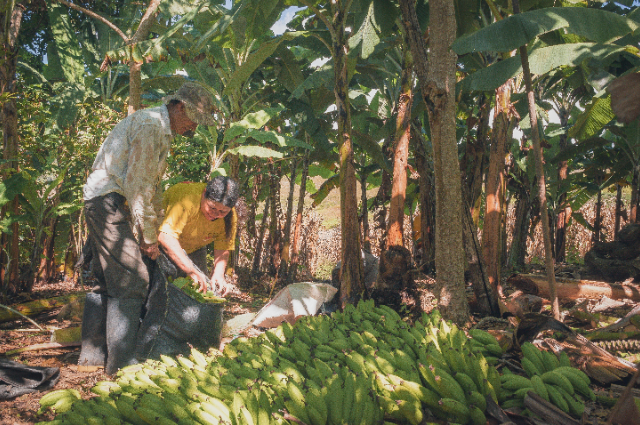
Every year, a quiet environmental crisis keeps growing in banana farms around the world. We peel and eat one of the most common fruits on the planet without giving a second thought to what’s left behind. For every kilogram of bananas we consume, nearly ten kilograms of the plant—thick stems, wide leaves, and fibrous biomass—are thrown away. When you add it all up, the scale is hard to ignore: close to 120 million tons of banana waste every single year.
In most banana-producing regions, this waste doesn’t go anywhere useful. Farmers often burn it to clear fields or leave it to decompose. Both options release methane into the atmosphere—a greenhouse gas far more potent than carbon dioxide in the short term. While climate conversations usually focus on cars, factories, and fossil fuels, agricultural waste like this rarely gets attention, even though its environmental impact is very real.
The root of the problem is simple biology. A banana plant produces fruit only once. After harvest, the plant’s strong stem, which was essential just weeks earlier, has no further use to the farmer. With little infrastructure and few profitable alternatives, farmers are left choosing between expensive disposal methods and practices that harm the environment. What’s usually seen as waste, however, is actually full of untapped potential.
That change in perspective is what led innovators like Jinali Mody to look at banana stems differently. Instead of seeing them as agricultural trash, she saw strength—quite literally. Banana stems contain long, durable fibres that can be transformed into something valuable. What started as an experiment eventually became banana leather, a plant-based material that closely resembles traditional leather without the ethical and environmental costs.
The process itself is refreshingly straightforward. After harvesting, banana stems are processed to extract fibres. These fibres are cleaned and bonded using natural substances like plant starches and tree gums—without harsh chemicals or toxic tanning agents. The material is then pressed, naturally dyed, and finished into flexible, durable sheets that look and feel like leather.
This innovation matters because conventional leather production is one of the most polluting processes in the fashion industry. Making a single leather bag can consume more than 10,000 litres of water and involves chemicals like chromium that contaminate waterways and endanger workers. Banana leather, by comparison, uses roughly 500 litres of water per bag, produces no toxic waste, and avoids plastic—something most so-called “vegan leathers” still depend on. It’s not just a substitute; it’s a significant improvement.
The impact goes beyond environmental benefits. For banana farmers, selling stems that were once discarded creates an entirely new income stream. In some cases, this can raise earnings by up to 30%, helping small farmers build more stable livelihoods. What was once burned or abandoned now holds value, turning farms into the starting point of a circular economy.
For the fashion industry, banana leather offers a rare solution to a long-standing problem. Brands are under pressure to move away from animal products and plastic-based materials without compromising quality or appearance. Banana leather meets that demand—it’s sustainable, scalable, and visually appealing. Its growing adoption suggests that consumers are ready for materials that align with both style and values.
These ideas haven’t gone unnoticed. In 2025, initiatives like UNEP’s Young Champions of the Earth highlighted innovators working on solutions such as banana leather, drawing global attention to the power of rethinking waste. Still, agricultural biomass remains largely absent from mainstream climate policy discussions, overshadowed by more visible industries and emissions.
Part of the reason is distance. Agricultural waste doesn’t pile up in cities or boardrooms. It sits quietly in rural fields, spread out and easy to overlook. But as scientists increasingly warn that methane is a major driver of near-term warming, ignoring these emissions is no longer an option. Solutions that turn waste into resources aren’t just clever ideas—they’re essential.
At its core, the story of banana leather is about changing how we define waste. Sustainability isn’t only about doing less harm. It’s about redesigning systems so that what we throw away becomes useful again. Banana leather shows that innovation can come from unexpected places—even from the stem of a fruit we eat every day.
In a world full of abstract climate statistics and distant policy targets, the banana waste problem feels refreshingly tangible. You can see it, measure it, and solve it. And that’s what makes it powerful. When agriculture, climate action, livelihoods, and design come together, solutions don’t just reduce damage—they create value.
The real challenge now is scale. If ideas like banana leather are integrated into global supply chains and supported by policy, waste stops being an afterthought. It becomes a resource. And maybe then, we’ll start paying attention not just to the problems we’ve ignored—but to the possibilities hiding in plain sight.
. . .
Sources & Further Reading:
Awards & Global Recognition
- UNEP Young Champions of the Earth 2025 – Winners Announcement https://www.unep.org
Innovator & Project Information
- Banofi Leather (India) – Official Website https://banofi.com
- UNifeed Feature on Banana Leather – Process & Story https://www.unifeed.com
Impact Data & Research
- Yale School of the Environment — Banana Waste & Textiles https://environment.yale.edu
- UN Decade on Ecosystem Restoration – Context & Progress https://www.decadeonrestoration.org