
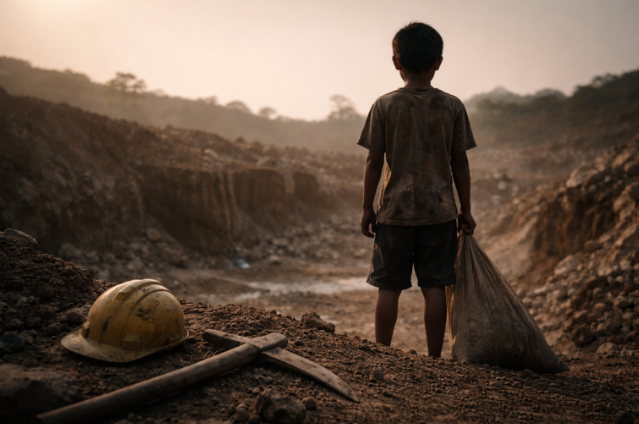
Across the world today, millions of children wake up not to the sound of a school bell, but to the clang of metal against rock. They spend their days bent over pickaxes in cobalt mines, sewing in cramped workshops, or harvesting crops in remote fields. These children are not the faces of the modern workforce that corporations advertise. They are hidden in the deepest corners of global supply chains, invisible to the public eye and absent from glossy company reports. Despite decades of promises and international agreements, child labour remains alive and embedded in the foundation of many industries that power modern life.
What makes this exploitation so difficult to confront is not just the scale but the architecture that sustains it. Global supply chains are built like ladders with multiple rungs, where the step closest to the consumer is the only visible part. At the top sit multinational corporations — brands with polished reputations and international reach. These companies usually purchase finished goods from large factories that appear organised, regulated, and audit-ready. This makes the first layer, known as Tier 1, look clean. But beneath that polished surface lies Tier 2, where smaller workshops produce parts and semi-finished materials, often operating beyond consistent inspection. And even further down are Tier 3 and Tier 4: farms, mines, informal sheds, and backyard operations where oversight collapses completely.
It is here, in these hidden layers, that child labour survives. While brands audit the top tier to meet compliance targets, the lower tiers — the ones most likely to use children — rarely face scrutiny. Work is often delegated to informal subcontractors who, to cut costs, rely on children because they are cheap, compliant, and desperate enough to accept dangerous conditions. In the case of mineral extraction, many children end up in the Democratic Republic of the Congo, digging cobalt that powers the batteries in phones and electric vehicles. In garment supply chains, children thread buttons and stitch garments in small, unregulated rooms, sometimes attached to their own homes. The system ensures that by the time a product reaches the global market, there is no visible trace of the child who helped make it.
The International Labour Organization and UNICEF estimate that around 138 million children are still engaged in child labour as of the latest assessments. Many of them are in roles that match the legal definition of hazardous work — tasks that threaten physical health, mental development, or personal safety. Agriculture accounts for the highest portion, but mining and informal manufacturing are among the most dangerous. These numbers challenge the promises made under international frameworks such as Sustainable Development Goal 8.7, which aimed to end child labour by 2025. That target has already been missed. Even more concerning is that progress has slowed rather than accelerated.
The reason the world continues to fail children is rooted in economics. For families living on the edge of survival, education becomes a luxury rather than a right. When wages are too low for adults to sustain a household on their own, sending children to work becomes a grim necessity. This is the poverty trap: children work to help their families survive in the present, but in doing so, they sacrifice the education that could have secured a better future. The world watches children carry minerals out of mines, but rarely examines the structures that force them to be there.
Even when governments and corporations claim to act, the systems designed to prevent exploitation often fall short. Many corporate audits are announced in advance, giving suppliers time to hide children from sight. Factories temporarily remove underage workers, cover up improper records, or shift production to off-site locations until inspectors leave. As long as compliance is treated like a checklist rather than a moral obligation, these inspections simply confirm what companies want to see, not what actually exists. The illusion of oversight becomes more valuable than oversight itself.
Change, however, is beginning to take shape — slowly, and with resistance. The European Union’s Corporate Sustainability Due Diligence Directive represents one of the first large-scale attempts to legally require corporations to take responsibility for every level of their supply chain, not just the parts they can see. The directive makes it possible to hold companies accountable when violations like child labour are found anywhere within their production network. It extends legal responsibility beyond the first tier and recognises that a company’s ethical obligations should not end where its direct contracts do. While critics argue that adjustments and watered-down versions of the law threaten its effectiveness, the directive still marks a shift from voluntary pledges to mandatory accountability.
Laws alone, however, are not enough. They must be paired with social protection systems that reduce the pressure on families to put children to work. Education needs to be accessible, affordable, and prioritised over labour. Local communities must have alternatives to dependence on exploitative employers. And corporations must invest in tracing, transparency, and real-time monitoring — not as charity, but as a cost of doing business in a world that should not be built on children’s backs.
The story of child labour is not just about children losing their childhoods; it is about the world losing its moral direction. If a child is mining cobalt that powers a phone battery, then every photo taken, every message sent, every step toward technological convenience carries the weight of a childhood that technology erased. It isn’t enough to condemn the image of a child with a pickaxe. The world must dismantle the system that put the pickaxe in their hands.
If this generation wants to claim progress, then it must start where the problem lies: not at the top layer of supply chains where everything looks clean, but at the bottom, where pens are traded for pickaxes and classrooms for quarries. A just future begins when children are valued not for the labour they can provide, but for the lives they deserve to live.
References:
- ILO & UNICEF. “Despite progress, child labour still affects 138 million children globally.” https://www.ilo.org
- ILO: “CLEAR Supply Chains – Ending Child Labour in Supply Chains.” https://www.ilo.org
- European Commission: Corporate Sustainability Due Diligence Directive (CSDDD). https://commission.europa.eu
- Wikipedia: Corporate Sustainability Due Diligence Directive overview. https://en.wikipedia.org