
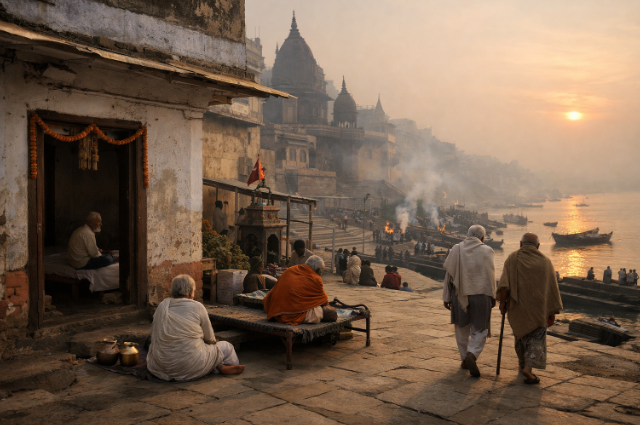
Varanasi is a city where life and death are not opposites but neighbours. On the banks of the Ganges, the smell of incense mingles with funeral pyres, and chants rise with the smoke that signals one more soul released. Among all the places that define this city, one of the most unusual and talked-about is Mukti Bhawan, often referred to as the “death hotel.” The term may sound unsettling, yet it encapsulates a reality that is deeply spiritual rather than morbid: many people come to this building not to be treated or cured, but to die.
The idea begins with a belief rooted in Hindu tradition—dying in Varanasi grants moksha, liberation from the cycle of birth and rebirth. It is believed that the Ganges carries away karma the way a river carries away silt, and that the final breath taken here frees the soul from worldly attachments. For many elderly individuals and those nearing the end of their lives, the chance to die in this city is considered a blessing greater than any luxury, wealth, or comfort one might accumulate over a lifetime. This belief is what fills the rooms of Mukti Bhawan faster than any luxury suite in the city ever could.
Unlike five-star hotels along the ghats, Mukti Bhawan operates with a purpose that has nothing to do with tourism or hospitality. The rooms are simple, the walls often bare, and the amenities are minimal—usually just a bed, a fan, and enough space for a family to sit close. It is not the appearance of the room that attracts people, but what they believe that room represents: the doorway to salvation. The building itself has very few rooms, only around a dozen, and this limited capacity immediately creates a situation where availability is almost always scarce. Luxury hotels can expand, invest, and add floors; this one cannot, because it is not meant to be a commercial property but a spiritual waiting room.
Admission here is not open to everyone. There is an unspoken expectation that a person must be near the end. Families arrive after long journeys, sometimes from across the country, and the staff are left to make difficult decisions. If someone appears to be recovering or shows no real signs of being close to death, they may be asked—gently, but firmly—to leave. Not out of cruelty, but because every room taken by someone with time left becomes a room denied to someone whose final hours are slipping away. It is a kind of emotional economy that luxury hotels never have to face.
Time plays a different role here than it does in ordinary lodgings. Stays are not based on vacations, conferences, or religious festivals, but on mortality. Many people are permitted to stay only a short duration—often around two weeks. If death does not arrive, the resident is asked to leave and return home. For the families, this creates a mix of hope and heartbreak: they pray for more life, yet know that too much life means losing the room. There is no reservation app for this waiting, no early check-in or late check-out. Everything depends on fate.
Luxury hotels, by comparison, are easy to access. If a five-star property is sold out, the solution is simple: call another one, pay a little more, adjust the dates, or book months in advance. Demand may be high, but the conditions are manageable. In contrast, the demand for rooms in Mukti Bhawan is not about holidays or pricing; it is about the fear of missing what could be a person’s final chance to die in the place they have dreamed of. The emotional urgency behind each family’s arrival is unlike anything that exists in commercial accommodation. A luxury hotel can soothe disappointment with refunds and upgrades. Here, disappointment feels like destiny stealing a final opportunity.
Another reason availability is scarce is the cost—or rather, the lack of it. Mukti Bhawan is not run for profit. The stay is symbolic in price, sometimes only a few rupees a day, because no one should be denied salvation due to money. This openness means that a wealthy traveller and a retired labourer could be knocking on the same door for the same purpose. In luxury hotels, money sorts people; here, mortality does. It creates a kind of equality that is unsettling yet strangely human: at the end, every life stands at the same distance from death.
For the travellers who come to Varanasi to witness the ghats or the aarti, the city may seem chaotic and mystical. But for those who enter Mukti Bhawan, the city is not an experience. It is a destination with a single purpose. They do not come for the views of the river but for what lies beyond it. They do not check out; they are taken out. And while a luxury hotel sends its guests away refreshed, this hotel sends its guests away to the cremation ghats, with the belief that the soul, at last, can rest.
This is why it is harder to get a room here than in any luxury hotel. Luxury offers comfort. Mukti Bhawan offers closure. Hotels promise a night; this place promises eternity.
References
- Gulf News – “Varanasi’s Death Hotel” https://gulfnews.com
- Times of India – Mukti Bhawan admissions and traditions https://timesofindia.indiatimes.com
- Prameya News – Spiritual reasoning and belief in moksha at Varanasi https://www.prameyanews.com
- Messy Nessy Chic – Mukti Bhawan feature story https://www.messynessychic.com