
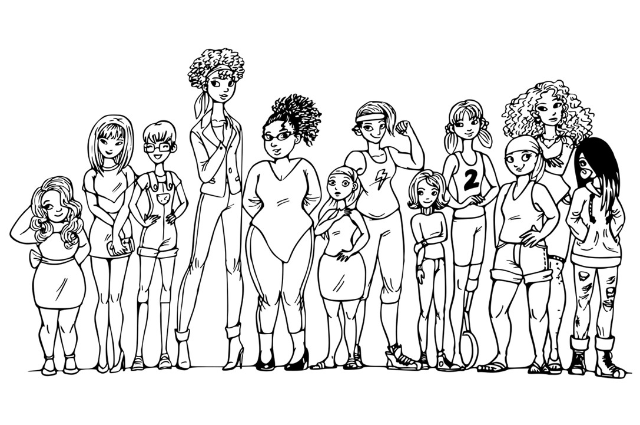
Image by Heyli Jiménez from Pixabay
I want to say something about body shaming that may sound harsh, but I genuinely feel it needs to be said.
For years, we have been told what a beautiful woman is supposed to look like. We have watched certain celebrities being celebrated for their perfect figures, beautiful faces, complexion, height, hair and youthful appearance. We put them on covers, in advertisements, on television and everywhere else—and slowly, without even realising it, we turned their appearance into a benchmark for every other woman.
And I have a problem with that.
Not because those women are beautiful. They are.
Not because they worked hard. Many of them undoubtedly did.
My problem is with what happened around that beauty.
An ordinary woman started looking at herself and thinking, “Why don't I look like her?”
A mother started wondering, “Why haven't I got my old figure back?”
A middle-aged woman began looking at her wrinkles as something she had failed to prevent.
A girl started believing that being slim, fair, youthful and conventionally beautiful was somehow part of being a successful woman.
Who created this pressure?
We did.
The media did.
The beauty and fashion industries did.
And yes, celebrities who became the faces of these standards also became an important part of that whole system.
That is the part I want to talk about honestly.
Because today, when these same celebrities are criticised for gaining weight, ageing, developing wrinkles or looking different from their younger selves, we rightly hear people saying, “Stop body shaming women. Bodies change. Motherhood changes women. Ageing is natural.”
I completely agree.
But then I have one question.
Where was this understanding when the beauty benchmark was being created?
If for years you allowed—or participated in—an industry that made extraordinary beauty look like the normal expectation for women, shouldn't we also acknowledge that this benchmark had consequences?
I am NOT saying these women deserve body shaming.
I repeat that because it is important.
No woman deserves to be humiliated for her body.
My point is something else.
If beauty is powerful enough to be celebrated, marketed, photographed, advertised, and monetised for years, then we cannot suddenly act surprised when society reacts when that beauty changes with age.
That doesn't make the reaction right.
It makes the system contradictory.
And this contradiction has affected ordinary women much more than celebrities.
I sometimes think about the average woman who has spent her entire life trying to keep up.
She has children.
She has a home.
She may have a job.
She may be looking after ageing parents.
She may have spent years putting everyone else before herself.
And then she looks in the mirror and feels guilty because her stomach isn't flat.
Another woman looks at a celebrity and thinks:
"She had children and still looks like that. Why can't I?"
But maybe the better question is:
Why should you?
Why should a woman with two children, a household to run, a career, responsibilities and an ordinary human body be compared with a carefully presented celebrity image?
Why did we make that comparison normal?
A woman can have degrees, build a career, raise children, run a business, teach, lead, invent, heal, write or serve society—and still someone will notice that she has gained weight.
A man's ageing is often described as maturity.
A woman's ageing is treated as deterioration.
A man's grey hair can become “distinguished.”
A woman's wrinkles become something to hide.
A man's success can make him more attractive.
A woman's success is still too often expected to come packaged with youth and beauty.
This is exactly what I want us to question.
I don't want women to stop appreciating beauty.
I don't want us to pretend that appearance doesn't matter at all.
Of course beauty can be appreciated.
But beauty should not become a compulsory qualification for womanhood.
And I especially don't want our daughters growing up believing that their bodies are projects that need constant correction.
Fairer skin.
Thinner waist.
Smaller nose.
Longer hair.
Younger face.
Perfect figure.
Then after marriage—maintain yourself.
After pregnancy—get your body back.
After forty, you look thirty.
After fifty, you hide your age.
Honestly, when does a woman get permission to simply be human?
This is why I feel that celebrities who have spent years being presented as beauty icons also have a responsibility:
not to accept abuse, but to recognise the culture surrounding that image.
Because when the benchmark they represented begins to disappear with age, that should not be treated as some kind of failure.
Beauty was never permanent.
Bodies were never permanent.
Youth was never permanent.
We simply behaved as if they were.
And perhaps the women who became symbols of that beauty culture can now help dismantle it—not by explaining every wrinkle, every kilogram or every change in their bodies, but by saying:
“Yes, I have changed. And so what?”
That would be far more powerful.
Because I don't want women to be praised only when they are beautiful according to society's definition and then defended only when they stop fitting it.
I want us to reach a point where neither praise nor criticism is centred entirely on a woman's body.
Talk about her work.
Talk about her intelligence.
Talk about what she has achieved.
Talk about what she has created.
Talk about the person she has become.
And if she happens to be beautiful, appreciate it, but don't turn it into a standard that every other woman has to live up to.
Because I have come to believe that the real damage of beauty standards is not that some women are called beautiful. It is that too many other women are made to feel that they are not.
And that is the part we should be talking about.
Not just body shaming after the beauty has faded.
But the beauty standard that created the comparison in the first place. As the writer Naomi Wolf observed, “A culture fixated on female thinness is not an obsession about female beauty but an obsession about female obedience.” This reminds us that beauty standards are not merely personal preferences; they can become powerful social expectations that limit women and make them feel inadequate.
Let us stop asking women to earn respect through appearance. Let us teach our daughters—and remind ourselves—that a woman’s worth is not measured by her face, figure, age or ability to remain unchanged. It is found in her courage, intelligence, kindness, work, resilience, creativity and the life she builds.
A woman is not a body to be judged. She is a whole human being to be valued.
So let us stop measuring women by what changes and start valuing them for what they contribute, create and become. No woman should have to look a certain way to be seen, heard, respected or celebrated.