
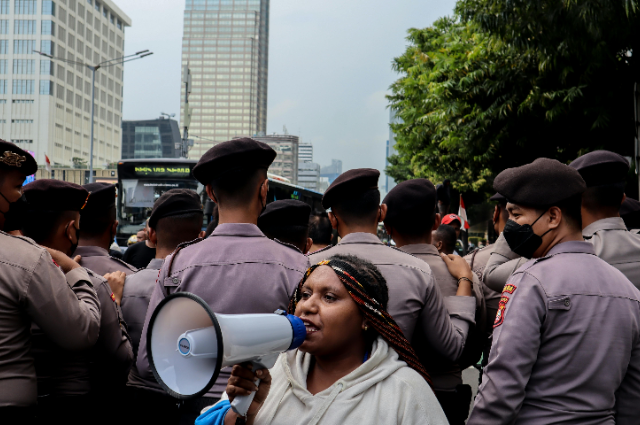
On 22 April 2026, a protest was organised by the Bhartiya Janata Party (BJP) in Worli, Mumbai. Held in support of the Women’s Reservation Bill, the march began at the Jambori Maidan and was supposed to proceed towards the Worli Dome. Thousands of women across Maharashtra participated in it, even under the harsh summer heat. This protest was meant to highlight women’s representation and empowerment.
However, what was supposed to be a gesture of support and solidarity soon became a curveball of irony.
The march took place during the peak afternoon hours, leading to severe traffic congestion in the Worli area. Roads were blocked, vehicles were hemmed in traffic for long hours, bringing the daily life of citizens to a halt. Girish Mahajan, Minister of Water Resources, Maharashtra, was present at the event and actively interacting with the media along the route. This media inṄṅṅṅṅṅteraction further slowed down the movement, turning the road into a parking lot.
Among the many affected by this situation was a local woman who was reportedly on the way to pick up her son from school. Stuck in traffic for a long time, she grew incensed and restless. In a moment that was both audacious and unforeseen, the woman stepped out of her vehicle and directly confronted the minister and the police personnel present there. She challenged their presence and questioned the disruption the rally caused in the daily lives of citizens stranded in traffic.
Someone in the crowd recorded this confrontation and posted it, and the video quickly went viral on social media.
At a glance, it was merely another inconvenient traffic jam for a local citizen commuting. But a deeper look at the situation reveals blatant hypocrisy. On one hand, a massive political rally was staged in the name of women’s rights and representation; and on the other, a woman was suffering the most from the chaos caused by it. By raising her voice and strongly questioning this disruption, she became the personification of the curveball of irony: “The Woman Who Protested the Protest for Women”
Her reaction was widely praised online. Many people saw her as a voice of the common citizen, because she spoke when others couldn’t. Opposition leaders also responded to the incident. Former state Congress President Nana Patole shared the video and criticised the protest, stating that it had caused unnecessary inconvenience for ordinary people.
This situation raises a very important question: Can a protest actually support people if it ends up making their lives even more difficult?
There is no doubt that protests play an important role in a democracy. They allow people to express themselves freely and shed light on important issues. The Women’s Reservation Bill itself is a substantial topic, as it aims to increase women’s representation in politics. Such issues deserve discussion and public attention.
But the way a protest is carried out also matters.
Studies like the Time Use Survey by the Government of India show that women spend a huge amount of time on unpaid care work, such as taking care of children and managing household tasks. This means their time is already limited and has to be carefully planned. When events like protests interfere with their movement, the burden often becomes heavier for them because it affects their schedules, their work, and their family duties.
This is why the Worli incident is so poignant.
The woman who protested was not opposing women’s rights and the idea of representation. She was questioning the method chosen to advocate for the cause. This incident pointed out the gap between political promises and real-life experience. The protest spoke about empowering women, but at the same time, it created problems for women like her who were simply trying to go about their day.
Her reaction also sheds light on an important truth: women are not a uniform group; different women face different problems and challenges. For some of them, the focus may be on political representation, while others have to worry about everyday struggles such as commuting, safety, and time management.
The Worli protest became more than just a political event; it became a reminder that the impact of such actions must also be taken into consideration.
Another important facet is the role of ordinary citizens. The woman who confronted the minister regarding the issue was not a public figure or leader. She was just another local citizen affected by the situation, and yet, her voice gained recognition because it was point-blank and valid.
This proved that speaking up doesn’t always require a position or power; sometimes, just a bit of courage is enough.
The phrase “The woman who protested the protest for women” is for sure a paradoxical one, but it captures an important idea. Such moments are invaluable because they force leaders and ministers to think about how their actions affect people on the ground and remind us that actual empowerment is not about speeches, slogans and large gatherings. It is about understanding and respecting the everyday realities of the people who are going to suffer the consequences.
Succinctly put, this incident was not about a moment of anger or the video that went viral. Rather, it leaves us with a very fundamental question to address: who do these protests and rallies actually serve? Is it really us, the ordinary citizens, as proclaimed, or are we simply a prop for someone else’s gain?
References
- Government of India, Time Use Survey: https://mospi.gov.in
- PRS India – Women’s Reservation Bill: https://prsindia.org
- UN Women – Unpaid Care Work: https://www.unwomen.org