
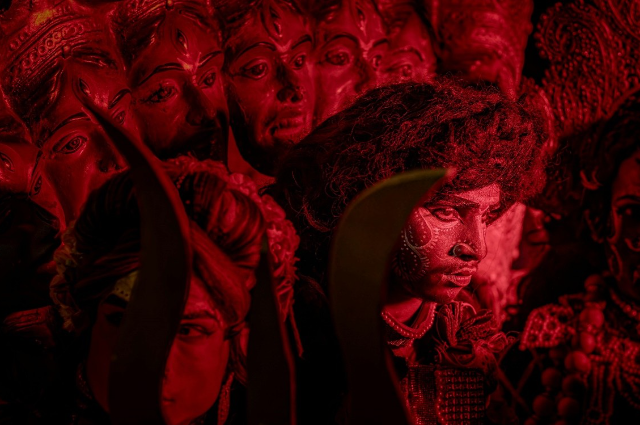
Inspired by director Rishab Shetty's early experiences in Keradi village, Kantara (2022) blends fictional tales of land disputes, ancestor pacts, and conflicts between nature and humans with the folklore and traditions of coastal Karnataka, particularly the Bhootha Kola ritual. The film explores themes of divinity, tradition, and nature versus modernity. The central conflict centres on a tribal community's spiritual link with forest deities (Panjurli & Guliga) versus a despotic monarch and later a rapacious landlord. This local god worship, a distinctive Tulu Nadu custom, is depicted in graphic detail in the movie. Performers take on the forms of spirits, such as Panjurli and Guliga, to convey messages from the divine. The conflict for land was thematically based on actual conflicts between forest authorities and people in Rishab Shetty's birthplace of Keradi.
Ritual experts from specific Tribe communities, such as the Nalike, Pambada, or Parawa communities, channel local spirits or deities (bhūtas, daivas) during an annual ritual performance known as a bhūta kōlā or nēmā. The Tuluvas of the Tulu Nadu region are heavily involved in the Bhūta cult. While a nēma entails the channelling of multiple spirits in a hierarchical sequence, the term kōla is often reserved for the worship of a single spirit. Family and village issues are addressed to the spirit for resolution and mediation in kōlas and nēmas. During the feudal era, the ritual's justice component covered both distributive and political justice issues, such as the legitimacy of political authority. The peasants received a redistribution of the produce from land immediately owned by the būta (commons) as well as certain donations from the principal manors.
Demons and evil spirits are not the focus of what the locals refer to as bhuta worship. These guardian beings are connected to families, villages, and woodlands. They lead, guard, and step in—but only for those who uphold justice and cherish the natural world. Additionally, the tales of Gulega and Panjurli in Kantara bring that ancient custom to life on television.
The story of Panjurli is incredibly touching. Legend has it that a little orphaned piglet was left behind on Mount Kailash after a wild boar perished. Adopting the piglet and claiming it as her own, Goddess Parvati was touched by compassion.
When Lord Shiva found the boar in his sacred home, he became furious and banished it to Earth. However, Parvati's devotion had already transformed the piglet into Panjurli, a celestial guardian of woods and the natural world. Panjurli bestows blessings to those who honour the earth. Panjurli was born out of love, while Gulega was born out of rage. During the cosmic catastrophe, Lord Shiva flung a stone that gave birth to this ghost. Gulega is the personification of divine justice and retribution. According to legend, Lord Vishnu himself instructed Gulega to appear whenever injustice threatened the weak. These two souls work together to create balance. Gulega makes sure that everyone is treated fairly, while Panjurli keeps watch over the land. Justice and nature coexist.
In sections of Kerala and the Tulu Nadu region of southern Karnataka, people worship Daivas. The worship of these indigenous folk deities, also known as bhuta or spirits, most likely dates back to pre-Vedic periods. The actual start of their worship has not been determined by any conclusive investigation. The classification of deities in Hinduism is based on their patronage. Some are ishta-devta, loved by people; some are gramdevta, belonging to a local community; and some are kuladevta, belonging to a clan. Daivas are referred to as the guardian deities of a specific land, or kshetrapalas.
Daivas are part of a folk culture that is separate from orthodox Hinduism; however, they are traditionally worshipped outside. During the Bhoota Kola festival, these folk deities are worshipped, and a dancer who mimics the spirit is thought to be under the deity's influence.
Panjurli, Bobbarya, Pilipoota, Kalkuda, Kalburti, Pilichamundi, Guliga, and Koti Chennaya are a few of the well-known bhutas or daivas. Originally, the daivas were revered as an unstructured stone placed in an open area beneath a tree. However, idols started to be employed for daiva worship throughout the course of centuries.
The devotion of two Daivas, Panjurli and Gulia, is central to the plot of the film Kantara. An oral tradition is the source of the Panjurli daiva narrative. In this tale, a wild boar that had died in Shiva and Parvati's pleasure garden was taken as a child by Parvati. However, Shiva chose to slaughter the juvenile boar because it became extremely destructive as an adult. However, the goddess Parvati persuaded Shiva not to murder her pet because she adored the boar. As a result, Lord Shiva exiled the wild boar to Earth, where it was tasked with protecting humans and collecting tributes. As a result, this boar turned into Panjurli, a bhuta or ghost. This myth illustrates how a local cult was absorbed into Shaivism.
Similar themes of Shiva, Parvati, and exile can be found in the Guliga narrative. From a stone, Guliga was born. Guliga was created when Shiva tossed this stone into the water after Parvati discovered it in a pile of ash. Guliga was supposed to serve Vishnu, but Vishnu doomed him to earth because of his destructive propensity. According to legend, Panjurli and Guliga clashed and even engaged in combat over the same territory, but after goddess Durga intervened, they finally declared a truce. Later on, Guliga grew to be Panjurli's close friend and even a devotee. As a result, the two daivas are worshipped jointly. Here, two local cults have united.
The yearly Bhoota Kola event, which takes place between December and May according to the Tulu calendar, is when the daiva or bhuta is venerated. A performer in this festival dances in a trance while donning a costume and makeup to mimic the spirit. It is thought that the spirit has taken possession of the actor. In the role of the spirit, the performer works as an oracle, resolving conflicts and providing answers to people's issues. During the ritual, locals from different castes and communities participate in the celebration and play particular roles. The celebration is held in the sacred area where the god is thought to live. Yakshagana is a prominent art form that is reported to have been influenced by the Bhoota Kola celebration.