
Myra could feel the pain in her legs now. Her body was begging her to stop —You can’t run anymore. But her mind screamed louder: You have to. Your life depends on it.
She remembered a reel she’d once seen of Acharya Prashant. He spoke of a hen that escaped a coop and ran right in front of his car. The owner came chasing after it, trying to catch it. Acharya was so moved by the hen’s courage that he bought it. Of all the hens in the coop, this one dared to run. He chose to support the one who dared.
That story stayed with Myra. She had to be that hen.
Her legs ached. Sweat poured down her back. Behind her, the pounding of feet— the men chasing her. Panic clawed at her chest, but she didn’t stop. She looked up at the sky for help. And, as if in answer, a large religious procession turned onto the road. Drums beat. People sang. She ducked into the crowd and vanished within it. The men were gone. She wandered into a narrow bylane and collapsed outside a broken house, chest heaving, lips dry. Her eyes scanned the street for water. Not far away, she saw a public tap. She rushed to it and drank the water like it was nectar. We take simple things like this for granted, she thought.
Suddenly, footsteps. Her heart leapt. But it was just children playing nearby. She closed her eyes and whispered a prayer.
She had escaped.
Myra had been sold by her stepfather into the flesh trade. Her biological father had died of cancer when she was little. Later, her mother married a man who pretended to be kind. But Myra always had doubts — especially after her mother’s sudden death. She now believed her stepfather had poisoned her.
One day, he brought her to Mumbai, saying they’d visit his sister. They stayed at a seedy hotel by the sea. Two days later, she understood what kind of place it really was.
So, she ran.
Myra was just 14, in Class 9, and had no money, no food, and no support.
Hunger gnawed at her. She stood near a snack stall for hours, eyes fixed on the plates others were eating from. A kind man finally noticed her and bought her an onion dosa.
It was the best meal of her life.
She knew she had to leave Mumbai. She reached Kalyan station and boarded a train to Solapur, hiding near the toilet in the general compartment, terrified of being caught.
At the next station, an 18-year-old boy got on and dropped his bag beside her.
“I’ve reserved this spot,” he said.
Myra glared.
He smirked. “Oh, so Miss India doesn’t like it? Yeh kisi ke Baap ka train nahi hai.”
Later, when the ticket collector came, the boy — Manak — paid her fine and even shared his food.
That night, she screamed when a rat brushed past her foot. Passengers glared.
Manak laughed. “Even the rat must be in the emergency room now. You scared the hell out of it! That rat must be struggling for its life in the rodent ICU."
When they reached Solapur, he asked, “Where to now, Princess? You can come to my palace. No pressure.”
She paused. Could she trust him? Her own stepfather had betrayed her. But somehow, she felt safe with this stranger.
She followed him.
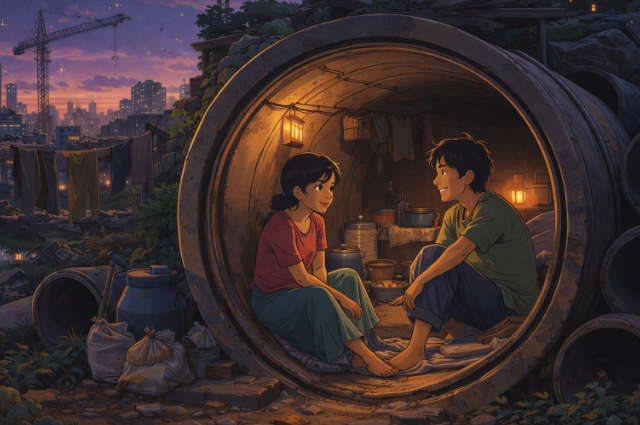
His “palace” turned out to be a large drainage pipe at a construction site.
Surprisingly, it was neat. He had a stove, some groceries, and even a separate pipe for a bedroom.
“This is the real world,” Manak said. “This is how people survive.”
She stared right in front of her. The vast illuminated city with all its contrasts stood in front of her.
That night, he cooked porridge and chutney. It wasn’t fancy, but it was warm and safe.
Later, as they lay in silence, Myra suddenly asked, “How come your name is Manak? Is it Manak , like Manak Gutkha?”
He gave her an annoyed look.
“Yeah,” he said. “My father was addicted to Manak Gutkha and alcohol. When it came time to name me, I guess he couldn’t think of anything else.”
There was a pause.
“But... I sort of like my name now,” he added, with a crooked smile.
“I like mine too,” Myra said immediately.
“That’s a bit of a Western name, no?” he asked.
“Yeah,” she nodded. “My mother once saw an English movie. The protagonist's name was Myra. She loved it so much, she said, ‘If I ever have a daughter, I’ll call her that.’ But while my father was alive, he used to call me Maya.”
Manak smiled. “Myra suits you better.”
Over the next few months, Myra did whatever she could to survive. She enrolled herself in a government school. In the mornings, she worked as a maid.
Later, she found jobs as a waitress and a receptionist at a gym. Her schedule was brutal — school by day, odd jobs in the evenings, and studies at night —but she refused to give up.
At school, she met Kuhu, a girl who stood out — not because of her clothes or attitude, but because she didn’t quite fit in.
Kuhu came from a rich family. Her politician father had admitted her into a government school “for public image,” and so he could personally monitor the facilities. But Kuhu, despite having everything, seemed oddly unhappy.
“I wish I had your freedom,” Kuhu said one day.
Myra stared at her. “Freedom? I ran from hell. I don’t even have a home.”
“Exactly,” Kuhu said. “You make your own decisions. My parents love me, but they control everything. My clothes. My friends. My future.”
“It’s always better to have parents who love and guide you,” Myra replied.
Kuhu didn’t answer.
Different lives. Different prisons. For each one his own.
It was during this time that Myra had her big idea. While commuting in trains, she noticed something: passengers often bought little things to pass the time. She talked about her idea to Manak. With his help that day, she went to the wholesale market. She began selling artificial jewellery on the train. Her pitch was sweet, persuasive, and smart.
She sold out on her first day.
Manak watched her with pride. “You’re a real businesswoman.”
They teamed up. Soon, they were selling snacks, keychains, earrings — anything with a margin. They saved religiously. Myra began sketching her own jewellery designs. "You have a knack for this designing stuff, Myra. I must say," said Manak after seeing her intricate and detailed designs.
Eventually, they applied for a government loan under a small business scheme. The loan was sanctioned.
Five years after that desperate escape, Myra’s — their own jewellery brand —was launched.
Because of its affordable pricing and unique designs, Myra’s became a hit.
They moved out of the drainage pipe and into a rented home. Life was no longer about survival — it was about growth.
One evening, Myra asked softly, “Why did you help me that day on the train?”
Manak looked at her. “I don’t know. Not everything needs a reason. You needed help. So I helped. It was like a clarion call”
They didn’t need fancy labels for their relationship. There was no need to say love, marriage or commitment. What they had was real — built on shared pain, trust, respect, and ambition.
And most importantly, they had each other — and a brand born from resilience, grit, and the belief that some people don’t wait for miracles... they run toward them.