
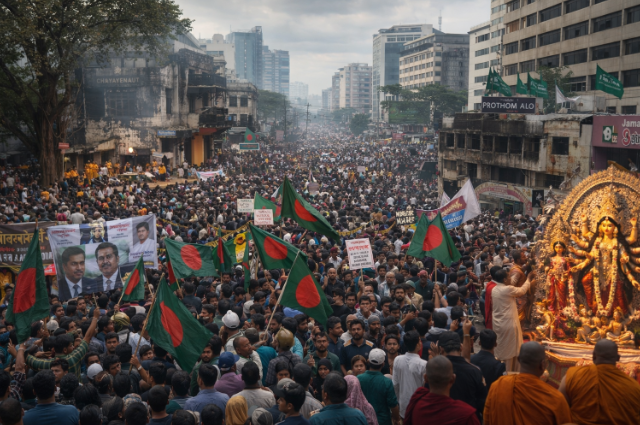
Surpassing the valley of destruction, Chhayanot again arrives at the arena of hope
Like the Phoenix bird of Greek mythology, Chhayanot was waking up from the ashes of destruction. The fire burning at the left side of main gate had died. Perhaps the killers were lurking somewhere nearby. Again after receiving some remote controlled order they would jump onto destroying the biggest pilgrimage of Bengali songs in Bangladesh, Chhayanot. In spite of that, today after crossing the border wall of Chhayanot, on the seven mosques road of Dhanmondi, the collective protest was taking a melodious expression throughout the entire Dhaka. The fire of resistance was burning with double energy here. Standing at the entrance of Chhayanot one could hear, children were singing the Rabindra Sangeet, Amar Mukti Aloy Aloy Ei Akashe, (my salvation comes in the illumination of eternity). In that hostile ambience the song sounded like the chanting of hymns. Under the sky of present Bangladesh, light had become rare to find, suspicion and horror were in the air. The dark clothed RAB battalion's jip and their temporary tent were guarding that eternal melody of the Tagore song. At the exterior, terror had emptied Dhaka and created waves of protest at the interior. On 18 December night, Chhayanot founder Sanjida Khatun's son Partho Tanvir Naved had taken away all the important official documents, old papers and preserved cultural records. He said, "In the evening the government highest authority informed, there was a chance of a raid. Few of us on that very night had left the cultural center with all the necessary materials around 01:15 am at night. And hundreds of wild marauders had attacked Chhayanot 20 minutes later. As a result they couldn't destroy the archive. We had been able to save that." Then on a quiet note Partho said, "A slight delay in our action would have stood us face to face with that wild mob. Then what would have happened, I cannot imagine today. But getting afraid won't help you. We have to save our cultural center. We have no malice against any religion."
Since 1967, Chhayanot has always been the opening venue for the Baisakhi festival on the first day of Baisakh under the famous Banyan tree at Ramna, with it's rich cache of Rabindra Sangeet, Nazrul Geeti and the songs of Lalan Fakir. On the next day, the Udichi cultural center had been raided in the same way. After that, Dhaka erupted in protests. From the entrance of Chhayanot on the seven mosques road, the length of the protest rally had reached Road NO. 27. Even after standing in three lines, the rally couldn't accommodate all the participating people. Under the open sky, people began singing in resonant voice, playing khol, tabla and harmonium. The interim administration had ordered for a probe into the looting and destruction of that night. And since then, security had guarded the centre. The general election was approaching. Anything could happen at any time. First, the total cost of destruction was estimated to be RS. 2 crores. Then after the smoke got cleared it was found that many objects were repairable. The organiser and teacher, Mominul Haque Dulu had decorated the entrance with all the destroyed musical instruments of that night. In the first week of January, 2026, Chhayanot held their annual cultural festival, Shuddha Sangeet Utsav. But according to the Chhayanot tradition, the whole night singing festival on the closing day was cancelled for the first time this year for the sake of security. "I was a student of this organisation. In those days the maximum students were Muslims. And nowadays the number of Muslim families coming to take singing lessons is shrinking. Now maximum number of students is Hindu. I think Muslim families are becoming more orthodox in terms of taking Bengali singing lessons. But is there any restriction on singing and learning songs in Quran or Hadis Sharif ? Actually that attack was aimed intimidating the Bengali national entity," informed Mominul Haque. And according to the Chief Organiser, Dulal Ghosh, "We have no affiliation with politics. We couldn't even think that this could have happened."
The Bengali New Year celebration of Chhayanot is recognised by UNESCO. But since the change of political power in 2024, the Muslim extremists have been openly opposing the celebration of the Bengali New Year. The people of this cultural periphery think that the killing of the extremist student leader, Osman Hadi was an excuse to propagate the vandalism in Chhayanot. The marauders not only destroyed all the CCTV cameras, musical instruments of this six storeyed building. They also looted all the mobiles and laptops and tore apart the photos of Bangladesh national poet, Kabi Nazrul Islam and Chhayanot founder, Sanjida Khatun, into pieces. On the same day, the extremists attacked the offices of Bangladesh's top two daily newspapers, Prothom Alo and The Daily Star. Amid the tremendous insecure and unstable time in Bangladesh, Chhayanot is writing a glorious history.
Proximity to Jamaat breaks the student union, NCP
NCP, one of the main initiators of the Bangladesh's July uprising, had been divided and a new platform was born. On 16 January, the mortified student leaders and workers had announced the birth of a new student’s party at the memorial of Bhasha Movement, Shaheed Minar. The probable name had been decided as Network for People's Action (NPA). The political experts considered this small beginning as a significant point in the political confluence of Bangladesh. This new organisation would gradually move towards becoming a full-fledged political party. The leader had the objective of preparing themselves well, so that they could fight in the coming general election. They had claimed to capture the political arena created by the sold out NCP. Because NCP was taking part in the election, by forming a coalition with Jamaat. Following this NCP agenda, many had left the party accusing that NCP had deviated from the ideology of the July uprising by indulging to the power mongering and opportunist politics. The protesting fraternity had protested against Jamaat's anti-independence doctrine in a letter. The letter stated, "The political history of Jamaayet Islami, especially their anti-independence stand during the 1971 Bangladesh freedom war, their cooperation in mass killing and their involvement in many other crimes in those days, fundamentally contradict with the democratic sentiment of Bangladesh and our party's ideology." The famous face of the July uprising and NCP's senior joint member secretary, Tasmin Jara had severed ties with NCP and was fighting the election as an independent candidate. She had informed that "after considering the prevailing situation" she wasn't being able to be with either NCP or any other political coalition. NCP's joint convener, Taznuva Zabin, after resigning from NCP told about their coalition with Jamaat, "I won't be able to die, if I compromise with this understanding." Anik Roy, who had left NCP and created a new political platform in the October of 2025, told, "After the foundation of NCP in the February of 2025, we had marched through the entire country in July. We had visited 62 districts. I still remember, when we had reached Pabna district, it was dead of the night and raining heavily. Even in that rain, people were sitting on a field waiting to see the student leaders. So much emotions and responses had been created throughout the nation then. Later, when we realised, that NCP was trying to become another BNP or Jamaat by entering into electoral and coalition politics, me and many others like me had left NCP."
In spite of roaring furiously in the beginning, why NCP couldn't establish a firm ground in Bangladesh ? Why did they have to take refuge as a weak ally of Jamaat ? The agitators inside the party pointed out many reasons. According to them the first and foremost reason was NCP's failure to create their political significance. NCP couldn't form their manifesto regarding why they were needed in Bangladesh's politics. Secondly, their organisational experience was zero. Third, the party was dependent on a handful of leaders. Fourth, NCP had quickly involved itself in the political scandals and ended up in corruption. The biggest allegation against NCP was, only 15 student leaders could not be the representatives of the three crores Bangladeshi who had participated in the July uprising and were shot and lathi-charged by police. Moreover, these leaders didn't have any coordination between them. Recently, in all the college students association elections it had become clear that the students of the July uprising had no place anywhere in the colleges. In Dhaka, Jahangir Nagar, Rajshahi, Chittagong and Jagannath Universities, Jamaat Students Camp had captured the students associations. The question remained, the organisation whose political activities were banned for the last 17 years and whose party offices throughout the country were locked all these years, how did that organisation create this kind of a wide influence among the students across the nation within such a short time? Why the revolutionary apolitical students who had later created NCP had not received the benefit of dethroning Sheikh Hasina?
Zillur Rahman, the president of Bangladesh's think tank, "Center for Governance Studies" opined, "The calculation is not that difficult. A large section of Awami League's Student League had joined the Jamaat Camp, by hiding their identity. After the change of power, they had shown their power mongering true colour. Obayadulla Qadar, the Awami League leader, used to warn repetitively about these sabotages, taking place inside Student League." Besides, Jamaat had spent huge amount of money for students association elections. There was no account about the source of all these money. As per the information, only in the Dhaka University election, Jamaat had spent 30 crore Taka which was beyond the imagination of any students association in Bangladesh. The leadership of Bangladesh's new political platform had made it clear that henceforth they would carry out their political practice through their financial strength. On the other hand, their objective would be to spread the leftist policy that couldn't raise their heads during the Hasina regime. The eradication of financial disparities and unemployment would become the central focus of their political and social discussions. With these, environmental issues would be brought to the front of the political demands, that hadn't happened earlier on. Many places like Sunamgunj were earthquake prone in Bangladesh. On geocentric and diplomatic grounds the new leadership was very much eloquent against India's supremacy culture. On the other hand, the leadership would talk to India about developing business relationship. According to Anik Roy, "Actually Jamaat wants to maintain good relations with India in order to run their business. After 2013, in order to run their business smoothly Jamaat went back foot giving the advantage to the Awami League. NCP too is walking on that same path. That's why we have thought of leaving NCP and establish a new party."
BNP aims for peace, becomes concerned about the Hindu trust on them
It was past 11 at night. Still inside the Dhanshiri restaurant of Gulshan - 1 area, there was enough crowds for mashed potatoes, fries and pullao. In the backside the crowd was thickening in the Rangpur tea stall for it's coloured tea and malta tea. Previously these shops used to remain open till late night. But nowadays the shop owners close them after 12 at night. On that night in the Tejaturi market area of Tejgaon, a leader of BNP's associate voluntary organisation was shot dead on open road by the criminals. Since the death of the anti - Indian leader of Inquilab Manch, Osman Hadi, the serial killings that had been going on in Bangladesh, had nothing to do with the murder at Tejaturi area, the government stated. But it is not difficult to sense the hidden air of terror inside the lively exterior of the city. The quiet faced Ismail who was serving at the restaurant said; "Still now there is one Awami League supporter in every household. They are in hiding. Previously after finishing the day's work we would close the shop and joyfully walk one kilometer to our houses. We would gossip while taking this walk. Now also, we walk home. But we leave during early hours. We don't make it midnight. There is constant fear. Nobody knows what can happen and when."
Today's Bangladesh is swimming between these conflicting currents - stability and terror. Since the death of Khaleda Jia, the entire Bangladesh has been overcast with a collective mourning. Still it has become clear that the coming election is not being affected by this emotion in any way. The experts on Bangladesh think some visible and invisible factor will decide the result of this general election. BNP's capital is the grassroot level support of Bangladesh's village areas. After seventeen years, in the comeback speech of Tarique Rahman, the people of Bangladesh have got dependence and maturity. That speech has worked as a solace amid this unrest. BNP is now hoping to get the voters of Awami League by their side along with 8.5% minority vote in their vote bank. All the election researches have pointed to BNP as the winner of the coming general election on 12 February.
The most important among these - in the research of Eminence Associates for Social Development, the opinions of 20000 people had been collected from 300 parliament seats. 70% people had said, they were in favour of BNP. The anti - Hasina, newly established students organisation NCP leaders including Hasnat Abdullah had always been strongly anti - Indian. In spite of creating all these anti - Indian sentiment throughout the nation, only 2.6% people had shown their support for NCP, according to the research ! 19% people had supported Jamaayet Islami. The Khaleda - close businessman Abdul Awal Mintu whose probability to become the business minister of Bangladesh was in the air, said, "A powerful circle doesn't want the election to happen at the right time. An unelected administration will be of much benefit for their vested interests. They are getting the maximum benefit out of the anarchy, the country is going through." A section of BNP thought, allowing Awami League to fight in the election would be good for democracy. Mintu continued, "Our leader Tarique Rahman said in his speech, about creating a nation with all the parties. He didn't say a word against Sheikh Hasina and Awami League. He didn't oppose India. In the past, his father, Jiaur Rahman had formed the nation with all the parties." According to him, it was not difficult to understand that putting the onus of Osman Hadi's murder on BNP and committing the murders and anarchy with that excuse was the plan for a larger conspiracy. Because after winning majority in the election, BNP wouldn't want to include Jamaayet Islami into the 'unity government'. Probably for this reason, Tarique Rahman and his party had become extra careful about the minority vote. The parliamentarian of Manikganj and the former industry minister of Khaleda regime, Shamsul Islam Khan's son, Moinul Islam Khan Shanto was holding meetings with the Durga Puja committees of his Hindu majority area. His chance of winning a ministry in the BNP government was maximum. He somehow managed time within his busy campaign schedule and said, "Here in Majhipara, the Hindus throw huge treat during poush sangkranti. But the Muslims also celebrate that occasion with great fun. I see everyone as Bangladesh citizens. These people wanted development before. Now they say, they want to sleep in peace. There are so many people in my constituency who are honest and work hard. But they have the stamp of Awami League on them. They are coming to us now, as they are in distress. We are moving ahead, taking them with us. BNP doesn't believe in the politics of murder and setting fire."
Jamaat hints at social revolution, once they win the election
Although the narrow lane of Mogbazar is called Elephant road, only one car somehow could enter the road, at a time. That too after stopping the advancing car from the opposite direction. In that lane nowadays, not only the entire Bangladesh, but the international observers also constantly kept watch on the house no. 550. After remaining closed for the last 16 years, on the 24 August of 2025, this central office of Jamaayet Islami had opened. Now that office was buzzing with the invitees coming from every corner of Bangladesh. The Jamaat cadres were controlling the traffic in the lane. "July revolution's vision was establishing the humanistic Bangladesh against corruption, discrimination, anarchy and terror. This coming election is the election of our hope. This election is against the sixteen years long fascism of Sheikh Hasina," said the joint - general editor of Jamaayet Islami, Ahsnaul Mahboob Zubair, an advocate and the former president of Bangladesh students camp. An extremely quiet man with a low voice. This Jamaat had opposed the 1971 war of revolution. According to the allegations, they were instrumental in hatching conspiracy against the freedom fighters. How they were looking at the freedom war of 1971, now ? With an unnerving voice, Mahboob said, "The 1971 freedom battle was our great achievement. And to justify that great achievement, the July uprising had taken place. The free, sovereign state had drowned into corruption and anarchy. The Hasina government had destroyed the spirit of 1971 to the maximum level by killing 1400 people."
In the past seventeen months, Jamaayet Islami had published the history of Bangladesh in eleven parts with a new explanation. Simultaneously they had condemned the minority killing. Mahboob said, "In the past sixteen years, there had been much politicisation of law and order. Police had tortured ordinary people. We are trying to say it clearly, that no leader or party workers of Jamaat was involved in the violence, took place since 24 August, last year. In 2008, after correcting our party constitution, it was declared that people from any other religion could become our member for establishing democracy in Bangladesh. In Khulna, we have nominated the business man, Krishna Nandy in the coming election. He is associated with our politics for many years. In the university elections, we have got the votes of women and Hindus because; Jamaat doesn't discriminate between Bangladeshi citizens on the basis of religion. We haven't got the chance, until now. But now, after getting the opportunity to interact freely with people, we have shown that we are not anti - Hindu." The "Nayebe Amiri" that meant the second in command, Abdullah Taher was doing the country wide election campaign. In his campaign he stressed on supporting the interests of the minorities, rising against terrorist activities and violence and keeping good relationship with India. But in between he didn't leave the opportunity to pinch the Modi government politically, "Two things have to be kept in mind regarding India - Bangladesh bilateral relationship. First, India is a vast neighbour country. That's why India should pay Bangladesh her due respect. India should not maintain it's good relations only with a particular political party of Bangladesh. Secondly, the way minorities are being harassed in India, which is also not right. We are regularly watching, what is happening in India." The Jamaat source wanted to point out, that if the torture on minority increases in India, which will create a natural effect in Bangladesh. Taher said, "Still we have no connection with the minority oppression. Ideologically we are against it. Those who have confiscated and enjoying the properties of the Hindus who have left Bangladesh, have become the Messiahs of Hindus ! You won't be able to show even one Jamaayet leader who has captured Hindu property."
At this moment, there were 4 crore youth voters in Bangladesh. Out of them, 70% was the first generation voters, who happened to be digital generation. In this situation, in terms of campaigning and making a narrative, Jamaat had left BNP far behind. They had advanced far ahead through digital campaigning. BNP was dependent basically on newspaper and television channels. But Jamaat had taken the advantage of mobile phones, to which the young generation always remained glued. Their trained propaganda team had spread in countless Facebook pages, X handles and portal pages. The Nayebe Amiri informed, there would be 'social revolution' in Bangladesh. What would be the nature of that social revolution ? Unwilling to divulge that plan, he said, "In every social sphere, there will be propaganda about our ideology and nationalism. All the academic establishments will be reformed." But the expert fraternity of Bangladesh said, Jamaat had many colours like the rainbow. Among them, one section was certainly realistic believer in democracy and well connected to the contemporary mindset. The political stand that BNP had taken in 2024, Jamaat was trying to take exactly that stand now. On the other hand, there were orthodox Islamist fundamentalists in the organisation. One section of Jamaat had admitted the mistake of not participating in the freedom war and accepted the responsibility of destroying the liberal spirit of Bangladesh. But the other powerful and influential section was not allowing that previous section to come forward. One section was in favour of the election, but the other section was surreptitiously spreading violence against it. That's why several BNP leaders who once were in alliance with Jamaat, said, "Either we have become confused after watching Jamaat, or Jamaat itself has become confused. We cannot recognise this Jamaat."
Solidarity has been created by rising above the wounds. Election approaches
Still then, pieces of broken bricks, stone chips, sand and cement had been piled up in front of the gate. Looked like the liberty of press itself had been broken into pieces. Dusk had settled on the Kaoran bazaar at a distance. The night trade, convoy of goods carriage trucks, rickshaws, hand drawn carts, tempos and the cacophony of auto rickshaws created the night time picture. "Those who were present knew how many people had come on that day to loot," said the journalists and editors of the renowned dailies, "Prothom Alo" and "Daily Star", where the offices were ransacked, set on fire a month ago. The journalists had come back from the face of death. The question of their security was so unstable that none of them were willing to reveal their names. Trembling with the fear of death amid the black smoke and fire, the night shift journalists had taken shelter on the rooftop of the buildings. Perhaps they wouldn't be in the position of talking, had the military not rescued them on that night. According to a journalist of Daily Star, "Because of this weak administration, the fundamentalist power is increasing their strength by spreading anarchy for the past one year. The attack on us was purely tactical. If secularism, freedom of speech and democracy can be crushed, then a darkness of fear will settle upon society. The battle of statement is going on now. On one side, after returning to Bangladesh, Tarique Rahman is speaking about reforming the country with stability, democracy and the people of Bangladesh. On the other hand, organisations like Ansarulla Bangla, Harqatul Jihad, Al Islami Bangladesh and Hizbut Tahrir are getting united. Although one section of Jamaayet is democratic, another underground section is the firm believer of 'destroy and mutilate' slogan. Money arrives from foreign countries. Still it can be said that this section is minority." According to the editor - in - charge of Prothom Alo, "The main aim was to cancel the general election by destroying the symbol of democracy. Simultaneously the offices of Chhayanot, Prothom Alo and Daily Star were attacked to deliver this message - establishment and government structures are destroyed. We have persevered the wounds. After we were attacked, the whole country had united in favour of solidarity. The worldwide social media had decried. The ambassadors of many countries had visited us to convey their empathy. The countrymen had also raised their voice in protests. As a result, it has become certain that the general election will be held at the right time."
Bangladesh's political observers were saying - it was difficult to include Jamaayet Islami within this group of fundamentalist marauders. Jamaayet had shown kindness in their election campaign at Dhaka. They were publicising the photo of a leader - at one side of whom there was a photo of a Chakma and on the other side there was the photo of a girl, clad in cotton saree. As if that leader had just arrived after singing at Chhayanot. At Dhaka international airport, the terrorized look on the face of Sulabha Baptist (name changed) couldn't be ignored in the context of today's Bangladesh. "Jamaayet says one thing and does another. They are showing kindness before election. Once they win the election, we won't be able to go out. Nowadays I am being compelled to tell my daughter to return home before dusk. It is not possible to trust the nighttime Dhaka. Afterwards, what will happen to our income, that's a separate issue. Already the shop owner has downsized the shop. He says, people are not reading books nowadays." A particular issue was coming back again and again in today's Bangladesh's narrative - the more powerful Hindutva was becoming in India and the more minority oppression news were coming to the public - the more opposite narratives and activities were in motion in Bangladesh. The expert lobby, think tank section and journalists of Bangladesh were saying one thing - the tendency to see Awami League and India together is being increased. Sitting at India, Sheikh Hasina and her party leaders were raising their voice about the internal matters of Bangladesh. Hasina had been granted shelter in India - that was one thing. But their point was, "If India doesn't stop Hasina from delivering speeches serially about Bangladesh's politics, whoever comes to power, the relation with India will remain complicated." The Islamist power had received another leverage after the Bangladesh cricketer, Mustafizur Rahman was dropped from Kolkata Knight Riders. From the pan shop to fish market, everywhere Bangladeshis were discussing about India's attitude towards this cricketer. The current of anti-Indian activities, the secret violence of fanatic Islamist organisations, after long gap BNP's election campaign at Tarique Rahman's return, many versions of Jamaayet, students' anger, the lack of employment, the young society reeling under the pressure of failing business - amid all these, people were discussing about the coming general election on roads, in the lobbies of five star hotels, in shanties. The Bangladesh general election was approaching on 12 February.
Life goes on beyond discrimination in one Bangladesh village
Besides the village, from Araicha river bank, the river Kali Ganga flows up to the nearest Dhaleshwari River. Previously there was roaring business of pepper and mustard through this river root. Today, legendary anecdotes can be heard about that glorious history throughout this rustic settlement. After crossing Khilji road and Mirpur, one reaches the huge bus stand in Gabtoli. From here Bangladeshis embark on their journey to the West Asian countries. Crossing this bus stand there is Araicha road. On both sides papaya, gourds, brinjal and mustard are scattered throughout the cultivated land in green and golden hues. This Singair sub - district of Manikganj district feeds potatoe, brinjal and corn to the entire Dhaka. Legend has it - Queen Elizabeth had become so happy after tasting the molasses of Singair that she had sent certificate of merit to Singair with the special seal of British lion on it. - The tradition of that 'hajari molasses' is still going strong today in Bangladeshi sweets, rice cake and milk pudding. One has to see, in order to realise the affection of Bangladesh's soil.
At a time when the narratives of minority oppression in Bangladesh is depriving the South Block of it's sleep at night, this Manikganj stands as an oasis in the desert. Here harmony is in the very soil of it's history. On a roadside, Jalebis are being fried on an oven. At a distance, there is Joymantap bazaar where in the nearby low land, Joymantap premiere league cricket match is going on. Hindus and Muslims together are showing their cricket talent there. Not only in cricket, in the course of daily life also, Ram and Rahim share the counter from the same bidi, here. BNP has a permanent foothold here. Jamaat has almost no existence. During the long rule of Awami League also, the BNP vote bank has remained intact. The nerve centre of Singair revolves around the Shiva temple of Guru Vaishnav Gossain, built during the beginning of the 17th century. At the east of a huge field, stands this temple, at both sides of which stand another Shiva temple and a Durga temple. Every day pujas are held in those temples. During Poush mela, Kalbaisakhi mela and Durga Puja, so many people arrive even from miles away that the field becomes jam packed. A permanent motel has been established for troubadours and saints at one corner. According to the local BNP nominee, Moinul Islam Khan Shanto, small Muslim traders do good business during the Hindu festivals. His father was a trusted minister of Khaleda Jia. People in the village bazaar often talk about the philanthropy of that person in the area. The local Sajal Das and the nephew of Moinul, Aminul say, "On the 5th of August, 2024, when the upheaval was going on throughout the country, I had arranged a community kitchen in this field for all the people, irrespective of religion. People had mixed dal - rice dish for days. It was like having a festival of our own. Remember, at that time there was no government in the country. But here the foundation of communal amity was so strong that nobody needed to worry about any trouble. Whereas in the rest of the country, the situation was worst. The fire of violence could have spread here too."
During Muktijudhdho or the liberation war, the Khan army had bombed and burnt houses in Ramnagar, two kilometres away from here. That time, the then BNP candidate, Shamsul Islam Khan (the father of today's Bangladesh industry minister, and BNP candidate, Moinul) provided shelter to the oppressed. At his initiative, the Hindu temples were guarded. The retired agriculture ministry employee, Dinesh Chandra Halder said, "The area used to remain tensed. Radio used to relay the war news. Then one day, news had spread from one house to another that our country had been liberated. I was too young, couldn't understand that much. But I still remember, everybody was rejuvenating. People were giving treats to one another with sweets on road. People here treated Bangabandhu with respect."
BNP candidate, Shanta discusses with the local Durga Puja organising committee. He has received the support of the entire Hindu vote bank following his father's goodwill. The puja council's general secretary, advocate Itirani Saha tells about the Muslim's participation in the Puja. She in her lifetime has not seen any act of violence in this area. But this is an exception. She says, "As feeling of inferiority is in our mindset, Hindu oppression is also the general habit of Jamaat. Hindus cannot speak freely in most of the places. The fanatic leaders of other organisations take the advantage of that. In districts like Chittagong, Mymansingh, Rajshahi, Srihatto, Hindus are in panic. This has not only happened in this administration. During the Hasina administration, there was no dearth of Hindu oppression during Durga Puja. During the Awami League regime, in places like Kumilla's Nasibnagar and Kushtia's Avaynagar Durga idols had been broken into pieces and copies of Quran Sharif were left inside those Durga shrines."
According to the government record, at present 4,500 temples are there in Bangladesh. The actual number is more than that. 34000 Durga Pujas are celebrated. Many celebrate puja for receiving the one time government grant of Taka 20000. Local political representatives also donate money. In the sub - district of Manikganj, there are 150 temples. According to Sajal Das, even in 1971, Durga Puja was celebrated here. During winter, dusk falls quickly in these villages filled with ditches and ponds. Concrete houses are maximum. Chickens and ducks play around the small yards. Rows of Hindu and Muslim houses stand at the opposite sides of the same wall. The two sides remain busy quarrelling with each other regarding daily life matters. But no difference arises surrounding religion. During trouble time they stand by one another. Small lootings and stealings are daily routine. But nobody gives any religious narrative to those regular crimes. On the huge playground of Manikganj, Bairagi Bhawani Charan wearing saffron clothes says, "I have been staying here for 25 years. Hindus and Muslims together organise all the pujas here. There is ample food supply. I am happy to be here. People like Masoom Sheikh and Ghanshyam Saha sell imitation ornaments, they fetch from Dhaka, during Shiv Ratri and Charak Fair. Thus, good days come into their lives. The general election result will bring no change in the lives of these ordinary people.
Delhi plays Hasina speech in open forum
"Bangladesh stands at the edge of an abysmal deep"- exactly this way, the Awami League leader and the former Prime Minister of Bangladesh, Sheikh Hasina had explained the prevailing condition of her country at a programme, "Save Democracy In Bangladesh" at the Delhi Foreign Correspondents Club. For the last one and half year, during her sojourn in India, she had been delivering her speeches from time to time. But for the first time, Hasina's speech was played openly in a programme held in India. Md. Yunus and his administration had repeatedly complained that Sheikh Hasina had been delivering instigating speeches from India. New Delhi needed to stop that immediately. Hasina said, "Our quiet, fertile land has turned into wounded, blood stained field today. In truth, the entire country has turned into a huge prison house, a valley of death." In her acerbic tone she held Yunus as the sole responsible for this situation, "Amid this destruction as people try to survive, their cry for help can be heard. A desperate cry for survival. The murderer, fascist Yunus - a lone - shark, money launderer, looter, corrupted, power monger, traitor - with his all - devouring policy, he has sucked the blood of our nation and desecrated the soul of our motherland." Hasina had made five demands for the interest of the nation - first, the democracy has to be re - established through dethroning Yunus. Secondly, the act of violence taking place on the open road, have to be stopped. Thirdly, for the minority women and the marginalised communities, security has to be ascertained. Fourth, the politically motivated legal harrassment of the journalists, Awami League workers and other opposition party workers, in order to silence them, intimidate them and imprison them, have to be stopped. And finally, the United Nations will carry out an impartial investigation into the atrocities that have happened in the last one year, throughout Bangladesh.
Besides targeting Yunus, Hasina had also attacked BNP. She had reminded that she had never banned BNP during her regime. Hasina made the appeal to the people of Bangladesh in the troubled time - "In this time of terror and crisis, the nation will have to unify and get revitalised in the spirit of the liberation war. In order to restore and re - establish the Bangladesh constitution, which was written with the blood of the martyrs, the valiant sons of Bangladesh will have to overthrow this puppet administration which is acting on behalf of foreign interests, at any cost. We will have to reclaim our freedom, reinstate our sovereignty and resurrect the democracy."
80 minority candidates fight in Bangladesh national election
In the forthcoming parliamentary election of Bangladesh, 80 candidates from the religious and ethnic minorities were taking part. Among the political parties, the Communist Party of Bangladesh (CPB) had nominated maximum 17 minority candidates. Out of 80 candidates, 10 happened to be women candidates. On 12 February, the Bangladesh general election was about to be held. The nomination filling was completed. BNP, Jamaayet Islami, Bangladesh Socialist Party, Bangladesh Socialist Party (Marxist), Biplobi Workers Party and other political parties had nominated 68 minority candidates in this election. 88 persons from the minority groups had revoked their nomination forms.
Several minority organisations had warned, if the administration didn't ascertain the minority security, they would boycott the general election. The minority organisations had expressed their dismay at the low number of minority candidates. Nirmal Rosario, the President of Bangladesh Hindu, Buddhist, and Christian Unified Council said, "As long as the minority people cannot take part in the political decision making process, their right, development and existence cannot be protected. Minority organisations need more opportunities in political programmes and elections."
Buddhist independent candidates are being threatened with life before election
In Rangamati constituency, the independent Buddhist candidates, the indigenous Pahel Chakma and in Khagrachhori constituency the indigenous independent candidate, Dharmojyoti Chakma is being constantly threatened. Also the supporters and party workers of them are being threatened and intimidated too. According to their demand, the Highland Chittagong People's Solidarity Committee (PCJSS), under the leadership of Jyotirindra Bodhipriya Larma, the chairman of the Highland Chittagong Local Council, is giving these death threats. This is a government supported armed organisation. Moreover, an NGO has complained, in Dudukchhara area of Logang union of Khagrachhori district, the Bangladesh army has deployed 75 armed cadres of PCJSS since 29 January. The independent candidates allege, the pressure is being created in such a way on the indigenous communities so that they vote only for BNP, Jamaayet Islami and Jatiya Nagarik Committee. The police have remained inactive. The director of Rights and Risks Analysis Group, Suhas Chakma says, "PCJSS is a government sponsored armed organisation. On 5 June, 2025, 13 PCJSS cadres were arrested in Agartala, Tripura. On 5 September, while delivering the verdict of a 2013 case, the Guwahati High Court had declared PCJSS, a terrorist organisation. The houses of Hindus and Buddhists were set on fire after locking them from outside. In Chittagong's Mirsarai and Raujan area, the maximum number of Hindus was burnt to death." From 1 December to 31 January, 16 Hindu houses, temples and assets were burnt to ashes in Chittagong's Mirsarai, Raujan, Ferozepur and Sylhete. Suhas claimed, immediately international observers should be sent to Rangamati and Khagrachhori. On 30 January, the MD. Yunus press department had informed that among the bilateral observers groups, Malaysia was sending the largest group of 14 observers. Besides, from Indonesia 5, from Japan 4, from Pakistan 3, from Bhutan, Maldives, Philippines, Jordan, Georgia, Russia, Kyrgyzstan and South Africa, 2 observers from each country and from Sri Lanka, Iran and Uzbekistan, 1 observer from each country were about to arrive.
Once 97% of the highland Chittagong population used to be the Buddhist Chakma and other Buddhist clans. But nowadays, the population had come down by 50%. In the Sakya Sammelan held recently in Kolkata, one of the organisers, IBMR professor, Mrinal Kanti Chakma said, "Several NGOs are working in the highland Chittagong, financed by the United Arab Emirates. And they were directly applying their forces to evict the Buddhists." Since the change of political power in 2024, the torture had increased many times more. The mendicants and pundits had expressed their collective fear - if the hardliners come to the power, then the Highland Chittagong Laws, 1900 would be cancelled. And the peace treaty that was signed between the adivasi rebellion group and the Sheikh Hasina government would be withdrawn too. As a result, the Adivasi groups would be deprived of their constitutional rights. The erstwhile Chancellor of Nalanda University, Avay Singh had asked help from powerful countries like Japan and South Korea into these matters.
Hasina will decide when she will return to Bangladesh, says S. Jayasankar
For more than one year Hasina has been staying in India. Although the Yunus administration had sent two letters regarding the extradition of Hasina, to the Indian government, the government had not paid that much attention to those letters. On 6 December, the central foreign minister, S. Jayasankar had informed, this matter was entirely Hasina's personal decision. She would make the final decision after studying the situation of her country. On that day, Jayasankar was asked; will Hasina stay in India as long as she wants ? He answered, “She came here under special circumstances. I think the situation of that time had made it clear, what had happened to her. But once again I am saying, this is such an issue, where she herself will have to decide about returning to her country." Since MD Yunus and his administration took over the power, one after another litigation had been filed against Hasina and her powerful family members. In Bangladesh's international tribunal, Sheikh Hasina had been sentenced to death for carrying out the mass killing. The order had been given to confiscate her entire property and use the same to pay compensation to the families of the deceased and injured in the July uprising. Regarding the current relationship between India and Bangladesh, Jayasankar said, "We have heard, the current administration was having trouble with running the upcoming election. If election be the issue, then first and foremost let there be a free and fair election. We pray for the welfare of Bangladesh. Like any other democratic country, Bangladesh also wants to hold the reflection of it's people through a democratic process. I hope whatever be the outcome of that democratic process that will maintain the symmetry and become fruitful for the bilateral relations. I hope the present situation will become better." On 6 December, 1971, India had recognised Bangladesh as a liberated state. Reminding that, the joint - general secretary of Awami League, Bahauddin Nachhim said, "As the first nation, India's recognition of Bangladesh as a liberated state was a historic and far - sighted event." In his statement he pointed to the interim administration's anti - Indian activities, "After being enriched in Pakistani line of thinking, spoiling the friendship with the huge neighbouring state and historically proven genuine friend like India will not bear any fruitful result for Bangladesh."
Are the terrorists of 26/11 Mumbai attack hiding in Dhaka?
Since the change of political power in Bangladesh, Dhaka and Islamabad were getting much closer. The current interim administration of Bangladesh had decided to relax the visa formalities in order to make the relation between the two nations, more friendly. Direct flight had resumed between Bangladesh and Pakistan. According to the Indian detective sources, several Pakistani terrorist organisations were using these facilities for their own purposes. The detective department claimed, probably few among the terrorists of 26/11 Mumbai raid had arrived in Dhaka. Owing to the latest visa relaxation, it had become much easier for the Pakistani terrorists to travel to Bangladesh. From the Indian security experts to the diplomats, everybody had expressed their concerns over MD Yunus administration's silence over this matter. And no official statement had been made on this matter either by the Biman Bangladesh authority or the concerned government department. According to sources, on 30 January, from Jinnah International Airport of Karachi, the BG342 flight of Bangladesh Airlines had carried 113 passengers and landed at Dhaka's Hazrat Shah Jalal International Airport at 04:20 am in the morning of that day. The allegation had been raised that on that flight at least 11 Lashkar militants had arrived in Dhaka. On social media, the pictures of few Pakistani passports had been posted. In those posts, it was mentioned that terrorists going by the name of Ibrahim, Maij Ullah, MD. Rosul and Mukammil had arrived in Dhaka. Indian source had claimed that among them, few terrorists involved the 26/11 Mumbai raid could also be present.
Indian security experts said that since Bangladesh had become an open ground for Pakistan's spying agency, ISI, it was natural that Pakistan's terrorists would travel to Bangladesh. Even according to one security expert of Bangladesh, "Presently, ISI has great influence over Bangladesh military. Taking this opportunity, through using their terrorist organisations, Pakistan is finishing their ground work in Bangladesh. Based on which, ISI can increase their anti - Indian activities in future." Since the beginning, Awami League had complained that terrorist organisations had active participation in the July - August uprising of 2024. Besides, in last October, alarm had been raised about Pakistan's Markaji Jamiyat Ahole Hadid leader and the close associate of Hafiz Saeed, Ibtisam Elahi Jahir's tour of Bangladesh, especially it's border districts. According to the security analysts, this situation could be a matter of great concern for the security of India's eastern border and Bangladesh's internal security also. Bangladesh's diplomatic department's logic was, in the name of reformation, the current administration was putting the country's security in the mouth of danger.
Jamaat eyes good relation with India in election manifesto, BNP aims a corruption - free nation
Jamaayet Islami, about which India was tensed, has mentioned about building friendly relations with India in their election manifesto. On the other hand BNP has stressed on controlling corruption and maintaining the law and order. The BNP chairperson Tarique Rahman has talked about building transparency and show causing the lawbreakers in the administration. Tarique said, it has been mentioned in their manifesto that justice would be delivered against all the crimes that had been committed during the 2024 uprising and the fascist regime. Tarique said regarding the liberation war, "We had seen how the attempts had been made to turn the liberation war into the personal property of a particular family and their party. So the memories of the liberation war should be preserved impartially."
But irrespective of all the good things written on the BNP and Jamaat manifesto, the "Hindu, Buddhist, Christian Unity Committee" cannot be certain about the security of their lives, profession, property and honour of their women. The committe says, this insecurity will discourage their people from casting their votes. In their statement the unity committee holds the government, administration, election commission and the political parties responsible for their anxiety and said all these concerned authorities should take bold steps in order to better this unwanted situation. The committee said, "The election is only few days away. Still now, like the previous year, the ethnic violence is going on. Within the 27th of January this year, 42 cases of ethnic violence have taken place. Out of this, 11 murders were committed. Minority people, especially their women are constantly living in fear. Minority business men cannot run their business peacefully. In this kind of a situation, minority people are searching for a safer place."
Silently Jamaat arrange their election dice
Jamaayet Islami is about to give a hard competition to the BNP in the forthcoming national parliamentary election on 12 February. The political analysts of Bangladesh believe that in the campaign tactics, Jamaayet Islami has left all other parties behind. A large section of the analysts claim, in the battle of election, Jamaat is no less powerful in terms of using financial and muscle power. According to the source, after targeting particular seats, Jamaat is fighting an all-out battle to win them. The opposition complains, Jamaat won't refrain from booth jamming and bringing in false voters. Jamaat has nominated 266 candidates in the election. The source says, they have been preparing for the election since the October, 2024. Out of 266 seats, Jamaat has finally targeted 162 and simply made a nosedive to win those. Their male and female workers are campaigning door to door throughout the country, especially in the rural areas. They are collecting the mobile numbers and national identity numbers of the grass root voters and economically deprived voters. Other parties complain, in order to capture those vote bank by influencing them, Jamaat is collecting all these numbers. According to a professor who cultures politics, "It is being heard that Jamaat has spent almost Taka 50 - 100 crores in each of their preferred 162-188 seats. They are even bearing the major chunk of their alliance parties' campaign expenses." The opponents complain, since the morning of the election day, large number of Jamaat workers may gather in the ques outside the voting centres, so that the voting procedures slow down and BNP supporters cannot caste their vote.
Since the change of power, as Jamaat silently has strengthened their organisation, simultaneously they have been successful in deploying their like-minded candidates in powerful positions of the administration. The Ansar - VDP members will be in charge of the security in the voting centres. Many have complained that in a shrewd tactics, it has been ascertained to deploy 15 Jamaat workers in every voting centre for the security purpose. Besides, words are doing the rounds that pro - Jamaat candidates will be deployed in the positions of DC, SP of the police, sub - district executive officer and OC of the police stations. Further complains have come that since the beginning Jamaat has recruited their candidates in the school committees, because the voting centres will be controlled by the school committees. So the presiding officers and polling agents, selected from those committees, will be able to influence the voting. It has been suspected that a large section of the army officers are pro - Jamaat. The complaint has been raised that the GOCs of the Bangladesh army's Jessore, Rangpur divisions and in the minority villages of Khulna have already pressurised the voters to vote for Jamaat. On the condition of anonymity an election analyst says, "For a long time, Jamaat has been arranging their dices, targeting this vote. When BNP was busy attacking the Awami League workers, Jamaat had silently carried out their activities. Out of the 30-35% Awami League voters, if 10% goes to vote, they will vote in favour of Jamaat. And there, Jamaat can breathe down BNP's neck."
Bangladesh army arrests journalists from newspaper office
Again news media was attacked in Bangladesh during MD. Yunus' regime. On 7 February, around 09:30 pm, the editor of Bangladesh Times, Sabbir claimed on his Facebook live, that in the evening of that day, people arrived in two cars at their office and introduced themselves as the Bangladesh army members. Then they picked up 21 journalists who were on evening shift, to the Uttora army camp. Sabbir informed that during the interim administration they had enjoyed a lot of freedom of the press. But on the threshold of the parliamentary election, this kind of raid in the newspaper office had set a bad example. Because as a registered news media, Bangladesh Times was well connected to the army media ISPR. Sabbir said, they assumed that this raid was carried out regarding defence related news that was published in their newspaper recently. But in that case also, there was particular protocol to communicate with them. That army related comment was posted on 6 February during the violent agitation of the Inquilab Manch protesting the killing of the militant student leader, Osman Hadi. In the night of 7 February, in a video post on Bangladesh Times Facebook page, a journalist informed that few of them were released. Three journalists were still inside the camp. The released journalists were still waiting outside the camp. Another journalist claimed that following a misunderstanding those arrests were made. Later, the newspaper informed that all of the detained journalists were released. In the name of the army, this kind of activity by some over enthusiast para military personnel was condemnable. Few days ago, the offices of the country's two leading daily, Prothom Alo and The Daily Star had been vandalized too.
Deployment of army to control the election. Administration's impartiality in question
From 8 February, army and the other security forces have begun maintaining the law and order throughout Bangladesh. More than 1500 executive magistrates will execute their duty on the day of election. But already the complain has risen that the national security structure is being used as a weapon to influence the results of the election. Mainly Ansar and Village Defense Party (VDP) are being used in this activity. The election commissioner, Abdur Rahmanel Machhud, before and after the election, for seven days, more than 9,70,000 army personnel will be in charge of the country's law and order. Among them, the maximum personal are from Ansar and Village Defence Party. But according to a section of the administration, the director of Ansar has recruited 3300 persons from students league and Hizbut Tahrir into Ansar. Besides, according to the allegations of several sections, almost 3000 more Ansar battalions have been recruited. In this connection, VDP's impartiality is being questioned. On the day of election, the activities of Ansar will be monitored through the AVMIS software. But several departments have alleged that using that software, secret orders will be sent to the voting centres in order to disturb the process and create mayhem.
One section has allegedly said, this concerned director of VDP has always been loyal to Jamaayet Islami. Even the director has appointed three army chiefs by going against the deputation of the Home Ministry. It has come to the public knowledge that the silent support of the higher authority of the administration is behind the director. A police officer who has carried many election duties, said, "Guarding the voting centres, securing the ballot, maintaining the law and order on the election day - if all these important matters are questioned, then naturally, people question the legitimacy of the election procedure."
9 February - Insecurity hides within the anticipation for election
After three days Bangladesh is going to hold it's 13th national election. The whole country is thrilled with the election fever. But amid this, an air of uncertainty rules everywhere. From the tea shop of the clumsy lane of Kaoran bazaar to the coffee house of aristocrat Gulshan 1, everywhere the argumentative battle is going on between manifesto versus manifesto, narrative versus narrative, secret conspiracy versus open proclamation. In Palton, the ancestor of his ancestral chemical business, Mojammel Hussain Pintu used to be a member of BNP student party. Presently, after his business has flourished, he doesn't get the time for active politics. But still he keeps an August company with the top leaders. He says, "The more you travel in this country, the more you will witness the fight between the manifesto of Jamaayet Islami and BNP. Although both are talking about ending the corruption, employment of the youth, security for the minority and purification of politics. Still there is a fine difference between the two. Jamaat is talking about bringing an overall change of the country by reforming all the government departments. On the other hand BNP is putting stress on repairing the damages in the system, rather than changing it. Reviving the parliamentary democracy, establishing vigilance in every government department, strengthening the election commission, bringing back the constitutional political culture - the chairman Tarique Rahman is talking about these things."
The election office of BNP on the road no.90 in Gulshan 2 area has become their head office now. The crowd of the nomination expectants has died down. Only several opportunist business men, die hard party workers, student groups, leaders of many statures and middle men are loitering in front of the office. In a nearby shop, posters of Jiaur Rahman - the father of Tarique Rahman, Begum Khaleda Jia, Tarique Rahman and badges with the symbol of grain of rice drawn on them, are being sold. From the app cab driver to the many members of the election committee of the party, all are saying, Tarique has changed the model of the election campaign. Still now BNP is the front runner in the survey. By the average result of all the surveys, BNP is leading in 160 seats. Besides, his coalition with Swatantra Party and other small parties can possibly win 200 or few more seats. But owing to Jamaat's powerful IT cell, scandals of several BNP leaders are being exposed every now and then. Besides, in 60-70 seats, BNP candidates are having problems with it's allies. Because BNP and its allies, both have nominated candidates in those seats. So in between this tug of war, Jamaat has a chance to become benefited.
A nationwide anxiety about the result of a three cornered situation is hovering across Bangladesh. Several persons in the interim administration and few other organisations, which control the extremist mob, are trying to increase the seats of Jamaat. Hizbul Tahrir is openly postering in support of the fundamentalism. They are also very much active on social media. Another question is who are supplying the financial support to the extremist organisation like Inquilab Manch ? People who came to Dhaka for the sake of profession are returning to their districts by diesel run trains. From 10 August, there will be public holidays till 13th, in the country for election purpose. People are going back to their home towns to caste their vote.
10 February - Dhaka watches election frenzy like Eid celebration
The overall election campaign is going gaga in Dhaka. On main roads, small election speeches are being delivered from matadors. But from 10 February, as per the election commission order, the election campaign has stopped. Still, in the interior places, campaigns are going on surreptitiously. In an interesting way, party campaigners are avoiding long speeches. Rather, they are mentioning only their beneficial agendas and then are moving to the next place. In all the points on roads, just like Kolkata, there are small gatherings where discussions about the election are going on. The date business man, Selim Jahid who imports dates from Saudi Arabia, says, "The atmosphere is like Eid. Also holidays are going on. After a long time, election is being held. People also wanted a change. All these have resulted into this celebration like mood." During the general elections of 2014, 2018 and 2024 there were no excitements surrounding the votes. The results were settled even before elections. But now, even amid the silence of the aristocrat area, slogans are flowing from rickshaws, "Don't surrender your country to the hands of the religion businessmen," "Caste your vote on the grain of rice symbol, in order to defeat those who opposed the freedom of 1947 and 1971." From all these, it seems that BNP should come to the power. The minority support is behind them. A large section of Awami League has also become pro - BNP.
A large section of the Muslim leaders have stepped forward in order to prevent Jamaat. Hifazat E Islami, the Kaumi madrasas and even the highly respected Khatib of the national masjid Bayatul Muqarram are against Jamaayet Islami. These establishments have meaningful influence on the pious Muslims of Bangladesh. The election commission has banned creating graffitis. So the parties are using banners and flexes. But the complicated enigma of this general election is, a strong influence of Jamaat is invisibly working in the country. Many experts and analysts think, there will be the difference of 25-30 seats between the elected party and the second place holder. According to the president of the Bangladesh think tank, Center For Government Studies, Zillur Rahman, "In the last one and half year, the first thing that Jamaat has said to the people was, 'You have persevered the corruption and dictatorship of Awami League and BNP. Then can't you give us one chance ?'" The general secretary and the media cell in - charge of Jamaayet Islami, Ahsnaul Mahbub Zuber is meeting the press in the morning and evening. He says, "Time and again we are telling to the election commission that having a lopsided support towards a particular party won't work. The nation won't tolerate that. Huge weapons are in the hands of the terrorists. Those who were in power previously had distributed these arms. These arms have to be recovered. So that the people don't panic during the election." In answer to what kind of message they have conveyed to India in their manifesto, he says, "India is not only our biggest neighbour; they are also responsible for our overall development. We want to solve the bilateral problems with India."
The meteoric rise of the Jamaat candidate for the post of prime minister
Shafiqur Rahman, a doctor by profession, who was an unheard figure until 2024 July uprising, has become a much known face all over the nation, and fighting head on with Tarique Rahman for the position of the premiere. Beginning his political career by joining the Leftist student organisation, Shafiqur later joined the Islami Chhatra Shibir, the student wing of Jamaayet Islami. In 1984 he officially joined Jamaayet Islami. In 2020 he became the chief of Jamaayet Islami. Since Hasina's ouster Jamaat has sponsored Shafiqur as their official face. He has travelled the country extensively during the past one and half years and built communication with the common people of Bangladesh. Thus, even two years ago, the person about whom people of the country haven't heard anything, has become a prominent political leader.
11 February - Gen Z hopes for new tide of employment and fruitful governance
Almost 28% of Bangladesh population is between the age limit of 15-29 years. So their opinion on ballot will make a lot of difference in this national election. According to the youngster, Farhan Sadik, "This election comes from the July 2024 movement. If candidates think, they can do politics the old way, that won't work." The government and politics professor at Jahangirnagar University, Shakil Ahmed says the young generation is "looking for a new political class to take charge. Since the newly formed party has not provided a broad - based political platform, the BNP is expected to be their preferred choice." The University of Dhaka professor Asif Shahan says about the young voters, "It may not be decisive, but it will certainly give Jamaat a significant boost." The 24 year old Monika Akhtar, the first time voter from Bogura district says, "I expect the new government to understand young job seekers like me. We need a fair and transparent recruitment and exam process. Especially National University graduates - we suffer the most." The 21 year old Mohammed Muniruzzaman says, "About 86% of National University students are unemployed - that's really painful. We don't want to finish our studies and remain jobless. We need IT based education, so we can compete globally." The 22 year old journalist, Mohammed Saimum Jahan, while talking about the freedom of speech that had become almost forbidden during Hasina's regime, says, "We couldn't speak freely during the fascist period. Whoever comes to power, we need freedom of speech - even to criticize the government."
Calculations are on about who will bag the Awami League vote bank
In a press meet today, Amir Shafiqur Rehman of Jamaayet Islami has sent a message about strengthening relationship with India, to the Indian press delegates in Dhaka. Not only that, he says, he doesn't believe in the word, 'minority'. He and his party do not believe in 'second class citizenship.' His objective is to 'move ahead taking everyone along with'. Although it was not possible to nominate female candidates, he assures of nominating female candidates next time, "How can I be misogynist ? I have a wife and two daughters." Whereas this Shafiqur Rehman very recently has commented in his X handle, "When women in the name modernism, venture outside to earn money that becomes synonymous with prostitution." In spite of their weak vote bank history, the way Jamaayet Islami is becoming powerful in social media and political narratives that make even the election experts confused. A political expert, on the condition of anonymity says, "Nearly half of the fake social media accounts belong to Jamaat. For the past one and half year, they have received the blessings of the interim administration." BNP claims, at present, 70% of the police, military and administration are Jamaat supporters. They are able to silently hide their identity inside other parties. Jamaat has captured the university students union of five universities. Because for a long time, Jamaat members remained inside the Students League, Awami League's students wing. Nobody could even realise that ! Now, whether Jamaat members are hiding, in the disguise of BNP members within BNP itself, has become a matter of concern for a large number of BNP members. BNP has also claimed that instead of talking about building good relations with India, Jamaat has supported the anti - Indian narrative of recent times.
For the time being, the Awami League vote bank is going to be the decisive factor in the election. News has come that in Dhaka, most of the Awami League supporters won't even go to vote centres. But village holds a different picture. Like the village panchayat in India, Bangladesh has 'union parishad' in villages. Comprising of 9 wards, each union parishad includes 15 - 30000 people. Jamaat and BNP are pressuring the chiefs of those union parishads to send maximum number of voters to the vote centres. The worried chiefs inform secretly, if they don't send those voters, false cases will be filled against them ! There was no union election in the last one and half year. Although the interim administration wanted that, BNP had put veto on the same. So all the existing union chiefs were elected during the Awami League regime.
Hope for good times
Shimulia ferry ghat is in Louhojung sub - district. This ghat, the adjacent shop, the bus depot, tells the story of a lost Bangladesh. There is suppressed longing for Awami League here. But by and large, the Padma riverbank area is with BNP now. The owner of the hair cutting saloon near the Gulistan Soap Opera bus stand, Mojammel Sheikh says, "The largest darkness stays under the burning flame of lamp. Previously people used to go to 24 districts like Khulna, Borishal, Jessore, Faridpur, and Satkheera after taking ferry from several ghats here. Even before going to Kolkata by crossing Benapole, people used to stay for one and half day over here. That way, this area used to have good business. Now everyone goes straight to the southern side by taking the bridge. Nobody stops here. So the Padma Bridge has been a blessing for the southern side. Not for us." Some people always pay the price for others' prosperity. But after the construction of the bridge, the navigability of Padma has decreased, sandbar area has increased and people complain that the interim administration has not taken any dredging initiative in the last one and half years. The local Moidul Mian says, "Once we had 120 fishing trollers. Now that number has come down to half. Before Awami League government used to continue the dredging. Now the wealthy business men have taken over the sandbars. If we want to make a move there, they drive us away. When BNP's Abdus Salam Azad came to ask for our vote in Munsiganj 2 seat, we have made this demand. Hope he will keep his words after winning the election."
Jamaayet Islami has no ground in this area. The candidate who is fighting with the Shapla flower symbol of NCP is completely unknown to the locals. No news of Hindu - Muslim feud can be heard in Maola Ghat. Row of restaurants serving popular hilsa dishes stand by the side of the main road beside this ghat. Nowadays they complain, their customer frequency has decreased. "People have lost their enthusiasm to travel all the way to the riverbank to eat fresh hilsa, owing to the tremendous unrest in Dhaka in the past one and half year. Besides, the job insecurity has stopped people from spending for recreational purpose. Lots of Indian tourists used to come here. That number has also declined. Tomorrow morning we will go to vote with the hope that our past good days will come back to us," says a restaurant manager. For few generations, Hindus are running the business of fish warehouse and fish supply here. Just beside fish warehouse, there is Daspara. This clumsy area is neither a suburb, nor a village. RadhaKrishna temple stands at the middle of the settlement. Just like the Awami League before, BNP also eyes the 5000 Hindu votes of this area. And in the struggle for survival, these Hindus also keep changing their political loyalty. The fish seller Niranjan Das says, "We have to maintain the rapport with whoever is in power." Another local says, "During the former government, our business was steady. But we didn't have the liberty to choose the candidate. Tomorrow, after many years, we will be able to choose our favoured candidate."
The main features of the election :-
- National parliament election and the July Charter election
- The colour of the national parliament ballot is black and white and the July Charter ballot is pink
- The total number of contested seats 300. Owing to the death of the candidate in Sherpur seat, the vote will be held in 299 seats
- Total contesting parties 51
- Total number of candidates 1981
Election commissioner stirs controversy over predicting vote percentage
The election commissioner, Anwarul Islam has said in the news media that 55% or slightly more than that percentage of voters may turn out to vote. And controversies have started surrounding that comment. Questions are being asked, how the election commissioner can predict the percentage of vote before hand ! Then, is the administration determining the percentage of vote in advance ?
12 February - Jamaat and Yunus create last moment buzz, the nation keeps it's faith on BNP
There is no other way besides road, Bangladeshis have realised this after paying heavy price. May be that's why many Bangladeshis have come on to the road since today morning and arrived at voting centres. As per the accounts of the Bangladesh election commission, till 02:00 pm 47.91% votes have been caste. Perhaps in the end that number will come to 50%. The counting has begun immediately after the voting has come to an end. According to the news, received till the late night of 12 February, BNP is leading in 73 seats, while Jamaat is leading in 26 seats. But Jamaat's three heavy weight candidates, the general secretary, the assistant secretary and the camp secretary are losing in their seats. The major BNP candidates including Tarique Rahman are leading in their seats. In the public vote, Yunus' reformation proposal is leading. Until even three weeks ago the Bangladesh diplomatic experts couldn't think, that this kind of a celebration could be held surrounding the democracy of the country that was in a pathetic condition for the last one and half years . For the whole day there is noticeable presence of women and young voters. And that the voters could caste their vote according to their wish - was the high point of this election. On 12 February, the entire Bangladesh is staying awake with their vote counting staffs. It will be tomorrow before the final result comes out. But a large section says, without any catastrophe, BNP will end up in the leading position. Major portions of Dhaka city and its surroundings being the main areas of Awami League have stayed away from voting. During the afternoon, Hasina in her statement to the public has appealed to them to boycott 'the farce of Yunus ' in the name of this election.
But in the majority seats of Dhaka, the whole day was celebrated like Eid. From the Manrat school of Gulshan an old lady and a gen - z girl come out. Supporting herself with a walking stick, the old lady says, "We are taking this hardship for the sake of democracy. After many days we have caste our vote." The first time voter, Shapla Alam says, "So many people have sacrificed their lives. We will have to vote thoughtfully, so that their sacrifices don't go in vein." A woman scientist has come to vote with her broken arm, "I have come to vote for the sake of democracy taking all the hardships." But simultaneously, BNP and Jamaat are blaming each other on account of rigging. Tarique Rahman says, "Rigging is going on everywhere. If the election cannot be completed in the disciplined way, we won't accept the results. Since yesterday we have been watching, how a particular party is trying to influence the election programme. People will have to deliver their opinion on ballot peacefully. We are confident, victory shall be ours." Jamaat also has sent more than 100 videos with the footage of unrest to the election commissioner. In Comilla district, 30 of their polling agents have been thrown out of the voting centres. In Khulna district, a political leader named, Mahibujjaman Kochi has died amid a BNP and Jamaat feud. In one seat of Comilla - 11, there was long que since the morning. Around 12 noon, one after another cocktail bomb have started exploding there. Besides, there have been few clashes. After accusing Jamaat of intimidating the voters and buying votes, the advisor to Tarique, Mahdi Amin says, "BNP's victory is ascertained. We are appealing to the voters to stay alert till the election result is not coming out." Within the next few hours the result of the constitutional reformation vote will come out. Many are thinking, through this reformation Yunus is gaining more power and planning to stay as the president.
13 February - BNP wins the national election. People's victory, says Tarique Rahman
BNP has come out the winner of the 13th national election with a landslide victory. But after securing the win, BNP has shown an exemplary restraint over their emotions. Not a single victory rally has come out. In front of the BNP head office in Gulshan, international media has gathered till late hours at night. BNP has come to the power after 20 years and the country has received it's male prime minister after 35 years. But at midnight of 12 February, the top leaders of BNP have warned the party workers not to make any open air celebration of the victory. The two reasons behind this decision are, first, the oath taking ceremony has not taken place yet. So, at this point any kind of frenzy will invite questions from Jamaat side. The nation is still in a dilapidated condition. Before bringing the entire system into order, BNP wants to keep their celebration a low key matter. Second, paying due respect to the people's emotions surrounding this vote was necessary. Time and again, one particular narrative can be heard in every corner of the country. That is, this vote is not only about handing over the power. This is about establishing one's voting right, human right, democracy, the joy of casting one's vote and erasing the 'fundamentalist Bangladesh' level. So whoever wins - this is ultimately the people's victory. Before taking over the administration, Tarique Rahman wants to spread this message throughout the nation, in order to maintain a better position in their political image.
It is a fact that with Tarique Rahman's return, BNP's popularity has increased at a tremendous pace. So, the political fraternity thinks this result is inevitable. The posters carrying the condolence message of Khaleda Jia's death has covered the entire country. Majority population was in harmony with this common emotion. With that the good co- ordination between the police administration, the election commission and the military has strictly prevented the fundamentalists' attempts to destroy the election programme.
The points that have worked in favour of BNP
- There was not a single lane or bylane or road where there wasn't a single poster of Tarique Rahman.
- BNP's capital was their age old foundation of support in the rural belt.
- The sympathetic maturity in Tarique's speech that worked as a relief amid the nation - wide unrest.
- The support of the Awami League voters and the 8.5% minority vote.
- But the most important matter was, the organization, Eminent Associates for Social Development had interviewed almost 20000 people from the total 300 seats. Out of which 70% people had said, they were in support of BNP.
- Moreover, Tarique Rahman and his party had taken special care of the minority vote. As a result, from the Hindu majority areas like Netrakona, Thakurgaon and Gopalganj, BNP had won one - sided victory.
In the morning of 13 February, BNP's Mirza Faqrul Islam Alamgir said in a press meet at the famous Dhaka Kalibari, "The Jamaat uprising was the result of this long 15 years of fascist regime. This is related to political science. Whenever people's voice gets lost under the pressure of autocracy, the extremist powers rise up. Exactly this had happened in this country."
Modi congratulate Tarique. India is relieved at BNP's victory
On 13 February, the government of India had stated, "India has accepted the election result of Bangladesh very positively. As a result, our relation with the neighbour state will be strengthened." Prime Minister, Modi has written in his X handle, "This victory proves that the people of the country have faith on your leadership. India will stand by Bangladesh in it's democratic process and overall development." Just after afternoon, Modi telephoned Tarique Rahman. After that he wrote in his X handle, "I am happy after talking to Tarique Rahman. I wished him good luck for his endeavours to fulfill the expectations of Bangladeshi citizens."
Tarique's challenges in the coming days
According to the diplomatic fraternity of Bangladesh, the Indian chapter is going to be a learning experience for Tarique Rahman in the coming days.
- He will have to be careful that no such message is sent to the Bangladeshi people that he works according to India's direction or he waits for Modi's pity. Until now Tarique and his party says that the bilateral relationship with India will have to be on equal platform. That means India will have to give equal importance to Dhaka.
- But amid all these, Sheikh Hasina's stay in India has remained a pain in the neck for Bangladesh. Until now Tarique hasn't uttered a single word about this matter. On 13 February, after the declaration of the results, BNP's Salahuddin Ahmad said, "The new government will increase it's pressure on India about the extradition of Sheikh Hasina."
- Tarique Rahman will have a hard task in making his India policy. As because the election result has been declared, that does not mean that the anti-Indian circumstances have changed. After two decades, Bangladesh has held an election where there wasn't even any indirect influence of India. Again, it is not possible for Bangladesh to make it's policy in business, health, visa and other departments by ignoring India. So Tarique will have to maintain a delicate balance.
Distant thunder ! Three death row inmates win the election !
BNP's Lutfuzzaman Babar, Abdus - Salam Pintu and Jamaat's ATM Azharul Islam, these three candidates had been delivered death sentences previously. But they have won this election by lakhs and lakhs of votes. In the August of 2004, there was a massive grenade explosion in Dhaka. 24 people had died. Sheikh Hasina had escaped her death in that attack by a whisker. Babar and Pintu were sentenced to death in that case. Pintu was also involved in supporting Pakistan's Huji militant group. Babar was also involved in the anti - Indian activities. Azharul Islam had murdered more than 1200 people during the 1971 Liberation War of Bangladesh. He was also involved in 13 rape cases. In 2014, Bangladesh's International Crime Tribunal had sentenced Azharul to death by hanging. Now the question is how Tarique Rahman's government deals with these elected criminals.
India cannot sit in peace as Jamaat enters into the Bangladesh parliament
After five decades since Bangladesh's independence, the very organisation that had vehemently opposed it, has received almost one - fourth vote in the parliamentary election and is going to take it's position as the major opposition in the parliament. Moreover, this organisation has always remained a religious fundamentalist organisation in Bangladesh. That kind of an organisation has secured their place as the main opposition in the parliamentary politics of that country, cannot be a good news for their neighbour country. Because in the coming days, Jamaayet Islami along with their alliance will be increasing their pressure in creating political tensions in India, specifically West Bengal. Strangely enough, Jamaayet Islami has won in most of the border districts of Bangladesh across the border of West Bengal. This has caused the biggest concern for the Indian government, especially for the people living in Bengal districts just at the opposite side of those Bangladesh border districts.
On the other hand, Jamaat and other opposition parties have become happy after the public opinion has gone in favour of the reformation of the Bangladesh constitution in the light of the July Charter. How the democratic state conception of Bangladesh will be benefited or affected by this charter, has not become clear yet.
Why this vote is more important for India - Bangladesh relationship
In the previous years, India government had become so much concentrated on Hasina and her administration that after her sudden ouster from power, the government of India had become somewhat confused about Bangladesh policy. Now, as India has started interacting with the Tarique Rahman's government in a thoughtful and supportive way, a new narrative about this bilateral relationship is about to build up. The important points will be :-
- This year the water sharing treaty about the river Ganga will be ended. So a renewal of the same will be discussed.
- Discussions will be on regarding the water sharing agreements of other rivers flowing between the two countries.
- Lot of sick Bangladesh citizens are not being able to come to India for treatment owing to the visa problem. This will definitely be considered by the Bangladesh government.
- Bangladesh's deficits in the bilateral business dealings will be discussed.
- Hasina's extradition will come under the radar.
- India will discuss about the materialisation of it's Act East Policy with Bangladesh, because the latter's participation in this case is very important. Bangladesh is also an important partner of India in BIMSTEC.
- Dhaka's significance about the security of the north - eastern and east Indian states cannot be ignored.
- The release of Swamy Chinmay Krishna Das from prison.
Awami League becomes active in the light of 21 February, International Mother Language Day
Awami League has begun it's activities on the occasion of 21 February, the International Mother Language Day. According to the source, in the past 30 days, in several district and sub - district offices of Awami League, the workers' activities had been noticed. On 21 February, in several places, this banned party leaders and workers have organised rallies, hoisted the national flag and paid tribute to the memorials of the Bhasha Andolan. Police have arrested few of the workers in this connection. The party flag, the national flag and the photos of Sheikh Mujibar Rahman and Sheikh Hasina were in the hands of the leaders and workers of Awami League. On 20 February, in their office at Pabna district, few party workers had hoisted the national flag. In the afternoon of 21 February, few workers had shouted 'Jai Bangla' slogan there. After that video became viral on social media, some unknown persons in the evening set that office on fire. In the morning of 21 February, some workers had tried to recover the party offices in Goalanda sub - district. The joint general secretary of Awami League, Bahauddin Nachhim said, "Md. Yunus has left. As the oppression on the party workers had lessened, they are looking at new hope. Many of them are hoping, in the regime of this newly elected government, carrying out the political activities will be possible. So, standing on the heap of destruction, they have started political activities." The national convener of NCP, Nahid Islam had smelt the support of BNP behind the activities of Awami League. Few days ago he said, "Without the support of BNP, Awami League wouldn't have either the opportunity or the courage to carry out their activities." According to the political analysts, the anti - Liberation War narrative that Jamaayet Islami along with other extremist organisations had built up prior to the election, had been destroyed by the election result. The anti - Liberation War power had been defeated. So, Hasina's party was gearing up in the hope that during the BNP regime they would be able to carry out their political activities in a democratic environment.
Bangladeshis in Kolkata welcome BNP with their heart, hope for stability and prosperity
Bangladesh citizens presently at Kolkata breathe a sigh of relief after BNP's win in the national election and pin their hopes on good times and prosperity. Economic progress is that vital aspect in Bangladesh's middle class and grassroot people’s lives that have been severely destroyed over the last one and half years' political turmoil. A native of Gazipur's Tongi, the 50 year old Mahmudul Hasan says, "Almost everyone thought that Jamaat would win more than 100 seats. In reality, that didn't happen. I think one of the reasons is that, many young people in Bangladesh resent fundamentalists. Most common people like me did not also like Jamaat's stand against Muktijudhdho (the Liberation War of 1971). Hasina had been in power for too long and had become autocratic. I hope this Bangladesh Nationalist Party will not become autocratic." 34 years old Shah Meraz, a marketing executive with an apparel manufacturing company is currently in Kolkata with his mother for her treatment at R. N. Tagore Hospital of Cardiac Sciences. He reflects on the recent trade and employment disasters, "Our company exports garments to Europe and the US. Since the turmoil began in 2024, business has gone down by 30%. Clients in Europe and USA were apprehensive about placing orders because of the unrest. Banks were not providing adequate cash supports to the factories. Many small manufacturing units that were our vendors had to shut down. That led to job losses and widespread tensions. Now when stability returns, I hope business will pick up." The Kushtia resident, Babul Hussain hails the election as the moment of new hope. He has come to Kolkata along with his wife, daughter and two close friends for medical purpose, "The election followed almost two years of turmoil. The return to democracy is being celebrated across Bangladesh like a festival. It was like Eid for us." He and his associates have supported Tarique Rahman. "He is the best bet for our country right now. He comes across as an educated and progressive leader," says Piya Akhtar, Hussain's wife. Everybody doesn't see this election as completely fair. Aloke Chandra Das from Ghazipur, Dhaka has been staying in Kolkata for treatment for the last two months. He says, "An election without the Awami League cannot be called completely fair. But my parents and relatives voted. They wanted to keep Jamaat at bay." Central Kolkata's Free School Street and Marquis Street are among those places where many Bangladeshis stay. During the last one and half years that number has declined. One of the two friends, who have come from Faridpur, says Awami League supporters there have voted in a calculative way, "Faridpur used to be an Awami stronghold. Many of our relatives and neighbours who support Awami League voted for the BNP to defeat Jamaat. But mark my words; the Awami League will make a comeback." The businessman Shihab Rana is in Kolkata with his wife Afroza Hussain for his cardiac treatment since last December. He says,
"It is a pity we could not vote. But we are in constant touch with people back home. The return to elections is a moment to cherish. We hope the dark days are behind us."