
.jpg)
All the political rivals want to take advantage of the Mallah vote bank
On 2nd November, Rahul Gandhi's jump into the pond at Begusarai was presumably a public stunt to gain the support and vote of the local fishing and boating community, known as Mallah. The Mallah vote bank would have come handy for the Mahagathbandhan to win the 2025 Assembly election in Bihar. But in reality this backward community of Mallah which had been the staunch supporter of the Chief Minister, Nitish Kumar and his government for the past two decades, had fallen into two separate sections. People of Bihar could only guess whether the pro - Mahagathbandhan swing could have become instrumental in making Tejashwi Yadav the next Chief Minister of Bihar. 10 kilometers away from Begusarai, sitting at a dilapidated tea stall at Telia village of Mujaffarpur, the sixty plus Laxman Sahani said, lot of people from his village were planning to caste their votes in favour of the lantern symbol of the RJD party. Although he didn't think that would bring forth any change in Bihar's political scenario. Addressing Jamunia Devi, the owner of the tea stall, Laxman said, "Mallah leader Mukesh Sahani has been promised the deputy chief minister's post (by the opposition alliance), so, many from here will vote for the lantern. But the current government isn't bad." Jamunia Devi nodded in affirmation and mentioned that of late, the state government had paid Rs.10000 to her daughter - in - law as the part of their welfare scheme. "Nitish has done a lot for the poor," Jamunia said. For the Mallah community, ranging across Telia and its surrounding villages, the point of inspiration had been their self - confessed son of soil, Mukesh Sahani who had established the Vikassheel Insaan Party. In order to gain the Mallah communities' favour, whose huge number of votes could be a deciding factor in the 20 constituencies in and around Muzaffarpur district, the Mahagathbandhan had already started publicising that once Tejashwi Yadav became the Chief Minister of Bihar, Mukesh Sahani would also become the deputy chief minister.
This publicity had already given hope to a substantial section of the Mallah community who constituted 9.6% of Bihar's entire population. The Mallahs included sub - castes like, Nishad, Bind, Manjhi, Kewat and Turaha. The RJD believed that the pro - Mahagathbandhan swing and the Mallah community would give the much needed leverage to Tejashwi Yadav's aspiration. But the ground reality showed that achieving this goal would be challenging. Bhagat Bind of Turki village said, "We don't trust Mukesh Sahani - he keeps changing sides." He also added, many of his community were opting for BJP. Mukesh's frequent change of political sides had spoilt his political goodwill. Soon after establishing his own party in 2018, Mukesh took sides with the Mahagathbandhan in 2019. Then again in 2020 he joined the NDA. Again he returned to the opposition fold and blamed BJP for taking away his party leaders. Rahul Gandhi, who had been advertising that he had championed the causes of the Backward Classes, believed that Mukesh could attract substantial votes for his party candidates. The Congress was contesting from 51 seats, whereas Sahani's party was contesting from 15 seats. Ram Babu Sahani of Telia predicts, "There will be a split. About 70% of Mallahs may vote for the Mahagathbandhan because of Mukesh Sahani and the rest will back the NDA." But the Mallah women still wanted the Nitish Kumar government back, not only because of the RS.10000 financial assistance that many of them had received for self - employment, but also because they worried that once the RJD came back to the power, the Yadav communities' Mafia culture would begin to rule Bihar.
Women of Bihar support Nitish Kumar
The 45 year old Mallah woman, Sunita Devi had firmly decided, she would cast her vote in favour of Nitish Kumar, even by going against her family. Sitting outside her shanty in an alley of Nawa Nagar of Muzaffarpur, she said, "The Nitish Kumar government gives us ration. We got cooking gas, and now we'll get a house. How can we not vote for someone who has given us so much? For us RS.10000 is a big help. I plan to buy goats and start a small business." She had hopes in her eyes. According to the 2023 caste survey in Bihar, the monthly income of 94 lakh families was less than RS.6000. An amount of RS.10000 meant a lot to them. The transfer of the RS.10000 to the bank accounts of women was already under way which was quietly building the foundation for Bihari women's loyalty towards Nitish Kumar government. Across the north Bihar villages, women believed, this much needed economic assistance would speak for itself in the ongoing election, irrespective of caste barriers. Bindu Devi, a relative of Sunita Devi said, "I haven't received the money yet. But who cares for us, once elections are over ?" Sunita assured her, "You'll get it, if you have filled the form." Officially, this RS.10000 dole was a one-time payment under the World Bank Rural Livelihood Programme, aimed at helping the helpless rural women to start self - employment schemes on their own. Those women who had started their own ventures using that money and had official proofs of the same would be eligible for the loan of bigger amount of RS. 1.9 lakh. And the others whose businesses had failed or couldn't even start anything, wouldn't have to return that money as it was given to them as a primary assistance.
As per the Bihar government's record, nearly one crore women who were related to various self - help groups had received the money. In September, Narendra Modi had initiated the transfer of RS.10000 to the accounts of 75 lakh women, after which Nitish Kumar was continuing the payment procedures to another 25 lakh women. In a state where the maximum male members of the families remained migrated to other states in search of fortune, the women of the households constituted an important number of voters. So any beneficial initiative for them could result into a deciding factor for any political side in the election.
Youths ask, where are the employment opportunities ?
The lean but strong young man, Vishal Kumar had returned to his village, Garigama in Vaishali from Chennai, where he was an employee in a chemical factory. He listened carefully as the women in his village talked excitedly about RS.10000 dole that they had received. Ruby Devi's face lighted up in hope the moment she told that she had received the money, "I do tailoring. With this I want to open a small ladies garments shop. But RS.10000 is too little - if the government gives more, I can really start something." Vishal interrupted her with his sharp question, "This cash support is fine, but what about jobs ? The government should set up factories here. We youths are forced to migrate, work like machines and face humiliation outside. In other states, they look down on Biharis." Ruby supported Vishal's viewpoint, "What can you do with RS.10000 ? They should build factories." All across Bihar, in tea stalls, offices, marketplaces and in houses, three words were doing their round, "factories and jobs." People acknowledged the overall development works that the Nitish Kumar government had done. Better quality roads, clean cities, sustainable electricity and a strict law and order system. Women could come back home late at night from work, safely. But in spite of all these, as the Dalit Paswan woman from Ara said, "Roads are fine, but they don't fill the stomach." Lakhs of young people migrated to Maharashtra, Gujarat, Punjab and other states to find jobs. Others like Vishal had returned to celebrate the Chhath puja. Vikas who kept track of Prashant Kishore's speeches on his mobile phone didn't rely on the major political parties. Recognising Nitish Kumar's development works he made his point - 20 years tenure was sufficient time to build up factories. "I'll vote for Kishore's Jan Suraaj Party. He's raising the right issues. Even if he doesn't win, he'll make an impact. I would've voted NOTA if Jan Suraaj weren't an option," said Vikas.
The unemployed educated urban youths had found solace in the Prashant Kishore's words of hope. Lately rural youths were also relating to the same. In Sonpur, situated at a distance from Patna, three college youths, sitting on the bank of Ganga, expressed their dismay at the police beating of the people agitating against the Bihar Public Service Commission's examination question paper leak that happened last year. "Our parents will vote for the 'lantern' (the RJD symbol), but all three of us are for Jan Suraaj. Prashant Kishore is talking about education and jobs. The current and past governments have failed on both fronts," said one of them Rohit Kumar, doing master degree in pharmacology. He didn't want to mention his surname, Yadav, as he preferred to remain caste - neutral. When asked about Tejashwi Yadav's promise that from every family one person would get government job, another youth Ayush laughingly said, "Everyone knows what happens to politicians' promises." His friend Amit joined him, "How many jobs can the government gives ? We need the private investment." Ordinary people across Bihar were praising Prashant Kishore for making the main political parties to keep employment and migration in their election manifesto. But the upper caste people did not prefer Prasanth Kishore. Manish Kumar, a private bank employee from Patna said, "I wanted to vote for PK but I'm afraid it will split our votes and help the RJD. I don't want a return of the Lantern Raj."
Although the mass temperament was that of discontent following the Nitish Kumar government's failure to create industries and jobs, the ordinary people were still not entirely against them. Caste sentiments spoke a lot in Bihar. So much so, that in Raghopur, Tejashwi's constituency, people gave the credits for all the development works to Lalu Prasad and Tejashwi Yadav, in spite of knowing that those developments were done by Nitish Kumar. Dilip Rai, a local, showing the newly built bridge on the Ganges, said, "This bridge is a gift from Lalu and Tejashwi." When he was told that the Nitish Kumar government had actually built that bridge, he argued, "But it was passed in 2015 when Tejashwi was deputy chief minister." Kunti Devi of Ara town, a supporter of LJP under the leadership of Chirag Paswan, said, "As a Paswan I'll vote for a Paswan. Chirag should be made chief minister; he'll set up factories here." Election analysts think, caste sentiments added to the government's welfare schemes diverted people's attention from the main problems. The NDA's cash dole of RS.10000 to women and increasing the social security pension from RS.400 to Rs.1100 had won considerable praise from people. Sarjug Mahto of Garigama said, "A pension of RS.1100 has made me very happy; I shall vote for Nitish Kumar." Admitting that unemployment posed the biggest impediment in front of Bihar's progress, Ruby Devi and other women still reposed their faith on Nitish Kumar instead of Tejashwi Yadav. "Factories can't be set up without the Centre's support. The double engine of Modi and Nitish will deliver," said Nishu Devi.
The irony in the name of "Vikas”
The people of Purnea district seemed very calm and restraint showing an indifference towards this election frenzy. Simultaneously they seemed to be well aware of the results beforehand. The grocer Prem Raj said, "There has been campaigning. The vehicles with loudspeakers blaring propaganda and film songs move around." He had shop in a dilapidated market complex called, Vikas Market. When reminded that 'Vikas' means development, he replied, "No, no, it's like this only after the rains .... The facade of the market was spoiled after they built the new footpath (which was covered in filth). Vikas had happened, but there was a tight contest. The BJP had been winning here and I think they would retain the seat." Since 2000, BJP had been winning the Purnea seat. Prem's neighbour Raju Kumar stayed at Delhi's tailoring unit most of his working time as a tailor. "In Bihar your employer thinks you are his slave. In Delhi you are paid better, and you take your money and go home. There's no need to kowtow before the owner," he said. Like Prem and Raju, almost every working person repeated the same thing as the prime focus of this Assembly election. And that was employment, jobs. The most important issue in Bihar that focused points like, low wages, migration to find job and underemployment. Raju said, "I can do the same work here that I do in Delhi if textile units are set up. But I prefer to work outside. Biharis will never pay a fair wage. It's the mentality. A top - class cinema hall was set up here recently. In no time, it's seats had been mutilated." A woman selling Bhakkas, a local popular snack, in the village of Parora, said shyly when told about the RS.10000 dole, "I shall vote for the one, who provided for me." She had repaid her loans with the major portion of the RS.10000 , she had received. And with the rest amount she was planning to better her business. To her "Vikas" meant a shed above her stove.
Few voters were as steadfast as she was. A Santhal Tola tribal woman from Dhamdaha constituency of Purnea district preferred to remain anonymous as she feared police harassment, "They barge into our homes on suspicion that Santhals brew hooch, turn everything upside down and sometimes detain us until we name some or other bootleggers. I don't brew hooch and there is no one to care for my sons if the police pick me up again for something you may print in the paper. These doles have created a big problem. I have not got it, but my neighbour has. She is my friend but now we are enemies. Why did she get it and I didn’t, I asked the officers at the local administrative office. They keep saying that I will get it. But when?" asked she. The Santhal houses were made of mud. Many Santhal residents had already applied for PM Awas Yojana's assistance long time ago. Addressing the issue the woman said, "Others keep saying that we get everything. But even the ration shop hasn't functioned here for three months. My brothers have passed class XII but can't get a job. One of them would have got a job as a home guard if we could afford a RS.2 lakh bribe." Some intoxicated non-tribal people tried to interfere into the conversation, but were discarded by the senior citizen Manendra Choudhary. "I have seen Bihar change. My old age pension has gone up from RS.400 to Rs.1100. Government schemes are now online and we don't have to go and beg for them. The real issue is the labour shortage. The daily wage here is RS.400 but the boys will rather go work in Delhi for double that amount. The government should help us get farm machinery," said Manendra Choudhary. The senior Santhal woman Talamai Marandi opposed Manendra, "Why don't you pay more wages? Our boys go to Delhi and get into fights and bad habits. If these landlords paid properly, our boys would have stayed here. When tigers have to leave the forest to look for water, then be sure that floods will follow. A change of government will be good," she expressed her displeasure. "But how can we pay more wages? The entire paddy crop was lost to unseasonal rains. I have neither got the insurance payout nor the support under PM Kisan because I refused to bribe the 'krishi salahakar' (a middleman of the agriculture department). No one is punished for bribery because the politicians protect them," argued Shyam Jha, a landlord.
The Hyderabad based B - team of BJP splits the Muslim votes
The people listened attentively every word, Asaduddin Owaisi, the head of the All India Majlis - e - Ittehadul Muslimeen and their Naqeeb - e - Millat (leader of the community) spoke. The name meant, "The council of Muslim unity", and the name of the party is Majlis. Known as the B - team of BJP, the party had already been accused of splitting the Muslim votes that generally go to the vote bank of Mahagathbandhan. The Majlis was united with the other three small parties. Speaking at a rally in Bada Idagh, Amour, situated on the banks of a backwater of the Mahananda river system, Owaisi said, "Saba Jafar Sahab (the JDU nominee for Amour in Purnea district) said, the Surjapuris will lose, make the Kulhaiyas victorious..... We have to make Seemanchal victorious, not individuals. We have to make unity victorious, not sectarianism." Kulhaiyas, Shershabadias and Surjapuris, these were the three biggest Muslim communities of the northeast Bihar, known as the Seemanchal. Owaisi continued, "The children of Amour..... made Lalu the CM. Then they made his wife the CM. Now Lalu is saying, 'Make my son the CM'. The son will say, 'Make my children the CM.....' Our children will become scientists, God willing, so that they can find out why there is Uranium and arsenic in the groundwater. Our daughters will become doctors, so that they can treat the mothers and daughters suffering from Cancer. Our sons from Seemanchal will become engineers so that they can build bridges that will not collapse into the water like the bridges built by Modi and Nitish and the RJD.
Afroz Alam, a local farmer and a social media commentator said, "The Mahananda river system was considered the demarcation line between the Kulhaiyas and the Surjapuris. Zafar is saying that Akhtar sahab is an outsider. The truth is that the entire region has been neglected - Muslims especially. Most of the boys go to work outside even before finishing school. I worked in Hyderabad for a decade." Every year, the flood would take it's heavy toll on Seemanchal. "The river - linking work saved my paddy crop by diverting the flooding of the Kankal River. Nitish has performed, no doubt, but Owaisi is rising on social media. People see his speeches in parliament and feel good that someone is speaking for Muslims." With 70% Muslim population in Amour, the Majlis was giving Mahagathbandhan a tough fight. Mohammad Haseeb, a local resident speaking at a rally of JDU in Amour said, "I am actually their (Congress, hand symbol) supporter..... But the Congress is not active like before. If I die, Saba Zafar's people will be there to lift me to my grave. The Majlis attracts the young because of Owaisi's oratory. But what can just one MLA do?" A substantial number of Hindu votes could come handy for JDU. Beena Devi, the seller of shekaris - colourful bamboo baskets, people buy to put gifts inside them, said, "Nitish has given us everything. I sell fish too. With the RS.10000 I buy more material to make and sell. Modi has given us free rations too. I don't care, who the candidate is, I shall vote only for Nitish."
Dhamdaha, Purnea had only less than 15% Muslim population. In the village Mogal Tola with the Muslim - majority, the conscious villager Tabassum Khatun spoke of the difficulties they come across all the times in the local system, "The rate (of interest by Jeevika, a local woman's self - help group) is 2% per month. If we don't repay in 10 months, the rate doubles. If the rains destroy the crops, or someone falls ill, and loses their income and can't pay, the Jeevika CM (Community Mobilizer) calls the police. They have our Aadhaar, PAN and everything. We are trapped." No bank granted the women loan without having their properties as mortgages. They had to pay the hefty 16% interest to the private financiers every year. Almost all the women were reeling under the loans they had taken either for their marriage purpose or for their children's education or for the medical emergencies of their families or to run their businesses. Addressing these issues, Tabassum Khatun said, "Right now, if I ask any of the candidates to wash my baby's bum, they will do it, but it's not use complaining to them, because they will never rein in the Jeevika CMs or the moneylenders of the banks . If they give us loans, we can do so many things and generate enough work, so our boys don't have to work in Delhi."
"Look at where we are today!”
Babulal and Faizan, the two childhood friends build bridges and culverts as sub - contractors along the Mahananda and Kosi river systems. Busy making videos of the collapsed bridges, Babulal said, "We used to be 'kattar' (hardcore) JDU. Nitish did a lot for the state. I still think he is a good chief minister. But look at the corruption. This contractor made money on the piling. The top part is OK but the foundation practically doesn't exist." He showed the video of a bridge in Araria with potholes, on his mobile phone. Then he continued, "What will a contractor do? All his profit goes into paying bribes. Even so he could have siphoned off money from other work, not the piling. It's as bad as committing murder." Now Faizan joined his friend, "Nitish is a good man; the BJP has spoilt him. They sow communal division at the drop of a hat." Babulal continued, "We don't look at caste or religion. Owaisi speaks well. He will split votes in all Muslim areas." Faizan argued, "Just because he speaks well, doesn't mean he will solve problems. Tejashwi Yadav should be given a chance. Everyone should get a chance. Rahul Gandhi also speaks well. It doesn't matter how well you speak, but if you can develop Bihar like Bengaluru, then Biharis will vote only for you." Both of them went on praising about Bengaluru and the life there. A construction job in that metropolis had changed their views of life.
The local haat was closing now. The fishermen were returning with their fish traps, made of bamboo. Women vendors, collecting the unsold bamboo baskets were getting ready to leave for the day. Some sellers were counting the day's sale. "What will you do with all the money?" Raju Khan, a driver, stuck up in traffic, teased one woman. "It's for my daughter's wedding. You boys won't come with a 'baraat' (bridegroom's party), if we don't give you a motorbike (as dowry), answered the woman. Later, Raju who used to work as driver in Kerala, said, "If I could learn Malayalam, I would stay there. Even the police are so polite there. Construction workers there earn more than what I get as a driver... And no Hindu Muslim (communal tensions). The CM is Hindu but his son - in - law is Muslim. Here, even if a Sheikh marries a Surjapuri (both Muslim communities), there will be riots." Suddenly, a hot altercation began amid the traffic jam. A young man wearing a freshly ironed shirt, jeans and polished shoes started shouting, "Give me my money; it's my right..... I'm warning you, you will pay for coming to Amour." The man shouted at a car, inside which BJP's Laxmi Kumari was sitting. Some BSP activists supported the young man. After a long argument, a man wearing a gamchha around his neck came out of the car and told everyone to be silent. "We have paid your boss; why are you shouting?” he said to the man. Then Laxmi Kumari, after warning the man, left the place. The seemingly disheartened youth after taking out his mobile phone addressed the crowd, “I did three stories for her. They said one was not positive enough, and they won't pay. But now they are refusing to pay for the others, either." He played the videos of the news reports he made, on his mobile phone. The man, a journalist, demanded only RS.2000 for taking two interviews of the BSP candidate. Looking at the commotion, a government employee, Alam lamented, "Bihar produced such great authors and journalists. Look at where we are today."
Nitish hasn't kept his words. The ghost of Rafigunj hasn't died!
On the other side of the dakbunglow after landing Nitish Kumar the chopper was waiting. His meeting was going on in support of the JDU candidate Pramod Kumar Singh. Leaving the station road, walking down the river bank, one would come in front of the rail bridge. Every time a train would run on the bridge, a terrible sound could be heard from a long distance. And amid this, during twilight, the call of jackal was heard from distance. This was Rafigunj. That was the bridge on the river Dhaoa - 23 years ago, on a rainy night, the Howrah - Delhi express train had fallen in the river Dhaoa when the bridge had collapsed. According to the government's count, 130 dead bodies had been found and many went missing. According to private count, the number of dead had reached 200. On that train coming from Howrah, there were so many Bengali passengers. Who was the rail minister during that accident? Nitish Kumar. Right now he was delivering his speech on that same spot. What was the name of the chief minister back then? Rabri Devi - she and her entire family was drawing all out support for her son, Tejashwi Yadav, to make him Bihar's next chief minister.
On the western side of the Rafigunj station, at a distance of few kilometers, a 300 feet bridge stood. The Dhaoa river beneath was almost dry now. Local boys had gathered on the iron made footpath added to the bridge. At a distance there was Abdulpur - 23 years ago, on that cursed night, the residents of this village had come forward with lanterns and torches for rescue work, before everyone did - Neeraj Kumar, a current resident of Abdulpur said, "We are living with guilt, babu. All these people had died that kind of pathetic death. Nitish babu had given his word; no guilty person would be spared. We were told, the fish plates had come loose. But not a single person was punished. The bridge had collapsed. The railway had there faults." On that dark rainy night, how difficult it was to rescue the alive or to bring out the dead from the bogies? Neeraj still remembered, “After we had finished tracing the dead bodies, we had found torned apart hands and legs all around. This place has become cursed. Nobody comes here after the sunset. The hooks that are used to hold the bridge at present are also old. After that kind of a horrible accident, nobody seemed to care about these vital things."
However, now the government was doing a little bit. After Rafigunj was included under Narendra Modi's Amrit Bharat Railway scheme, alongside the old railway tracks, the construction of new tracks had started. Accompanying Neeraj was Chandan Kumar, "Here every now and then people die from accidents. Every alternate few years, people here worship the rail bridge on that September date of the accident. To drive away the curse." Chandan added "Every time at the time of election it was told, the bridge would be repaired. Modi ji has just begun that. But had Nitish babu kept his words?"
This reminded Sunil Kumar Rai's words, 45 kilometers away from here, "22 years ago, on a November morning, that colony of Gaya just after waking up, had listened to the news of the engineer Satyendra Dubey's murder. The investigating agency, CBI had presented the report as an incident of murder while trying to prevent the loot and dacoity." After all these years, Sunil Kumar was saying, "To ward off corruption, an honest officer had sent a letter to the Prime Minister. The contractors - mafias had erased him from life. The CBI said, Satyendra had died while trying to prevent the theft of RS. 4500! Prime Minister Atal Bihari Vajpayee had told the guilty would be punished. Nobody kept his word in this country." He asked again, "Now that Modi Ji was saying time and again that he wouldn't let the jungle raj return. Then why isn't he opening that Satyendra Dubey's file again? Nitish Kumar also has not done anything."
Satyendra Dubey, the Kanpur IIT pass out, was the Director of Vajpayee's Golden Square Plan that had changed the road transport scenario in Bihar and Uttar Pradesh. He was transferred for protesting against corruption. Owing to the use of adulterated material, he made the contractor build a 6 kilometers road once again. He even requested in his letter to the prime minister, to keep his identity secret. But that letter's copies had reached other departments from the Prime Minister's office. Then, at one dawn after getting down at Gaya station while Satyendra was returning home by cycle rickshaw, he was shot dead. That rickshaw puller Pradip Kumar, just after giving his statement to the CBI, had vanished forever! Two more witnesses had died unnatural deaths! At last, three miscreants were punished in a petty case of murder and loot in 2010. Now Satyendra's brother, Dhananjay Dubey said in different meetings, the name of a whistle blower had leaked from the Prime Minister's office and the case was closed with the excuse of an ordinary looting. After all these fights, justice had not been delivered still today.
When people carried the burden of an old curse, election after election, what did the leaders say? According to the former MLA of Rafigunj, JDU's Ashoke Kumar Singh said, "What's the use of opening an old chapter? Nitish Ji is working in collaboration with Modi Ji." The RJD leader, Ram Chandra Purab questions, "Why do you digging up the grave after all these days? Don't you people have anything else to do?"
If they come in power, Dipankar and his party will fight to keep their promises
A smiling Dipankar Bhattacharya was saying, "According to the IPL coinage, we are the 'most valuable players' of the Mahagathbandhan." When asked in what sense? He answered, "People know that the CPIML through their liberation movement will ascertain that the promises that the opposition Mahagathbandhan are making, will be fulfilled after coming to the power." After finishing his study from Narendrapur Ramakrishna Mission, Kolkata, with a brilliant result, he took admission to the Indian Statistical Institute of Kolkata to study statistics in graduation level. Afterwards he had done his Masters. But by that time, he became involved in the leftist politics. In those days, CPIML had started to build a strong hold in Bihar. During the mid '80s he was sent to Bihar to spread the range of party's operation.
After four decades, when the left front's number of seats had come to zero in Bengal, at that time the CPIML Liberation's strike rate at Bihar was more than that of Surya Kumar Yadav ! This is why the man from West Bengal, Dipankar Bhattacharya is an important character in Bihar's politics. Five years ago the Liberation had won 12 out of 19 seats that they had contested in Bihar's assembly election. In three seats they had lost by narrow margin. In the last Parliamentary election, they had won 2 out of 3 seats, they had contested in. In the present Assembly Election, the Liberation is fighting in 20 seats. Not only in his party, but also in case of campaigning for the other candidates of Mahagathbandhan, the demand for the CPIML Liberation's General Secretary Dipankar Bhattacharya was at the highest. Because not only for the leftist ideology, in the calculation of Bihar's casteism, CPIML played an important role. In Patna, in the MLA residential complex, above the CPIML flat, red flags were flying. In between his busy campaign schedule, Dipankar said, "Not only in 2-3 districts, all over Bihar we have our influence. This is the reason behind the party's social foundation. We have the support of Dalit, Backward Classes and the EBC always with us." Under Nitish Kumar's leadership the NDA had united the upper caste, OBC, EBC in their vote bank. Tejashwi was trying to break that vote bank by bringing together the EBC society leaders Mukesh Sahani and I. P. Gupta. CPIML Liberation was the another axis to this power. Among the list of Liberation's candidates, was the JNU student council’s former president, Dhananjay, Patna University's students’ movement leader, Divya Gautam, among the other senior leaders. Divya Gautam happend to be the late Bollywood actor, Sushant Singh Rajput's uncle's daughter.
Upto the '80s, CPIML used to boycott elections. Afterwards the party leaders realised, the party supporters, the poor Dalits did not have any voter rights. Then what was the benefit of vote boycott? Then the party had decided to come out of the underground politics and started taking part in the election politics. They began fighting for the election rights of the Dalits and Backward Classes. "After all these years, again we had to fight the same battle for SIR. Had we not been active, many voters’ names would have got cancelled from the voters list."
Accusation was this that, 28 years ago, the then young Turk of Liberation, the JNU student leader, Chandra Sekhar Yadav, was murdered by the hooligans of the RJD leader, the 'Don of Siwan', Sahabuddin. This time RJD had given the candidacy to Sahabuddin's son, Osama Sahab. Liberation had joined the opposition under the leadership of RJD in order to depose NDA from the power. Dipankar said, "BJP talks about 'Sabka Sath, Sabka Vikas'. But out of their 101 candidates, 49 are from the upper caste. They constitute only 14-15% of Bihar's population. The change would have come to Bihar five years ago. Somehow, the NDA had formed the government. In the past five years, the public discontent has increased a lot."
Will we run our families by making reels on social media? Ask the migrant labours to Modi
"Prime Minister Modi had said to run our households by selling pakoras. Now he is telling us to earn our living by making reels, as the internet data is available at a cheap rate in the market. I had hoped to join government service after finishing study. Do I have to run my household by making reels now?" asked Dheeraj Kumar of Mujaffarpur with much annoyance. The geography graduate was preparing for government service. To manage his pocket money he would give few tuitions at home. His friend Ravindra Prasad said, "NDA has said, once they come back to the power, they will establish a Janaki temple in Sitamoree. But when it comes to set up factories, Amit Shah has said, there is no land available in Bihar. Then from where do they find the land to build the temple?"
After crossing the city and the village surrounded by the litchi garden of Mujaffarpur when one enters the Dalit community, one will get to meet the likes of Bikas Raj and Raju Paswan. Some toiled as day labourer in Pune, some in Gurugram. They had returned for Chhat Puja and after casting their votes they would go back to their places of work. But Sunil Paswan didn't know when he would get back to his place of work. He used to work in Himachal Pradesh. "Biharis are taking away the food and clothing of the Himachalis by working in cheap wages", under this allegation Sunil Paswan had to leave Himachal Pradesh. Now he was spending the days waiting to get the phone calls from the labour contractors in order to get work in other states. Raju said, "Truly we get ready to do the work of RS.10 at RS.8 in other states. Naturally objections will rise." Now Bihar had a population between 12-13 crores. According to the central government's E - Shram portal, 3 crores 18 lakhs people worked in other states. According to the Election Commission's calculation, out of the 7 crores 41 lakhs voters, 46% voters were in the age category of 18-39 years. Among the urban youths, more than 10% were unemployed. Bread and butter had become the main issue in front of them in this election.
In his Samastipur campaign, Modi said, ".... Bihar's youths are earning by making reels. This is NDA's achievement." In answer to this, Prashant Kishore had replied, "Not the cheap data, the house needs it's beta. The son of the house will earn by staying in his own place. The parents won't have to talk to their son over phone." BJP alleged, the people of Bihar wanted factories. But they didn't want to offer lands. In Mujaffarpur's Brahmapura village, Mallah and Nishad communities lived. This place fell under the EBC category. The residents here earned their livelihood by fishing and riding boats in the Buri Gandok River. The Mukhiya of the Nishad village, Vipul Sahani said, "Brahmins, Bhumihar and Yadavs are the landlords. We have no land. Else we would have given that for setting up factories. Our boys won't have to go to Andhra or Pune by two days' train ride."
In Nitish's village, schools only on Friday just to have an egg on the mid - day meal
"Kalyan bigha ke lal, aap ne kar diya kamaal!" Written on a blue board, these words were read out by the 8th standard student, Divyangshu. Now he would become a pass out of the high - primary school. However, this was not certain whether he would take admission in a higher secondary school or not.
- "Are there regular classes in school?"- No, nobody goes to school regularly. Everyone go to school on Friday only."- When asked why? Divyangshu smiled.-" On Friday they serve eggs in our mid-day meal. On other days, only rice, pulse curry and vegetables."
Divyangshu lived in Bihar's Kalyan Bigha village, the place of Nitish Kumar's ancestral home, for the last twenty years. The main gate of this yellow coloured two storeyed house was locked. Nobody lived in this house now. Nitish would visit his village home three times every year. On the death anniversaries of his parents and wife. No name plate hanged on the main gate. Still, beside the concretised bank of the pond in front, it was written on a blue board, "15 saal, bemisaal." Nitish had become the only Chief Minister of Bihar who touched the record for staying in power for 15 years at a stretch. Kalyan Bigha became proud for their son of the soil, Munna.
Five more years had passed. Already Nitish had spent 20 years on the chair of Bihar's Chief Minister. Tejashwi Yadav had asked this question every day, "Is Nitish mentally stable?"
If NDA had come to the power, would BJP let Nitish become the Chief Minister? When the group of people, chatting under the Banyan tree in front of Nitish's house, were asked this question they became angry. Maximum population of the village belonged to the Abadhia Kurmi community. Nitish himself belonged to this underdeveloped community. Chandrakant Kumar of this community asked this question, "Nitish Babu was born in 1951. He is only 74 years old. After crossing 75, if Narendra Modi can run this country, why can't Nitish Kumar run Bihar at 74?"
Kalyan Bigha fell under the Harnaut assembly constituency. In 1985, Nits’ Kumar had become MLA for the first time from Harnaut. Nitish no longer fought in election. He became Chief Minister after getting selected from Bidhan Parishad. The Brahmins of Kalyan Bigha, the Kurmis of underprivileged class, the Kahars or Nais of the extremely backward class; together said, if Nitish didn't fight in the election, they still would vote JDU on the arrow symbol. Not only Kalyan Bigha, the entire Nalanda wanted to see Nitish Kumar as their Chief Minister. Because in the past 20 years, the scenario of their district had changed. From national highway up to the village, lied smooth paved road with rows of trees standing on both sides. There were concretised roads inside the village also. There was electricity for almost 24 hours of the day. State Bank of India had opened their branch along with the ATM centres. A branch of ITI had opened. Most surprisingly - a shooting range had been established in the village! The JDU leaders were saying, the daughters of Bihar were dreaming of becoming like Sreyoshi Singh, the famous shooter of Bihar. The gold medal winner at the Commonwealth Games, Sreyoshi Singh is now an elected MLA of Bihar.
Under the light of the lamp remaind the darkness. With the efforts of Nitish Kumar, the conditions of Kalyan Bigha's inter school and high school had truly improved. But no student went to the school without the temptation of having an egg. At a glance, it became clear, why in terms of the numbers of admission in schools and school drop outs, Bihar remained a backward state in the country, still today. With this reputation of the village of Chief Minister, two storied hospital had been established in Kalyan Bigha. But allopathic drugs were not available regularly. Only herbal medicines were available daily. Coincidentally, the father of Nitish Kumar, Ramlakhan Singh was an ayurvedic doctor. Infront of his ancestral home, Nitish had built the Ramlakhan Singh Memorial Park. He had erected the statues of his parents. Following the election campaign, crowd gathered in front of the Chief Minister's ancestral home and park. Looking at the crowd, the Toto driver, Dhori Paswan chuckled and said, "If needed, Nitish babu will change alliance. But he will remain the Chief Minister." The school truant, Divyangshu reads the last lines written on the blue board, "Aap hi Nitish Kumar, aap ki sarkar, aap se sarkar.”
Bahubali murdered. The Don of Nitish Kumar in the box
The entire Mokama town was almost silent. The election campaign had almost stopped. 100 kilometers away from Patna, before reaching Mokama, laid the Mokama Tal Area at the two sides of the road. Low marsh lands laid on the two sides of Ganga. These were the dwelling place of Bihar's dons, mafias and bahubalis. Two decades ago, there was only the smell of gunpowder in Mokama's air. And according to the popular saying, the dead bodies used to float in the water bodies of those marsh lands. Now, the police investigation was going on the roads of Mokama. Only one word could be heard, 'murder'. At the opposite side of the Mahakali temple of Gurudev Tola on the Mokama station road, a photo would attract everyone's attention. A robust figure with stylish sunglasses, carefully maintained moustache and a red tilak on his forehead. Looking at this photo, only one name came to the mind, Bahubali Anant Singh. The 'Chhote Sarkar of Mokama’, the Bhumihar leader. He had been an MLA four times. He also happened to be the JDU candidate in this assembly election from Mokama. His assets worthed more than 100 crores. There were horses in his barn. Half a dozen expensive SUVs stood in his garage. There were 38 cases, filed in his name in police stations. Four kidnapping, eleven attempts to murder, 4 murders. The rest of the cases were about money extortion and possession of banned firearms. Already, following the allegations of keeping AK 47, cartridges and grenades at his ancestral home, he was released from jail after two years. On 3st October, another case had been filled against Anant Singh's name in the murder charge of Mokama's 'Dabang leader', Dularchand Yadav. Once, Lalu Prasad Yadav's close associate, 'Don' Dular Chand Yadav had been charged with eight murders and under Illegal Arms Act. In his mature age he became involved with Prashant Kishore's Jan Suraaj Party. On 30th October morning, in the Mokama Taal area, he was campaigning on behalf of the Jan Suraaj Party candidate, Piyush Priyadarshi. During that time, Anant Singh was also campaigning with his convoy of 40 cars. A strife between two sides followed, in which Dularchand was shot in a leg. After that he was crushed under a car. It was alleged that Anant Singh had given the order saying, "Maar do." That was the first murder in this assembly election of Bihar.
The Election Commission had asked for a report to the DG of Bihar's police. All this while BJP - JDU was complaining, the return of Tejashwi Yadav's government would bring back the jungle raj once again. Against that Tejashwi had questioned, were not the murders in Nitish Kumar's administration another jungle raj? This Mokama murder had turned the limelight once again towards the jungle raj of Bihar. Tejashwi Yadav's Mahagathbandhan had got it's political weapon against Nitish Kumar. Anant was not present in Gurudev Tola's JDU camp. Following the murder, with an FIR lodged in his name, Anant had withheld his campaign. He had claimed that his old archenemy, Suraj Bhan Singh had murdered Dularchand and was making him a scapegoat. Suraj Bhan Singh, another Bhumihar Bahubali of Mokama used to be a notorious gangster, once. A former MLA, Suraj Bhan Singh, according to the public saying, had hegemony in the railway contract work from Gorakhpur up to Mokama. There were several cases of murder, kidnapping and money extortion in his name. He had served in jail also. Owing to his involvement in the murder of the former minister, Brijbihari Prasad and shooting at police officers, he couldn't fight in election. So, he made his wife Bina Devi the candidate for RJD. Just as three years ago, when Anant Singh was suspended from participating in election, owing to his involvement in the arms case, he had made his wife, Neelam Devi win the bi - election and become an MLA. Anant's follower, Kanhaiya Singh was saying, "During the '90s a casual hot altercation in any sweet shop of Mokama would start shooting. There used to be battles between Bhumihar and Yadav gangsters in order to take control over an area. During one such shootout, my father, Balram Singh was murdered. In those days, the infamous gangster of Yadavs, Asoke Samrat had attacked Suraj Bhan with an AK 47. Suraj Bhan still had the mark of the bullet injury on his leg. Suraj Bhan and Anant, both are Bhumihar. But they have old enmity between them." After joining politics both of them had changed parties many times. Anant was a follower of Nitish. JDU wanted to tap on the entire Bhumihar vote using the influence of Anant Singh. Tejashwi also had taken Suraj Bhan Singh in his party to tap on the Bhumihar and Brahmin vote. Suraj Bhan's wife Bina was fighting against Anant from Mokama. She claimed, "My husband is no longer associated with crimes. I have changed him. If I win the election, I will bring forth developments in Mokama."
Mintu Paswan proves, he hasn't died, by casting his vote
- Are you still alive? After listening to this question, Mintu Paswan tried to smile. But he couldn't. He only answered, "I shall definitely cast my vote." Sadar Ara was situated in Bihar's Bhojpur district. From Patna, after crossing the Son River, one would have to cross 70 kilometres road. Mintu Paswan lived in Barki Sinahi village in Ara. He had few lands and worked as a driver to earn his living. It was not possible to write the SIR history on Bihar's voter list by omitting Mintu Paswan.
In the beginning of the SIR project the government of India had produced a draft of the voter list. From Bihar's 7.9 crore voters list, 65 lakh names were cancelled. The Election Commission had stated, out of that voter list, 22 lakhs were dead voters. The 41 year old Mintu Paswan's name was on that list of dead voters. On the last 12 August, the dead Mintu Paswan had appeared in Supreme Court in flesh and blood, at the SIR hearing. Then? Mintu said, "The Election Commission hadn't seen any documents while striking me off from the voter list, as a dead voter. Whereas I had cast my vote in the 2014 and 2019 Parliamentary Elections and in the 2015 and 2025 Assembly Elections of Bihar. I had to fill up a form in order to prove that I was alive. I had to submit the photocopy of my Aadhar Card also." The Election Commission had repeatedly claimed at Supreme Court that Aadhar Card was not a proof of citizenship. But that Aadhar Card had proven that the 'dead' Mintu was actually alive.
When SIR was started in Bihar, the opposition Mahagathbandhan made allegations of stealing the vote. Rahul Gandhi and Tejashwi Yadav had begun the "Voter's Right" rally. That "Vote Chor, Gaddi Chhor" slogan was no longer heard at present. Had the allegation of vote stealing been proven wrong then? Mahagathbandhan's ally, CPIML Liberation's leader in Ara, Abhyudaya said, "There is enough evidence that BJP had stolen votes." The Liberation leaders had taken Mintu and few others, who were in similar situation, to the Supreme Court. They had alleged, BJP had targeted to cancel the names of the opposition party members and supporters from the voter list. The Election Commission, since the beginning of the SIR process, had given the option to make an appeal to cancel the name of any disputed voter from the list. There was the option of appealing for the entry of the voter's name that had been cancelled by mistake. According to that, Mintu's name had been added to the list. But the names of 3 lacs 66 thousand voters got cancelled from the draft list. Abhyudaya continued, "The BJP MLA of Ara, Amarendra Pratap Singh had urged in his letter to the Election Commission to cancel the names of 220 voters from the Assembly center. He said, if needed, those names can be added to the Assembly list of the neighbour Assembly. Later, after investigation it came out that those 220 voters were all CPIML Liberation's supporters." Abhyudaya made an important point; the MLA himself couldn't select the names and cancel them from the list. All these years, the voters had elected the MLAs. The matter hadn't ended there. Again, it had come to the attention, that a BJP worker, Manish Kumar had submitted an application urging the cancellation of 93 voters of Ara. Again those 93 voters turned out to be CPIML Liberation's workers. The opposition party leaders actively had prevented the cancellation of those 220 and 93 voters. The BJP had laughed off all these allegations.
Applause for Dipti Sharma, but anger for the women of household for staying without veil!
On 2nd November, three persons in the age between 50 - 60, were attentively watching the women's cricket World Cup final on mobile screen. All of them were dairymen. At the end of a day's work, they were smoking bidi, sitting on the bank of the village pond watching their latest form of entertainment - mobile reels. A smiling Rojju Prasad said, "Chhoriyon ne kamaal kar diya. Ab inko kaun rokega?" When asked, whether the women of Bihar would show their wonder in the assembly election, or not, he said with a little annoyance, "What to tell you! All the parties are giving out cash to women, in order to win the election. Now the women themselves are deciding who will tap which button. They don't care who belongs to which cast. They don't even listen to us." Sitting beside Rojju was Balram Yadav, who got angrier. He vented all his anger on Nitish Kumar, "What is this working sister that has begun nowadays? The women of household are going out with vanity bags. They don't even let down veil. They go to the banks alone. They talk to the outside men." Rajit Kumar supported him, "This game of politics has made men out of our women."
The Chiksoura is a village of Bihar's Nalanda. For the past twenty years, Nitish Kumar had remained the son of soil in Nalanda. In the last two decades, Nitish had made the women vote bank for him - in panchayat, 50% and in the government service 35% seats have been reserved for women. He had distributed cycles among the school girls. He had raised the salaries of Anganwadi and ASHA workers. A total ban on liquor and the development of law and order had ensured the women safety inside and outside of home. It was not that women were casting vote more than men. But they had crossed beyond castism while voting. Among the 7 crores 43 lakhs voters of Bihar, 3.5 crores were women. But the female voting percentage was 6% higher than the male voting. JDU thought these women voters would materialise the "Pachchis se tees, phir se Nitish" slogan into reality. With his aim to take a bite of Nitish's vote bank, Tejashwi Yadav had announced that if the Mahagathbandhan got elected, the women of Bihar would receive RS.2500 every month into their savings account. Nitish Kumar had also rolled his dice in answer, by initiating the Mukhyamantri Mahila Rozgar Yojana. The number of the women receiving the RS.10000 dole had reached almost 2 crores. All through Bihar, women had gathered in front of the government banks, querying when the money would arrive. The opposition had called it, "The bribe to buy votes." From Nitish's Nalanda to Tejashwi's Vaishali, from Chirag Paswan's Hajipur to Mukesh Sahani's Mujaffarpur - in every village of Bihar, only one question was being asked at the every card playing gathering - why only the women would receive the gift? What was the men’s fault? In the Sakra village of Mujaffarpur, surrounded by litchi gardens, Dheeraj and his friends from the Nishad community were playing cards. Dheeraj asked, "What possible harm it would have caused, if that Rs.10000 dole was given to the man of the family?" Dheeraj's friend Mohan teased him, "You would have wasted that money by drinking CNG." CNG? Mohan made it clear, Nitish government had declared ban on liquor in Bihar. Still in the village area, country liquor, Mahua and taari couldn't be stopped. In order to confuse the police, the code CNG had been generated for these liquors. Dheeraj replied angrily, "I would have never wasted the money by drinking CNG. I too worry about my family. Go and see, the women are buying sarees and jewelleries in that money."
In Bidupur of Vaishali district, Sarada Devi doesn't want to accept this version. For many days she is the 'Jivika Didi' of her village. She is the leader or 'Community Mobiliser' of a self-dependent group of women. The women call her the CM. They deposit RS.10-20 to her every month. Any woman of that group can take a loan from that collected fund. The loan has to be repaid with 1% interest per month. With that RS.10000 dole Sarada Devi along with three other women have bought buffalos. They will begin their milk business. Previously, many women have bought knitting machines. Some have started poultry farm. In suburban and urban areas, women have opened beauty parlours and cyber cafes. In Patna's Chandragupta Institute of Management, the professor, Debabrata Samanta says, "The women empowerment is a fact now. The backward women no longer fear the upper caste men. We have trained many women about how to start venture with a loan. They can become small scale industrialists in the coming days. The educated women are very much interested in standing on their own feet."
Why all these women were cancelled from the voter list?
After the SIR, the final voter list had been published in Bihar. It had been noticed that 7.2 lakhs more women's names, than the total number of men had been cancelled. In the first draft, 29.3 lakhs men and 36.5 lakhs women had been cancelled. Whereas like many states, in Bihar too the number of women were less than the number of men. There were 934 women per 1000 men. Then how could the number of women become more than that of men? It was noticed that in the 'permanently transferred ' section the maximum number of women's names had been deleted. The journalists and sociologists had noticed that the main reason behind this cancellation was changes of places following women's marriages. That happened within the state or some had even gone outside of Bihar. This transfer was Bihar's social custom. Through the administrative procedure like the SIR, the state had tried to rob the women of their social rights. After all these years, this question was being firmly raised, that after going to the in - laws house, why the name of the bride wouldn't be included in that area's voter list and all other government documents? Strangely enough, nobody had thought about it all these days. So, "Marital transfer of place" had become the reason for the Bihari women's deprivation. In West Bengal lakhs and lakhs of women's names would be in the risk of getting cancelled in this process.
In order to enter one's name on the voter list, the determined criterias are land ownership and the papers of government housing grants. The reality in Bihar is, not only among the backward classes, but also in the developed classes, women's names are not documented as the owners of lands and houses. That's why it was not possible for women of Bihar to present these related papers. There are two other documents, papers related to higher education and government service. It was not possible for many village women of Bihar to produce these two documents. One more problem is, after marriage, the surnames and in many cases the names of women are changed. As a result, in the pre - marriage papers and post - marriage papers, lots of dissimilarities remain. The most unacceptable point of the SIR is, that the responsibility of proving the citizenship has been put on the citizens themselves. This is against the justice. Those who have made these rules know this very well that the marginal communities of India - Dalit, Adivasi, minority communities, women, refugees and homeless people; in a large number won't be able to produce these documents. The women of Bihar are very weak in their social and financial stands.
It was clear beforehand, that the large number of Bihari women would not be able to submit the enumeration forms with the mentioned documents. Out of the names that were enlisted in the voter list, made on 1st January, 2025, more than 5 lacs women became rejected from the first list post SIR. How our country was benefited by taking away the voting rights of all these women with the excuse of non -submission of the legal documents? What the Bihar experience had shown us was that, SIR was the process to delete the citizens' names from the voter list. Whereas according to the Election Commission's rule, this should have been the process of name inclusion. In a country like India, this SIR procedure would surely rob the citizenship of crores and crores of citizens in the future. In this defective procedure, the cancellation of huge number of women would be an injustice to them, as well as detrimental to the nation politics.
The two big issues in the election - bribery and joblessness
In Chowki Bazaar of Kadwa constituency, a group of people were engaged discussing about corruption after an election rally of Priyanka Gandhi Vadra. Among them, a senior citizen, Habibur Rehman said, "We all went just to see Priyanka ji, as she is the granddaughter of Indira Ji. I don't know who will win, but everyone is unhappy with bribery. Everyone here has paid the donation to the 'officials' for land registry. The officers get salaries. So why should we pay them, and yet have to spend days getting land documents? We are spending whatever little money we get from our children who work outside. Can any party solve corruption? During my father's and grandfather's times, officials would come for panchayat meetings with all the documents. Responsibility would be fixed, if something was wrong. Now we have to go to their offices and do 'ji hazoori '. The whole system has to change." Women attending the rally were coyish to speak their minds. One of them said addressing her son, Rahul, "Rahul, when you grow up, you should get a good job, not do mazdoori, like papa - mummy." Another woman joined her, "But how will they give all our children jobs? All politicians just make promises." The Mahagathbandhan had made promise for government recruitment from every family.
The carpenter, Dhirendra Sharma makes cots out of Neem woods and sales them to a middle man who later sales those at a four times higher prices in Delhi. He says, "Our bank accounts get blocked if we don't use them for three months. No politician will talk about it. What do we do if we have no money to deposit for three months? I didn't pay the RS.5000 bribe for the government housing scheme. My relatives got the grant, but I didn't. The problem is that, opposition workers only go to Muslim houses and the ruling party men go only to Hindu homes to campaign. Neither of them is sincere in solving problems."
In Bahadurganj near the Nepal border, the youth Yasser and his two friends were walking to join the Rahul Gandhi's rally. He told his friend, Danish, "Will you sale your value so easily? First listen to Rahul Gandhi before supporting the AIMIM." Yasser and Danish had studied Urdu at the Purnea University. After that, they were taking preparations for appearing in the Teachers' Eligibility Test and different civil service examinations. Yasser continued, "There is some favourable wind for the MIM because, despite Rahulji's talk of cast census and fair representation, the Mahagathbandhan fielded Muslims in disproportionately low numbers to their population. Smaller communities have got a higher number of seats. People see Rahul Gandhi as our national leader, but feel that we should also have a Seemanchal Party like the MIM to take up our voice. I support the Mahagathbandhan, because I feel that, they alone can possibly change the system, where all of us have to leave the state to get a good education or jobs. I see an (ulterior) agenda in the third parties, and I am not convinced by their rhetoric." Rahul Gandhi had touched upon his Vote Chori theme in that rally. But the participants were not convinced by this issue. The politically unaffiliated ward councillor Raju Kumar Harijan said, "The electorate in my ward reduced from around 1500 to 1456. Of those deleted, 53 are dead; a few households have members from Nepal who were deleted. We are helping them apply for Indian citizenship so they can be added back. Here at least, I have not seen any vote chori. There are far more serious problems. The nearest government hospital equipped for surgeries is 30 km away. We don't even have a surgeon at the local health center. Women or their unborn children have died on the journey to the Mata Gujari Memorial Medical College in Kishanganj. I like the Congress candidate, Masawar Alam, because he is an academic who appears sincere in taking up such issues, unlike the MLAs we have had so far. But even if he wins, I plan to go to Delhi and appeal directly to the Prime Minister to intervene, because I don't think that any government in Patna will be able to successfully end this deprivation here in every sphere."
Ramji Sah, a hawker in plastic made items in Purnea's Joragunti railway crossing said showing a waste paper basket, "It costs Rs.400. Earlier, customers would be to buy it at that price or at most at a discount of Rs.50. Now no one wants to buy it for more than RS.250. That is lower than the wholesale price. The market went down after Covid but I feel it's worse now as all the youth have left to work outside Bihar. There is no money in the market. We are happy with welfare schemes, but we can't survive, if there is no business." In a village of Raniganj, Sakaldev Yadav and his friends who belonged to the Dalit and OBC clans, pointed to a vast expanse of inundated paddy fields, "They did not do the embankment or dredging work, so the Kosi flooded our fields and destroyed the entire crop this monsoon. We have not got compensation or the insurance payout as the MLA's (BJP's Niraj Singh) henchmen in our village are inefficient. But if you are close to the MLA, you will get what is due to you. The submergence has only happened because our corrupt politicians get contracts for embankment and canal maintenance work. We saw them desilting the canal, taking photos as proof of work, and dumping the silt further upstream so the canal (to prevent the Kosi from breaching the embankment) gets choked again and they get more work contracts..... in Bihar, we will make Tejashwi Yadav the chief minister. Otherwise, we will go broke losing crops, not getting compensation and spending money on bribes....."
Massive spending from the public exchequer. The finance department worries for the future
Nitish Kumar had made a comeback by spending enough in several public welfare schemes. But in order to win the voters' favour, RS.40000 crores had to be spent from the state government exchequer. The political and finance department insiders had started raising the question, without any strong revenue earning source, how the government would be possible to run in the coming days. According to a government source, in the process of sending out the RS.10000 dole to the women of the 243 assembly constituencies, more than RS.15000 crores had been spent. With this, a relaxation in tariff for 125 electricity units for the lower income families had been announced. The government had announced to increase the amount of elderly pension from RS.700 to RS.1100. The Nitish Kumar cabinet had also decided to increase the contract labours' wages two to three times according to their classifications. A section of finance department had asked the government to make advance plan about the sources that would supply money in these projects in the long run. After the election result, the opposition had started blaming the Nitish administration to buy votes at the expense of the state's money. Prashant Kishore's Jan Suraaj Party had alleged, the sitting government had spent RS.14000 crores from the money it had received from the World Bank. Jan Suraaj had claimed that they were the first to announce, that after coming to the power they would make the old age pension to Rs.2000 per month. Their national president said, "In a way, by using public money, the vote had been bought! The assistance are given for the time being. But afterwards? Will the government be able to allocate money for spending in health, education and employment schemes?" Brijesh Pandey of Pradesh Congress said, "In spite of the Election Commission's code of conduct, people had received money. Election Commission had seen that sitting hand in hand. If the government takes this kind of unlawful recourse, how the opposition will be able to fight?"
The people's leader ultimately wins their votes!
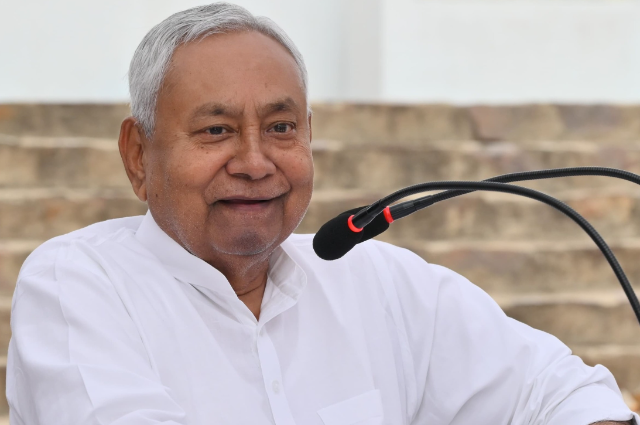
Nitish Kumar was there all along, like a shadowy figure in this assembly election. He was there, but in concealment. Although legends around Nitish Kumar are floating in the air. The good results of his policies and visions are illuminating the farm lands of Bihar. The women of the state, while serving litti chokha to their family members, keep a small fragment of that aside for Nitish. The Extremely Backward Classes (EBC) has kept their trust in Nitish. For the entire 1990s, the Yadavs, who had kept Bihar terrorised, apart from them, the other backward classes have sought their salvation through the election of Nitish Kumar. But in this just concluded election, Nitish has made his presence in some kind of absenteeism. Whereas, in 2020 assembly election, Nitish was seen roaring and stomping in rallies and public meetings. He had attended 240 public meetings in that election. But this time, that number has come down to 80. Still, after doing one - third of last election campaigning, Nitish has taken home almost double seats this time. How? Let's take a journey 23 years ago to find that answer.
The year was 2002. The passively aggressive Nitish Kumar was the railway minister of India. He had an ever smiling face. His voice never crossed a certain decibel. His reserved talking, good sense of humour and motivating skill were very well. Even sometimes, his use of rustic jargon had made it difficult to understand that the man was sitting on the expensive wooden chair of an aristocratic central ministry. Rather it seemed as if he was busy chatting with the villagers sitting at the 'chaura' of his village home holding a hookah in his hand. His predecessor Lalu Prasad Yadav also had this virtue. In fact somewhat more. Still there had been a fundamental difference between Lalu and Nitish. On the points of passive aggression and tremendous professionalism, Nitish was light years ahead of Lalu. As an engineering graduate, Nitish Kumar was a hard taskmaster. During his tenure in the railway ministry, he used to keep his officers always on their toes, in terms of timely submission of file report, attending meetings timely, show causing them for negligence in duty. Nitish used to keep watch so that no file remained pending for tomorrow. But this man as the railway minister once said, "In our time, when we began politics, we had only one aim. That was not becoming a leader, minister, MLA or someone powerful. I didn't join politics with those objectives at all. Me and others like me had dreams of becoming parliamentarians. The parliament was our ultimate destination and becoming a parliamentarian was a highly respectable matter." But this same Nitish had left the parliament and gone back to Patna and never returned. He stayed there by becoming the Chief Minister of Bihar. The coinages, 'Palturam' and 'Shusashon Babu' became added to his kurta like two brooches. The myths and legends, created surrounding him became his flags.
Nitish Kumar can handle his friends and foes all alike. He can manage situations both in front and behind simultaneously. He always keeps few of his party men in the opposition camp. So that when needed, he can change his political alliance. Like Chanakya he also believes, in politics, there is no permanent friend or foe.
The passenger of a long political roller coaster ride, Nitish Kumar had taken oath for the tenth time as Bihar's Chief Minister at Patna railway station adjacent Gandhi Maidan. All this while, he had changed his political alliance more than once. That was much talked about history. But the point to be noted was that, Nitish hadn't changed those alliances only to stay in the power at any cost. If that was his objective, then after his party's poor performance in the 2014 election, he wouldn't have stepped aside and made the Dalit leader, Jeetan Ram Majhi the Chief Minister of Bihar. It was not that Nitish had changed Bihar inside out. He and his administration couldn't materialise many things still - in terms of income per capita, Bihar still belongs to the bottom of the national list. He couldn't make those investments and private organisations come back, who had left during Lalu's tenure. The departure of the meritorious students to other states still remained like carbuncles on Bihar. In spite of all these, how Nitish's popularity had stayed continuously in Bihar - investigation is and will be going on about the reasons behind this. He had appeared in very few campaigns. He was standing, staring blankly while the official representation of the party's election manifesto had been completed within one minute. He was seen not answering to any question of the journalists by going against his usual manner. Opposition had teased him on account of his age related illness and losing his usual aptness. Also people became curious about him. This Nitish Kumar was not seen in front of media's camera within the twenty four hours of his victory. When questions and anxieties were deepening throughout the nation surrounding his absenteeism, at that moment suddenly he had appeared with his usual smiling face with his former opposition leader, Chirag Paswan. With warm smile and flowers in hand he had embraced people. Although he hadn't that sharp look, but a passive calmness was there instead. So the obvious question remained was, would he be able to continue for another five years?
Still Bihar will keep on deliberating on the Nitish magic. His party is still enjoying the benefits of the silent revolution this man had initiated with the women of Bihar. Rising above the castism, Nitish Kumar has united the women from all classes of Bihar, even including the Yadav women who usually support RJD. The presence of 37% women in the Bihar police force is Nitish's contribution to the state. Not only women, the empowerment of Dalits and Backward Classes have brought huge votes to his party repeatedly. After staying in power for two decades, corruption couldn't touch him even in the slightest manner. Maintaining this kind of a character is not easy in a state that stood entirely on coal mines. Undoubtedly, this is going to be the last innings of Nitish Kumar as the Chief Minister of Bihar. Perhaps, after realising that, the entire state has stood beside him in the twilight of his political career. In the 2025 assembly election, the people of Bihar have paid their heartfelt tribute to the leader of their hearts, Sri Nitish Kumar.