
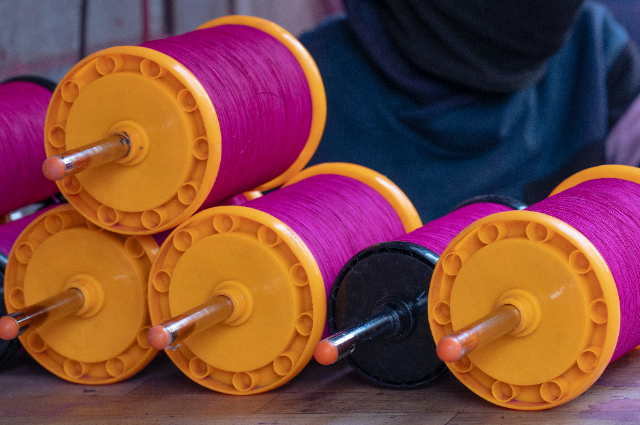
In the past year, the extensive use of Chinese Manja or hazardous nylon kite string has resulted in a series of accidents claiming at least six lives and causing multiple injuries in different parts of Uttar Pradesh. Till the middle of the month February this year, 11 such incidents were reported, out of which one person died, and 10 people were injured. Once upon a time, the so-called Chinese manja was manufactured in China and exported to India. But of late, most “Chinese manja” sold in India is manufactured locally. The label “Chinese”, however, remains in vogue as early versions or key raw materials like synthetic polymers and polypropylene were imported from China, or the technology was associated with Chinese manufacturing.1 Chinese manja is quite distinct from traditional kite strings in use for decades, which are typically made from cotton thread coated with natural adhesives such as rice glue or tree gum, along with mild abrasives like powdered glass or alum. These strings, prepared manually by skilled workers, are considered relatively safer as they tend to snap under stress. On the contrary, the Chinese manja is made from synthetic materials such as nylon or plastic monofilament and often coated with finely ground glass, metal dust or other sharp abrasives. Such a string is definitely stronger, sharper and far more dangerous. Moreover, unlike cotton strings, synthetic manja does not snap easily. It can remain stretched across roads and open spaces for a long time, posing a serious risk to the public. This kind of synthetic kite string is nearly invisible and can prove to be fatal for unsuspecting commuters, particularly those riding two-wheelers.2
Chinese manja or synthetic kite string is not only dangerous to humans but is equally dangerous to birds. In the city of Hyderabad, Telangana, 26 birds were rescued on Makar Sankranti day alone this year, of which five died, and four were released on the spot. The remaining 17 were shifted to the shelter with injuries. Species falling victim to the manja include rivertern, green bee eater, black-headed ibis, shikra, peafowl, black kite, and barn owl, to name a few. According to Soudharm Bhandari from Greater Hyderabad Society for Prevention of Cruelty to Animals, “Chinese manja was not the culprit in all cases. Of all the cases, 10 were caused by glass-coated cotton thread manja while one was caused by normal cotton thread, which caught the bird but did not cause injuries.”3
The Reason Behind the Use of Chinese Manja.
Undoubtedly, kite- flying is a popular sport in India, which often takes the shape of a kite-flying contest where the ability to cut the rival's kite becomes the focal point. In this pursuit, a stronger and sharper string offers a better advantage to cut other people's flying kites easily. Chinese manja, or synthetic manja, is cheaper than the traditional manja. Its low cost and effectiveness have led to its widespread use despite the ban imposed by several States. Thus, the cheaper nylon or plastic string becomes lethal when it is stretched across streets or ‘tangled’ at neck level. “The competitive practice of ‘tangling’ gives the pastime a lethal edge as rooftop participants attempt to cut the kites of others, often prioritising victory over safety.”4
The plastic-based thread is manufactured in cities like Ahmedabad and Bengaluru, and it is sold openly through online platforms. A spindle of traditional cotton string costs between Rs. 2,500 and Rs. 3,500, while the banned plastic string is available online for as meagre an amount as Rs. 250 to Rs. 600 per spindle, making it easily accessible despite legal restrictions.5
Some Specific Cases
- In Jaunpur district of U.P., a 28-year-old physiotherapist, Dr Sameer Hashmi, died as a kite string slits his throat on January 16, 2026. He was returning home on his bike when a nylon kite string cut his throat.6
- In Shajahanpur district of U.P., a police constable, Shahrukh Hasan, 30, died after his neck was caught in a banned synthetic plastic kite string on January 11, 2025.7
- In Aligarh district of U.P., a poultry trader, Salman (28), riding a scooter, died a painful death after being hit by a nylon kite string on September 30, 2025.8
- In Shahjahanpur district of U.P., a 26-year-old man, Ravi Sharma, who was going to his in-laws' house with his wife, suffered a serious injury as his neck got entangled in a nylon string near Roza bridge on October 23, 2025. He died in hospital.9
- On December 10, 2025, a 40-year-old private school teacher, Sandeep Tiwari, lost his life after his throat was slit by a nylon kite string. He was returning home on his motorcycle after dropping his daughter off at school.10
- In Gorakhpur, one Amit Gupta was going to Dharamshala with his mother on a bike when his neck got caught in a kite string at Surajkund bridge, cutting four veins. After a long operation, his life was saved. The incident happened on July 29, 2025.11
- On December 11, 2025, a 35-year-old man, Aishwani Kashyap, riding a motorcycle, sustained serious injuries after a nylon kite string slit his throat near Burlington Crossing. He was instantly taken to the nearby hospital, where his life was saved.12
- On February 8, 2026, Mohammad Shoaib (35) was riding on his motorcycle on Haiderganj flyover when a sharp kite string got stuck around his neck and fatally injured him, resulting in his death.13
- February 8, 2026, Guddu, a delivery porter, narrowly escaped a major accident on Bandha Road in Lucknow when the string cut into his nose. He was then riding a motorcycle with a helmet on. He managed to stay upright despite the impact.14
- In Lucknow, another incident took place around the time when Mukesh Verma, travelling with his wife, was injured on the Naka flyover when the kite string cut both his eyebrows, leaving him bleeding profusely. A passerby helped him reach the hospital in time to get medical help.15
Police Action
In all such cases, the police have invoked the following Sections of the relevant Acts:
Bhartiya Nyay Sanhita, 2023
- Section 125-negligent acts that endanger human life;
- Section 293 repeats or continues a public nuisance; and
- Section 223-b--disobedience of orders lawfully promulgated;
Environmental Protection Act, 1986
- Section 15-Violations are punishable by a penalty of not less than Rs. 1 lakh, which may extend to Rs. 15 lakh, and
- Section 5-empowers the Central government to issue written directions to any person, officer, or authority to ensure compliance with environmental standards.
Note: In all reported cases, an FIR was filed, but no further progress was made by the police. Even the culprits have not been identified.
What the High Courts Said in Different States
High Courts across the country have expressed serious concern over the 'deadly effects’ of ‘Chinese manjha’ (nylon kite strings) and directed the respective state authorities to impose a complete ban on its manufacturing and sale.16
- A Division Bench of Allahabad High Court, comprising Justice Arun Bhansali and Justice Kshitij Shailendra, in January 2026, once again reminded the government of U.P. to strictly implement the ban on the manufacture, sale, and use of ‘Chinese manjha’ and enforce earlier orders of this Court on this issue.17 The Court has earlier passed a clear Order on November 19, 2015, directing strict action against ‘Chinese manjha’, but it is still available easily in the market, as per the petitioners and is being used widely.18
- In January 2026, the Bombay High Court imposed a Rs. 25,000 fine on anyone flying kites using banned ‘nylon manjha', citing risks to human life, birds, and public safety. The Court also ordered a Rs. 22.5 lakh fine for vendors found selling/stocking ‘nylon manjha'.19
- The Indore Bench of the Madhya Pradesh High Court in January 2026 passed an Order on a suo motu PIL holding guardians legally responsible if minors are caught using banned Chinese manjha (nylon or synthetic kite string). Following a series of fatal accidents and injuries in Indore, the Court took suo motu cognisance of the issue to ensure stricter enforcement.20
Position in U.P.
In the U.P., the situation is more drastic, and the use of Chinese manjha seems to be unstoppable despite the complete ban on it by the State government. Recently, the Chief Minister Yogi Adityanath has clearly stated that deaths caused by the sharp synthetic thread should be treated on par with murder. He said, “Strict legal action will be taken against those responsible in such cases.” However, no effective preventive action has yet been taken to control the online shopping of Chinese manjha or synthetic nylon string by the e-commerce companies.21
For decades, kite flying has been a popular sport among the masses. People enjoy this game at a few specific festivals and occasions. This sport is linked with mental and manual skill, in which cutting the string of others' kites flying high in the sky matters most. It gives immense joy to the victor whose kite remains in the realm of the open sky. But of late, kite fliers have developed the habit of winning by hook or crook. For this, they employ dangerous threads such as the Chinese manjha and synthetic nylon strings to cut the flying kites of others. These strings are almost visible to the wayfarers on the road. It entangles mainly the upper parts of the body, cutting the throat or bruising the parts of the face and head, often resulting in death or serious injuries to the victim. Now, e-commerce has come to the rescue of the buyers, and unfortunately, no effective checks can be enforced by the respective governments. Since the number of casualties is gradually increasing, there is an urgent need to control the ill-conceived and dangerous practice of using Chinese manjha and other synthetic nylon strings. Safeguarding the lives of people is the primary duty of the State, and that should be ensured at all costs. Though the government has banned its use, the implementation of government orders leaves much to be desired. Different High Courts of the country have also issued appropriate orders to effectively control the problem. Only sufficient willpower is required by the official machinery. The laws should be enforced strictly, and the culprits should be punished without showing any mercy. It is high time to take stringent measures to save the lives of innocent people who travel on roads without anticipating any trouble of such a dangerous nature.
Reference
- Manish Sahu, 33-year-old man its latest victim: How banned ‘Chinese’ manja continues to flood markets, The Indian Express, February 25, 2026.
- Ibid.
- Swathi Vadlamudi, Scores of birds fall prey to killer ‘manja', The Hindu, January 17, 2026.
- Anupam Srivastava, Hindustan Times, February 6, 2026.
- Ibid.
- Aakash Gupta, Pulling dangerous strings in cut-throat world of ‘manjha', Hindustan Times, February 6, 2026.
- Ibid.
- Ibid.
- Ibid.
- Ibid.
- Ibid.
- Ibid.
- HT Correspondent, Crackdown under doubt as four hurt by manja in city in 24 hrs, Hindustan Times, February 9, 2026.
- Ibid.
- Ibid.
- HT Correspondent, High Courts Of Several States Have Taken Serious Note, February 9, 2026.
- Ibid.
- Ibid.
- Ibid.
- Ibid.
- HT Correspondent, Deaths due to ‘Chinese manjha’ tantamount to murder, says Yogi, Hindustan Times, February 6, 2026.