
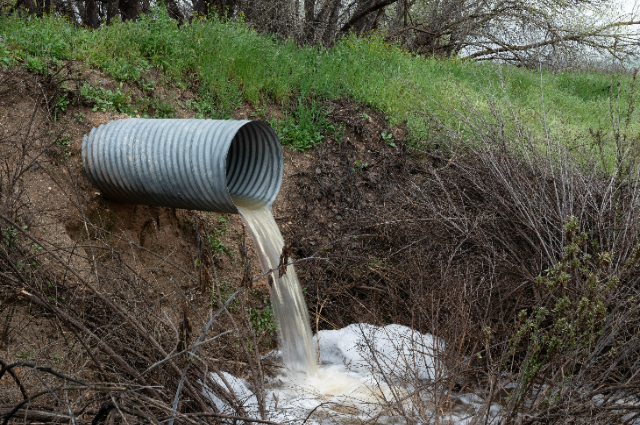
Recently, in Indore, a ghastly tragedy occurred where at least 8 people died and about 300 people were hospitalised due to the consumption of dirty and unhygienic water supplied by the Indore Municipal Corporation. This happened in one locality, Bhagirathpura, where generally the poor and low-income-earning group of people reside. Afterwards, such complaints were also received from a few more localities where the drinking water is being supplied by the Indore Municipal Corporation. The Madhya Pradesh government has removed the Municipal Commissioner and penalised a few other municipal officers/officials. The High Court has taken cognisance of the case, and a regular hearing is ongoing. The exact causes of the tragedy will be known after the completion of the enquiry and the verdict of the Court.
However, the immediate cause, as the government sources mentioned, was the contamination of drinking water through the infiltration of sewage water, which is running through separate drains adjacent to the drinking water pipeline. The condition of the water pipeline in general is far from satisfactory. It is rather deplorable. Such pipelines are rusted and broken here and there, through which all kinds of pollutants can enter the mainstream of potable water. Not only this, but also, the condition of the sewage drains is not good. The most surprising matter is that the residents of the affected localities were complaining about the problem for a long time, but the Municipal authorities seemed to be reluctant to take any ameliorative action in this regard. Now, they are pointing out several reasons for that, which may be categorised as follows:
Lack of Funds
The most common excuse is a lack of enough funds for undertaking such kind of activity. In this case, it was overhauling the whole system of pipelines carrying potable water through the various parts of the city. No doubt, the pipelines were laid long back and over a passage of time, the problem of rust and leakages, mainly, has seen an exponential growth. From the response of the authorities, it also appears that no comprehensive plan for changing the existing old and worn out pipelines system has ever been prepared. Indeed, such a mammoth exercise can not be undertaken in one go due to financial and other constraints, but such an overhauling operation can be done selectively based on the damage every year. The lines most damaged can be changed first, and such an exercise can be undertaken every year. But things are pushed to extremes, inviting calamities of this nature.
Lack of Staff
Ordinarily, every municipal body in India is facing staff shortage. It is because of the fact that at the time of their formation, the local population was very less as compared to modern times. Now, there is an enormous increase in the population for which the number of staff/officials is definitely low. The respective governments are not ready to increase the existing staff due to financial constraints. The existing municipal laws and bylaws hardly make them self-reliant. Rather, nearly all of them depend on government grants for disbursement of salary and carrying out developmental works. Even for routine works like scavenging, maintenance of municipal roads and streets, lighting arrangements etc., there is always a dearth of funds. So, due to lack of financial strength, the additional staff is not recruited. In such a scenario, the maintenance of the existing infrastructure becomes difficult. Therefore, a graded approach is needed to tackle the situation. The municipal authorities can't just wait and watch. This approach of being reactive instead of proactive should be forsaken forever.
Lack of Latest Scientific Knowledge and Technological Advancements
This is also an important factor in dealing with such exigencies. The latest scientific knowledge and technological advancements are rarely discussed among the staff members because of a lack of adequate literature. Secondly, workshops of this nature are rarely organised at the government level or below. This is a hearing lacuna in the working of the municipal bodies.
Lack of Proper Labs and Testing Facilities
There is hardly any testing lab anywhere in the country, especially under the control of municipal bodies. This makes it extremely difficult for the authorities to scientifically check the quality of potable water being supplied through the pipelines, both at the source and the receiving end. Thus, it becomes really difficult to mix adequate quantities of water purifiers, such as alum, etc., at the source before distribution to the public. This also calls for deployment of several technical or skilled staff for this purpose.
Regular Inspections by the Staff
This is an acknowledged fact that the regular inspections of the water pipelines and the sewer system is hardly done anywhere in the municipal areas. As a result, the only source of information remains the affected public who makes hue and cry when faced with any odd situation. In this regard, it is most essential that at least quarterly routine inspections be done by the municipal staff. It will help in ensuring timely disposal of a nascent problem before its growing up in a big shape.
Necessity of Attitudinal Change
There is an urgent need to bring an attitudinal change in the mindset of the municipal staff that healthcare of the taxpayers under the domain of municipal bodies are of prime concern. So, provision of fresh and unpolluted drinking water is one of the major duties of the municipal staff. This work needs to be given primacy over other municipal works. In fact, people suffer for a long time due to the apathy of municipal authorities.
Fixing of Responsibility in Unambiguous Terms
Generally, whenever such a situation arises, the game of shifting responsibilities is played, and at times, nobody is found directly responsible for the offence committed. In order to avoid this, a clearly laid out mandate should be prepared to hold anyone responsible for the offence so committed.
Constitution of an Emergency Fund
An emergency fund should be created in every municipal body to deal with such calamities. This will avoid the possibility of fund crunch to the maximum.
Indore like incidents are not uncommon in our country though many such mishaps don't attract the limelight of the media and the press. The reasons have been enumerated above which are the same in every case. The worst part is that all such mishaps are brushed under the carpet by the municipal authorities and no ameliorative measures are undertaken to avoid future tragedies. The public, too, often tends to forget such incidents. The errant officials are rarely punished to the minimum. After a while, everything goes normal as if nothing happened. The citizens who are also taxpayers owe a responsibility to raise their voices and make efforts to set things right. Otherwise, not much improvement can be seen in civic matters of a serious nature. It is high time the respective governments took it seriously and made serious efforts to change the existing scenario. Even a single life is important, which should not go to waste on account of any laxity on the part of the municipal bodies. The Indore incident is a wake-up call for all. Let us collectively rise to the occasion lest we encounter more casualties in the future.