
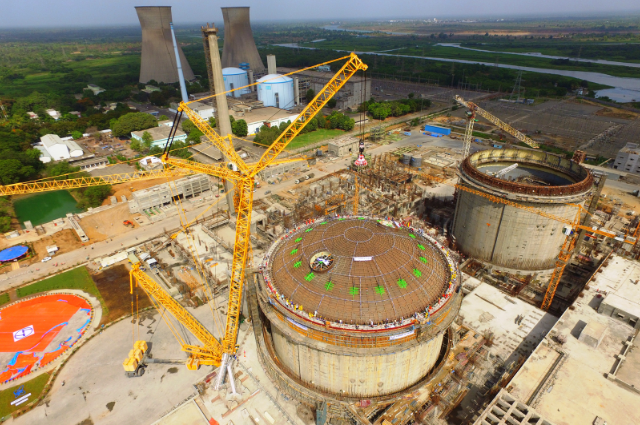
On 18th December 2025, the Indian Parliament passed the ambitious Sustainable Harnessing and Advancement of Nuclear Energy for Transforming India Act (SHANTI Act), 2026, to pave the way for increasing the nuclear energy programme in the country in a futuristic perspective. The Act has replaced the previous Atomic Energy Act 1962 and the Civil Liability for Nuclear Damage Act (CLND Act) 2020. “The country is now ready, in terms of technology, to realise the Nuclear Energy Mission (NEM)'s target of 100 GW generating capacity by 2047”.1
India is currently the fifth-largest economy in the world with a population of over 1.5 billion. Accordingly, its energy needs are growing exponentially every year. Though India's electricity demand is projected to rise three times by 2047, nearly 70 percent of power generation still depends on fossil fuels. There lies the tough challenge of reducing carbon emissions and ensuring energy security, along with promoting the rapid economic growth of the country. In such a scenario, nuclear energy has emerged as a crucial pillar in India's quest for a sustainable and self-reliant energy future. ‘Nuclear energy represents one of the most concentrated forms of power generation, where small amounts of fuel can produce enormous quantities of electricity with minimal carbon emissions. France, which generates over 70 per cent of its electricity from nuclear sources, has demonstrated how this technology can form the backbone of a low-carbon energy strategy.’2
The Historical Perspective
India's nuclear strategy owes its origin to a visionary three-stage programme designed by the great scientist and visionary, Homi Bhabha, who envisaged using nuclear energy for peaceful purposes. It aims to provide leverage to India's Thorium reserves, which are abundantly available, to achieve complete energy sufficiency. As the country is marching ahead on the path of its net-zero target by 2070, its importance has also increased manifold. The original vision of Homi Bhabha, the father of India's atomic energy programme, was to provide for India's energy security through nuclear power as well as make up for India's scarcity of uranium through the use of thorium. This involves, in Stage 1, building and making pressurised heavy water reactors which use natural uranium (U-238) to produce plutonium and energy. In the second stage, by using ‘fast breeder reactors', more plutonium and uranium-233 are made along with energy. In the final stage, U-233 is combined with the plentiful thorium to make electricity and create a self-sustaining U-233-and-thorium power-generating system. India has not yet reached the second stage; it only has a prototype Fast Breeder Reactor. Delayed for 20 years, it was to be active in 2025, but now the commissioning has been further pushed to September 2026. For its nuclear goals, India is looking to rely on Small Modular Reactors (SMRs).3
The genesis of India's nuclear journey goes back to 1948, after Independence, when the establishment of the Atomic Energy Commission took place. Furthermore, Asia's first research reactor, Apsara, was commissioned in 1956 at Bhabha Atomic Research Centre (BARC) in Trombay. These early steps laid the foundation of India's ambitious nuclear energy programme later.
Current Situation
At present, India's nuclear programme stands totally transformed. In 2013-14, the nuclear capacity was a mere 4,780 MW, while it has jumped by 70 per cent since then to reach 8,180 MW, spread across 24 operational reactors. Annual electricity generation from these plants has increased from 34,228 million units in 2013-14 to 47,971 million units in 2023-24. Currently, nuclear power capacity contributes approximately 3 per cent of India's electricity generation. However, it is set to grow substantially with 21 reactors totalling 15,300 MW at various stages of implementation.4 According to the World Nuclear Institute, IEA, media reports, India stands at 7th position in the world in terms of Installed Capacity (GW) of nuclear energy. The U.S. tops the list with 102 GW capacity, followed by France with 64 GW and China with 58 GW capacity. Japan (32 GW), Russia (29 GW) and South Korea (27 GW) are also ahead of India.5
The Shift in Focus
In the current scenario, the focus of India's nuclear programme has shifted to developing indigenous technology from merely expanding nuclear capacity. In 2023-24, India's first indigenous 700 MWe Pressurised Heavy Water Reactor (PHWR) at Kakrapar, Gujarat, was successfully commissioned, which marked a significant milestone in self-reliance. Besides that, India has also made rapid strides in nuclear fuel cycle capabilities, with the Prototype Fast Breeder Reactor (PFBR) in 2024, which is also a critical milestone, including primary sodium filling and commissioning of sodium pumps. Moreover, India has gained mastery in designing and constructing PHWRs. The technology to construct the Fast Breeder Reactors has reached the field, and at present, nearly 500 MWe Prototype Fast Breeder Reactors are nearing completion. At this juncture, it is pertinent to know that the second stage of India's nuclear programme is crucial as it multiplies fuel utilisation efficiency and prepares the ground for the Thorium-based third stage.6
In the above context, a revolutionary shift in focus is concerned with Small Modular Reactors (SMRs) and Bharat Small Reactors (BRSs). The Union Budget of the financial year 2025-26 has allocated Rs. 20,000 crore for SMR research and development, aiming to develop at least five indigenously designed operational SMRs by 2033. At the same time, the upgradation of BSRs, essentially 220 MW PHWRs with proven safety and performance records, is being carried out to reduce land requirements, making them suitable for deployment near industries as captive power plants to aid in decarbonisation efforts.7
The International Collaboration
In furtherance of India's nuclear energy programme, international collaborations are being pursued with vigour, particularly with countries like Russia, France, and the U.S. In this reference, the central government has accorded in-principle approval to set up six 1208 MW nuclear power plants in cooperation with the U.S. at Kovvada in Andhra Pradesh. In addition to this, a significant development is the partnership between the Nuclear Power Corporation of India Limited (NPCIL) and the National Thermal Power Corporation (NTPC), forming a joint venture named ASHVINI to develop nuclear power facilities.8
The Salient Features of the SHANTI Act, 2026
The Act opens up the sector for private participation. However, the public sector would remain as the engine of growth. Core functions such as fuel enrichment, spent-fuel reprocessing and heavy water production remain exclusively under Central Government control. This ensures that areas with the greatest safety implications are kept with government agencies and not exposed to external risk.9
The government will set a threshold limit of uranium or thorium in the minerals being mined, beyond which private participation will not be allowed.10
The Act proposes the grant of licences to private companies to operate nuclear power plants, the removal of an existing contentious liability clause for suppliers of fuel and technology, as well as the rationalisation of the levels of payouts by operators in case of accidents.11
The new Act creates a framework to encourage indigenous research in nuclear energy by amending the Patents Act, 1970, which barred any invention in the nuclear energy space from patent recognition. Now, the patents may be granted to inventions if the Union government doesn't deem these to be related to activities that are of a sensitive nature or have implications for national security.12
The Act gives statutory status to the AERB, granting clear authority to inspect facilities, investigate incidents, issue binding directions and suspend or cancel operations that do not meet safety standards. This leaves no scope for executive discretion, and it enables quicker and more credible intervention when risks emerge.13
Enhanced safety measures have been enshrined in the new Act. The government's clear motto is “Safety first, Protection next". A safety oversight is embedded in the Act itself, legally across the entire cycle of nuclear facilities, ensuring continued compliance rather than reliance on one-time permissions.14
The Act separates permission to operate from permission to operate safely, requiring both a licence and an independent safety authorisation.15
Accident prevention is significantly enhanced by legally recognising serious risk situations such as nuclear incidents, even without actual damage.16
In case of a nuclear accident, only operators of plants above 3,600 MW are liable for a Rs. 3,000 crore penalty; from 3,600 MW to 1,500 MW, the amount is Rs. 1,500 crore; from 750 MW to 150 MW, it is Rs. 300 crore; and it is Rs. 100 crore for plants under 150 MW. All India's plants are currently 3,000 MW or lower. However, according to Science Minister Jitendra Singh, this graduation was not meant to “scare off" potential private sector participants. 17
Out of all the energy sources, nuclear energy production has been controversial and at times, disastrous, as proved by the nuclear accidents at Chornobyl (1986), Three Mile Island (1979) and the Fukushima reactor meltdown in Japan in 2011. Consequently, Germany, which fulfilled its quarter of energy needs from nuclear energy, decided to abandon its quest for nuclear energy and shut down all nuclear plants after the Fukushima disaster. However, there seems to be a revival of interest in nuclear energy throughout the globe. The two important reasons are the establishment of huge data centres, which need enormous amounts of energy for running AI and crypto, and the arrival of Small Modular Reactors (SMRs) on the scene. So, the most formidable challenge in India before adopting an ambitious nuclear energy programme is to shape a favourable public perception in this regard. The concerns about nuclear generation and its management can only be answered by convincing the public about the robustness of the safety regime as proposed in the new law. Apart from securing clean energy and addressing the burning issues of climate change risks, the Nuclear Energy Mission, which has set the target of 100 GW generating capacity by 2047, can also boost the economy significantly. It would help create jobs at all levels across the activities involving materials, manufacturing, construction, commissioning, operations and maintenance, quality assurance, safety and neighbourhood engagement. There is a dearth of trained and qualified talent in the country. But India is strong enough to face these challenges. With the involvement of private players, the nuclear energy programme in the country will certainly go a long way. But for this, the government's willpower and people's participation are necessary. There is no doubt that India needs nuclear energy to solve its clean energy riddle and to boost various developmental programmes in several fields. It is hoped that the SHANTI Act will act as a catalyst to usher in an era of clean energy climate, and a better life for the people. India's nuclear programme, along with renewable energy initiatives, can certainly do the makeover of the country's existing energy landscape. For India, this development is also crucial as it would significantly reduce our dependence on energy imports that made the country vulnerable to external shocks. Recently, the attainment of criticality by the Prototype Fast Breeder Reactor in Kalpakkam, Tamil Nadu, is a long-awaited milestone that is going to boost India's nuclear programme in an unprecedented way. Overall, the setting up of a Nuclear Energy Mission, the enactment of the SHANTI Act, the thrust for development of SMRs, and the opening up of the nuclear sector for private participation are vital steps in the journey of achieving nuclear energy goals and on the way to India's quest for a sustainable and self-reliant energy future.
Reference
- Anil Kakodkar, Road map for realising nuclear energy goals, Hindustan Times, Dec. 16, 2025.
- Jitendra Singh, The nuclear leap, The Indian Express, Mar 23, 2025.
- Jacob Koshi, Will the new Act aid India's nuclear development? The Hindu, Dec 21, 2025.
- Jitendra Singh, The nuclear leap, The Indian Express, Mar 31, 2025.
- Nirmal John, N, It’s Back, The Economic Times, Apr 20, 2025.
- Jitendra Singh, The nuclear leap, The Indian Express, Mar 31, 2025.
- Ibid.
- Ibid.
- SHANTI Bill, 2025, The new Nuclear power law, The Economic Times, Dec 19, 2025.
- Saubhadra Chatterji and Sejal Sharma, Parliament passes nuclear energy bill, paves way for pvt investments, Hindustan Times, Dec 19, 2025.
- Ibid.
- Editorial, Hindustan Times, Dec 17, 2025.
- SHANTI Bill, 2025, The new Nuclear power law, The Economic Times, Dec 19, 2025.
- Ibid.
- Ibid.
- Ibid.
- Jacob Koshi, Will the new Act aid India's nuclear development? The Hindu, Dec 21, 2025.