
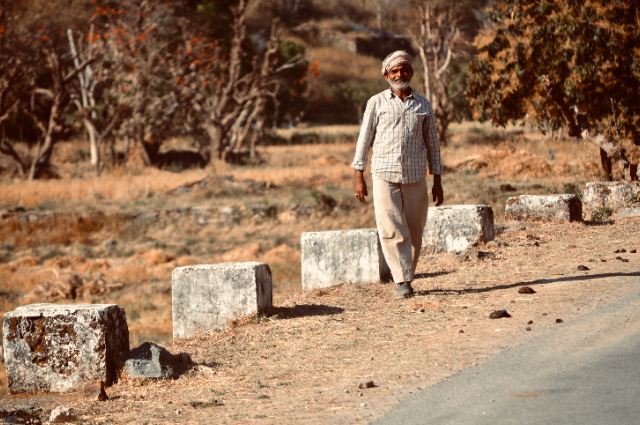
Walking on foot on roads is not a wholesome idea, though treading at a slower pace on footpaths is a welcome idea for many who can't afford a personal vehicle or two to travel on roads for various purposes. However, this is not merely a necessity but a pleasure also for those who prefer to walk on these pathways in a leisurely fashion. Since time immemorial, the tradition of walking on foot is in vogue and is still continuing. In the post-Independence era, when the roads were not so developed in India, people used to travel on foot on the kuccha roads. But during the last few decades, the number of motor vehicles shot up exponentially and gradually, the notion sat permanently in the minds of policymakers that the metalled roads were meant for motor vehicles only. Though initially, footpaths were developed alongside a few roads, they were gradually demolished in the process of widening the roads. Secondly, in case of remaining footpaths, all kinds of impediments were raised to make them unusable by pedestrians. “Footpaths in Indian cities are under constant siege. If they are not broken, they are encroached upon by parked cars, flowerpots, extended ramps of four- storey houses, security guard cabins, construction waste, mounds of garbage, dangerously low-hanging overhead wires, and shop extensions.” Adding to the low-hanging, inflated list, footpaths in many cities become a getaway for two-wheelers in heavy traffic, work as a parking bay or host makeshift chai tapris (tea stalls). Resultantly, the poor pedestrians become the worst sufferers who would pass by these footpaths because of income and other constraints. In this context, it would be worthwhile to note that according to ‘’Census 2011 work-travel figures show that roughly 31% of urban workers walk to work, with the share even higher among women.” Factually speaking, footpaths by and large have become meaningless in the Indian context.
Walking-an Ancient Tradition in India
India nourishes a strong tradition of walking. In the epic age, Lord Ram is said to have walked from Ayodhya to Lanka. Gautam Buddha traversed all along the Gangetic plains to spread his message all through the country and beyond. The great seer, Adi Shankara, walked from Kaladi in Kerala to Kedarnath in the Himalayas and from Dwarka in the west to Puri in the east. In the later years, the ancient Uttara Path and Dakshina Path-arterial routes of the Mauryan empire, among the oldest planned roads in the world-were built to carry people, most of them on foot. These roads were travelled by traders, pilgrims, soldiers, ascetics, and messengers who walked across kingdoms and seasons. Their alignments survive today in the Grand Trunk Road and NH-44. The tradition continued with the passage of time too. Mahatma Gandhi walked 385 kilometres from Sabarmati to Dandi in 1930 while Sant Vinoba Bhave walked 70,000 kilometres over 14 years, mobilising nearly 42 lakh acres of land for redistribution to the poor. In modern times too, padyatra is often a convenient tool for politicians to ensure public connect.
The Supreme Court Walking Rights of Pedestrians
In this context, a decision of the Supreme Court of India pronounced on 19th June 2026 has brought huge relief to the regular users of these footpaths. In the case of Maniyar Iliyaz vs. P.P. Ayyappan, the Bench of Justices P.S.Narsimha and A.S.Chandurkar went beyond the compensation covering an insurance liability culminated in a road accident case, and declared that the right to walk on safe, demarcated footpaths is a fundamental right protected under Part III of the Constitution of India. “The Bench also converted the broader constitutional question into ongoing suo motu proceedings, titled “Re: Fundamental Right to Walk and Footpath". The Court further directed the Union Ministries of Housing and Urban Affairs, Rural Development and Road Transport and Highways to deliberate upon the formulation of a comprehensive statutory framework. The Court also directed the Law Commission of India to identify the State's duties and provide effective remedies in order to make walking conditions safer in the country. The Court also opined that a regulatory mechanism is needed to enforce this right. It would help the citizens in seeking Constitutional remedies and compensation directly from the concerned authorities. “The ruling expands jurisprudence by anchoring the right to walk within the guarantee of free movement under Article 19(1)(d) and the right to life and personal liberty under Article 21. The bench recognised that walking is not merely a mode of travel but an essential part of expression, assembly and association, like traditional neighbourhood processions where communities reclaim public spaces.”
Accidents on Indian Roads
As per the data provided by the Union Ministry of Road Transport and Highways, road accidents claim around 1,75,000 lives every year, with the number of casualties among pedestrians in the year 2024 standing at 36,526 or 20.20% of all road fatalities. It amounts to 100 every single day. At the time of fatalities, according to the Road Safety Network’s white paper for 2025, the country continues to lose 1.7 lakh lives annually to road accidents, with pedestrians, cyclists and two-wheeler riders at greatest risk. In Delhi, the police data shows that 43% of road crash fatalities are pedestrians.
Guidelines to Protect Public Spaces
There are various guidelines to protect public spaces given under different enactments, but these frameworks are treated as discretionary rather than binding mandates.
1. Motor Vehicles Act, 1988
This Act was drafted primarily keeping in view motor vehicles, treating human interests as incidental. It has prioritised the speed and throughput of personal cars, thereby marginalising the majority of citizens walking on foot. This has enhanced the daily safety hazards. The Central Motor Vehicles Rules (CMRV) explicitly prohibit parking on footpaths but lack other provisions to prohibit the unauthorised use of footpaths by vested interests. Section 198A of the Motor Vehicles Act imposes criminal and financial penalties against designated authorities, engineers, and contractors if safety standards are not adhered to.
2. The Rights of Persons with Disabilities Act, 2016
This Act envisages barrier-free environments under Sections 40 and 41, mandating guidelines that require tactile paths for the visually impaired and gentle curb ramps at junctions. Any street excluding these requirements is deemed to be non-compliant with the statutory diktats.
3. The Street Vendors Act, 2014
The Act aims to protect the right to livelihood under Article 19(1)(g) and Article 21 by asking Town Vending Committees to map cities into distinct zones. When urban administration fails in its duty to allocate proper space for street vendors, they throng on the empty footpaths, making the lives of pedestrians miserable.
Technical Parameters of the Footpaths
1. Engineering manuals like the Indian Road Congress provide the specification guidelines for constructing footpaths along the roads. If these guidelines are followed strictly, no such spatial disputes or conflicts will arise emanating from the encroachments of footpaths. “The Indian Road Congress standards mandate safe, continuous and accessible footpaths on roads where vehicle speeds exceed 15 kmph. The guidelines envisage that footpath width should be planned in three different zones: pedestrian or walking zone, frontage or dead zone, and multi-utility zone, with footpaths wide enough to accommodate pedestrians, street furniture, bus stops, trees, vendors and other public amenities. Such standards, however, remain far removed from the reality on most city roads. The pedestrian zone alone should be at least two metres (six feet) wide to allow two wheelchairs to pass comfortably. On commercial roads, accommodating all these elements would require footpaths between 5 and 7.5 metres (16 to 24 feet) wide, which is equivalent to a two-lane road, and a different proposition in a city where road space comes at a premium.”
Current State of Affairs at Field Level
1. Hyderabad
“Within the limits of the erstwhile Greater Hyderabad Municipal Corporation, the city had more than 800 kilometres of four-plus lane roads that should have had pedestrian walkways on both sides. For a requirement of roughly 1,600 kilometres of footpaths, only about 430 kilometres existed, many too narrow or encroached to be of practical use. Though the government launched an initiative in 2019 to build footpaths along major roads, the effort fell short.”
2. Lucknow
In a survey conducted by Hindustan Times newspaper in June this year which covered Lucknow city's posh areas such as Hazratg,anj, Lalbagh, Civil Hospital, Indira Nagar, Kapoorthala and Aliganj, it was found that "in many places, footpaths either do not exist, are discontinuous or have been rendered unusable due to encroachments and poor maintenance, forcing pedestrians to step into busy roads.” It further highlights the dreadful condition of footpaths in the market by noting that ‘A walk across the market revealed that it is nearly impossible for a pedestrian to traverse the entire stretch using only the footpath. At almost every few metres, walkers encounter an obstacle that forces them either to change direction or descend onto the carriageway. Large permanent structures occupy portions of the walkway at many locations. Elsewhere, motorcycles have taken over sections of the footpath despite parking restrictions, while vendors have spread their stalls across pedestrian space. The result is a fragmented walking corridor where continuity is repeatedly broken.” There is a lot more to say about the present state of affairs of the existing footpaths in the historical city of Lucknow.
3. Delhi
In a 15-part video series this month of July 2026, the national newspaper Hindustan reported that “the Capital's footpaths were absent, inconsistent, and encroached upon-open drains and tyre shops were found on footpaths in Mukherjee Nagar, horses and garbage in Okhla, broken tiles in Lajpat Nagar, and a de facto public urinal in Panchsheel Park. Only Connaught Place, Lutyen's Delhi, and parts of Central Delhi had walkable stretches. The rest of the city was caught in a web of jurisdictional confusion with at least 14 agencies tasked with maintaining roads and footpaths.” An eye-opening picture of footpaths in the national capital, indeed!
Some Positive Initiatives
At this juncture, it would be worthwhile to mention some of the positive initiatives by several agencies to sustain safe and protected footpaths in their respective work zones:
- Metro Rail Policy, 2017. This policy mandates pedestrian infrastructure within a 200-500 square-metre radius around stations as a condition for States seeking central performance-linked funding. While the Kochi Metro and Nagpur Metro networks have integrated this layout, the plans are limited to localised transit hubs only. In this regard, a city-wide network is needed for continuous sidewalk coverage of the entire urban landscape.
- Chennai is credited with having formulated and adopted India's first non-motorised transport policy in 2014, incorporating the commitment to earmark 60% of its transport budget to walking and cycling. The city redesigned street networks, upgraded hundreds of bus stops and secured school zones. These initiatives have spread across six neighbourhoods with the help of the World Bank-backed Mega Streets Project.
- Financially, Pimpri-Chinchwad has broken new ground by launching India's first green municipal bond explicitly earmarked for non-motorised transport. The Municipal. Corporation raised Rs.200 crore for its ambitious Harit Setu (Green Connectivity) Masterplan, turning pedestrian and cycling networks into investable assets.
- Srinagar, in Jammu and Kashmir, also leveraged its Smart City budget to redesign a nearly 100-kilometre pedestrian infrastructure network.
How to Implement the Supreme Court Verdict?
There are two main constraints in implementing the Apex Court's recent decision, which has declared the right to walk as a fundamental right, which are as follows:
- The weakest link is the lack of a clear mandate for road-building agencies to consider human-centric design as a priority. The existing frameworks like the Indian Road Congress guidelines are biased towards vehicular carriageway design over walkways. To make the right to walk operational, people-friendly urban design must be made legally mandatory. At the same time, advisory engineering codes must be converted into binding regulations. That should culminate in ensuring no detailed project report for a new road or flyover receives financial approval or environmental clearance without an independent accountability audit.
- Experts emphasise that the right to walk cannot be sustained without dedicated financial backing. Non-motorised transit has often failed to attract adequate capital. Currently, there is no system in practice to earmark a share of road investment specifically for walking infrastructure.
In India, roads without footpaths are unthinkable, but it is the harshest truth. Seeing the expanding urban growth during the last few decades combined with economic compulsions, people living in the cities are bound to go outside their homes to eke out their living. This is also a fact that a majority of them attend their jobs by walking on foot. Only a very few of them enjoy the facility to purchase a motorised vehicle. At the same time, not many of them opt for public transport due to various reasons. Hence, the significance of the right to walk of ordinary people cannot be underestimated-neither by the administrators nor by the policymakers. Unfortunately, this human aspect of walking on the roads has largely been ignored or overlooked by all. In India, the construction of footpaths is only for the namesake. Moreover, their maintenance leaves much to be desired. All kinds of impediments in the name of encroachments on these footpaths can be easily seen by anybody. The worst thing is that no authority is trying to check the growing menace, and things are growing from bad to worse day by day. What is imperative in such a situation is to develop a consciousness of the feelings on the part of the concerned authorities of pedestrians who are constrained to walk on foot every day. Secondly, it should be legally mandated by them every day they build any road without having a provision of footpaths. For this, necessary amendments should be made in the concerned Acts and guidelines. Thirdly, the necessary financial backing must be made available without any hitch by the central and state governments. It is high time to put an effective check on the increasing road accidents in which pedestrians have a large chunk. Furthermore, their requirements should be given more priority than motor vehicles, while everything is being done at the cost of pedestrians.
References:
- Editorial, Hindustan Times, July 18, 2026.
- Anuradha Mascarenhas, Our right to walk is broken-just like our footpaths, The Indian Express, July 8, 2026.
- Sajith Sukumaran, India walks. Its roads don't take notice, Hindustan Times, July 15, 2026.
- Ibid.
- Anumita Roychowdhury, Reclaim the footpath, Down to Earth, 16-31 July 2026, p.14.
- Ibid.
- Ibid.
- Anuradha Mascarenhas, Our right to walk is broken-just like our footpaths, The Indian Express, July 8, 2026.
- Editorial, Hindustan Times, July 18, 2026.
- Anumita Roychowdhury, Reclaim the footpath, Down to Earth, 16-31 July 2026.2026, p.15.
- Anumita Roychowdhary, Reclaim the footpath, Down to Earth, 16-31 July 2026.
- Swathi Vadlamudi, The right to walk derailed by design, The Hindu, June 28, 2026.
- Swathi Vadlamudi, The right to walk derailed by design, The Hindu, June 28, 2026.
- Editorial, Hindustan Times, July 18, 2026.
- Anumita Roychowdhary, Reclaim the footpath, Down to Earth, 16-31 July 2026.
- Anumita Roychowdhury, Reclaim the footpath, Down to Earth, 16-31 July 2026.
- Ibid.