
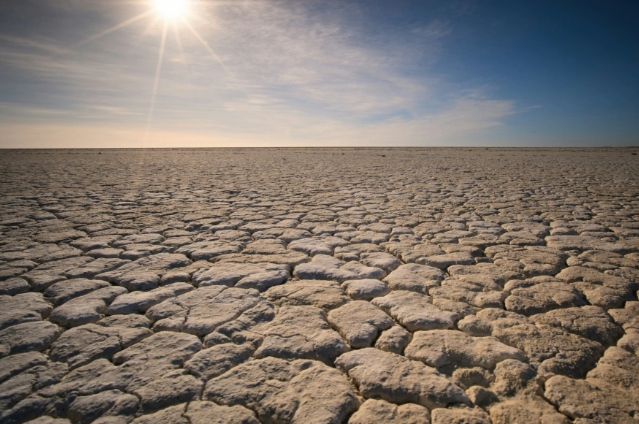
At present, the whole of north India is reeling under a crushing heatwave with temperatures shooting over 40 degrees. The ominous trend is continuing, and there are hardly any signs of respite. Banda is a revenue district of the Bundelkhand region of Uttar Pradesh, termed the “world's hottest city". Banda has consecutively topped the list with temperatures reaching as high as 48.2 degree Centigrade. This is not a new phenomenon for this remote part of Uttar Pradesh. Contrarily, this has become the norm for so many decades in the past. Banda's topography plays a major role in the enhancement of temperature every year. The surrounding region encompasses open land, rocky terrain, and exposed agricultural land. The situation is aggravated by less green cover, which is the lowest in all the districts of the Bundelkhand region (2.31%). The other significant reason is ascribed to its proximity to the Tropic of Cancer, which naturally makes this region warm. According to Rajneesh Sarin, Director, Sustainable Building and Habitat Programme, Centre for Science and Environment, New Delhi, the land cover pattern was a major factor behind the extreme temperature in Banda. He opines that “After harvesting, much of the land remains exposed in Banda and starts behaving like a heat centre.”1 It is not surprising that many experts describe the Banda region as a “man-made heat centre.” Sareen further adds that “Banda is one such location, where the rise in temperature has more contribution from land cover than from urban morphology or anthropogenic contributions.”2
The Ground Situation
The maximum temperature recorded:
On 27 April 2026-47.2026-47.6 degree which stands highest in the country on that date. It is also the highest temperature recorded in April there since 1951.
- 17 May 2026: 46.4 degrees.
- 18 May 2026: 47.6 degrees.
- 19 May 2026: 48.2 degrees.
- 20 May 2026: 48.0 degrees.
Highest temperature recorded in Banda so far: 49.2 degrees on 10 June 2019.3
The Immediate Causes
As per the expert opinions of the scientists and environmentalists, the heatwave in Banda is the manifestation of various ecological reasons, namely:
1 Deforestation
In the past, Banda was endowed with green cover and hills. But in the course of time, there is a gradual loss of forests and hills. According to the claim of the local forest department officials, one crore six lakhs 32 thousand and 371 plants were planted in the last four years. However, in reality, the total forest area of the Banda district is 5193.547 hectares, which is only 2.31 per cent. However, they, by and large, appear to be non-existent. In comparison, this percentage is about 18 in Chitrakoot, 11.5 in Lalitpur and about 6 in Jhansi, the neighbouring districts of Banda.4
2. Reducing Water Bodies
Banda had several ponds and water bodies a few decades ago, but over the years, many water bodies have disappeared. The water flow of the so-called Baghain River in the district has considerably slowed down. The Ranj River, at the same time, has almost dried up. Several small rivers in Banda have almost vanished. Furthermore, three thousand wells have become dry. These include the areas of Naraini, Girwan and Chilla.5
3. Mining Along the Ken River
Large-scale sand mining around the Ken River region has adversely affected the local ecosystem. The mining activity results in rapid evaporation of water from the Ken River, and its water dries up before the peak season of the summer season. It also affects the groundwater recharge system. Consequently, the surface of the Earth has started to absorb more heat.
4. Meteorological Conditions
According to IMD scientist Atul Kumar Singh, there is currently no weather system over southern Uttar Pradesh. “Due to this, intense daytime radiative heating is taking place", he says, adding that an anticyclonic circulation over central India is trapping warm air over the region.6
Situation 30 years ago
The old residents of Banda vouch for the same intensity of heat 30 years ago. However, they braved the situation with the help of more green cover, the presence of verdant hills, limited mining in the Ken River region, and people's better resilience. They hold the opinion that people today are more prone to live with ACs and coolers in their houses and workplaces, so that they find themselves unable to resist the effects of the current heatwave. Also, the present generation has further moved away from nature. Open spaces have taken the shape of concrete jungles today, adding to their woes in this regard.
The current crisis of Banda is more man-made in nature than a natural calamity. All the reasons enumerated above for this excessive heating of the region can be effectively checked and controlled by human agencies. To begin with, better and solid tree plantation work can be started afresh with a provision to take care of plants for at least three to four years. This will certainly increase the green cover to a great extent. Secondly, the surrounding hills also need proper intervention to stop animal grazing, soil degradation, and water conservation initiatives. This plantation drive should not stop there. Rather, it must be a part of city planning, and the trees should be planted along the roads and empty spaces within the precincts of schools and colleges. Only plants can make a great difference in facing the onslaught of unbearable heatwaves. Secondly, large-scale mining in the Ken River region should be minimised to the maximum. This will be very helpful in controlling environmental degradation and rejuvenating the riverbed ecosystem. Thirdly, old and dried wells should be given priority to fill them with fresh water, so that the recharging work can start as soon as possible. If need be, they should be further deepened to gain access to fresh water from below. Thirdly, the rivers that dried up can be taken up for rejuvenation under schemes like VG-GRAM JI, previously MGNREGA. The to-do list is not exhaustive, but the real challenge is mustering enough willpower by the political masters. Unless it is done, no required headway can be made to control the adverse effects of the heatwave, which is an annual affair in Banda. The use of modern science and technology will certainly help in fighting the scourge, which seems to be insurmountable at this moment.