
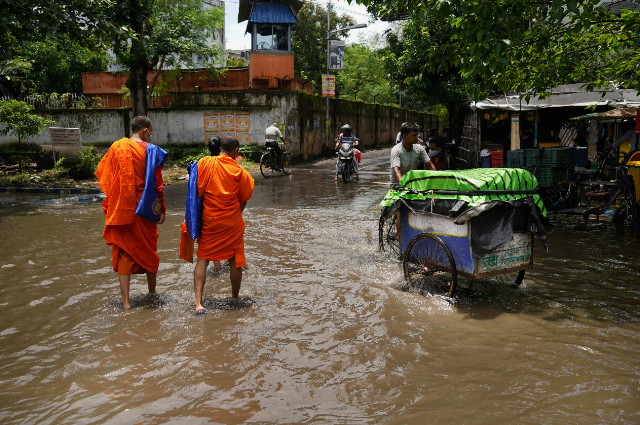
Photo by Dibakar Roy on Unsplash
India today stands at the epicentre of a global climate crisis. The nation is not just facing a future problem; it is in a state of clear and present danger. This danger is not an abstract forecast but a lived reality, a fact confirmed by India's own government and a powerful consensus of scientific and economic data. The threat is not singular but systemic, a "threat multiplier" where a warming climate compromises the nation's most fundamental systems: its water, its food, and the stability of its economy.
This perilous position is the result of a unique and precarious convergence of factors. First, India's geography a 7,500-kilometre monsoon-dependent coastline, the vast Himalayan "Third Pole" containing the world's largest non-polar ice mass, and massive, fertile plains, makes it exceptionally susceptible to climatic shifts. Second, this physical vulnerability is amplified by India's demographic and social reality: 1.4 billion people, a high density of poverty, and an economy still reliant on a climate-sensitive agrarian backbone.
This combination means that a single climate shock, a delayed monsoon, a scorching heatwave, or a catastrophic flood can set off a devastating chain reaction. This is not a hypothetical scenario. A landmark analysis by the Council on Energy, Environment and Water (CEEW) revealed a stark reality: over 80 per cent of India's population already lives in districts that are highly vulnerable to extreme climate-related disasters. This essay will argue that this combination of high vulnerability and high exposure places India in a unique state of existential danger. It will trace the cascading impacts of climate change from the mountains to the plains and coasts, quantify the staggering human and economic toll, and analyse the national response, revealing a critical paradox that lies at the heart of India's climate challenge.
The Cascading Crisis: From Unstable Mountains to Besieged Coasts
The foundation of India's climate danger is built on scientific fact, acknowledged by the highest international and national authorities. The Intergovernmental Panel on Climate Change (IPCC), the world's foremost climate science body, has stated that human-induced warming is unequivocally intensifying heatwaves, disrupting the monsoon, and accelerating glacier melt across Asia. This is not just an external warning. India's own Ministry of Earth Sciences (MoES), in its foundational "Assessment of Climate Change over the Indian Region," moved the discussion from speculation to government-acknowledged fact. The report confirms that India's average surface temperature has risen by approximately 0.7°C between 1901 and 2018. This seemingly small number has been enough to destabilise the complex systems that govern life on the subcontinent.
The most immediate consequence is the destabilisation of the Indian monsoon, the lifeblood of the nation's economy. The MoES report highlights a deeply concerning trend: a decline in summer monsoon rainfall of around 6% between 1951 and 2015. Even more dangerous than the simple decline is the change in its character. The monsoon is becoming more erratic, marked by long, agonising dry spells punctuated by short, violent bursts of extreme rainfall. This volatility leads to the devastating paradox of simultaneous floods and droughts, which the India Meteorological Department (IMD) confirms are increasing in frequency and intensity. This erratic rainfall is the first domino, setting off a cascade of crises across India's entire landscape.
This cascade begins in the Himalayas. Often called the "Third Pole," the Hindu Kush Himalaya (HKH) region is the source of Asia's ten major river systems, including the Ganges, Indus, and Brahmaputra, which provide water to over 1.3 billion people. This region is a climate "hotspot," warming faster than the global average. The primary danger here is the accelerated and irreversible retreat of its glaciers. This process creates a profound dual threat: one of floods in the short term, and one of scarcity in the long term. The short-term threat comes from Glacial Lake Outburst Floods (GLOFs). As glaciers melt, they leave behind vast, unstable lakes dammed by loose rock. A failure of this natural dam can unleash a catastrophic wave of water and debris, a primary and immediate hazard to all downstream communities. The long-term threat is one of "peak water." The seasonal meltwater from these glaciers is not a bonus; it is a critical component of river flow that sustains agriculture, especially during the dry, pre-monsoon season. This meltwater is used to irrigate the crops of an estimated 129 million farmers. The current increase in river flow from the accelerating melt is a deceptive bonus, a one-time withdrawal from a finite bank account. Once the glacier itself is gone, this reliable seasonal flow will permanently disappear, triggering a catastrophic drop in the base flow of India's great rivers and destabilising the entire Indo-Gangetic plain.
This instability flows directly downstream to India's food basket. The Indo-Gangetic Plain, which feeds hundreds of millions, faces a pincer attack from both extreme heat and acute water stress. Climate is the single most important determinant of crop productivity in India, where a staggering two-thirds of all cultivated land is rainfed and thus completely dependent on a predictable monsoon. First, the danger of heat stress is acute. India's staple crops, particularly wheat, are highly sensitive to temperature. The IPCC has warned that even a minor rise in winter temperature can significantly reduce wheat yields. Studies in Haryana, a key part of India's "breadbasket," confirm this, showing that even short exposures to high temperatures, which are becoming more common, can cause wheat yields to plummet. Second, the danger comes from water stress, which has created a critical and dangerous cycle of maladaptation. To cope with the warming temperatures and the newly erratic monsoons, farmers, particularly in the Punjab-Haryana breadbasket, have turned to the only reliable water source they have: groundwater. This has set a ticking time bomb.
This "adaptation" is, in fact, a "groundwater-climate doom loop." The process is circular and self-accelerating. Climate change (warming and erratic rains) reduces surface water availability. Farmers adapt by pumping massive amounts of groundwater to save their crops. This over-extraction is so intense that studies project groundwater depletion rates could triple by 2080. This intensive pumping is also incredibly energy-intensive. The Reserve Bank of India (RBI) notes that the agriculture sector consumes a massive amount of electricity and diesel, primarily to power 20 million water pumps. This energy use, sourced largely from coal and diesel, releases more greenhouse gases, which in turn accelerate the initial problem of climate change. The "solution" has become a driver of the crisis, accelerating both the depletion of India's water reserves and the warming of its climate, while contributing to the land degradation and desertification that the IPCC warns is a major threat in South Asia.
While the mountains and plains face a crisis of water scarcity, India's 7,500-kilometre coastline, home to 250 million people, faces a crisis of water excess. The nation's largest economic engines, including Mumbai, Kolkata, and Chennai, are all low-lying coastal cities directly in harm's way. The danger to the coast is twofold. The first is the "slow onset" threat: a permanent rise in the Relative Mean Sea Level (RMSL). Projections from India's own national oceanography institute are alarming, warning of a sea-level rise of up to 87 cm in some areas by 2100. The second, more immediate danger is the "acute" threat: the rise in Extreme Sea Level (ESL). This is what happens when the new, higher sea-level baseline is combined with storm surges from more intense cyclones, high tides, and heavy rainfall.
The impact on India's megacities is projected to be catastrophic. Research shows that Mumbai, Kolkata, and Chennai all face a high risk of catastrophic flooding. Mumbai, the nation's financial capital, faces "extensive flooding" in all emissions scenarios. But the true nightmare scenario for these cities is a "compound event." The IPCC and MoES warn that climate change is increasing the intensity of cyclones in the North Indian Ocean and the frequency of extreme rainfall events. The ultimate urban crisis is when these two events happen at the same time: an intensified cyclone brings a massive storm surge (ESL) from the sea just as an extreme rainfall event floods the city from the sky. The ocean, now higher than ever, blocks the city's stormwater drains from emptying. The rain, falling harder than ever, floods the city from within. This combined assault, which existing urban infrastructure was never designed to handle, represents a single point of failure. Beyond this spectacular danger, the rising sea also brings a silent crisis: saltwater intrusion. As the sea pushes inland, it contaminates the coastal freshwater aquifers, destroying drinking water supplies and rendering vast tracts of farmland sterile.
The Human and Economic Consequences
The consequences of this physical destabilisation are not abstract; they are measured in livelihoods lost, bodies sickened, and a national economy under threat. The climate crisis is, first and foremost, a public health crisis. The 2025 Lancet Countdown on Health and Climate Change provides shocking data on the human cost, particularly from the direct impact of extreme heat. In 2023 alone, India lost an estimated 181 billion potential labour hours due to heat exposure. This translated into a staggering USD 141 billion in potential income loss. This is not an evenly distributed loss; it disproportionately devastates the livelihoods of outdoor workers in the critical sectors of agriculture and construction, the very people with the least capacity to cope.
This is a "lost labour" poverty trap. Vulnerability reports confirm that the poorest people, such as daily wage labourers, are the most vulnerable to climate change. The Lancet data confirms that these same people are the ones most affected by heat. This creates a vicious cycle: the people most vulnerable to climate impacts are also the ones whose only means of adaptation (earning a living) is being taken away by those very impacts. They cannot work, so they cannot earn. They cannot earn, so they cannot build resilience, improve their housing, or afford better nutrition. The climate crisis is making it impossible for the poor to escape poverty, thereby deepening inequality.
This heat crisis is compounded by the "indirect" impacts on disease. Warmer, wetter conditions are creating "conducive environments" for vector-borne and water-borne diseases. The Lancet report found that the transmission potential for dengue (carried by Aedes mosquitoes) increased by 85% when comparing the last decade to the mid-20th century. This is accompanied by the re-emergence of chikungunya and the expansion of coastal water pathogens like Vibrio, which causes cholera. A 2°C temperature rise could expand dengue transmission into new, previously safe regions of northern India. This is all happening against the backdrop of an existing air pollution crisis, which is itself linked to climate change and is already responsible for an estimated 1.6 million deaths in India annually.
The micro-economic pain of lost labour and sickness scales up to a macro-economic threat that now endangers the entire Indian economy. The World Bank has been unequivocal in its warnings: in a business-as-usual scenario, rising temperatures and changing monsoon patterns could cost India 2.8% of its GDP and depress the living standards of nearly half its population by 2050. This threat has become so systemic that the Reserve Bank of India (RBI), the nation's central bank, now officially identifies climate change as a core risk to financial stability. The RBI's logic is based on a dual risk. The first is "Physical Risk": the direct, brute-force danger to the economy when a flood, cyclone, or drought hits. Banks and financial institutions have loaned billions to projects, homes, and factories that are physically located in harm's way. When a disaster strikes, those assets are damaged or destroyed, and the loans default. Urban flooding alone caused an estimated economic loss of USD 4.2 billion in 2023. The second is "Transition Risk": the more subtle danger that, as India and the world "transition" to a green economy, assets in carbon-heavy sectors (like coal power plants) could become worthless, triggering a wave of defaults that could destabilise the banks that financed them.
The World Bank's "hotspots" concept implies that climate change will cleave India into a "two-speed" economy. The report states that 600 million people live in locations that will become "hotspots" where living standards will actively decline due to falling agricultural yields and lower labour productivity. Critically, these areas are already "less developed" and suffer from "poor connectivity". Climate change will thus act as an "inequality accelerant." Resilient, well-adapted urban centres may continue to grow, while these vast "hotspots" identified as being in central, northern, and north-western India will see development reverse. This will create massive social and political instability as the economic gap between regions widens.
The final, and most profound, danger is the tearing of India's social fabric. Climate change is a crisis of inequality. As organisations like Oxfam have stated, climate change, poverty, and inequality are inextricably "linked". The poorest and most marginalised communities, who are the least responsible for the problem, are hit "first and worst". This is not a theory; it is a map. The Indian government's own National Climate Vulnerability Assessment, conducted by the Department of Science and Technology (DST), identifies the eastern states Jharkhand, Mizoram, Odisha, Assam, Bihar, Arunachal Pradesh, and West Bengal as the most vulnerable in the country. The drivers of this vulnerability are not just exposure to floods or droughts. They are socio-economic: low income, a high dependence on "weather-dependent livelihood activities" like small-scale farming, and "low adaptive capacity" (e.g., poor infrastructure, lack of financial capital).
When these two forces, high vulnerability and high exposure, meet, the inevitable consequence is displacement. Climate-fuelled disasters are already the number one driver of internal displacement globally, forcing an estimated 32 million people from their homes in 2022 alone. The World Bank's "Groundswell" report, the key study on this topic, projects that, globally, 216 million people could become internal climate migrants by 2050. This is not primarily about cross-border refugees; it is about internal migration within nations, as people are forced from their homes by acute disasters (floods, cyclones) and "slow-onset" events like drought, agricultural failure, and sea-level rise. This reveals a predictable "vulnerability cascade." A family in a "highly vulnerable" district in Bihar or Jharkhand is already on the edge. A single climate event, a "flash drought" or an extreme rainfall event, which the MoES confirms is now more frequent, wipes out that household's "weather-dependent livelihood". That family, having no financial capital and "low adaptive capacity", has no choice but to move. They become an internal climate migrant, likely moving to a precarious urban slum in a city like Mumbai or Delhi, which itself is highly vulnerable to urban floods, trading one form of vulnerability for another.
Conclusion
This report has demonstrated, through synthesised evidence from India's own government, international scientific bodies, and economic institutions, that the danger to India from its changing climate is not singular. It is a cascade. It begins as a scientific certainty, with a warming-fuelled, erratic monsoon, and flows through every artery of the nation's life. It is destabilising the Himalayan "Third Pole", placing the food basket in peril through a "groundwater-climate doom loop", and besieging the nation's coastal economic hubs with a compound crisis from both the sea and the sky. This physical cascade translates into a staggering human and economic toll. It is a public health emergency costing billions in lost labour and income, a systemic financial risk that threatens to cost 2.8% of India's GDP, and a social rupture that is accelerating inequality and creating a new, growing class of internal climate migrants.
Faced with this clear and present danger, India has developed a two-pronged policy response, but this response is defined by a deep and dangerous paradox. The national framework is built on the National Action Plan on Climate Change (NAPCC) and its international pledges, or Nationally Determined Contributions (NDCs). On one side of this paradox, India has achieved remarkable success. In the realm of mitigation (reducing emissions), India is a recognised global leader. Investment in clean energy is surging, and the country is on track to exceed its 2030 NDC targets for reducing emissions intensity and building non-fossil fuel energy capacity.
This success, however, masks the other side of the paradox: a critical failure in adaptation (preparing for and surviving the impacts that are already here). First, the IPCC AR6 report (the global scientific consensus) clearly states that all current NDCs submitted by all countries are not sufficient to prevent a 1.5°C breach, meaning the impacts will only get worse. Second, the impacts are already here. As CEEW's analysis showed, 80% of India's population already lives in highly vulnerable districts. Critiques of the national plan have found it was "more development-oriented," with adaptation as an afterthought. Crucial sectors for the poor, such as food security and housing, received "inadequate attention" in the policy response.
This reveals the "mitigation vs. adaptation" imbalance. India is, in effect, winning the global public relations battle on mitigation while losing the domestic war on adaptation. The successful headlines on solar power do not change the fact that five out of six zones in India have "low adaptive capacity" and that adaptation financing has been insufficient. The danger is not that India will fail to meet its 2030 climate targets; the danger is that those targets are insufficient to address the immediate, existential threat that is already displacing its people, destabilising its food and water systems, and draining its economy. India's national plans are linear, assuming a gradual, manageable increase in risk. But the climate system is non-linear. It contains "tipping points," or abrupt, irreversible thresholds. Studies have warned that the Indian monsoon itself could have two "stable states," its current wet state and a second, stable dry state and that it could, in theory, abruptly tip from one to the other. India's incremental policy approach is fundamentally blind to this non-linear, systemic, and existential threat. The ultimate danger is not that India will miss a future target; it is that the nation is not prepared for the reality that is already here.
. . .
References:
- Council on Energy, Environment and Water. Mapping India’s Climate Vulnerability.
- Intergovernmental Panel on Climate Change (IPCC). AR6 Synthesis Report.
- Ministry of Earth Sciences, Government of India. Assessment of Climate Change over the Indian Region.
- Lancet Countdown. India Policy Brief on Health and Climate Change.
- World Bank. South Asia’s Hotspots: The Impact of Temperature and Precipitation Changes on Living Standards.
- International Energy Agency. World Energy Investment – India.