
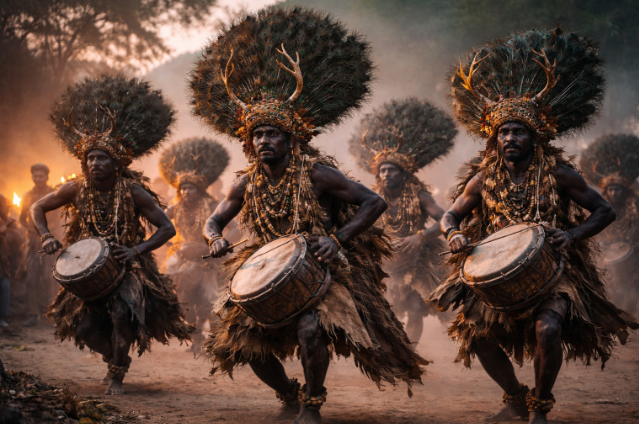
Journey into the Heart of the Gussadi Festival
As the harvest season draws to a close in the northern districts of Telangana, a palpable shift occurs in the crisp autumn air. The scent of woodsmoke mingles with the earthy aroma of the cooling land, and from the heart of the Adivasi gudems (hamlets), a new sound emerges. It begins as a distant, rhythmic pulse—the resonant beat of the dappu drum, an ancient heartbeat signaling the dawn of the Dandari-Gussadi festival. This is not merely a celebration; it is a profound spiritual metamorphosis. For ten sacred days leading up to Diwali, the communities of the Raj Gond and Kolam tribes enter a liminal space where the veil between the human and the divine thins, and mortal men are chosen to "become gods".
At the center of this vibrant tradition are the Gussadi dancers, figures of immense spiritual power and visual splendor. They are not performers in the conventional sense but are revered as sacred beings, living embodiments of deities who descend to bless the villages. To witness their dance is to step into a world where mythology is re-enacted, social bonds are forged anew, and the very essence of a community's identity is celebrated with every rhythmic step and percussive beat. This journey into the world of the Dandari-Gussadi festival is a multi-faceted exploration, revealing a premier cultural destination, a unique spiritual pilgrimage, and an opportunity for profound culinary immersion. It is an invitation to travel not just across landscapes, but across spiritual planes, navigating the path of a responsible and respectful observer.
The Land of the Gonds: Exploring the Cultural Landscape of Adilabad
The Geographical and Cultural Context
The heartland of the Dandari-Gussadi festival lies in the four northernmost districts of Telangana: Adilabad, Kumram Bheem Asifabad, Mancherial, and Nirmal. This region, cradled by the Sahyadri mountain range and nourished by the sacred Godavari River, is a land of breathtaking natural beauty. Its landscape is punctuated by spectacular waterfalls like Kuntala, the highest in the state, and the serene Pochera Falls, which form the stunning backdrop against which this ancient culture thrives.
This is the ancestral home of the Gond tribes, one of the largest tribal communities in the world, whose history is not one of isolation but of significant political power, having formed many kingdoms of historical importance. Their cultural practices are not quaint folk traditions but the living legacy of a people with a rich and sovereign past. The Adivasi calendar here is intrinsically tied to the rhythms of the earth, divided broadly between the agricultural season from June to November and a subsequent season dedicated to religious ceremonies and marriages. The Dandari-Gussadi festival marks the vibrant pivot between these two periods, serving as both a celebration for the culmination of the harvest and the sacred inauguration of the religious season.
The natural geography of Adilabad, however, is not a passive stage for the Gussadi festival; it is an active and essential participant. The entire celebration is framed by a pilgrimage that begins and ends at the Padmalpuri Khako shrine on the banks of the Godavari, where offerings are made directly to the river, acknowledging it as a sacred, life-giving entity. The very being of the Gussadi dancer is constructed from the local ecosystem. The magnificent headgear is woven from peacock feathers, adorned with the horns of deer and goats, and complemented by garlands of wild nuts and the hide of a goat worn across the body. The forest is, quite literally, worn by the divine dancer. Furthermore, the dance itself is a kinetic tribute to the local fauna, with movements explicitly imitating the gait and grace of the deer, the peacock, the rabbit, and the bison. Understanding this deep ecological integration elevates a journey to the festival. The waterfalls, rivers, and forests of Adilabad are not separate attractions on a tourist itinerary; they are interwoven into the same cultural and spiritual fabric as the dance, transforming a trip from simple sightseeing into a holistic eco-cultural experience.
The Celebration of Being God: An Immersive Experience of the Dandari-Gussadi
The Transformation: Becoming the Gussadi
The journey to becoming a Gussadi dancer, or Ghusark, is a sacred undertaking, not a casual performance. Men who wish to take on this role—often to fulfill a vow or pray for children—must formally declare their intent to the village headman (Patel). This commitment is a profound spiritual obligation, often lasting for a period of three or five consecutive years. The transformation that follows is both physical and metaphysical. The chosen men become Gussadi tados, their faces and bodies ritually smeared with sacred campfire ash known as Guru Neeru. As they don their elaborate, sacred attire, they shed their mortal identities and are transfigured into living deities, conduits of divine energy and blessing.
The Sound and Movement: A Masterpiece of Tradition
The arrival of the Gussadi troupe is heralded by a symphony of traditional instruments. The air vibrates with the resounding beats of the dappu and dhol drums, the high, sweet melody of the pepre (a shehnai-like wind instrument), and the complex rhythms created by the thudum, vette, dolki, kalikommu, and ghumela. The dance that follows is a mesmerizing spectacle. The Gussadi dancers, embodying the spirits of the wild, enter in a line, their movements energetic yet controlled, mimicking the animals of the forest. This is often contrasted with the Dandari dance, where a larger group of men forms a circle, tapping sticks together in a rhythmic kolattam performance. The coordination is seamless, guided by a call-and-response chant where a leader hums "Cha-choi Cha-choi" and the troupe responds with "chaah-ve" to signal a change in the routine.
The Social Spectacle: Kinship, Courtship, and Commentary
Beyond its spiritual core, the festival serves as a dynamic, living institution that reinforces the entire social fabric of Gond life. It functions as a mobile network of kinship, as troupes are obligated to travel from their home village to host villages, specifically visiting the homes where their sisters and daughters have been married. This annual ritual ensures that familial bonds remain strong and prevents the social fragmentation of communities spread across a wide geographical area.
Remarkably, the festival also functions as a "traditional matrimony festival". The vibrant, celebratory atmosphere provides a socially sanctioned space for eligible bachelors and young women to meet, interact, and express marital interest. The men's dancing prowess is a key element of this courtship, and it is estimated that around 100 marriages are finalized through these interactions each year, ensuring the continuity of the tribe. The festival is also a platform for contemporary concerns. Between the sacred dances, troupes may perform humorous skits that address critical issues facing the Adivasi community, such as the ongoing struggle for land rights, demonstrating a commitment to the community's future survival and justice. Thus, a traveler witnessing the festival is not just seeing a performance; they are observing the annual reinforcement of the spiritual order, kinship networks, and community continuity that form the three pillars of Gond society.
The Sacred and the Symbolic: Unveiling the Mythology and Rituals
The Gond Pantheon and Core Beliefs
The Dandari-Gussadi festival is deeply rooted in the cosmological beliefs of the Gond people. The rituals are centered around the worship of key deities, including Yethmasarpe, the god of the soul, and the revered goddess Jangu Bai. The festival officially commences with a puja dedicated to the sacred musical instruments and the divine entity Aethmasur pen, consecrating them for the days ahead.
The very identity of the Gussadi dancer is explained through a foundational myth. According to Raj Gond lore, the Ghusarks are personifications of the God of Creation. They originally served as divine protectors for the wedding procession of Yetma, the creator's daughter, when she married a Raj Gond hero and had to travel through dense, dangerous forests. The entire festival, with its traveling troupes of dancers, is a ritual re-enactment of this sacred, mythological journey, bringing that divine protection to every village it touches.
The Rigors of the Sacred Role
The transformation into a Ghusark demands extreme ascetic discipline. For the entire duration of the festival, which can last from ten to fifteen days, the dancers are considered pure embodiments of God. As such, they are expected to live in a state separate from mundane human life. They do not bathe, wash their faces, or sleep in a conventional bed. They carry a piece of deer or goat skin, the Paasudi, which serves as their only mat for resting. This rigorous asceticism is not for show; it is a profound spiritual practice that underscores their temporary separation from the profane world and their complete immersion in the divine.
The Pilgrimage: Beginning and End at the River
The entire festival is structured as a sacred pilgrimage. It begins with a visit to the Padmalpuri Khako shrine in Gudirevu village, located on the holy banks of the Godavari River. After nearly two weeks of traveling, dancing, and blessing the surrounding villages, the festival concludes at this very same sacred spot. This act of starting from and returning to a consecrated point grounds the entire celebration in a sacred geography. The festival culminates with the Kolabodi ritual, a final ceremony where the Gussadi tado reverently and ritualistically removes his divine attire, signifying the end of his sacred duty and his return to his mortal life.
The costume of the Gussadi dancer is not merely an outfit but a sacred assemblage of symbols, a wearable text that communicates the core tenets of the Gond worldview.
A Feast for the Senses: The Culinary Traditions of the Gondwana
The Foundation of Gond Food
The culinary traditions of the Gond people are a direct reflection of their sustainable, agrarian lifestyle and their intimate relationship with the land. The foundation of their daily diet consists of two hardy millets, kodo and kutki, which are typically prepared as a simple porridge or a dry cereal served with vegetables foraged from the forest or grown in small gardens. This reliance on millets underscores a food culture built on sustenance and ecological harmony. In stark contrast, rice is considered a luxury. It is reserved almost exclusively for festivals and special feasts, its consumption marking an occasion as sacred and celebratory.
This clear distinction between everyday food and festive food is a powerful indicator of the culture's authenticity and its remove from the mainstream tourism circuit. The food choices are dictated by tradition and seasonality, not by market demands. This is further evidenced by the general absence of commercial restaurants in Adilabad serving dedicated Gond cuisine. For a traveler, this means that accessing authentic Gond food is not a transaction but an experience of genuine cultural immersion. It cannot be passively purchased; it must be actively earned through community interaction and hospitality. The food, therefore, becomes a barometer of the authenticity of one's journey.
Tasting the Festival: Signature Dishes
A traveler fortunate enough to be welcomed into a village celebration will encounter flavors that are robust, earthy, and unique. One of the most remarkable dishes is the Kicad Roti, a special bread whose preparation is a ritual in itself. A simple wheat dough is pressed between two Camel Foot leaves and slow-cooked directly in the embers of dung cake charcoal. The leaves char and blacken, imparting an earthy, smoky flavor to the bread, which emerges with a crisp, cookie-like texture. Another staple of the festive plate is the fiery Bhedra Chutney, made from roasted tomatoes and a blend of spices, which derives its potent flavor from being hand-crushed on a traditional sil batta (grinding stone).
Other celebratory dishes include Paan Bada, which are savory urad dal balls simmered in a spiced gravy, and Bhramakass ki badi, crispy, deep-fried rolls of spiced chickpea flour spread on colocasia leaves. These meals are often accompanied by Mahua liquor, a potent local beverage distilled from the flowers of the Mahua tree, which is an essential element of any cultural celebration. The truest culinary experience is not found on a menu but in the act of sharing the paathi (festive food) from a communal plate, as the Gussadis do, an act of profound communion.
The Responsible Traveler's Path: Experiencing Gussadi with Respect and Awareness
Practicalities of the Journey
Embarking on a journey to witness the Dandari-Gussadi festival requires planning and a spirit of adventure. The gateway to the region is Adilabad town. The nearest major airport is Rajiv Gandhi International Airport in Hyderabad, approximately 280-340 km away, while Adilabad has its own railway station connecting it to the broader network. Accommodation options are primarily centered in the towns of Adilabad and Nirmal, where one can find a range of hotels and guest houses. The festival itself unfolds in the tribal gudems scattered across the tribal mandals of Utnoor, Jainoor, Narnoor, and Sirpur (U). Villages that have been noted for their vibrant celebrations include Mallapur, Pittabongaram, Keslapur, and Indravelly, offering potential starting points for exploration.
Navigating with Respect: The Principles of Sustainable Tribal Tourism
A visit to these communities is a privilege, and it must be approached with the principles of sustainable and responsible tribal tourism. This means prioritizing community well-being and cultural preservation over personal convenience. A powerful lesson comes from the work of filmmaker Jennifer Alphonse, who spent years documenting the Gussadi tradition. She made her initial visits to the villages of Keslapur and Indravelly without a camera, understanding that building trust and rapport was paramount. The Gonds, she noted, tend to "freeze" when a camera is immediately presented, and her patient, respectful approach eventually led to them welcoming her into their homes and sharing their sacred lores. This approach should be the guiding principle for any visitor, especially photographers.
Engaging with the community through proper channels is crucial. Hiring a local guide or connecting with community elders (Patels) can help facilitate a visit that is respectful and non-intrusive. The Integrated Tribal Development Agency (ITDA) at Utnoor, which has been involved in documenting and preserving the culture, may also serve as a valuable point of contact for guidance. The goal is to ensure that tourism supports the local economy and empowers the community without commodifying their sacred traditions.
The Guardians of Tradition and the Specter of Change
The preservation of the Gussadi dance has been the life's work of dedicated individuals. The most celebrated among them was the late Kanaka Raju, a master of the form who was awarded the Padma Shri, India's fourth-highest civilian honor, for his contributions. He spent over 40 years teaching the dance to hundreds of young men and was instrumental in establishing the Kanaka Raju School of Gussadi Dance in Adilabad to ensure the tradition's survival. His legacy is a powerful testament to the internal drive for cultural conservation.
However, the tradition exists in a world of constant change. Observers have noted the subtle "dilution" of ancient rituals, with the festival period sometimes shortening and modern elements, such as sunglasses worn with traditional attire or the use of DJ music systems, making an appearance. This presents a realistic picture of a culture in flux, grappling with the pressures of modernization while striving to hold onto its ancestral roots.
A journey into the heart of the Dandari-Gussadi festival is far more than a holiday. It is an opportunity to witness a profound expression of humanity's connection to the divine, the natural world, and the intricate web of community. It is a pilgrimage into a living, breathing culture that is navigating the delicate balance between a 4,500-year-old history and the inexorable pull of the 21st century. The final responsibility lies with the traveler: to approach this vibrant world not as a consumer of an exotic spectacle, but as a humble and respectful guest. By doing so, one can ensure that their presence is a force for preservation, helping to sustain the echo of this divine dance for generations to come.