
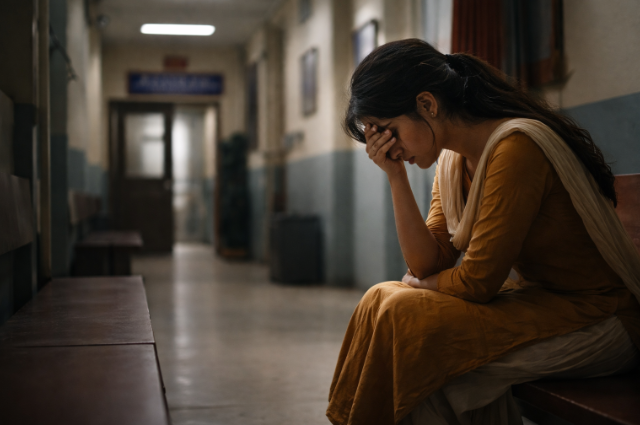
Sita was just nineteen when it happened. She was shocked, ashamed, and deeply hurt. It wasn’t a stranger in a dark alley or a dramatic act of violence that people expect when they hear the word “crime”. It was someone she knew. Someone her family trusted. When she finally gathered the courage to tell her mother, the response wasn’t anger or concern—it was fear. Fear of “what people will say,” fear of ruining the family’s reputation, fear of police stations and courtrooms that seemed far more threatening than the crime itself. The matter was quietly buried. No complaint was filed. No record exists to say that Sita was ever wronged.
Stories like hers are not exceptions in India—they are the norm. For every crime against a woman that reaches a police register, many more are absorbed into silence. National crime statistics may show rising numbers, but they fail to capture the countless women who never report abuse because the cost of speaking up feels higher than the crime itself.
For many women, reporting is not a step towards justice, but an invitation to judgment—by family members, neighbours, employers, and even authorities meant to protect them. Questions about character, clothing, timing, and intent often replace empathy. Long legal battles, low conviction rates, and economic dependence further discourage victims from seeking help.
This article looks beyond numbers to understand why crimes against women in India remain largely unreported. By examining social conditioning, institutional barriers, and lived realities, it seeks to highlight the human cost of silence—and why creating a safe space for reporting is as important as creating laws.
When silence feels safer than speaking:
Imagine a girl being raped and then having to live through the trauma of the same all ALONE. She knows whatever has happened to her is not her fault. Yet, she chooses silence. Yet, she chooses to keep this emotional burden within herself rather than speak up for herself. All because of FEAR. Fear that no one will even try to understand her and her emotions. Fear that everyone will make it a topic to gossip about rather than find real solutions. Fear that she would be judged for her morality, sense of clothing, character, and the time at which she comes back home. Isn’t it weird that instead of questioning the wrongdoer, our society is obsessed with continuously questioning and pointing fingers at somebody who has been wronged?
Thinking about it makes me angry, sad, and disgusted, all at the same time. Many women are often silenced from speaking up by their own families, and that’s something that completely breaks my heart. They’re ready for the victim who might be their mother, daughter, wife, or sister to suffer and go through so much, but they aren’t ready to fight a case and demand legal justice?
Family honour over Personal Trauma:
For many women in India, the first battle after experiencing a crime is not with the law, but with their own families. Long before a police complaint is considered, a quieter conversation takes place behind closed doors—one where fear and reputation often outweigh a woman’s pain.
In countless households, honour is treated as fragile, something that can be permanently damaged by the mere acknowledgement of abuse. A woman who speaks up is not seen as a survivor, but as a risk to the family’s social standing, to marriage prospects, to community acceptance. Parents worry about neighbours whispering, relatives distancing themselves, and future relationships being “ruined.” In this environment, silence is presented as protection, even when it comes at the cost of long-term emotional trauma.
Crimes that occur within familiar spaces are especially difficult to report. When the perpetrator is a relative, a neighbour, or even a husband, families often urge women to “adjust” rather than confront. Domestic violence is dismissed as a private matter. Marital sexual abuse is rarely recognised as abuse at all. Women are told that enduring suffering is part of their responsibility towards marriage, children, and family stability.
This pressure is not always imposed harshly. Often, it comes wrapped in concern. Families fear the emotional exhaustion of court cases, the humiliation of repeated questioning, and the possibility that the woman may not be believed. They fear retaliation, social isolation, and the financial strain that legal action might bring. In trying to protect their daughter, sister, or wife, they unknowingly invalidate her experience, sending a clear message: peace at home matters more than justice.
The psychological impact of this silencing is profound. Women internalize guilt, wondering if speaking up would truly destroy everything their families fear. Over time, trauma turns inward, manifesting as anxiety, depression, and a deep sense of helplessness. Many survivors later describe feeling as though their pain was acknowledged only if it remained invisible.
Cultural conditioning plays a significant role in normalising this silence. From a young age, women are taught to compromise, to endure, and to prioritise others’ comfort over their own safety. Reporting a crime is framed as rebellion rather than self-preservation. In contrast, families rarely worry about how a perpetrator’s actions affect honour—only how exposure might. As a result, justice becomes conditional. It is pursued only when the crime is severe enough, public enough, or impossible to hide. Everyday violence—emotional, sexual, psychological—remains buried under the weight of expectations.
Until honour is redefined to include a woman’s dignity and well-being, silence will continue to be mistaken for strength. True protection does not lie in hiding pain, but in standing beside those who speak, even when society looks away.
Victim Blaming- The Second Crime:
For many women, the trauma does not end with the crime itself. It continues—sometimes more painfully—through the questions that follow. Why were you there? What were you wearing? Why didn’t you say no? Why didn’t you report it immediately? These questions, often asked casually and without malice, become a second violation. This is victim blaming—the process by which responsibility subtly shifts from the perpetrator to the person who suffered the harm.
Victim blaming is deeply rooted in societal attitudes that expect women to constantly manage risk rather than expect men to control harmful behaviour. From an early age, women are taught safety rules: don’t stay out late, dress modestly, avoid certain places, and be careful around certain people. When a crime occurs, the immediate instinct is to check which rule was broken, rather than questioning why the crime occurred at all. This mindset makes violence feel conditional—as if it could have been avoided had the woman behaved “correctly.”
In police stations, courtrooms, and even hospital rooms, survivors often find themselves under scrutiny. Their statements are dissected for inconsistencies, their behaviour analysed for “red flags.” Delays in reporting are interpreted as lies, emotional numbness as indifference, and visible distress as exaggeration. Instead of empathy, they are met with suspicion. The unspoken assumption is clear: a woman must prove her innocence before the crime itself is believed.
This blame is not limited to institutions. Families and communities often participate in it unconsciously. Relatives ask why the woman trusted someone, why she didn’t resist harder, and why she “allowed” the situation to happen. Friends distance themselves, unsure of how to respond, or afraid of being associated with controversy. In extreme cases, survivors are labelled as attention-seekers or accused of falsely accusing men to “settle scores.”
The psychological consequences of victim blaming are severe. Survivors begin to doubt their own experiences. Many question whether what happened to them was “serious enough” to deserve help. Shame replaces anger, and silence feels safer than explanation. Studies consistently show that fear of not being believed is one of the strongest reasons women choose not to report crimes.
Victim blaming also protects perpetrators. When attention shifts to a woman’s choices, the offender’s actions fade into the background. Accountability weakens. Society becomes more comfortable questioning victims than confronting uncomfortable truths about power, entitlement, and gender-based violence.
Perhaps the most damaging aspect of victim-blaming is how normalised it has become. It is woven into everyday conversations, media reporting, and even legal processes. Headlines focus on the victim’s lifestyle rather than the crime. Public debates question morality instead of justice.
Ending victim blaming requires a fundamental shift—from asking women why they didn’t prevent the crime, to asking why the crime was committed in the first place. Until survivors are met with belief instead of doubt, reporting will remain an act of extraordinary courage rather than a basic right.
Police Stations as spaces of FEAR:
For many women, the decision to report a crime does not collapse because justice feels impossible—it collapses because the police station itself feels unsafe. What is meant to be a place of protection often becomes a space of fear, judgment, and emotional exhaustion. Long before any legal process begins, women imagine the experience of reporting: sitting across from unfamiliar officers, repeating painful details, and bracing themselves to not be believed.
For first-time complainants, especially young women, the atmosphere of a police station can be overwhelming. The physical setting—crowded rooms, raised voices, constant movement—offers little privacy. Survivors are often required to narrate deeply personal experiences in open spaces, sometimes within earshot of strangers. This alone is enough to deter many from walking through the door.
Fear is intensified by stories that circulate widely—of insensitive questioning, dismissive attitudes, or complaints not being taken seriously. Women hear of officers asking why they were out late, why they trusted someone, or why they didn’t resist more strongly. These questions, whether intentional or not, communicate suspicion rather than support. The crime becomes secondary to the woman’s behaviour, reinforcing the idea that reporting will invite humiliation instead of help.
Another major concern is the fear of retaliation. In cases where the accused is known to the survivor—a neighbour, employer, family member, or influential individual—women worry that filing a complaint may expose them to further harm. The perception that the police may not provide adequate protection, or that information may leak, makes silence feel safer than risk. For women in smaller towns or tightly knit communities, anonymity is almost impossible.
Delays and procedural complexity also play a role. Filing a First Information Report (FIR) can be a lengthy process, involving repeated visits, detailed statements, and follow-up questioning. For working women, students, or those with caregiving responsibilities, this time commitment is daunting. For others, especially those who are economically dependent, engaging with the police risks attracting unwanted attention that could destabilise their lives. Women from marginalised backgrounds face even greater barriers. Language differences, lack of legal awareness, and social power imbalances make interactions with law enforcement particularly intimidating. Migrant women, domestic workers, and women from rural areas often feel unheard or dismissed, reinforcing mistrust in the system.
The emotional toll of this experience is significant. Survivors describe feeling interrogated rather than supported, as though they are the ones on trial. Each retelling of the incident forces them to relive trauma, often without access to counselling or psychological support. Over time, many conclude that preserving their mental health requires letting go of the pursuit of justice.
When police stations inspire fear instead of confidence, underreporting becomes inevitable. The law may promise protection, but unless its first point of contact feels humane and safe, those promises remain distant. Transforming police stations into truly protective spaces requires more than policy—it requires empathy, training, accountability, and a shift from suspicion to belief.
Economic Dependence and Emotional Blackmail:
For many women, silence is not chosen—it is forced by circumstance. Economic dependence remains one of the strongest, yet least visible, reasons crimes against women go unreported. When survival itself depends on the very people causing harm, speaking up feels less like courage and more like self-destruction.
In countless households, women do not have independent income or financial control. Their education may have been cut short, their careers paused for marriage or caregiving, and their daily expenses controlled by someone else. In such situations, reporting abuse is not just a legal decision—it is a financial gamble. The fear is simple and terrifying: Where will I go? How will I survive?
This dependence is often reinforced through emotional blackmail. Families and partners frame silence as sacrifice. Women are told they are being selfish for wanting justice, ungrateful for questioning authority, or irresponsible for risking financial stability. Phrases like “Think about the children,” “Don’t destroy the family,” or “We have provided everything for you” are used to suppress resistance. The abuse is minimised, while the consequences of speaking up are exaggerated.
In abusive marriages, financial control is frequently used as a tool of power. Women may not have access to bank accounts, documents, or even basic cash. Threats of abandonment, eviction, or withdrawal of support are common. Reporting a crime in such conditions feels impossible when it could mean homelessness, loss of custody, or complete social isolation. Even educated women with prior careers struggle to re-enter the workforce after years of dependency, making the idea of independence feel distant and unrealistic.
Young women face similar pressures. Students who are financially dependent on their families are discouraged from reporting sexual harassment or assault out of fear of being blamed, restricted, or pulled out of education entirely. Families worry more about social fallout than the psychological well-being of their daughters. Silence becomes the price of continued support.
The emotional toll of this dependency is severe. Women begin to believe that enduring harm is the cost of stability. They measure pain against practicality, trauma against survival. Over time, self-worth erodes. Many survivors internalise the belief that they are a burden, that seeking justice would inconvenience everyone around them. What makes this situation particularly tragic is that economic dependence is often created by the same social structures that later blame women for staying silent. Society encourages women to give up careers for family, discourages financial autonomy, and then questions why they do not leave abusive situations. The lack of accessible shelters, legal aid, and long-term financial support only deepens this trap.
Breaking this cycle requires more than legal reform. It demands economic empowerment—access to education, employment, financial literacy, and support systems that allow women to choose safety without sacrificing survival. Until independence becomes a realistic option, silence will continue to feel like the only option.
Economic dependence does not erase trauma; it merely hides it. And as long as survival depends on silence, justice will remain out of reach for many women.
Workplaces where silence is a Survival Strategy:
For many women, the workplace represents far more than a job. It is independence, dignity, and often the first step toward financial security. This is precisely why harassment in professional spaces forces women into an impossible choice—speak up and risk everything, or stay silent and survive. Harassment rarely begins as an overt act. It enters quietly, disguised as casual comments, personal messages sent outside office hours, or “jokes” that cross invisible boundaries. When women consider reporting such behaviour, they are often met with caution rather than support. Colleagues advise them to be careful, to avoid conflict, and to remember who holds power. The message is unspoken but clear: the system is not built for you.
Power imbalance lies at the heart of workplace silence. Those who harass frequently occupy positions of authority—supervisors, senior managers, clients, or long-standing employees whose influence extends beyond their designation. For women early in their careers, on temporary contracts, or working in male-dominated sectors, this imbalance makes resistance feel dangerous. A complaint is not just a complaint; it threatens performance reviews, promotions, and even continued employment. Women fear being labelled unprofessional, oversensitive, or problematic. Instead of being recognised as survivors, they risk becoming liabilities. In many cases, the response to reporting is not justice but subtle retaliation—exclusion from key projects, hostile work environments, or forced transfers. The punishment is quiet, systematic, and difficult to prove.
Even where formal mechanisms exist, trust remains fragile. Laws may mandate Internal Complaints Committees, but implementation is often inconsistent and superficial. Many committees exist only on paper, lack independence, or are staffed by individuals with little training or empathy. Confidentiality is frequently compromised, turning private trauma into office gossip. In smaller organizations and family-run businesses, reporting feels like confronting the entire power structure alone. For women in informal or unorganised sectors—domestic workers, factory workers, interns, freelancers—there are often no mechanisms at all. Their employment is precarious, their voices easily replaceable. Harassment in such spaces is normalised as “part of the job,” and endurance is mistaken for professionalism.
The emotional cost of this enforced silence is profound. Women adapt by shrinking—avoiding certain spaces, changing behaviour, limiting ambition. They carry anxiety into meetings, fear into emails, and exhaustion into everyday interactions. Many eventually leave workplaces they once loved, not due to lack of capability, but because staying becomes psychologically unbearable. What makes this silence particularly damaging is its invisibility. It hides behind productivity metrics and professional appearances, leaving no record of the emotional labour women perform simply to feel safe. Until workplaces value dignity as much as performance, women will continue to choose silence—not because they lack courage, but because survival demands it.
Justice Delayed, Justice Denied:
For many women who do report crimes, the hardest part begins after the complaint is filed. What follows is not swift justice, but a slow, exhausting process that tests patience, resilience, and hope. Justice, when delayed endlessly, begins to feel like another form of punishment—one that quietly pushes survivors to question whether speaking up was worth it at all.
Court cases involving crimes against women often stretch across years. Hearings are postponed, witnesses fail to appear, evidence is re-examined, and legal procedures move at a pace far removed from the urgency of trauma. For survivors, each delay means reliving the incident repeatedly—through statements, cross-examinations, and recollections demanded by the system. Healing becomes impossible when closure remains distant and uncertain.
The emotional burden of prolonged trials is immense. Women describe feeling trapped in time, unable to move forward because the case follows them everywhere. Personal milestones—education, marriage, career changes—are overshadowed by pending hearings. Each court date revives anxiety, fear, and humiliation. Over time, many survivors grow emotionally numb, not because the pain has faded, but because carrying it for years becomes unbearable.
Low conviction rates further weaken faith in the system. When cases end in acquittals due to lack of evidence, hostile witnesses, or procedural lapses, survivors are left with a deep sense of injustice. The question that haunts many is not just “Why wasn’t I protected?” but “Why did I go through all of this for nothing?” This perception spreads quickly through communities, providing a clear warning to others: reporting may cost you everything, and still not deliver justice.
Economic and social pressures amplify this fatigue. Attending court hearings requires time, travel, and money—resources many women cannot afford indefinitely. Employers may lose patience, families grow resentful, and social support slowly erodes. In some cases, survivors are pressured into withdrawing complaints or settling privately, not because justice was achieved, but because endurance ran out.
What makes delayed justice especially damaging is the imbalance it creates. While survivors remain emotionally and socially tied to the case, accused individuals often continue their lives with relative normalcy. This disparity reinforces a sense of powerlessness, making the legal process feel less like protection and more like prolonged suffering.
Justice delayed does not simply postpone relief—it actively discourages reporting. Women watching these processes unfold learn an unspoken lesson: silence may be painful, but the pursuit of justice can be devastatingly slow. When the system demands endless resilience without offering timely resolution, it unintentionally rewards silence.
True justice must be timely, sensitive, and survivor-centric. Fast-track courts, consistent follow-ups, and trauma-informed legal procedures are not privileges—they are necessities. Until justice moves at a pace that respects survivors’ lives and healing, delay itself will continue to deny justice, long before any verdict is delivered.
From Laws on Paper to Safety in Reality:
On paper, India has no shortage of laws meant to protect women. Legal provisions address domestic violence, sexual harassment, stalking, assault, and workplace abuse. Guidelines are drafted, committees are mandated, helplines are launched, and amendments are passed after public outrage. Yet for many women, this legal framework feels distant—something that exists in books, websites, and press releases, but rarely in lived experience.
The gap between law and reality begins with awareness. Many women, especially in rural areas and informal work settings, are not fully aware of their legal rights or how to access them. Laws written in complex language, scattered across acts and amendments, remain inaccessible to those who need them most. Even educated women often know that laws exist, but not how to use them, where to go, or what the process will demand from them emotionally and practically.
Implementation is another major fault line. Institutions responsible for enforcing these laws often lack training, sensitivity, or accountability. Police officers may not be adequately trained in trauma-informed responses. Internal Complaints Committees may exist only on paper. Helplines may be understaffed or unresponsive. As a result, the first interaction a survivor has with the system frequently feels dismissive or procedural rather than supportive. When empathy is missing, the law itself begins to feel hostile.
For many women, safety is not defined by the existence of legal protection, but by whether they feel believed. Laws promise justice, but reality demands proof, endurance, and repeated explanations. Survivors are expected to narrate their trauma clearly, consistently, and calmly—often multiple times—while managing fear, shame, and emotional distress. When their responses do not fit expected patterns, credibility is questioned. In such moments, legal protection feels conditional rather than guaranteed.
Social realities further weaken legal impact. Families may discourage legal action, employers may quietly retaliate, and communities may isolate those who speak up. The law does little to shield women from these informal punishments. A woman may win a case and still lose social acceptance, employment opportunities, or emotional support. Safety, in this context, becomes more than legal protection—it becomes social survival.
The most painful contradiction lies in how laws are often reactive rather than preventive. Reforms usually follow extreme cases that capture public attention, but everyday violence remains unaddressed. Women navigating daily harassment, emotional abuse, or coercion rarely see the law intervene meaningfully in their lives. This creates a dangerous illusion: that protection exists only after irreversible harm.
Transforming laws into real safety requires more than legal texts. It demands accessible awareness, sensitive enforcement, economic and emotional support systems, and social accountability. It requires institutions that listen before they judge, protect before they question, and act before silence becomes permanent.
Until women feel safe approaching the law—not just protected by it—laws will remain symbols rather than safeguards. True safety is not measured by how many laws exist, but by how confidently a woman can rely on them when she needs them most.