
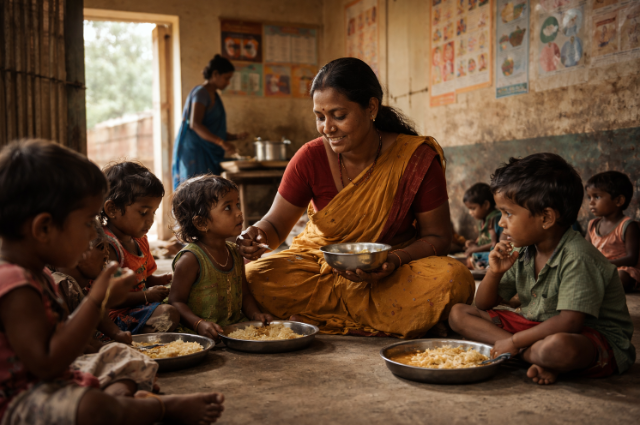
Anganwadi workers – millions of women across India – form the backbone of the Integrated Child Development Services (ICDS). Launched in 1975, ICDS was envisioned as a bold, nationwide effort to combat child malnutrition and support pregnant and lactating mothers through “six services” at the grassroots. Today, roughly 1.3 million Anganwadi workers (with over 1.2 million helpers) serve from 13–15 lakh centers nationwide. In villages and cities alike, these women staff centers intended to be mini crèches: they weigh and feed children, run preschool classes, distribute nutritious meals or take-home rations, counsel mothers, organize immunization drives, and maintain health and attendance records. In many areas, an Anganwadi centre is the sole source of nutrition and early education for local children; indeed, over 70% of eligible children enroll in these centres. As one union leader notes, Anganwadi workers are the “foot soldiers” of India’s child welfare scheme.
Yet despite this vital role, the reality for Anganwadi workers is one of relentless hardship and frustration. Their tale is woven into the stories of rural hardship, unfunded promises, and grassroots struggle. Across states – from Andhra Pradesh to Assam, Maharashtra to Manipur – workers labor daily under punishing conditions for paltry honoraria. Their lives mirror the struggle of the communities they serve. The Anganwadi story is one of hope – a promise of child welfare and women’s employment – and of hardship: chronic underinvestment, overwork, and persistent neglect by authorities.
A Day in the Life: Caring, Teaching, Documenting
A typical day for an Anganwadi worker begins early and ends late. By dawn, she has prepared the site – often a rudimentary shed or open courtyard – for the children. Throughout the day, she juggles roles: caring for infants, feeding toddlers, teaching preschool lessons, cleaning, collecting health data, and more. For example, an Anganwadi worker in Andhra Pradesh described waking at 6 am to clean the center, then overseeing preschool and meal times from about 8:30 am through the afternoon. She ensures each child gets a meal (often eggs and milk under schemes like PM POSHAN), helps with preschool learning activities, and tends to sanitation. Pregnant and lactating mothers are not overlooked: they receive take-home ration packets or supplementary cooked food. Workers also track growth – measuring and weighing each child – and log these figures meticulously.
In many states, record-keeping has grown burdensome. Anganwadi staff are required to update multiple digital portals: the Union government’s POSHAN Tracker app plus a set of state-specific apps (for example, nutrition projects, milk schemes, or ID verification). One worker in Vijayawada explained how she now photographs the cleaned bathroom, uploads children’s attendance and meals, and even uses a facial-recognition system to log each child’s presence. In some tribal hamlets, an Anganwadi worker might wear many hats: often, she is the only government health representative in the village. In Gadchiroli, Maharashtra, worker Chhaya Kagdelwar describes how, without her and one ASHA worker, “no one from the government is here”: if they stop work, “the cooked nutritious food for pregnant women, new mothers and children stops, and so do counselling sessions… take-home ration… and pre-primary education”. It is clear: their duties bridge gaps in education, nutrition, and primary healthcare, making them indispensable local leaders.
The range of services an Anganwadi worker provides can be summarized as:
- Nutrition: Distribute mid-day meals or take-home rations of grains, pulses, and eggs to children and expectant/nursing mothers.
- Pre-school Education: Conduct non-formal early childhood classes for ages 3–6, using simple teaching aids and activities.
- Health Monitoring: Weigh and record each child’s growth, maintain health cards, monitor immunization schedules, and refer sick children to clinics.
- Counseling & Outreach: Visit homes to educate parents on breastfeeding, nutrition, hygiene, and care of infants. Provide nutrition education and health messages to pregnant women and adolescent girls.
- Administrative Reporting: Maintain registers and files, often now digitally, recording attendance, food distributed, growth data, and scheme compliance.
In addition to these duties, Anganwadi workers often support census surveys or vaccination drives, and in many states, they helped run COVID-19 screening and quarantine enforcement in 2020–21. There is no strict eight-hour workday: if children demand it, the worker spends extra time tutoring or convincing parents. In practice, many report working 10 to 12 hours, including paperwork, plus chores at home. As one Maharashtra AWW (Anganwadi worker) notes, she works “nearly five hours in the anganwadi and another four hours at home for data filling and record-keeping”. There is typically no salary-grade relaxation: arriving a few minutes late can halve the day’s meager pay, with no leave or sick time.
Underpaid and Unrecognized: The Cost of Serving
For all this labor, Anganwadi workers are paid only an honorarium, not a true wage. Governments across India treat them as part-time volunteers or social workers. In this setup, there are no benefits: no pension, no provident fund (PF), no health insurance, no maternity or sick leave. Instead, workers receive fixed monthly honoraria, funded partly by the Centre and partly by state budgets. These sums are shockingly low given the scope of their work. In most states, a full-time Anganwadi worker’s pay is still closer to what a manual contract laborer earns, despite performing far more skilled tasks. For example, in Maharashtra (2023), workers start at just Rs 10,000 per month and helpers at Rs 5,500. A tribal worker from Pune, Shubhangi Shete, recounts joining ICDS in 2006 and still getting only Rs 10,000 monthly, “less than what a contractual employee in the government sector earns”. Helpers – known as sahayikas – receive even less, often around Rs 4,000–6,000, depending on the state.
This pay is below the prescribed minimum wage in many cases. Trade union research points out that a skilled frontline worker’s minimum wage should be well over Rs 12,000 per month (at current rates), yet Anganwadi workers in many states often earn far less with no cost-of-living adjustment. In Haryana, for example, the base honorarium was just Rs 4,000 per month during COVID times. Across the country, union leaders report that some states still do not even fully pay the meagre honorarium on time. In Delhi, for instance, only a promised raise from Rs 9,678 to Rs 12,720 in 2022 (for Anganwadi workers) actually materialized; in most places, main-centre AWWs still see only Rs 4,500–11,000 depending on local policy. One union leader tallies current pay: Tamil Nadu Rs 14,000, Kerala Rs 10,000, Madhya Pradesh Rs 10,000, Punjab Rs 9,500 – but Chhattisgarh just Rs 6,500!. Helpers in some states survive on as little as Rs 2,250 per month from central funds.
Beyond the low pay, formal recognition is lacking. For decades, Anganwadi workers were classified as “paraprofessionals” or volunteers, not as government staff. Only in recent years have courts and commissions begun pressing for regularization. A landmark Supreme Court ruling in April 2022 declared that Anganwadi workers and helpers are entitled to gratuity under labor law, explicitly rejecting the claim that “they are not full-time employees. The bench noted they render “all-pervasive duties” – cooking, preschool teaching, immunization support, and counseling mothers – and asked governments to improve their working conditions. But implementation has lagged. Many states have yet to grant gratuity or properly pay their central share. And even basic recognition as government workers (with PF, pension, and social security) remains elusive. Union demands – many echoed on protest placards – call for regularising Anganwadi workers as government Grade-III employees, granting minimum wages (Rs 26,000 per month as per 45th ILC recommendations) and pensions (Rs 10,000 per month). So far, these are still unrealized aspirations.
Pandemic Frontline: Another War to Fight
The COVID-19 pandemic laid bare both the resilience of Anganwadi workers and their vulnerability. When the nationwide lockdown hit in March 2020, almost 90 million children under six were abruptly left without access to creches or meals. Anganwadi centres were shuttered, but Anganwadi workers did not simply wait. They were redeployed as frontline volunteers in the crisis. From the start, they began going door to door to monitor health and hunger. A World Bank feature described how these workers went village by village: recording travel histories of returnees, noting flu-like symptoms, advising families to quarantine, and even mapping contacts. In Uttar Pradesh, for example, Asha Tripathi and her colleagues educated villagers not to violate lockdown orders. In Chhattisgarh, worker Amrika oversaw the quarantine of newcomers in her hamlet, informing the panchayat and counseling the returnees. Their mission: to ensure even the poorest and most remote communities understood COVID guidelines and continued to fight it.
Crucially, Anganwadi workers kept the nutrition network alive. Pregnant women, infants, and toddlers still needed food and care despite closed centers. Many AWWs arranged home deliveries of supplementary nutrition, take-home ration packets, and medical advice. Photographs from the time show AWWs standing in lines, handing out ration kits to families under trees or at doorsteps. Even when fear and stigma spread (some people shunned anyone near a known COVID patient), these women continued. One survey (Apr 2022) found 47% of frontline workers reported working longer hours during the pandemic, and many delivered more take-home rations (though almost no hot meals were given during lockdown). For instance, in most surveyed states, nearly half of Pregnant or Lactating women faced challenges getting any food from Anganwadis during the peak lockdown. UNICEF-backed reports noted some families in UP, Bihar, and Rajasthan experienced increased child weakness from missed meals.
The stress on workers was immense. By early 2021, 38% of surveyed Anganwadi workers reported increased stress levels (and 36% reported longer hours). They often lacked adequate PPE or sanitizer, yet they were expected to continue home visits. Payment delays added to anxieties: in Haryana, one worker borrowed money for a year during COVID only to be fired for protesting late wages, culminating in a hunger strike just for reinstatement. Still, many articulated a sense of duty. “If the doctors and nurses can leave their families and work day and night, why can’t we contribute in our own small way?” said Anita Devi of Jharkhand. UNICEF and other observers noted that the efforts of Anganwadi workers and ASHAs would not be forgotten once the pandemic passed. Indeed, for millions of mothers and children, these “COVID warriors” were the lifeline: providing medical referrals, delivering rations, supporting families through the crisis, all while being undervalued themselves.
Rising Voices: Strikes, Protests, Demands
Frustrations over pay, status, and conditions have repeatedly boiled over into collective action. In the last few years, anger has erupted from Delhi to Kerala, Assam to Andhra. In March 2022, thousands of Anganwadi staff marched on Delhi and Haryana demanding basic rights (wages, leave, pensions). Nationwide “Demands Day” rallies, organized by the All-India Federation of Anganwadi Workers and Helpers (AIFAWH) on July 10 each year, gather tens of thousands; in July 2024, around 2 lakh workers across 28 states demonstrated in unity. These protests often coincide with state budgets or legislative sessions, when unions submit lists of “11-point demands” to authorities.
The common demands are clear: a living minimum wage, full social security (pension, PF, insurance), gratuity implementation, and formal recognition as government employees. Unions cite the 45th and 46th Indian Labour Conference recommendations (2013, 2015), which called for scheme workers to earn at least Rs 26,000 per month plus a Rs 10,000 pension. They point to the Supreme Court’s call to “take serious note of [AWWs’] plight”, and to the central government’s own promises. For example, Prime Minister Modi announced in 2018 a raise in honorarium (Rs 1,500 for workers, Rs 700 for helpers) that never fully materialized.
State-level clashes have been particularly dramatic. In Andhra Pradesh (Dec 2023–Jan 2024), more than 100,000 workers went on strike for over 40 days, demanding better pay. At a major protest in Vijayawada, over 15 women lay fasting on stage (some requiring hospital care) to dramatize the cause. They demanded a monthly salary of Rs 26,000 (versus the existing Rs 11,500), as well as gratuity, leave, and pensions. After five weeks, and with national elections looming, the state government relented by agreeing to raise wages and offer insurance, finally ending the strike. Workers noted that their anger was not only at the state CM but also the Union government: federal budget cuts to ICDS had made local promises hollow.
In Maharashtra (Dec 2023), over 200,000 Anganwadi workers and helpers began an indefinite strike. Marches and sit-ins occurred from tribal Gadchiroli to urban Pune. On camera, Pune worker Shubhangi Shete explained, “Whether it is nutrition for mothers or teaching young children, we do it all… and yet I started in 2006, and I’m still paid Rs 10,000 a month – less than a contractual government employee – with no pension or gratuity. Union speakers demanded minimum wages and government status. In Gadchiroli, worker Chhaya Kagdelwar (quoted above) told officials that if AWWS stopped, all childcare stops – yet she and her helper work double shifts for Rs 10,000. The strike compelled talks with state ministers and union leaders, though even while negotiations proceeded, many planned mass protests in Nagpur if demands weren’t met.
Kerala saw a 13-day state-wide protest in March 2025. Grassroots workers held round-the-clock vigils in front of the secretariat, demanding similar issues (mainly salary hikes). The strike ended only after the state finance minister agreed to form a committee to study and resolve their issues within three months. This reveals a common pattern: months of agitation elicit only vague assurances of committees and studies, not immediate remedies.
Even in the north, tensions simmer. In Odisha (Nov 2025), thousands of Anganwadi staff rallied outside the state assembly. They presented an 11-point charter asking for government-employee status and higher pay: specifically, Rs 18,000 per month for workers (Rs 9,000 for assistants), plus Rs 5,000 pensions, official smartphones, etc. Union president Sumita Mohapatra warned that if assurances – already promised in past strikes – were not kept, another indefinite strike would be launched.
And in Telangana (Sep 2025), workers staged a dramatic “Chalo Secretariat” protest over the state’s new pre-school education policy, which they feared would abolish their jobs. Thousands chanted “CM down down” as they demanded the Congress government honor its 2023 promise to raise salaries to Rs 18,000 per month. They argued that federal NEP rules were being blindly followed, risking abandonment of ICDS. Police eventually detained many protesters, highlighting the tension: when Anganwadi workers demand their rights, they are often met with political stonewalling or even force.
Each protest has human stories behind it. One worker recalls borrowing money from neighbors just to scrape by when her honorarium was withheld during lockdown, then being fired for going on strike. Hundreds have been dismissed or suspended in some states simply for attending demonstrations – as many as 884 Delhi AWWs in 2022 – leaving children in those localities without care. Yet as one union banner put it, their struggle is “not just for us, but for the children and the scheme itself.” The consistent message: without Anganwadi workers, all the welfare schemes they implement would collapse.
Systemic Neglect: Funding, Policy, and Infrastructure
Behind these local battles lie systemic problems. Funding for ICDS has stagnated or shrunk, undermining even basic service delivery. Experts note that between 2014-15 and 2019-20, the real budget for ICDS and Mid-Day Meals fell by over 36%. For FY 2023-24, the allocated ICDS budget was only Rs 20,554 crore – a meagre 1% increase from the prior year. In effect, scheme payments are often delayed or cut. The Centre’s share of Anganwadi staff honoraria, meant to be reimbursed to states, has at times not been paid for months, forcing workers to strike or rely on partial state funding.
Financial shortfalls also hit the core services. Poshan (nutrition) tracker data released in 2025 shows that 37.7% of enrolled children are still stunted and 17.1% underweight. Even with years of ICDS, malnutrition is stubbornly high. The Women & Child Development Ministry contrasts real-time ICDS data against older surveys to show improvements, but the fact remains that over a third of children under six suffer chronic undernutrition. Workers and advocates argue that this is precisely why Anganwadi centers must be strengthened – rather than starved for funds. Unfortunately, policy moves like the 2020 National Education Policy threaten to poach pre-schooling from ICDS: by shifting Anganwadi preschools into government schools as “pre-primary”, states like Telangana have alarmed workers who fear losing their raison d’etre.
Meanwhile, infrastructure and logistics are weak. Many Anganwadi centers are makeshift: a veranda, a tin shed, or even an open field. Toilets, clean water, utensils, and cooking gas may be inadequate or absent. Workers often travel long distances on foot or on their bicycles to reach children in remote hamlets. During COVID surveys, lack of protective gear and the stigma of dealing with sick neighbors were frequently reported reasons for stress. One study noted that in almost all states, each AWC serves far more people than guidelines allow – the national norm is 800 people per centre, but actual averages run over 1,100. Overloading is exacerbated by high vacancies: when an Anganwadi worker is absent, nothing happens – unlike in a government school, there is no backup.
Policy gaps loom large. Although the Supreme Court has recognized Anganwadi workers as “workmen” entitled to labor rights, no central law yet enshrines their status. Unions routinely demand that regularization as state employees be enacted. The 45th Indian Labour Conference (2013) even recommended that scheme workers be given grade-III/IV status, with proper wages, pensions, PF, and ESI coverage – but these recommendations were never implemented. The government’s flagship POSHAN Abhiyaan (launched 2018) has pumped some attention (and smartphones) into ICDS, but these have been criticized as cosmetic without actual resource increases. In fact, large portions of nutritional funds continue to flow into aid, NGO grants, or tech pilots, while the frontline workforce is squeezed.
The Human Toll: Stress, Sacrifice, and Resilience
The human cost of these shortcomings is high. Anganwadi workers live with chronic anxiety about unpaid dues and guilt over any child or mother they cannot reach. The 2022 stress-survey found that over one-third of Anganwadi workers reported longer working hours than before the pandemic, and those in Tamil Nadu, Andhra, and Odisha saw stress jump above 60%. “When others got risk allowances and rush benefits,” noted one report, “we went unpaid and unprotected. Many women in the system are themselves from economically weak backgrounds; often, they had to take a personal loan to manage their household during the pandemic. The fear of losing even the small honorarium means workers rarely take leave – and suffer docked pay even when legitimately ill.
Yet through this, Anganwadi workers have shown tremendous dedication. Day after day, they help lift infants into their laps, memorize blessings in local dialects, and chart growth curves on scrapbooks – all while surviving on the edge of poverty themselves. Pregnant women and new mothers often hold them in high regard; the workers’ advice on feeding or cleanliness can mean the difference between life and death for a child. In Kerala, one center’s wheelchair-bound AWW arranged for food packets to be delivered during COVID, outwitting mobility challenges. In Odisha, a helper turned extra-nurse, assisting a midwife on more deliveries than she could count.
The profound social impact of Anganwadi work must be noted. By educating toddlers and feeding children, they arguably help build India’s future human capital. By counseling new mothers (often themselves illiterate village women), they spread critical health knowledge. By actively enrolling and following up on children with tuberculosis, anemia, or low birth weight, they save lives. Yet society has not yet acknowledged this fully. As a leader from the Delhi union puts it: “They are still treated as second-class citizens of the scheme” – entitled to neither recognition nor security.
Towards Recognition and Reform
The struggle of Anganwadi workers epitomizes a wider struggle: balancing India’s development goals against the need to care for the carers. The “path forward” demands both immediate fixes and systemic change. On one hand, governments must honour existing commitments: implement the Supreme Court’s gratuity order, raise honoraria substantially (at least to the level of formal minimum wages plus inflation), and pay pending dues. Several states have shown what is possible: Kerala and Tamil Nadu now offer modest pensions and insurance to scheme workers; Karnataka has raised AWW honoraria to Rs 10,000. Replicating such measures nationally would ease poverty among those who nurse our children.
Long-term, India needs to reimagine ICDS investment and architecture. Experts and activists call for making Anganwadis into fully-funded, full-time nurseries with proper buildings, kitchens, toilets, and materials. The proposed Right to Early Childhood Care and Education (ECCE) could enshrine Anganwadis as legal entitlements, not charity. Budget allocations must be hiked – the AIFAWH has demanded ICDS be allocated at least 0.5% of GDP (current is under 0.1%) – to ensure adequate food, staff, and facilities. Importantly, any pre-school reforms (like NEP’s 5+3+3 model) should integrate Anganwadi staff as educators, not replace them; their deep community trust and experience are invaluable.
Trade unions also press for social security: national pension schemes, ESI/health coverage for all AWWs and helpers, and institutionalized representation in policy bodies. They argue that a special Scheme Workers' Pay Commission should be formed to address their unique status. In budget sessions, Anganwadi and Asha workers have jointly lobbied for expanding universal healthcare and nutrition coverage – recognizing that a healthy frontline workforce is key to any public health strategy.
For society at large, the question is whether we see these women as fair-weather volunteers or as rightful architects of public welfare. The families they serve overwhelmingly trust them; when they speak of shortages, malnutrition, or demographic changes in their own villages, policymakers should listen. As the Economic Times recently noted, ICDS digital data shows vast numbers of children still failing basic nutrition indicators. It would be tragic to dismantle or devalue the very system battling those problems.
In the end, the real story of India’s Anganwadi workers is a story of devotion under duress. These women took the promise of ICDS to heart – that every child deserves nourishment and care. For decades, they invested themselves in that promise. Today, they ask the country: Will you invest back in us? The answer will shape not just their fate, but that of India’s children.