
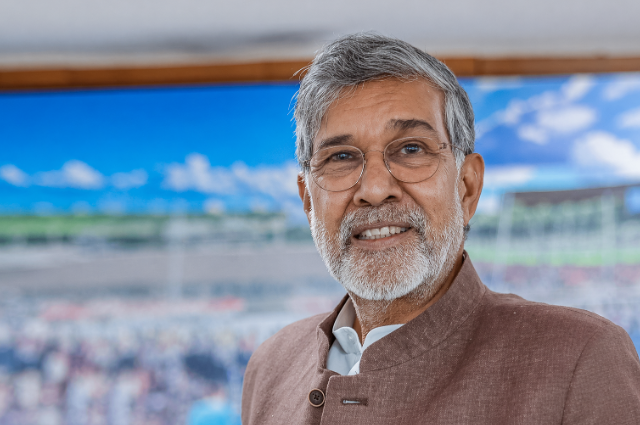
Kailash Satyarthi (born 1954) is an Indian social reformer who has led the modern struggle against child labour and for children’s education. He founded the Bachpan Bachao Andolan (BBA, Save the Childhood Movement) in 1980, pioneering mass raids on workshops and brick kilns to free bonded children from servitude. His advocacy culminated in the 1998 Global March Against Child Labour – a 100-country campaign that succeeded in prompting the ILO’s 1999 Convention No. 182 on the worst forms of child labour. In 2014, Satyarthi was co-recipient of the Nobel Peace Prize (with Malala Yousafzai) “for their struggle against the suppression of children and young people and for the right of all children to education”. His life and work illustrate how grassroots courage and policy advocacy can combine to advance human rights.
Child Labour: Scale and Legal Context
Child labour remains a pressing global and Indian problem. According to 2024 estimates by UNICEF and the ILO, about 138 million children worldwide were engaged in child labour in 2024, including 54 million in hazardous work. While this is down from 246 million in 2000, progress has been uneven. Asia-Pacific saw a sharp drop from 49 million to 28 million child labourers between 2020 and 2024, but the region still missed the SDG target to end child labour by 2025. The pandemic and poverty continue to drive many children into work rather than school.
India has one of the world’s largest populations of working children. Recent analysis (PLFS 2018–19) estimates 1.8–3.3 million Indian children aged 5–17 in child labour, depending on definitions. (For context, almost all Indian children are in primary school today, so any number of child workers is a concern.) About half of working children in India labour within their own families (often in agriculture), with roughly 50% in agriculture, one-third in industry and the rest in services. Notably, the UNICEF analysis found that the vast majority of Indian child labour (93–97%) is hazardous or involves long hours. These data indicate that poverty, social disadvantage and lack of schooling drive children into dangerous work.
In legal terms, India has banned child labour on paper, but enforcement has lagged. The Child Labour (Prohibition and Regulation) Act, 1986, first outlawed employment of children under 14 in “hazardous” occupations. However, Satyarthi and others criticised this law as too weak: it allowed many forms of child work and had insufficient penalties. After decades of advocacy (including BBA’s raids and mass mobilisations), India passed an Amendment Act in 2016 prohibiting almost all employment of children under 14. At the same time, India strengthened related laws: for example, the Right of Children to Free and Compulsory Education Act, 2009 (RTE) made education a fundamental right up to age 14, while the Protection of Children from Sexual Offences Act, 2012 addressed trafficking and abuse. Under Satyarthi’s influence, law enforcement began to better link child labour eradication with education rights. Nevertheless, implementation gaps remain: recent reports show continued child labour in sectors like garment-making and agriculture, often under the radar of official surveys.
Early Awakening and the Founding of BBA
Satyarthi’s activism had early roots. As a schoolboy in Vidisha, Madhya Pradesh, he was struck by social injustice: he formed a football club to raise tuition for poor classmates and ran a “textbook bank” so underprivileged children could share books. Over time, he encountered the fact of bonded child labour firsthand. Working briefly for a Hindu reform organisation, he read about caste-based exploitation and bonded servitude. In 1980, he formally left his engineering career to launch the Bachpan Bachao Andolan (BBA) – literally “Save Childhood Movement” – dedicated to rescuing exploited children.
From its inception, BBA took a confrontational, grassroots approach. Satyarthi and volunteers would descend on brick kilns, carpet workshops, glass factories and bangle-making units (often with police assistance), freeing children who were forced to work to repay family debts. These “raid and rescue” operations were dangerous; Satyarthi and his associates faced beatings, threats, and even assassination attempts. Nonetheless, the tactic saved lives. By the 1990s, BBA “claimed to have freed thousands of children” from conditions of bonded labour, moving them into BBA-run ashrams for shelter, education and rehabilitation.
BBA also pioneered the Bal Mitra Gram (“Child-friendly Village”) model. Starting around 2011, villages in which no children work and all are in school were certified as Bal Mitra Grams, with democratically-elected child assemblies and pledges against exploitation. Within a few years, roughly 350 Indian villages had adopted this model, demonstrating that community-level vigilance can eliminate local child labour. In sum, BBA’s strategy combined direct intervention with community mobilization: freeing individual children and changing the social norms that tolerated child labour.
Legal and Policy Reforms
Alongside field rescues, Satyarthi pursued legal and policy change. Between 1980 and 1986, he led dozens of protests and petitions pressing the Indian government to legislate against child labour. These efforts contributed to the passage of the 1986 Child Labour Act, India’s first comprehensive ban. However, Satyarthi viewed that law as inadequate, so BBA joined global campaigns to strengthen standards. Notably, Satyarthi was instrumental in the 1998 Global March Against Child Labour, which rallied millions of people worldwide and demanded an international treaty on child labour. The ILO responded by adopting Convention No. 182 on the worst forms of child labour in 1999 – the fastest-ratified ILO convention ever – effectively making forced labour, trafficking, sexual exploitation and hazardous child work illegal everywhere.
Domestically, Satyarthi pressed for Indian law to keep pace. As the Right to Education (RTE) Act was enacted in 2009, he argued that child labour laws should be updated to align with the new right to schooling. In 2012, he and BBA organised nationwide consultations and helped convince the Indian government to amend the Child Labour Act. In December 2012, Satyarthi testified before Parliament and rallied support to expand the ban on child work. By 2016, the Child Labour (Prohibition and Regulation) Amendment Act outlawed almost all employment of children under 14 (except in family enterprises with parental presence), and strengthened penalties. The new law also mandated government-run rehabilitation for freed children, reflecting Satyarthi’s emphasis that “rehabilitation [is] a key component” of child rights programs.
Beyond child labour statutes, Satyarthi influenced related reforms. Following the 2012 Delhi gang-rape case, he led a campaign that resulted in the Criminal Law (Amendment) Act 2013, which for the first time recognised human trafficking for labour (including child trafficking) as a distinct offence. He also engaged the Indian judiciary directly: in 2013, BBA won a Supreme Court order defining “missing children” and establishing protocols for investigating abductions, on the premise that many missing kids end up as hidden child labourers. These judicial gains, while less well known, demonstrate how Satyarthi’s activism extended into legal arenas to protect children from exploitation of all kinds.
International Leadership and Education Rights
Satyarthi’s impact was not confined to India. He helped organise the Global March Against Child Labour into a permanent international coalition and co-founded the Global Campaign for Education (GCE) in 1999. The GCE brought together NGOs, teachers’ unions and international agencies to make education a universal right. Under Satyarthi’s leadership, civil society pressures led to the inclusion of education as a fundamental right in India (the RTE Act 2009), and to ongoing campaigns ensuring governments worldwide invest in schooling.
Satyarthi also co-founded RugMark (now GoodWeave) in 1994, a pioneering certification scheme ensuring carpets were made without child labour. This was the first industry-led “child-labour free” label, which has since influenced ethical sourcing standards in textiles, mica, cocoa and other sectors.
His status as a human rights icon grew internationally. He addressed UN bodies, the ILO and parliaments around the world. In 2014, he and Malala shared the Nobel Peace Prize, which many hailed as overdue recognition for children’s rights activists. The Nobel announcement explicitly cited his fight against child labour and for education: “for their struggle against the suppression of children… and for the right of all children to education.”
Continuing Challenges and Legacy
Despite these advances, child labour persists. The UNICEF-ILO report of 2025 warned that at the current pace, global elimination of child labour will not be achieved by 2025. In India too, estimates of child labour remain in the millions (even if recent surveys report declines). Millions of children still work in agriculture, brick kilns, mines, textiles and domestic service. Girls’ unpaid household labour, in particular, is often invisible but can preclude schooling. As of 2025, experts agree India must significantly accelerate education access, poverty reduction and law enforcement to break the cycle of poverty and child labour.
Kailash Satyarthi himself underscores that the fight must continue. He frequently emphasises that rescuing each child is urgent – quoting his own words, “I know I haven’t done enough.” His ongoing work with the Kailash Satyarthi Children’s Foundation focuses on survivor empowerment and pressing governments to implement existing laws fully. The real measure of his legacy will be India’s success in fulfilling its constitutional promise that “the tender age of children shall not be abused” (Article 24) and that education is a right (Article 21-A).
In sum, Satyarthi’s life illustrates the interplay of moral conviction, grassroots action, and policy change. He took up the cause of “the children of India” when few others would, and he linked their emancipation to universal human rights norms. His example – of a citizen stepping into the breach on behalf of the powerless – shows how individual initiative can reshape society. As the Nobel citation implied, ending child labour and achieving education for all are bound together; Satyarthi’s work reminds us that treating children with dignity is both a moral imperative and a foundation for democracy. In his words, “We have to place children at the heart of the world.”
Sources:
- This article draws on Kailash Satyarthi’s biographical and Nobel Peace Prize materials, reports from UNICEF and ILO on child labour statistics, official Indian legislative texts, and analyses of child labour and education policy. Each citation above indicates the specific source of the information.