
Ghost Villages and Empty Fields
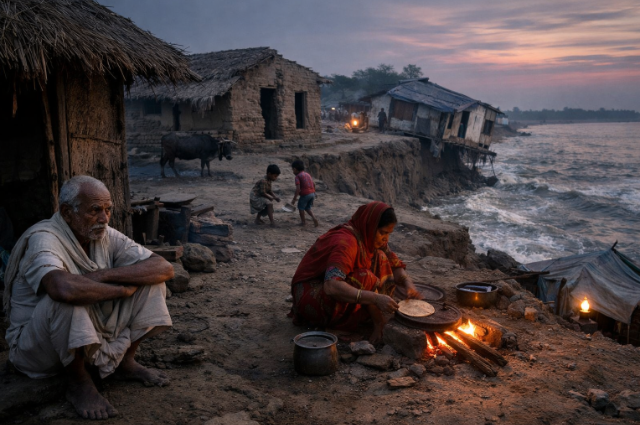
In the waning light of dusk, a small Bihar village lies silent and half‐empty. A lone woman cooks over a clay chulha while children play amidst partially ruined mud houses. Beyond the embankment, the Ganga roils and eats into the farmland. Monsoon floods have carved away whole lanes; once lively homesteads have collapsed into the river. An octogenarian named Sriram shakes his head: “We never imagined it could be this bad,” he says of Jawaniya, a village in Bhojpur where everything changed in one storm. He and other survivors now live in makeshift reed huts and tents along the high ground, clutching memories of sturdy brick homes and lush fields. “No ghar (house) remains — only the longing for it,” whispers Sandeep, a middle‐aged farmer whose family’s concrete house was left hanging precariously over a riverbank.
Across Bihar, such scenes are no longer rare anecdotes but an everyday reality. Dozens of once‐thriving villages now resemble ghost towns: yards overgrown with weeds, cattle tied to empty verandas, cooking pots drying in the sun. In one field, a boy studies his schoolwork by lantern light in a canvas camp; in another, a group of elders chat as summer heat breaks over barren rice paddies. In every direction, the exodus is clear. Newborn calves sleep alone as their migrant fathers toil in distant cities. These snapshots capture a larger transformation: rural communities hollowed out by relentless out‐migration.
Exodus from Bihar
Official data and surveys paint a stark picture. Bihar’s population is overwhelmingly rural — nearly 89% lives in villages — but an outsized share of its people spend their working years far away. By the last census (2011), Bihar was already the country’s second‐largest source of inter‐state migrants (after Uttar Pradesh). Subsequent studies show the trend accelerating. A 2020 survey by India’s Institute of Population Sciences found that more than half of Bihar’s households have at least one person migrating for work. Another recent rural study found that roughly two‐thirds of sample villages had at least one member living outside the state. In our impressionistic observations, nearly every hamlet of 100 homes has dozens of faded passport photos tacked to the wall — reminders of family members in Delhi, Mumbai, Surat, or abroad.
This migration is overwhelmingly labor migration, not grand relocation. Over 80% of migrating adults from Bihar go out primarily “for work,” as wage laborers or factory hands. Surveys show that most of these migrants are men in their prime working ages. (One sociologist notes that easily 85–90% of Bihar’s migrants are male.) Yet women and girls are also on the move — often marrying into cities or joining husbands where possible — especially in specific communities. By some measures, migration now touches almost every caste and class: seasonal maids, factory workers, construction laborers, and domestic help all carry Bihari origins.
Remittances have become a lifeline for many rural families. In villages still settling, nearly every migrant‐household bank account lights up with small wire transfers from cities. Local surveys show that over 90% of Bihar households with migrants receive remittance income, which on average makes up more than half of the family’s total income. In fields and tea shops from Madhubani to Patna, one hears tales of migrant uncles sending cash for school fees, daughters being educated on city wages, and even the family puja box now stocked from new earnings. Yet this money has its limits: it sustains people but does not necessarily revive livelihoods at home.
Why They Leave
The reasons are layered, but all are symptoms of a shrinking rural economy. Foremost among push factors is environmental strain. Bihar is India’s most flood‐prone large state. Every monsoon, back‐to‐back cyclones or Himalayan snowmelts send rivers into spate. Villages on the Kosi, Gandak, and Bagmati floodplains face repeated deluges and erosion. As one old farmer put it, “Flood doesn’t scare us; it is soil erosion that breaks our back.” In late 2025, rising Ganga waters abruptly swallowed Jawaniya in Bhojpur: over 200 homes, schools, and temples were swept away in hours. In survivors’ words, entire neighborhoods were “carved into pieces like cake” by the water. Every harvest is now a gamble with these shifting river courses; villagers run to higher ground with the first flash flood warning, often losing their paddy or home.
Meanwhile, even dry months offer no certainty. Bihar’s rainfed farms live under an unpredictable sky. Recent weather patterns have brought seasonal droughts across the northern plains: late‐onset rains, intense drought during peak planting, followed by torrential downpours that wash away fields. “For years,” explains a local NGO leader, “from June through September we get drought‐like conditions, then suddenly a wall of water.” The result is subsistence farming at best, with a growing number of failed crops. In such desperate years, small farmers and landless laborers have scant choice but to send workers out, often even before kharif sowing.
Joblessness is another relentless push. Most villages in Bihar have few industries or factories, and government jobs are rare. The average annual income per person is among the lowest in India. Subsidies and aid aside, a farmer’s typical earnings from rice or wheat barely clear pocket money. Young, educated people find themselves idle: local schools exist, but few firms absorb even those with intermediate certificates. This rural stagnation is painfully clear in an empty market in Gopalganj or Purnia: shops close by evening, tractors stand idle, youth drift in aimless circles. One recent survey of migrant households noted that 8 in 10 migrants were landless or owned under one acre. In villages where one extended family may own large tracts, the bulk of work accrues to those at the bottom of the social ladder. The landless now often see migration as not just an option but a necessity for survival.
Public services are also deteriorating, further driving people out. Education and health indicators in Bihar are among the country’s worst. Only about 61% of people can read and write — far behind the national average — and female literacy is especially low. Many villages have a brick school building but no teacher, or at most a single aide who cannot keep up with children who may also work in fields. Parents despair that even if school is available, it too often ends at middle age. “What good is a certificate if no job follows?” mutter elders who once prized schooling. Clinics and basic amenities are similarly sparse: piped water is a luxury in many panchayats, and tuberculosis and malaria still kill in remote hamlets. In such circumstances, people feel abandoned by the state; for thousands of families, the only lifeline is the faraway city.
Then there is social structure: caste and status disparities add another layer of pressure. Land and local power are concentrated in the hands of the upper castes or a few dominant families. Lower castes, tribes, and the very poor often cannot afford bribes for schemes or admission to new housing colonies. Many Dalit and minority households live in segregated hamlets and scrape by as farmhands. For them, migration is not just economic but social escape. Some elders recall that a decade ago, even farmers from higher castes migrated to Punjab or UP for harvests. Now, increasingly, young men from disadvantaged castes feel compelled to leave if anyone can find enough irrigation or work. In one village, we heard an animist farmer say his people “had exhausted savings”, and could no longer afford seed or fertilizer — another way of saying, “We must go.”
Roads to the City
Once the decision is made, the migration follows well-worn paths. Bihar’s youth and laborers flow along predictable corridors to booming regions beyond. Official data and ground research agree: over 90% of Bihari migrants travel out of state. Destination states fall into a handful of clusters. The richest draw is the rural north and west. About half of all migrants head to Punjab, Haryana or Delhi, states famous for intensive agriculture or industry. Punjab’s rice and wheat farms absorb thousands of seasonal pickers each year. Haryana’s construction sites and mills take many more. Delhi, India’s capital cluster, pulls in millions – it alone hosts nearly ten million migrants of which a large slice originate from UP and Bihar. In the west, Maharashtra and Gujarat are prime targets. Cities like Mumbai, Pune and Surat promise industrial or port work; in 2011, over one million Biharis counted Maharashtra as their destination. (Practically every “coolie contract” we saw from Madhubani says “Surat” or “Vadodara.”) Recently, even southern metros like Bangalore and Chennai have begun to host Bihari migrants, but to a much lesser extent.
Most migration from Bihar is circular but semi-permanent: workers will return home periodically, then head out again. A detailed survey in 2016 found the majority of migrants spend 10 months or more away. This means they live months at a stretch in distant towns, only coming home for brief sowing seasons or festivals. For example, one man from Sitamarhi explained that he plants rice in his paddy in summer, then leaves soon after Diwali to find work hauling bricks in Faridabad. Seasonal migrants make up the rest. These are usually the poorest: landless laborers, lower castes, and scheduled tribes who take whatever short-term day wages they can. They often move in groups to nearby states (such as Uttar Pradesh, or even as far as Assam for harvest work) for just a few months.
In a sense, every district has its favored routes. From Purnia and Araria (flooded highlands near Nepal), young men trek to Punjab’s fields each winter. From Madhubani and Darbhanga they stream to Delhi and Mumbai’s brick kilns. From Nalanda and Patna’s fringes, busloads pour into Bengaluru’s factories and Chennai’s ports. From Gopalganj and Siwan, workers often choose to go to Hyderabad or Pune. And all along, personal networks multiply the flow: uncles call nephews, neighbors help with travel money. Word of mouth is a stronger compass than any government scheme.
Life in the city is precarious. Yet migrants confess they endure it: living ten to a room, sleeping in open chawls, hiring out as day laborers for 300–400 rupees a day. They marvel that a three‐wheeler driver in Delhi might earn ₹15,000 a month, while daily wages back home are barely a fifth of that. But with rents of ₹4,000+ in small towns, even those incomes are stripped to the bone. Many migrants report spending nearly a third of earnings on food and shelter. An experienced labor activist notes: “Migrant jobs are almost always informal and dangerous — factories, construction sites, domestic work — yet migrants cannot bargain for better pay and live in constant fear of police harassment.” The young man in Mumbai’s slum holds on to one hope: if he saves even a little, maybe he can send his siblings to college back home.
Lives Left Behind
As men depart, villages change character. The fields are the first to feel the strain. In many places, the mills that process rice and tobacco now sit idle – too few hands to carry harvests. Large farmers sometimes rely on migrant relatives to till fields on rotation; smaller ones hire whatever local labor they can find, which is often only children or the elderly. Some plots simply go unplanted for lack of time or energy, contributing to a decline in local grain production. In extreme cases, cattle are sold off because no one is home to tend them to flowering fields. A 2018 study in drought‐hit Bundelkhand (central India) showed almost half the farmers leaving their lands. While Bihar’s situation is not uniformly as dire as parched Bundelkhand, similar reports come: many villagers wonder, “Who will till our land?” when nearly all able-bodied men are away.
Yet money circulates through the village in new ways. Stalls in local markets now accept MobiKwik and payTM numbers, and women often come around each month collecting remitted cash from brothers and husbands. Families spend it on household goods, kerosene, and private tuitions for their kids. Interestingly, many mothers report that remittances have improved their children’s schooling and health: one survey found that wives of migrants overwhelmingly see improvements in lifestyle, nutrition, and school attendance for their families. Teachers in rural schools sometimes spot a rise in mid-year admissions — families moving back temporarily with the harvest, then heading out again. So in one way, migration has become a source of development at home, channelling funds into villages that would otherwise languish.
The social effects are profound. Households are now split across distances. Children grow up with only one parent around, or sometimes with grandparents and a distant breadwinner. In dozens of villages we visited, the under‐ten age group is often composed mostly of girls: many boys are “pakka runners” (waiting out in cities). Married or soon-to-be-married women often see their husbands come home only once a year. This has shifted the gender balance at home. Many elderly women are now decision-makers, deciding farming plans and investments. One middle-aged matriarch in Sitamarhi told us she must now handle the family’s paddy, ration, and remittances alone — “It is my responsibility; when he returns, he will resume, but till then, I run everything.” Wives left behind report mixed feelings: they value the added autonomy and income but also lament the loneliness and labor. About 47% of these women are literate, and roughly a fifth work as farm or factory labor themselves. Most of them live in nuclear households and cope by daily phone calls — nearly three‐quarters chat with husbands every day by mobile. Still, only around 30% belong to local women’s self-help groups, showing that social networks can be weak without men to organize them.
Policy Failures
Why has no policy stemmed this exodus? One key answer is that the safety nets are broken. The Mahatma Gandhi National Rural Employment Guarantee Act (MGNREGA), India’s flagship rural jobs program, promised 100 days of paid work to any village laborer. But in practice, it rarely lives up to that promise in Bihar. Village committees report months-long wage delays, petty corruption, and unapproved stoppages. In one village, when a farmer protested that a nearby field was being used for MGNREGA work, the project was abruptly halted. A 2020 field study found many migrants unable to find any local work for four months straight — despite huge government COVID programs aimed at rural relief. One returnee in Araria, 57-year-old Raqib, describes his fate: “I stayed home expecting some work under MGNREGA, but nothing came. If my village cannot give me one day’s work in four months, what else can I do?” He eventually hopped a bus back toward Haryana, because even an exploitative 5,500 rupee-a-day harvesting job (split among a dozen men) was better than idleness at home. Stories like his are common: as soon as the jobs made available by the government dry up, migrants figure they might as well go chase daily wages elsewhere.
Budgetary constraints make matters worse. Even after the pandemic, Bihar’s real spending on rural schemes remains low. Despite having 32 of the 116 districts in the central government’s ‘Garib Kalyan’ scheme, Bihar used only 66% of the allocated funds for rural work by late 2020. Critics note that Kerala and other states similarly affected by COVID mobilized far more resources proportionally. Experts observe that simply ploughing a billion rupees into villages is not enough unless it reaches every hamlet fairly and builds skills for the future. On skilling, Bihar lags too. Vocational schools and apprenticeships are few; low-cost urban skills training has not percolated to the hinterlands. A college graduate in Muzaffarpur lamented that even computer or driver training were distant concepts for most rural youths. Without alternate livelihoods, the default response is migration.
On the policy side, other failures loom. Irrigation canals and rural infrastructure have been undermined by political inertia and neglect. Many panchayat roads still wash out each monsoon, isolating villages for months. Schools lose teachers who seek transfers out. Efforts at social harmony have also failed migrant households: an affront in neighboring Punjab (the celebrated “migrant hostel row”) showed that Bihari outsiders can quickly become targets of local frustration. Although that incident occurred in another state, it underscores the lack of institutional support for millions of Biharis living beyond home. If a Bihari migrant family in rural Bihar feels unprotected, where can they feel secure?
Crisis in the Countryside
The consequences of this silent exodus are unsettling to contemplate. If villages shrink, who will farm the fields that feed India’s cities? If only half the children remain, what happens to local schools and traditions? And if each successive generation grows up believing that life can only be lived in Mumbai or Delhi, India’s rural heritage will be irrevocably eroded. Some economists warn of a “degeneration of the rural economy”: farmland can lie fallow or be sold off, pushing agriculture toward corporate holdouts. Public health in villages may suffer as manpower drains: fewer people mean less chance of building clinics or even maintaining basic water and sanitation.
At the same time, cities will creak under the strain of absorbing ever more informal workers. We already see inner cities choked with slums, and migrants with nowhere to go when jobs vanish. The urban shelters overwhelmed during lockdown hinted at deeper crises to come. For the nation, losing its villages risks not just food insecurity but social fracture. Rural depopulation can worsen caste and regional divides; it can amplify distrust between “haves” and “have-nots”.
Yet these trends are not irreversible. Many analysts argue that a decisive change in rural policy is needed: genuine investment in Bihar’s irrigation, education, health, and small industries. They point out that under proper schemes, villages could become self-sustaining hubs instead of labor factories. Examples from other states suggest that when local work (roads, public buildings, agro-processing) is reliably available, migration slows. Strengthening MGNREGA to actually pay on time and expanding skill centers could keep more youth engaged at home. Crucially, Bihar’s own young politicians and planners must recognize that building rural infrastructure and creating rural jobs is as urgent as any city development.
What is at stake is profound. Every empty house and abandoned field represents not just a lost job, but the erosion of a way of life. India’s villages have been its backbone and reservoir of identity. If their people continue drifting away, India risks creating two nations: one urban and booming, the other stagnant and lonely. The story of migration from Bihar’s villages is more than just numbers; it is a warning. The clock is ticking for these villages. If the current flight is not halted, the cultural, economic, and human loss will be immense — and India’s planners will have forfeited the chance to keep its heartland alive. Only with urgent, sustained attention can the tide be turned; otherwise, the vanishing villages may well vanish into memory alone.