
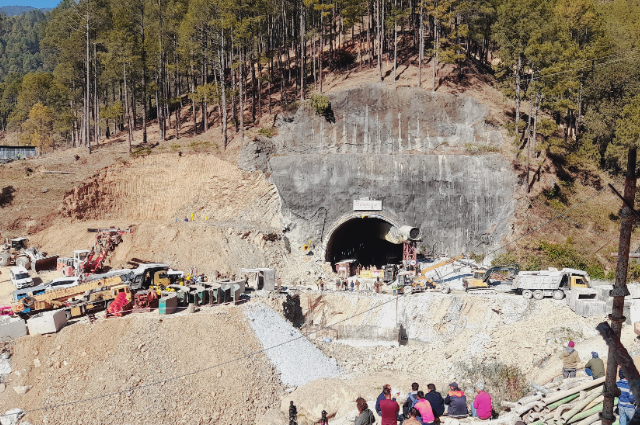
On 12 November 2023, a section of the under-construction Silkyara Bend–Barkot tunnel in Uttarakhand, India, collapsed, trapping 41 workers for 17 days. Despite mobilising multiple government agencies and ₹800 crore worth of imported drilling machinery, all mechanical rescue attempts failed. The breakthrough came from 12 rat-hole miners—workers from Dalit and Muslim communities practising a technique banned since 2014—who completed the rescue manually in 26 hours. This article analyses the incident as a case study in three intersecting failures: geological overconfidence in Himalayan infrastructure development, the absence of basic safety design, and the structural invisibility of India’s most marginalised labour. It argues that the Silkyara rescue, while celebrated as a triumph, exposes a pattern of institutional recklessness that remains unresolved.
The collapse of the Silkyara tunnel was not a random disaster. The tunnel, part of the ₹12,000-crore Char Dham Pariyojana highway project, was built along a major geological fault near the Main Central Thrust of the Himalayas—a known shear zone of brittle, unstable rock. Investigators later confirmed the structure had experienced 19–20 minor collapses during construction and was built without emergency escape shafts (Wikipedia, 2023). Seismologist C. P. Rajendran described it as “an example of shoddy construction that ignored the preliminary geological report” (Mervis, 2023). When 60 metres of debris sealed 41 men inside at 5:30 a.m. on 12 November 2023, the failure had been years in the making.
Seventeen Days: The Failure of Technology
Rescue efforts began immediately. A narrow pipe was drilled to supply oxygen, food, and medicine—keeping all 41 workers alive throughout. The primary strategy was horizontal augering: an American-made drill would bore a 900 mm escape pipe through the debris. It failed repeatedly. Iron lattice girders embedded in the rubble destroyed the drill’s blades on multiple occasions. By Day 13, Arnold Dix—president of the International Tunnelling and Underground Space Association—confirmed the verdict: “Augering is finished. The auger is broken. It is irreparable. There will not be a new auger” (Odisha TV, 2023). Five parallel agencies pursued vertical and horizontal alternatives from different angles; all encountered setbacks in the fractured Himalayan geology (UAOA, 2024). After 16 days, every engineered solution had been exhausted.
The Rat-Miners: Twenty-Six Hours
On 27 November, a team of 12 contract labourers—led by 45-year-old Wakeel Hassan and including Feroz Qureshi, Munna Qureshi, Rashid Ansari, and others—was called in (The Citizen, 2023). Most were from Dalit and Muslim communities in Uttar Pradesh. They had purchased their equipment before leaving Delhi: two shovels, four spades, 14 iron taslas (shallow scooping bowls), and a four-wheel trolley, for a total of ₹10,000 (The Print, 2023). Working inside an 800 mm pipe, they used chisels and gas cutters to dismantle the iron girders that had stopped the auger. They passed debris backwards by hand, using wet towels over their noses to breathe through the dust. At 8:50 p.m. on 28 November 2023, all 41 workers were evacuated. What ₹800 crore of machinery could not do in 17 days, 12 men with ₹10,000 of hand tools accomplished in 26 hours.
Mohammed Rashid, who worked six continuous hours inside the pipe, captured the episode in a single sentence: “Isme mazdoor bhaiyon ko unke mazdooro bhaiyon ne nikaala”—the labourers were rescued by their brother labourers (The Hindu / Inkl, 2023). It is the most precise account of what happened at Silkyara, and the one that received the least media attention.
The Invisible Labour: Who Are Rat-Hole Miners?
Rat-hole mining involves extracting coal from narrow hand-dug shafts—passages barely wide enough for one person. The National Green Tribunal banned the practice in 2014 as unscientific and hazardous; fifteen miners died in a Meghalaya rat-hole mine in 2019 after being trapped underground for nearly a month (The Citizen, 2023). Those who continue the practice do so because no alternative employment is available to them. They work without insurance, safety equipment, healthcare, or guaranteed wages. After the Silkyara rescue, Chief Minister Dhami announced ₹50,000 per miner. Neta ji called them “rajas of rat mining.” Nobody discussed their daily wages, their health, or the structural conditions that made their occupation necessary. As Naseem Malik, one of the team members, observed: “We are always underground, so not many people know about us” (The Print, 2023). The Silkyara rescue made them visible for a week. The cameras then moved on.
Accountability and Unresolved Questions
The post-rescue policy response included new tunnel safety guidelines from the Ministry of Road Transport and Highways and a five-member investigative panel. Critics noted, with reason, that comparable guidelines had existed before Silkyara and had not prevented the collapse (Sanskriti IAS, 2023). Environmental scientist Ravi Chopra—former chair of the Supreme Court’s Char Dham oversight committee—identified the root cause plainly: governments prioritise completing projects “with the least amount of money and in the shortest time,” leaving geological surveys as administrative formalities rather than genuine risk assessments (SANDRP, 2023). In April 2025, a breakthrough was achieved, and the two tunnel ends finally met (Wikipedia, 2023). The tunnel will open. Whether the institutional culture that produced the collapse has changed is a different, and still open, question.
The Silkyara tunnel rescue is a real story with two faces. The first is the one that was celebrated: 41 men saved, a nation united, perseverance rewarded. The second is more difficult to celebrate: a preventable collapse caused by ignored warnings, ₹800 crore of technology that failed, and a rescue delivered by 12 men whose occupation is illegal, whose communities are marginalised, and whose heroism was acknowledged briefly before the structural conditions of their lives were returned to invisibility. The lesson of Silkyara is not that human ingenuity can overcome any crisis. It is that a society cannot indefinitely rely on the desperation of its most disadvantaged workers to compensate for the failures of its institutions. Rashid does not want his children to work underground. That wish, and what it would take to honour it, is where the real story of Silkyara continues.
References
- British Safety Council India. (2023, December 8). Himalayan tunnel collapse: Safety in the spotlight. https://www.britsafe.in
- Mervis, J. (2023, December 14). The Indian government ignored repeated warnings from scientists before the massive tunnel collapse. Science. https://www.science.org
- Odisha TV. (2023, November 25). Auger is finished, it’s irreparable [Video report]. https://odishatv.in
- SANDRP. (2023, November 15). Nov 2023 Uttarakhand Barkot-Silkyara tunnel disaster: Where is the rescue plan? https://sandrp.in
- Sanskriti IAS. (2023). Road tunnel safety norms after the Silkyara incident. https://www.sanskritiias.com
- The Citizen. (2023, November 30). Silkyara tunnel rescuers are national heroes, not ‘rat-miners’. https://www.thecitizen.in
- The Hindu / Inkl. (2023, November 30). On all fours in ‘rat holes’, the heroes of Silkyara scrape by on the margins. https://www.inkl.com
- The Print. (2023, December 4). Rajas of rat mining, heroes of the Himalayas, have no insurance, safety gear or social dignity. https://theprint.in
- UAOA. (2024, April). Silkyara tunnel section collapse: A case study. Uttarakhand Academy of Administration. https://uaoa.gov.in
- Wikipedia. (2023). 2023 Uttarakhand tunnel rescue. https://en.wikipedia.org