
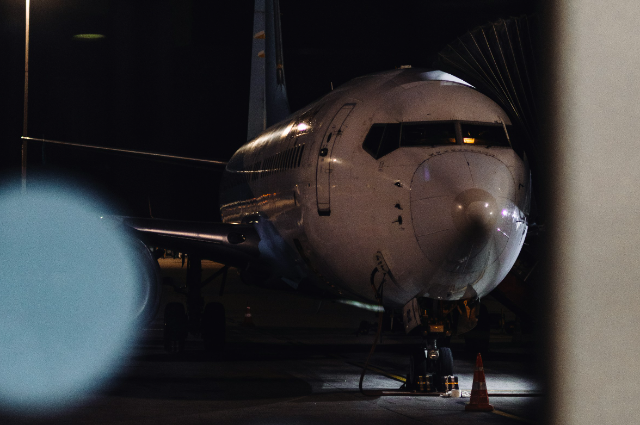
Photo by Divyadarshi Acharya on Unsplash/ Representative Image
The Hijacking
On 24th December 1999, Indian Airlines flight IC 814 took off from Kathmandu. This flight was headed to Delhi. It usually takes 2 hours to fly from Kathmandu to Delhi. But the passengers and crew members on this flight were unaware that for them, reaching Delhi would take a much longer time. 5 people hijacked this plane. These hijackers asked for $200 million from the Indian Government to free the passengers. They had some additional demands as well, such as releasing some terrorists from jail. The entire country held its breath for the next 7 days and watched this unfold on its television screens. This hijacking was the biggest in Indian history, and the last plane hijacking. Fortunately, since then, no other plane has been hijacked in India. Let's understand this entire incident in detail.
Hijacking Begins
On 24 December 1999, an Indian airplane flying from Kathmandu to Delhi was hijacked. The plane was carrying 11 crew members and 179 passengers. A little after this flight took off from Kathmandu, the passengers of this flight were served food. And while they were having lunch, suddenly, 4 masked men stood up and started taking away the food. They announced that the plane had been hijacked.
Flight Diverted West
The hijackers went into the pilot's cabin, and with Capt Devi Sharan at gunpoint, he was instructed to keep flying westwards. Actually, the hijackers wanted to take this plane to Pakistan. So this plane kept flying beyond Delhi towards Pakistan.
Specifically, to Lahore's airport. But the Pakistani air traffic controllers in Lahore strictly forbade the flight from landing in their territory. On the other hand, the Indian air traffic controllers came to know about this hijacking at 4:40 PM.
And interestingly, our incumbent Prime Minister Atal Bihari Vajpayee, and his Principal Secretary Brajesh Mishra came to know about this one hour later, at 5:20 PM. At 06:04 PM, the Indian air traffic control tried to establish communication with flight IC814.
Denied Landing in Lahore
Capt Devi Sharan tells them that the plane was running low on fuel. And they weren't permitted to land in Lahore. The captain requests that the Indian air traffic control ask their Pakistani counterparts to permit them to land in Lahore.
Because the hijackers were getting frustrated. The hijackers were threatening to kill the passengers if they weren't allowed to land in Pakistan. At 6:30 in the evening, the Indian High Commission in Pakistan requests Pakistani authorities to allow the plane to land in Lahore.
But they weren't granted permission. Meanwhile, Capt Devi Sharan tried to talk to the hijackers to tell them that the plane was running low on fuel, and that they couldn't keep waiting for permission. They had to land somewhere and refuel.
Emergency Landing in Amritsar
He proved successful in convincing the hijackers. And the hijackers agree to have the plane land in Amritsar for refuelling. At 6:44 PM, the flight starts descending towards Amritsar.
The hijackers did not want this to happen. They had hijacked an Indian plane, and to have it land in India would give a huge upper hand to the Indian government and authorities. In this crisis, this situation was very advantageous for India.
The Indian forces could now get better control over the situation because the plane was about to land in India. But what happened next turned out to be a historic blunder.
Amritsar Blunders
What did the Indian authorities do wrong? There was not one, but several mistakes. At 7:01 PM, the flight landed at Amritsar airport. Immediately, they request that the flight be refuelled.
Amazingly, Punjab's Director General of Police, Sarabjit Singh, was informed about this hijacking 1 hour earlier, around 6 PM. And not through other official sources, but through the TV news. Can you imagine the scale of the communication failure here? Such an important officer got to know about this hijacking while watching TV.
Crisis Management Fails
After this hijacking, a crisis management group was formed. And a local committee to delay the plane as much as possible.
This would allow more time for the commandos to develop a strategy and to conduct some operations on the ground. But the hijackers on the plane refused to communicate with the local police officials. They wanted to communicate with the officials in Delhi.
But this communication couldn't be effective. Captain Devi Sharan requested again to have the plane refuelled. If it wasn't refuelled, the hijackers were threatening to attack the passengers. They would start killing the passengers.
First Passenger Attack
5 minutes passed. 10 minutes. 15 minutes. No refuelling was initiated. Hijackers actually attacked a person. Satnam Singh. They used a knife to injure his neck.
Once again, Captain Devi Sharan requested to refuel the plane immediately. 40 minutes pass like this. By 7:45 PM, the Crisis Management Group formulated a plan and gave orders to the Punjab Police.
They decided to take advantage of the fuel tanker fuelling the plane to hide some officers of the Punjab Police so that they could go and puncture the tires of the plane. With damaged tires, the plane would not be able to take off again.
Failed Tire Plan
It was a good plan, but before this plan could be brought into action, the ATC came up with another plan. Why not place a fuel tanker in front of the plane to block its way? So a fuel tanker started moving towards the plane.
But the driver of the fuel tanker was driving it a bit too fast. So the ATC was worried that the speed of the tanker might tip off the hijackers that they were planning on doing something. So the driver was asked to drive slowly.
And the driver, due to miscommunication or something else, suddenly stopped the fuel tanker. The hijackers and the captain in the cockpit of the plane saw this happening. The hijackers were shocked to see this.
Takeoff from Amritsar
First, the tanker was moving towards them so fast, and then it stopped suddenly. They figured out something was wrong. This frustrated the hijackers. They gave up on refuelling and wanted to take the plane back into the air. Without refuelling.
Captain Sharan was pressurised into having the plane take off by ignoring the fuel tanker, even if it meant hitting it. They wanted the plane to be airborne. Under pressure, Captain Sharan prepared to have the plane take off.
NSG Arrives Too Late
While speeding on the runway, he barely avoided hitting the fuel tanker in front of them. There was almost an accident. But it didn't happen, and once again the plane was in the air. This happened exactly at 7:49 PM. The moment when the NSG commandos reached the airport. The operation backfired terribly. The NSG Commandos didn't get the chance to take any action. And most importantly, the plane was still not refuelled.
While taking off, Capt Devi Sharan sent a message to the ATC. "We are all dying." Lahore is just 50 km from Amritsar. Once again, this flight turned towards Pakistan.
Forced Landing in Lahore
Once again, the ATC in Pakistan denied permission to land this plane in Lahore. They were worried that the hijackers would force the pilots to land the plane in Lahore. So all lights were turned off at Pakistan's airport.
All the navigational aids and lights in the airport were turned off. So that even if they wanted to land the plane, it would be exceedingly difficult without lights. But Capt Sharan was under so much pressure from the hijackers, he couldn't care whether the runway was visible or not.
He had to land the plane, no matter where it was. The plane descended slowly, and suddenly, Capt Sharan realised that they were about to crash land on a highway. Seeing this, he made a final request to Pakistan's ATC. That they will crash land on the highway if they weren't allowed to land at the airport. Hearing this, finally, the ATC at Lahore agreed, and this plane landed in Lahore at 8:07 PM.
India tells Pakistan's Airport Officials to prevent this plane from taking off again. India planned to send the Indian High Commissioner in Islamabad, G Parthasarathy, to negotiate with the hijackers.
Lahore Refueling and Standoff
At this airport in Pakistan, this plane was finally refuelled. And to prevent this plane from taking off once again, the lights were turned off once again. And their commandos surrounded the plane. Apparently, the Pakistani forces tried to negotiate with the hijackers.
They asked them to release the children and female passengers. But these negotiations failed. Hijackers were frustrated that their negotiations couldn't reach a solution. Their demands weren't fulfilled.
Second Passenger Killed
Another passenger was attacked. Rupin Katyal. A 25-year-old man from Gurgaon is returning with his wife from their honeymoon. Rupin passed away later. Pakistan was tasked with providing a helicopter to the Indian High Commissioner. So that he could reach Lahore for the negotiations as quickly as possible.
But the helicopter was provided 3 hours late. By the time he reached Lahore, he found that the plane had taken off once again. How was this possible when all the lights at the airport were switched off?
Departure to Dubai
And the plane was surrounded by the Commandos, how could the plane still take off? We do not have much information about this. But we get some clues later on in the story. The flight was directed from Lahore to Oman. But even there, their permission to land was rejected. The next landing of this flight was at Dubai's Al Minhad Air Base.
Around 3:00 AM, after relentless negotiation, the hijackers finally released 26 passengers here. A special relief aircraft of Indian Airlines was called to Dubai to take the passengers back to India.
Passenger Insights from Dubai
The then Civil Aviation Minister Sharad Yadav was present on this flight. And was accompanying the passengers to take them back to their homes safely.
Some important information was revealed by the passengers returning from Dubai about this hijacked flight. It was found that on the plane, men were segregated from women and children. And everyone was blindfolded.
So that no one could see anything. Some women claimed that the hijackers were decently behaving towards them. And were quite affectionate with the children. They said that there were 5 hijackers and they had code names.
Code Names Revealed
Their leader called himself the Chief. And the four others were Burger, Doctor, Shankar, and Bhola. Obviously, these were the fake names they were using for the hijacking. Most of the hijackers were from Pakistan. Captain and hostages later revealed that hijacker Burger kept people calm on the flight. By singing, making jokes, and simply talking to them.
It was quite surprising that some hijackers were behaving like this because there were also stories of how people weren't being given food.
Conditions Worsen
A woman claimed that her child was crying because of hunger, and the hijackers shouted at her to shut the child up. 1 day passed. The passengers on the plane were in worse conditions. Food and water were running low. The toilets were in terrible condition.
The plane took off once again. And this time, it flew to Afghanistan. 26th December, at 8 in the morning.
Arrival in Kandahar
The plane landed at Kandahar International Airport. After the landing, the Taliban's authorities present here offered to mediate between the hijackers and India.
That's right, at this time, the Taliban was in power in Afghanistan. But India didn't recognise the Taliban government. So India sent an Indian High Commissioner from Islamabad to Kandahar to negotiate.
The plane and its passengers remained there for the next 6 days. 6 days. Even after everything, they were trapped there for 6 days.
Taliban Surrounds Plane
They had no idea about what would happen next. What their future held. If they were killed there. The Indian government was suspicious of the Taliban's real intentions. Because this plane was surrounded by Taliban members carrying weapons.
Taliban claims to have taken action against the hijackers. So that the hijackers wouldn't behave recklessly, they had placed their members all around the plane as security.
ISI Involvement Suspected
But Indian analysts believe that. This was done so that India couldn't carry out military operations against the hijackers. Ajit Doval was a part of a special team that was sent to Kandahar to negotiate with the terrorists. They claim that the hijackers were getting support from active ISI in Kandahar.
That they were guaranteed to get a safe exit. They claim that without ISI's involvement. The year of the Kargil War. Prime Minister Atal Bihari Vajpayee tried to have peaceful relations with Pakistan. But the efforts failed.
Hijackers' Demands Escalate
And this hijack was a sensitive issue for the Prime Minister's image. Many things are still not clear about this case. Even now, we do not know how the security was breached at Kathmandu's airport.
The hijackers at Kandahar demanded $200 million. They wanted to get ₹16.5 billion. Additionally, they demanded the release of 36 prisoners. Apart from this, they also demanded the dead body of Sajjad Afghani, the founder of Harkat-Ul-Mujahideen. These were outrageous demands. They made high demands and asked for a lot of money. But in India, the government was under different pressure.
Public Pressure Mounts
On 26th December, External Affairs Minister Jaswant Singh was at a press conference regarding this hijacking. Suddenly, a mob of people disrupted this press conference. They were the family members and relatives of the passengers of the plane.
At this press conference, they asked the External Affairs minister to fulfill the demand of the hijackers, so that their loved ones could be safe. They refer to the December 1989 incident, 10 years ago, when Union Minister Mufti Mohammad Saeed's daughter Rubiya Saeed was freed after.
The government released the militants. They stressed the importance of civilian lives; they demanded that the government take action to get their loved ones back into the country immediately. They believed that the safety of the passengers of the plane should be the number 1 priority.
Negotiators Arrive
Their safety trumped all else. Whether that's a demand for the release of a prisoner or money, everything else was a second priority. Everything was happening in front of External Affairs Minister Jaswant Singh.
But the Indian negotiators were yet to reach Kandahar. They reached the next day, on 27th December. The team of negotiators was led by Vivek Katju. He was the Joint Secretary of the Ministry of Home Affairs then. And Home Ministry's official Ajit Doval.
Protests Intensify
The same day, the pressure on the government intensified when the relatives of some hostages gatecrashed into Rajiv Gandhi Bhawan, where the Crisis Management Group was in a meeting.
Some people were protesting in front of the Prime Minister's residence. Taliban clearly stated that they won't allow Indian forces to conduct rescue operations. But they do offer to negotiate on behalf of India.
And the negotiations went on so. Taliban leader Maulana Mohammad Umar told a Pakistani newspaper that the hijackers should either leave the plane or lay down their weapons. The negotiations lasted for days.
Demands Narrowed Down
The team of Indian negotiators was placed there, with the Taliban in between them and the hijackers. Ultimately, the demands of the hijackers could be narrowed down a lot. Only 3 prisoners were to be released instead of 36.
The credit for bringing down the demands of the hijackers is given to both the Indian negotiators and the Taliban. Coming back to the hijacking, by the 5th day, the toilets in the plane were overflowing. People were losing hope.
Reluctant Prisoner Release
The RAW Chief back then, A. S. Dulat, reached Jammu on 30th December. He tried to convince Chief Minister Farooq Abdullah to release 2 prisoners. Farooq Abdullah was very reluctant.
He argued that this would have a negative impact later on. As we see now, it did. But eventually, the pressure was so intense back then. That he was forced to abide by the demands. The prisoners were transported to Delhi. And were placed on a flight with External Affairs Minister Jaswant Singh. Off they went to Kandahar. The next day, 31st December.
Demands Met, Passengers Freed
The demands of the hijackers were met, and 3 prisoners were released in Kandahar. On the other hand, the hijackers released the passengers of the plane. At this point in time, the Indian team had expected that.
The hijackers would be arrested by the Taliban. But they didn't do this. Taliban's supreme leader and another Taliban member put the hijackers and the released terrorists in a vehicle, and drove towards the border. Towards Pakistan's border.
Pakistan Confirmed Involved
By this point in time, it was clear to India about Pakistan's involvement in this hijacking. Harkat was a Pakistan-based militant group, active in PoK, and 33 prisoners out of the 36 whose release was demanded were Pakistanis.
These hijackers safely crossed the border to reach Pakistan. On the other hand, the passengers were finally safe. Several passengers were injured, and most of them were starving. On 31st December, they came home.
Aftermath and Criticisms
The plane that was hijacked was retired in 2001, because it was already a 20-year-old plane. The blame for this incident obviously falls on the hijackers. And the stakeholders supporting them. Whether that's the Taliban or the Pakistani forces.
But along with this, the incumbent government was also criticised. How terribly they failed at dealing with this crisis. When this plane was in Amritsar, it was a golden opportunity for the Indian forces to regain control of the plane. But the big blunders committed by the government could be labelled as a communication gap.
Long-term Consequences
But as a result of these blunders, the Jaish-e-Mohammad group was later formed. And we witnessed these attacks. Another shocking reveal from Amritsar's controversy surfaced. The RAW Chief tells us that among the passengers in the plane, Shashi Bhushan Singh Tomar was one of them. The brother-in-law of N K Singh. N K Singh was Prime Minister Vajpayee's Secretary.
It's said that the plane was allowed to take off from Amritsar to ensure Tomar's safety. If Tomar's safety played even a minute part in Amritsar's lost chance, it was a shameful act by the authorities.
Leadership Failures
The other shocking thing was that many of the top leaders of the nation came to know about the hijacking through the TV news. Instead of their communication channels. Such as LK Advani, the then Home Minister. He says that he came to know about this incident through the news programs. Instead of being informed by the Crisis Management Group.
Positive Outcome
At the end of this story, there is some good news. And it's that since then, there has been no other hijacking incident in the country. The regulations and processes have been made so strict that it has become extremely difficult to hijack any plane.
. . .
References