
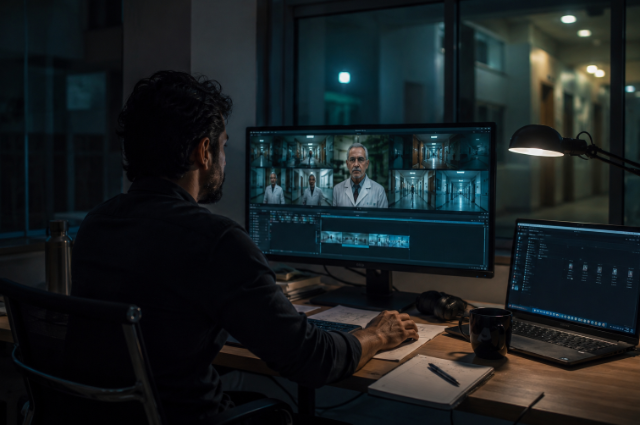
It is eleven at night, and the doctor on my screen has the wrong face again.
The fourteenth time. I know it is the fourteenth because I have named the folders, and the folder is called 14, and inside it are six versions of a man who does not exist, and none of them is him. In the first, he is too young. In the third, his left hand melts into the door he is meant to open. In the fifth, he looks at the camera with an expression of such serene lunacy that I say a word out loud, in the empty office, that I would not want the doctor who commissioned this film to hear.
Outside, the hills are black. The college is empty the way only a place built for hundreds is empty when it holds one. It is a Sunday. I am the entire creative department of a medical college in the south of India—not the head of it, the whole of it—and I have spent two days trying to make a machine build a man, and the machine has built me fourteen strangers instead.
The old voice arrives right on time. See, it says, gently, the way it always does. It cannot do what you do. Fifteen years. Your years are safe.
I want to believe the voice. You have no idea how much I want to believe it. But I am too tired tonight to lie to myself, and somewhere under the exhaustion I already know the voice is not comforting me. It is trying to keep me from learning something.
Let me tell you about the man who sat down at this desk two days ago, because he is not quite the same man typing now.
That man was a filmmaker, and pr,oud of it, and his pride had a particular shape. It was built on difficulty. For fifteen years he had learned the moving image the hard way—the patience of the edit, the grammar of the cut, the thousand small decisions of light and lens, one ruined shoot and one three-in-the-morning deadline at a time. He believed the worth of the work lived in the hours it cost him. If a thing was easy, it could not be good. If it was good, it must have hurt.
So when the machines came—when everyone began speaking of them at once, in that breathless way—that man did not feel wonder. He felt insulted. He watched the early AI video, the warping faces, the limbs dissolving between frames, a person melting into a stranger halfway through a shot, and he felt a small and ugly relief. Good. It cannot hold a human being steady for six seconds. Let it try to do what I do.
He was not brave. He was afraid, and the contempt was the shape the fear took, the way a cornered animal makes itself look bigger. Underneath it sat a question he would not look at directly, and the question was very simple. It was: what am I, if the hard part stops being hard?
The brief had come in on the Monday. A senior doctor, one of the good ones, wanted a film for the day that honours his profession—and he wanted it to feel unlike every hospital video ever made. No stethoscope. No sunrise. Half-joking, he said the word cinematic. He said, imagine a doctor moving through a world of light. Like something science-fiction. Like a hero.
The old me heard that brief and felt the dread before the excitement. Not because I could not see the film—I could see it instantly, whole, glowing. But I could feel the cost of it in my body. A single hero across fourteen scenes meant a cast, locations, a budget, a crew—or it meant weeks of nights alone at the timeline, and I did not have the weeks any more than I had the crew. So the old me would have done what the old me always did. I would have quietly folded the vision down until it fit inside my capacity. A talking head. A montage of stills. The safe thing I could carry alone to Friday. And I would have called that professionalism, when it was only ever surrender.
This time, for reasons I still cannot fully name—tiredness, maybe, or the particular recklessness that visits you when you have nothing left to protect—I did not fold it down. I opened the tools I had spent a year sneering at, and I asked the machine for the impossible film. And the machine gave me fourteen strangers.
Which brings us back to eleven at night, and folder 14, and the word I said out loud.
Here is the thing I did next, and it is the whole story, though it looked like nothing. I stopped typing at the machine and started talking to it.
I had been commanding it. Terse, impatient, the way you jab at a tool that is failing you— doctor, hospital corridor, walking. Now, too tired to be impatient, I described the man instead. Not a doctor, but the specific tiredness I wanted at the corners of his eyes. The dignity of someone who has given forty years to a small town and expects no thanks for it. The exact grey of the light in our own wards at dusk, when the day staff have gone and the ones who stay are the ones who care. I described him the way I would describe him to a human being I trusted— slowly, with everything I knew.
And the machine listened, and gave me fifty more attempts. Most were still wrong. But now, when a wrong one came, I could say why, and the saying-why was doing something. I threw
away forty-nine. I kept one. Then I did it again, and again, and each time the thing I was actually doing was not making—it was choosing. No. No. Not that. That one—there. Him.
Near midnight the fourteenth scene resolved, and the man on the screen turned toward me with exactly the tired dignity I had been carrying in my chest for a week, and I stopped breathing for a second, because he was real. Not real like a photograph. Real like a character. Real the way
a stranger in a good film is more real to you than the people on your own street. He had arrived in minutes what would once have cost me nights, and he was, beyond any argument, the man I had imagined.
I sat in the dark and waited for the grief I had been braced against for a year—the death of the thing I was. It did not come. What came instead, absurdly, sitting alone at midnight in an empty college in the hills, was gratitude. And under the gratitude, arriving late, like a light coming on in a room I had lived in for years without seeing, the answer to the question I had refused to look at.
The machine had not taken my work. It had shown me which part of it had ever been mine.
For fifteen years, two different things had been braided so tightly inside me that I mistook them for one. The first was execution—the trained hand, the mastered tool, the labour of forcing the picture in my head out through my fingers and onto the screen. The second was judgment— knowing which picture was worth forcing out at all. Knowing which of fourteen strangers was the man. For all of history you could not have the second without paying years for the first, so I had assumed the paying was the art. It was not. It was the toll. The art was the choosing, and the choosing had always been mine, and I had been too busy at the timeline, night after night, to notice it was the only thing I truly owned.
The machine made the execution nearly free. That is why it terrifies people, and it should—if you built your whole worth on being the one who could operate the tool, the ground really is moving under you. But if you understand that the tool was only ever the vehicle, and the judgment was always the destination, then the machine is not the end of you. It is the removal of everything that was standing between you and the reason you started.
The film went out on Doctor's Day.
I did not tell anyone the hero was not a person. I did not need to. Patients watched a doctor who was never born walk through corridors that were never built, and afterward, more than one
of them told me he reminded them of their own physician. A man who does not exist reminded them of someone they love.
That is not a trick, and it is not new. It is the oldest thing making has ever done—take a thing that is not real and shape it until a stranger feels that it is—and I had done it not despite the machine but through it, my forty years of a doctor's tiredness joined to its tireless, tasteless, patient hands, each of us supplying exactly what the other could not.
I still work alone in that office. Some nights it is still eleven o'clock and the face on the screen is still wrong. But the old voice has gone quiet, because I finally know the thing it was trying to keep from me, and I will give it to you now, in case you are standing where I stood—a filmmaker, a writer, a maker of anything, feeling the ground move and certain it is an earthquake when it may only be a door.
The machine cannot take your years. It can only take your busywork. And when the busywork is gone, what is left standing in the empty room is the one thing that was always, only, yours: your judgment, your taste, your reason for making anything at all.
Guard it. And then go make something that does not exist.