
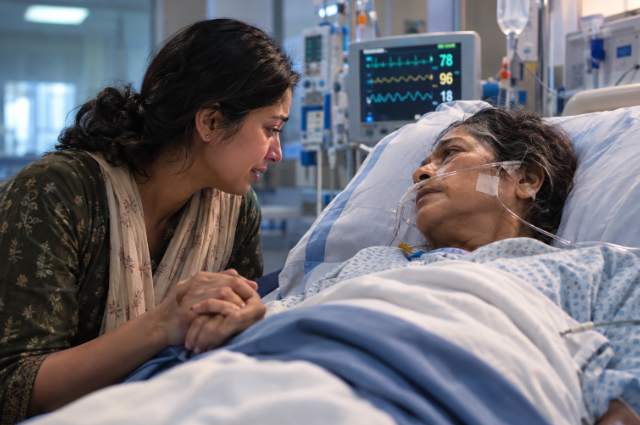
Some losses arrive like a door slamming shut. Others arrive like a tide - slow, relentless, pulling something away inch by inch while you stand at the shore telling yourself it will turn back. My mother's death was the second kind. It took six months, spread across hospital wards and ICUs in our city in India and a hundred small moments of hope that I clung to like a drowning woman. And at the end of it, it took her.
My mother was eighty years old, but you would never have known it to meet her. She was not a woman who asked for help. She ran her home, her finances, her days, entirely on her own terms. She did not believe in doctors. She did not believe in medicine. If she had a headache, she would rather wait it out than take a tablet. And yet, in the final six months of her life, doctors and medicines became the only language spoken around her- tests, reports, dosages, procedures- while the woman underneath all of it, my mother, the one who raised me, held my hand, scolded me, loved me fiercely and wordlessly, slowly grew quieter and smaller inside that hospital gown.
I still see her most clearly not in that hospital bed, but exactly as she was before any of this began, her hair pinned back neatly, her reading glasses sliding down her nose over the morning newspaper, her hands quick and sure as she managed a dozen things at once without ever asking for help. I think of her humming an old film song under her breath while she rolled out rotis in the kitchen, or scolding me affectionately for coming home late, or sitting on the balcony in the evening with her tea, utterly certain that nothing could touch her. That is the woman I want to remember first, before the tests and the tubes and the terrible words.
This is not just a medical timeline. It is the story of a daughter trying to hold her mother's hand through a storm neither of us understood, and of a bond that did not break even when her body did. As an old saying goes, a mother is the one whose place no one else can ever take. I am writing this because I still don't have all the answers, and because I suspect that somewhere, another daughter or son is sitting in another ICU waiting room right now, just as confused and just as frightened as I was.
Why does the body so often choose its quietest moments to reveal its greatest failures? And why do we, as families, only recognise the weight of a warning once it is far too late to turn back? If this reaches you — you are not alone, and you are allowed to ask the doctors more questions than you think you're allowed to ask.
The First Warning
It began on an ordinary night, the way these things so often do, quietly, almost apologetically, as if the body were clearing its throat before delivering terrible news. My mother reached for a glass of water. Her hand would not listen to her. The coordination between her hand and her mouth simply failed, and the water spilt down her wrist, onto the bed, onto the floor. She looked at her own hand as though it belonged to someone else.
I remember the fear in her voice when she told us the next morning — not fear of illness, but fear of losing control, of losing the independence that had defined her entire life. My sister and I called a doctor to see her at home. He took one look and said, without hesitation, that she needed to be hospitalised immediately.
The tests revealed a blocked artery, though her body, resourceful even then, had been quietly rerouting blood to her brain through another vessel. Her blood sugar had also spiked dangerously high. She was treated and discharged after a few days, and I remember the relief in the house, the way we all breathed a little easier, the way she went back to insisting she didn't need anyone hovering over her. I did not know, then, that this was only the first ripple of something much larger gathering underneath. Was this the first true sign of what was coming or simply the ordinary unravelling of an ageing body, one that none of us yet knew how to read?
The Sugar That Wouldn't Behave
Four months passed. Then, one day, the ground shifted the other way — her blood sugar crashed instead of spiking. I did what I had been taught to do in moments like this: I gave her sugar, a piece of chocolate, anything sweet I could find in the kitchen in those frantic minutes. Nothing worked. Her hands began to shake uncontrollably, and I watched my strong, composed mother tremble in front of me like a leaf, and I felt something in my own chest tremble along with her.
We rushed her to the hospital again. She stayed there for four or five days while doctors worked to stabilise her sugar, which kept swinging unpredictably from one extreme to another, like it couldn't decide which way to fail her. She was also found to be low on iron. It felt, still, like something manageable, another hurdle, another hospital stay, another discharge summary we would file away and try to forget.
About a week after she came home, she began passing blood in her stools.
A Diagnosis We Didn't Want to Hear
We admitted her again. This time, doctors suspected her blood-thinning medication was responsible for the bleeding, so it was stopped, along with medicine to control the bleeding directly. In our desperation to help her in every way we could, we even brought in a Reiki therapist because when medicine alone doesn't feel like enough, you reach for anything that might carry a little more healing into the room.
Then the senior doctor recommended a colonoscopy. Every instinct in our family rebelled against this. My mother, especially, did not want it; this was a woman who had spent her whole life avoiding hospitals, and now here we were, asking her to go through arguably the most invasive test she had ever faced. But the doctors' logic was impossible to refute: how could they stop bleeding whose source they couldn't even see?
The day before the procedure, she was given a blood transfusion. Then came my task, small on paper, agonising in practice — getting my mother to drink two litres of water mixed with a laxative to clear her bowels. She was so uneasy, so nauseated, fighting her own body just to keep it down. I sat beside her through it, coaxing her the way she must have once coaxed me through a fever as a child, our roles quietly, permanently reversing.
The next day, under anaesthesia, the colonoscopy was performed. I sat in that waiting area feeling as though time itself had thickened, every minute stretching longer than the one before it. When the doctor finally came out, he told us there was a growth. It might be cancerous. It would need to be surgically removed.
How do you tell a mother who has spent her whole life fearing illness that illness has finally found her? We made a decision then that I still turn over in my mind — we chose not to tell her the word "cancer." We told her there was an injury causing the bleeding, one that needed an operation to fix. Slowly, gently, we convinced her to agree to surgery. She looked at me once, before signing the consent forms, and said only, "I have never needed anyone to look after me before — don't let this be the thing that changes that." I don't know, even now, whether keeping the truth from her was the right choice or simply the only one we could bear to make. I only know it came from love, and from a desperate wish to protect her from a fear we weren't sure she could survive.
The Operation
Before the surgery, she had to go through the bowel preparation once more. This time, the laxative mixed with a fizzy soft drink did not sit well at all — she vomited repeatedly and grew utterly exhausted, drained in a way I had never seen her before. Watching her deteriorate the night before her operation, I made the call to ask the doctors to postpone the surgery by a day. She was simply too tired, too depleted, to survive another round of bowel cleaning that same night. I remember holding her hand and telling her we would wait, that there was no rush that mattered more than her.
But the surgical team did not agree. The senior surgeon and his colleagues came to explain that the operating theatre slot had already been arranged and could not simply be moved, and that in their judgment, any further delay carried its own risks — the bleeding, the transfusions, the toll it was already taking on her body. They assured us she was fit enough to go ahead as scheduled, and that waiting would not necessarily make things easier for her. I remember the particular helplessness of that conversation, standing in a corridor, watching a team of specialists weigh a decision about my mother's body that I could not overrule, no matter how strongly my instincts told me she needed one more day.
The next day, she was taken into the operating theatre. The surgery lasted almost three hours; a large mass was removed, and the two ends of her bowel were surgically rejoined, what doctors call an anastomosis. It was successful, we were told, and I let those words wash over me like a blessing. She was moved to the ICU for observation, and once she stabilised, she was shifted back to the general ward.
For the first days, she was allowed only clear liquids. She was in a great deal of pain, and I felt it in my own body as I sat beside her, the particular helplessness of watching someone you love suffer and being able to do nothing but stay close. I kept whispering to her that she would be okay, that this was almost over, that soon she would be home in her own bed. I believed every word of it.
The Signs We Didn't Understand
On the fourth day after surgery, she began bleeding again. We were told, once more, that this was likely due to the blood thinners that had been restarted after the operation. I wanted so badly to believe it - it was a simpler, more familiar explanation than the alternative none of us had yet dared to consider. Physiotherapists came daily, helping her sit up, helping her attempt small, wobbling steps, though she could barely support her own weight. Doctors slowly introduced semisolid food — khichdi, soft and gentle, meant to ease her back into eating.
Two days later, everything changed within the space of a single evening. Her pulse, which had been steady, suddenly spiked. An ECG showed irregularities in her heart's rhythm. She grew breathless, gasping in a way that made my own breath catch in my throat. She was wheeled back into the ICU.
I went to see her. She was on oxygen, and strangely, almost cruelly, she told me she felt much better. But the doctors' faces told a different story. They said she was critical. That gap, between what she felt in her own body and what her body was actually doing to itself, was one of the most disorienting things I have ever witnessed. Her words said one thing. Her body was already saying another.
How the Body Unravels: Acidosis, Sepsis, and the Long Fall to Dialysis
I want to slow down here, because this is the part I have replayed the most, the part where I finally understood, far too late, just how far things had gone.
When my mother's pulse spiked, and her blood pressure began to fall, what was actually happening inside her was a war. Somewhere, likely at the site of her surgery, in the joined ends of her bowel, an infection had taken hold, and her body had responded the only way it knew how: by flooding her bloodstream with an overwhelming inflammatory response. This is what doctors call sepsis. It is not simply "an infection" in the way we casually use that word. It is the body's own defence system turning into a runaway fire, releasing chemicals that cause blood vessels throughout the body to widen and leak, so that blood pressure collapses even as the heart races faster and faster, trying desperately to compensate by pumping harder through vessels that can no longer hold pressure.
That is why her pulse shot up while, underneath it, her blood pressure was quietly crashing, her heart working overtime against a system that was giving way beneath it. With blood pressure too low, her organs stopped receiving the oxygen-rich blood they needed to function. Cells across her body, starved of oxygen, switched to a desperate, inefficient backup method of producing energy, one that floods the bloodstream with lactic acid. This is what led to her acidosis: her blood was literally becoming too acidic to sustain normal organ function, and the doctors had to give her bicarbonate to try and neutralise it, running repeated ABG (arterial blood gas) tests just to keep track of how far the tide had turned.
Her kidneys, among the most sensitive organs to poor blood flow, bore the brunt of it. Starved of adequate circulation, they began to shut down, which is why her urine output dropped so low, and why the toxins her body should have been filtering out began instead to accumulate inside her. Dialysis was started to do, mechanically, what her kidneys could no longer do on their own: filtering her blood, trying to buy her body time to heal. But by then, the damage had spread too far, too fast. The following day, her lungs, exhausted from the same battle, could no longer sustain her breathing on their own, and she was placed on a ventilator.
It is called multiple organ failure for a reason: once one system gives way under this kind of assault, it drags the others down with it, like a row of dominoes none of us could see falling until they had all come down. Heart, kidneys, lungs, each one holding on a little less than the one before, each one asking more of the others until there was nothing left to ask. How does a heartbeat that races so hard, trying so desperately to save the body, end up becoming part of what fails it?
The Hardest Decision
We could not bear to watch her suffer any longer. She had stopped responding when we called her name in the ICU, a silence more frightening than any cry of pain. As a family, we made the hardest decision of our lives and signed a DNR, a Do Not Resuscitate order. It was not giving up on her. It was, I have to believe, the last act of love we had left to offer, releasing her from a pain her body could no longer fight through.
I have asked myself many times since whether we made that decision too soon, or not soon enough, or whether there was ever really a "right" time to make it at all. There isn't a manual for this. There is only a room full of machines keeping someone alive, and a family trying to decide, in real time, what love actually asks of them in that moment - more time, or less pain. We chose less pain. I still don't know if that was mercy or surrender, and I suspect I never fully will.
The Morning She Left
Two mornings later, on the day of Ekadashi, I was called from the ICU waiting area. I knew, in the way you sometimes just know, before anyone said a word, that something was terribly wrong. I ran in and learned she had suffered a cardiac arrest.
I stood there holding her hand, saying a prayer, memorising the shape of her fingers one last time. My sister, who had stood beside every hospital bed and sat through every sleepless night just as much as I had, arrived within minutes, and in that terrible hour, we held each other up almost as much as we held her hands. And in her face, in that stillness, I could see something that looked almost like peace, as though, after a month of fighting a battle her body was never going to win, she had finally been allowed to rest.
I kept thinking, absurdly, of something she used to say whenever any of us hovered over her too much: "Go on, finish your work. I'm not going anywhere." I would have given anything, in that moment, to hear her say it one more time.
I keep coming back to her hands in that moment. The same hands that once could not lift a glass of water on an ordinary March night. The same hands that had held mine through every fever, every heartbreak, every ordinary Tuesday of my life. I held them until they went still, and some part of me has been holding them ever since.
The Questions I Still Carry
What haunts me most, even now, is this: could the bleeding on the fourth day after surgery and the sepsis that followed have been caused not by blood thinners, but by an anastomotic leak? This is a known and serious surgical complication, where the surgically rejoined ends of the bowel fail to heal properly and begin leaking their contents internally, seeding infection throughout the abdomen and, eventually, the bloodstream. It can produce exactly what my mother went through: the sudden pulse spike, the falling blood pressure, the acidosis, the sepsis, the organ failure, one after another, like a fuse that had been quietly burning since the day of her surgery.
I also keep returning to that corridor conversation the night before her operation, the one where I asked the surgical team to give her one more day, and they decided against it. I don't say this to assign blame; I know the decision was made in good faith, weighing risks I am not qualified to weigh myself. But I do wonder, and I don't think I will ever stop wondering, whether a body as exhausted and depleted as hers was truly given its best possible chance going into that theatre and whether that exhaustion had any bearing on how poorly she was able to heal in the days that followed.
I am not a doctor, and I do not know, with certainty, whether earlier recognition would have changed her outcome. I do not know how much her age and her existing health conditions, such as the blocked artery, the unstable blood sugar, the low iron, stacked the odds against her before she ever entered that operating theatre. Would even a single day's earlier recognition have bought her more time, more days, more ordinary mornings, more of the small unfinished conversations we never got to have? I may never have a complete answer. But I believe her story, and these questions, deserve to be spoken aloud rather than quietly buried with her.
What the Research Says About Age and This Kind of Surgery
In trying to make sense of what happened, I looked into what medical research says about colorectal surgery in older patients because I suspect our story is not as rare, or as random, as it felt in the moment.
Anastomotic leaks are more dangerous in older patients, even if not necessarily more frequent. Studies on colorectal surgery have found that the risk of a leak occurring is roughly similar between older and younger patients, but the consequences are far more severe for the elderly. One large study of patients aged 80 and older found that when a leak did occur, the 30-day mortality rate was about 16%, compared to roughly 3.5% in younger patients and a leak was found to be the single strongest predictor of death after surgery.
Leak rates vary, but are far from rare. Across studies, anastomotic leaks after colorectal surgery occur in roughly 2% to 19% of cases, depending on the type of procedure and how a "leak" is defined, and death directly linked to a leak has been reported anywhere from under 1% to as high as 27% in more severe cases. A separate nationwide audit found overall surgical mortality of about 4%, which jumped to over 16% specifically among patients who developed a leak.
Two-year survival drops sharply for older patients who develop a leak. One study comparing outcomes found that among patients without any leak, those over 80 already had somewhat lower two-year survival than younger patients (about 71% versus 87%). But among patients who did develop a leak, the gap widened dramatically: two-year survival was around 80% for younger patients, but only about 43% for those over 80.
Once sepsis sets in, the odds worsen considerably. Postoperative sepsis carries a mortality risk often cited between 30% and 50% in general, and this risk climbs further with age. Studies of critically ill elderly sepsis patients report in-hospital mortality near 49%, rising above 54% in the "very elderly" (80 and above). National health data also show sepsis-related death rates rising steeply with age, from about 151 per 100,000 among those 65–74 to roughly 750 per 100,000 among those 85 and older.
Frailty and existing health conditions compound the risk. Research consistently identifies age, emergency surgery, high comorbidity scores, and frailty as independent predictors of death following complications like a leak or sepsis, which reflects, painfully, much of what my mother was already carrying into that operating theatre: her blocked artery, her unstable blood sugar, her low iron, her age itself.
None of these numbers can tell me precisely what happened inside my mother's body in those final weeks. But they tell me this: what we went through was not some rare, unlucky anomaly. It is a recognised, documented risk that disproportionately threatens older patients, one that perhaps deserves a far more open, far more specific conversation with families before surgery, not after.
Conclusion
I don't know if writing this changes anything. But it has let me say, out loud and in full, what I watched my mother endure and what I watched myself endure alongside her, powerless in the way only love can make you powerless.
I think often about the strange, quiet privilege of being the one who held her hand through all of it. Of being trusted with her fear, her pain, her small jokes on the good days, her silences on the bad ones. Motherhood and daughterhood are strange mirrors — she spent decades caring for me before I ever understood what care cost her, and in those final six months, I finally understood, standing beside her hospital bed the way she once stood beside my crib.
If there is anything I want other families to take from this, it is to ask more questions before surgery, about age-specific risks, about what "successful" surgery really guarantees, about what the early warning signs of a leak or sepsis actually look like, and about what the emergency plan is if something goes wrong on day four or day six, rather than day one. Doctors carry extraordinary expertise, but families carry a different kind of knowledge no chart can capture: the tremor in a hand, the flicker in tired eyes, the sense that something is wrong before the numbers ever show it. What good is expertise, after all, if it never learns to listen to the people who know the patient best?
My mother lived independently and fought quietly, right until the very end. I choose to believe that in her final moments, surrounded by prayer and her daughters' hands, she was finally, mercifully at peace, free of the pain, free of the tubes and the tests, free even of the fear she had carried her whole life about ever needing anyone's help. There is an old saying I return to often, one that feels truer to me now than it ever did before: "Grief is the price we pay for love." I hope that somewhere, someone reading this asks one more question of their doctor than they otherwise would have and, in the end, isn't that the only inheritance any of us can truly leave behind for those we love? I am still looking for answers. Perhaps I always will be.
Author's note: It has only been a month since I lost her, and I am still learning how to sit with everything that happened in those final six months. Writing this down was the only way I knew how to hold it, not to find closure, because I'm not sure that exists yet, but simply to say what I saw, honestly, while it is still fresh enough to tell truthfully. If you are somewhere in the middle of your own version of this, you are not walking through it alone.
References:
- springer.com
- pubmed.ncbi.nlm.nih.gov
- pubmed.ncbi.nlm.nih.gov/24536013
- cdc.gov
- onlinelibrary.wiley.com