
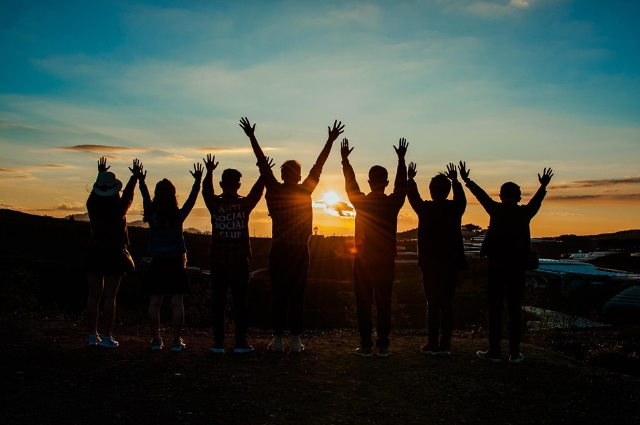
Think about the last time you felt genuinely happy. Not the small, fleeting happiness of a funny reel or a liked post. Not the dull comfort of a series you watched alone until two in the morning. Think about real happiness, the kind that sits in your chest for days afterwards. The kind you can still feel when you close your eyes.
Chances are, there were other people in that memory. Chances are, something was happening that you could not pause, rewind, or scroll past. Chances are, you were fully there, not half-there with your phone in your hand.
That feeling- full, present, irreplaceable is what India's young people are desperately searching for right now. And they are searching in the most unexpected places. At six in the morning, dancing to a DJ in a café. In a locked room with strangers, solving puzzles under a ticking clock. At handicraft workshops on Sunday afternoons. At rooftop cinema nights under open skies. At midnight food markets lit by lanterns in the middle of a city that never needed any of this until now.
Something is happening in India. Something quiet and urgent and important. And it is worth paying close attention to.
Consider someone like Meera Nair, who noticed it first on a Sunday morning in January. She was twenty-six, a UX designer in Bengaluru, and she had just spent her third consecutive weekend barely leaving her flat. On a whim or what felt like one, she set her alarm for five-fifteen and went to a coffee rave in Indiranagar. "I almost cancelled four times," she told me later. "But I went. And something happened in that room that I still don't know how to explain properly."
The Screens Promised Everything. They Delivered Something Else.
India has 750 million people online. We are one of the most digitally connected countries on earth. We have more content than we could watch in ten lifetimes, more people to follow than we could ever meet, and more ways to communicate than any generation before us ever dreamed of.
We are also desperately, quietly, persistently lonely.
A study by the Indian Council of Medical Research found that 55 percent of Indian adults under 35 report frequent feelings of loneliness. A March 2026 study by WashU School of Public Health, spanning eight countries including India, found that nearly 4 in 10 adults reported feeling lonely during the pandemic period, even though they were online every single day.
The World Health Organisation now classifies loneliness as a public health crisis comparable to smoking fifteen cigarettes a day. India is not exempt from this. Urban youth loneliness has been rising fast, with constant digital presence replacing real conversation with consumption. Social media rewards performance, not presence, creating what psychologists call "performative intimacy," where people share
everything and yet feel invisible. Likes accumulate. Connection does not.
You can have a thousand followers and no one to call at midnight. You can be in six WhatsApp groups and feel completely alone on a Tuesday evening. You can watch a hundred reels of people laughing together and finish scrolling feeling more hollow than when you started.
That is the quiet crisis behind every coffee rave and every escape room booking in India today. Not boredom. Not novelty-seeking. Hunger. A deep, specific, human hunger for the feeling of being in a room with real people, doing something real, together. And when you understand that hunger, everything that follows makes perfect sense.
The Numbers Behind the Movement
Before we go further, it is worth understanding the scale of what is happening.
India's live entertainment sector grew by 17 percent in 2025. In that year alone, India hosted 34,086 live events such as concerts, theatre shows, comedy nights, and immersive experiences. Seventy percent of those attendees were under 35. Fifty-two percent were under 30.
India's live events market, valued at Rs 88 billion in 2023, is projected to hit Rs 143 billion by 2026, growing at 17.6 percent annually. Gen Z is driving this demand, with 62 percent planning trips around concerts and events, spending over Rs 51,000 per event.
A report by EY-Parthenon and BookMyShow found that 78 percent of Indian consumers now prefer experiences over products, which is a profound shift in what people are willing to spend their money on. They are not buying more things. They are buying more moments. More evenings. More rooms full of people. More memories that sit in the chest for days.
Naman Pugalia, Chief Business Officer at BookMyShow, described this shift as a "real renaissance", driven by audiences placing greater value on how they spend their leisure time. The shift is not confined to major metropolitan areas. Smaller cities are seeing rapid growth too.
This is not a niche lifestyle trend. This is a mass movement. And it is powered by something much deeper than the desire for entertainment.
Six in the Morning. A DJ. No Alcohol. Two Hundred People Dancing.
The first time most people hear about a coffee rave, they laugh.
Dancing at sunrise? To a DJ? Sober? It sounds like something designed to be absurd. And then they go. And they stop laughing.
Coffee raves are India's newest social phenomenon, events where young professionals and students gather at sunrise to dance, network, and begin their day, fuelled by caffeine instead of alcohol. The format began quietly in Europe and arrived in India with surprising speed, finding soil that was far more fertile than anyone expected. Mumbai had some of the first. Then Delhi. Then Bengaluru, Pune, Hyderabad. Now cities like Nagpur, Jaipur, and Kochi are catching up.
M.S. Kumar, who hosted one of India's first coffee raves in Nagpur, describes the shift clearly: "Since players like Starbucks entered the market, coffee's alignment shifted to being associated with productivity and co-working. It became a signal of hustle. The youth are gravitating towards coffee because it's the drink of the newer generation, but they want to use it differently. Not to power through work. To actually enjoy being alive."
Think about what a coffee rave actually is, stripped of the label and the novelty. It is people choosing to wake up early, genuinely early, not accidentally, to be in a room with strangers, moving their bodies, feeling music with their whole selves, starting their day with joy instead of anxiety. No hangover the next morning. No money regretted. No blurry memories. No creeping shame. Just two hundred people who decided, on purpose, to begin their morning by feeling something real.
The coffee rave is also, quietly, a feminist statement. In a country where late-night socialising carries safety risks that women navigate constantly, the sunrise event removes that calculation entirely. Women arrive in the early morning. They dance freely. They go home in daylight. The coffee rave does not just offer sobriety; it offers safety. And for many young Indian women, that matters enormously.
Meera describes her first coffee rave the way people describe a place they did not expect to love. The room smelled of filter coffee and something she calls "nervous energy that somehow turned warm." She did not know anyone. She did not dance immediately. She stood at the edge for about ten minutes, watching. And then the music kicked into something faster, and the person next to her turned and smiled, and she stepped forward. "I cried a little on the way home," she said. "Not because I was sad. Because I realised I had been sad for months without admitting it. And for two hours, I wasn't."
That is not a party trend. That is a statement about the kind of life an entire generation wants to live.
Locked In, But Finally Free
On a Saturday evening in Mumbai, a group of seven strangers walk into a room together. The door clicks shut behind them. They have sixty minutes to find clues, solve puzzles, and get out. They do not know each other's names yet. By the time the door opens again, they will know something more important: how the other person thinks under pressure, whether they listen when someone else speaks, whether they panic or focus when the clock runs down, whether they laugh when things go wrong.
Escape rooms are growing at an extraordinary pace. The global escape room market is projected to reach $12.5 billion by 2030, growing at 9.2 percent annually. The Asia-Pacific region, which includes India, is leading this expansion, driven by rapid urbanisation and a growing middle class seeking meaningful shared experiences. India's own escape room industry, once concentrated in a handful of metro cities, has spread into Tier-2 towns and smaller cities where young people are equally hungry for this kind of experience.
But here is the question worth asking. Why? What do a locked room, a ticking clock, and a set of cryptic clues give a young Indian that their phone cannot?
The answer is surprisingly simple. It gives them a problem that is real. A moment that cannot be saved for later, forwarded to someone else, or revisited on a highlights reel. Stakes that are low enough to be fun but high enough to feel genuine. And most importantly, it gives them other people to face it with, in real time, in the same room, with no option to look away.
In the era of digitalisation, the mode of communication has shifted almost entirely to online platforms, with very few social interactions in the real world. People experience emotional isolation and disconnection even when surrounded by people online. An escape room removes every layer of that mediation. You cannot text your way through it. You cannot Google the answer without ruining it. You cannot pretend to be engaged while actually elsewhere. You have to be there, physically, mentally, completely, and so does everyone else.
For sixty minutes, the phone goes away. The notifications stop. The performance stops. The curated version of yourself that you manage online goes quiet. And something rare and almost forgotten happens: you become a real person in a room with other real people, doing something that only matters right now, in this moment, together.
The best escape rooms are not just puzzles. They are permission, permission to be uncertain, to fail, to try something without knowing whether it will work, and to laugh when it doesn't. That permission is increasingly rare in a world that demands polished outputs and visible success at every step.
The Live Music Renaissance
It is not only coffee raves and escape rooms. Something larger is happening in how India's young people are spending their evenings, their weekends, their savings, and their emotional energy.
Concerts today are no longer just about music. They are evolving into immersive lifestyle experiences where audiences are spending not only on tickets, but also on travel, fashion, food, hospitality, exclusive access, and curated moments. From Coldplay and Diljit Dosanjh to global EDM festivals and spiritual music gatherings, India's live entertainment economy is witnessing a visible shift toward experiential spending.
In 2025 alone, several large international tours helped drive the surge, including Coldplay's Music of the Spheres Tour in Ahmedabad and Travis Scott's Circus Maximus Tour concluding in New Delhi and Mumbai. The doubling of footfall for premium live experiences, VIP pits, viewing decks, and enhanced hospitality zones signals that India's live entertainment market is moving up the value chain.
What is striking about all of this is the age profile of the people spending this money. These are not wealthy older consumers purchasing luxury entertainment. Seventy percent of live event attendees are under 35. Fifty-two percent are under 30. These are young people, many of them carrying educational debt, many of them in gig jobs without benefits, who are nonetheless choosing to spend significant sums on tickets, travel, and the full experience of being there in person.
Why? Because they have done the comparison. They have spent the evening watching the concert livestream on their phone. They have scrolled past the highlights reels afterwards. They have seen it all from a distance. And they have decided, with striking clarity, that seeing it is not the same as being there. That watching is not the same as living it. That the screen gives them the information of an experience without the feeling of one.
And they want the feeling.
Why We Stopped Trusting the Night
There is a deeper question beneath all of this. Why now? Why is India's young generation reaching so urgently for sober, physical, shared experiences in 2026?
Part of the answer is that the traditional alternative stopped delivering what it promised. In a country where nightlife has always existed while navigating moral policing, safety concerns, family expectations, and societal pressures, the alcohol-fuelled late-night party was never a perfect solution. It offered one kind of release but at a cost. The hangover. The money spent in an evening. The morning after that felt worse than the evening before. The creeping sense that you had been in a crowd all night and still come home feeling alone.
Young Indians are increasingly turning away from alcohol and substances. Gen Z across the world is drinking less than any generation before it. In India, that trend is particularly visible not because of prohibition or moralising, but because young people have done the arithmetic. The cost- financial, physical, emotional- does not match what they get in return.
Nikunj Gupta, who organises sober social events for young people in Mumbai, says the audience is overwhelmingly young, like college students, recent graduates, and early-career professionals searching for connection in rapidly changing urban environments. "People have so much anxiety and stress," he says. "People feel relief when they come to such places."
Meera felt this relief without having a name for it. She describes the moment the music surged and the room full of strangers all moved at once as feeling like "something unclenching." She has been back eleven times since January. She goes alone. She never feels alone when she is there.
The relief is real. And it is measurable. Every ping, buzz, and notification on a device is a small interruption, a demand on the brain's attention system. The human nervous system was not designed to process hundreds of micro-demands every hour, and the cumulative effect of constant digital stimulation is a state of mental exhaustion that researchers call attention fatigue. Attention fatigue makes it harder to concentrate, harder to feel emotionally present, harder to genuinely enjoy anything. A coffee rave at sunrise, an escape room on a Friday evening, a pottery class on Sunday afternoon- all of these share one essential feature. They demand your full attention. They do not function if you are half-present. They reward you specifically and generously for showing up completely. And in return, they give you something a screen cannot replicate: the memory of having genuinely been there.
The Craft Night That Changed a Weekend
On a Sunday afternoon in Bengaluru, twenty-four people sit around long wooden tables. Some know each other. Most do not. They are here for a pottery workshop, two hours of getting their hands dirty, making something imperfect, learning something entirely new. There is background music playing softly. There is chai. There is the quiet, focused sound of people doing something with their hands that produces a real, physical object in the world.
By the end of the afternoon, nobody wants to leave.
This story is being repeated across India. In Mumbai, old mill buildings in Lower Parel have been transformed into creative spaces hosting pop-up markets and music nights. In Delhi, heritage neighbourhoods fill with young people after eight in the evening, browsing handicraft stalls, watching street performers, drinking chai in narrow alleys that have nothing to offer algorithmically and everything to offer humanly. In Hyderabad, a sold-out cultural performance drew 750 attendees for an immersive experience that had no equivalent online.
Globally, Eventbrite data shows attendance at coffee and running events jumping 233 percent and anime and cosplay raves growing 82 percent, blended experiences that combine activity, community, and physical presence in ways that no digital format can match.
The interesting thing about all of these activities is what they share with each other and what they have in common with some of India's oldest social traditions. The village gathering. The mohalla cricket match. The neighbourhood festival. The shared meal that lasted four hours because nobody wanted to be the first to stand up and go home.
These were never really about the activity itself. They were always about being together. The activity was the excuse, the reason to show up, to stay, to be part of something larger than yourself for a few hours.
Escape rooms are the excuse. Coffee raves are the excuse. The pottery class is the excuse. What people are really showing up for, what they are really paying for, waking up early for, driving across the city for, is the feeling of being with other human beings in a way that is unmediated, unrecorded, and fully real.
What This Generation Is Actually Saying
When a twenty-four-year-old sets her alarm for five-thirty on a Saturday morning to go to a coffee rave, she is not making a statement about nightlife. She is making a statement about what kind of life she wants to live.
When a group of colleagues books an escape room on a Friday evening instead of going to a bar, they are not being boring or safe or suburban. They are choosing a different kind of fun, the kind that requires them to actually be there, to actually talk to each other, to actually work together on something that matters for sixty minutes and then disappears.
When a young man in Hyderabad spends his Sunday afternoon at a pottery workshop making something lopsided and imperfect with his own hands, he is not wasting his time. He is doing something that his brain and body have been quietly starving for: the feeling of making something real in the physical world, that did not exist before he arrived, and that carries the visible marks of his effort and his care.
Ten years ago, live events were primarily attended by Gen X and older millennials, whose spending often leaned toward material possessions. Today's Gen Z and millennials have completely reshaped the market, emphasising experiential value and driving unprecedented growth in the events industry, driven also by a "revenge" attitude toward experiences after the isolation of the pandemic years.
This generation has been called shallow, distracted, addicted to screens, incapable of depth or commitment. The escape room trend, the coffee rave movement, the live events boom, the craft workshop surge, all of it says something very different. It says that this generation knows exactly what it is missing. It knows, with quiet precision, that the screen cannot give it. And it is willing to wake up at five-thirty on a Saturday morning, to drive across the city, to spend money it cannot quite afford, to find it somewhere else.
That is not shallow. That is wisdom. That is a generation looking at what is being offered to it and saying clearly, firmly, with its feet and its wallet and its alarm clock that it wants more than this.
What We Owe Each Other
There is a lesson in all of this that goes well beyond lifestyle journalism and trend reports.
If 55 percent of Indians under 35 feel frequently lonely, if 40 percent of urban Indians said they felt more isolated during the pandemic despite being online every single day and if young people are waking up before sunrise and locking themselves in rooms with strangers and spending their savings on concert tickets just to feel something genuine, then something is wrong. Not with this generation. With the structures we have built around them.
Our cities were not designed for community. Our apartment blocks were not designed for neighbours who know each other's names. Our workplaces were not designed for genuine friendship. Our social media platforms were not designed for belonging; they were designed for engagement, for time spent, for data collected. Engagement and belonging are not the same thing. They never were.
The escape room cannot fix that. The coffee rave cannot fix that. But they point clearly, urgently, with their growing numbers and their sold-out venues toward what needs fixing. Human beings need each other. Not as followers. Not as profile pictures in a group chat. Not as digital contacts in a network. But as actual people in actual rooms doing actual things together, in the same physical space, breathing the same air, laughing at the same moment, failing at the same puzzle.
That need does not go away because we gave it a phone. It goes underground. It goes quiet. And then one Saturday morning, it wakes up at five-thirty, puts on its shoes, and goes looking for a dance floor that smells like coffee and feels like being alive.
The Real Trend
Meera still sets her alarm for five-fifteen most Saturdays. She still designs digital interfaces during the week, still spends her days making screens more engaging, more sticky, more impossible to put down. She is aware of the irony. "I help build the thing people are escaping from," she laughs. "Maybe that's why I need to escape it more than most." She does not think of the coffee rave as a solution to anything. She thinks of it as a reminder. A reminder of what it feels like to be a body in a room with other bodies, doing something that cannot be saved, replayed, or liked.
The real trend is not escape rooms. It is not coffee raves. It is not craft nights or rooftop screenings or midnight food markets or sold-out concerts in repurposed mill buildings, though all of those are real, and all of them are growing.
The real trend is a generation deciding, quietly at first, and then loudly, with its time and money and energy, that the half-life of a digital experience is too short. That a like does not feel like love. That a view does not feel like being seen. That a message does not feel like a real conversation. That being online is simply not the same as being alive.
And so they are doing something their parents might not have predicted and their grandparents would have recognised immediately. They are leaving the house. They are showing up. They are putting their phones away for an hour. They are looking at the person next to them who could be a stranger, a colleague, a friend they had only texted lately, and choosing to be, together in a room, in a moment that cannot be saved or shared or scrolled past.
Just lived.
That is the whole story. That is everything.
We were always going to end up here. The screen was never going to be enough. The only question was how long it would take us to remember what enough actually felt like.
Turns out, it feels like a locked room and a ticking clock. It feels like a cup of coffee and a dance floor at dawn. It feels like getting your hands dirty on a Sunday afternoon and making something that did not exist before you arrived.
It feels like two hundred strangers choosing, on purpose, to be in the same room at the same time, not performing for each other, not recording each other, not competing with each other. Just being there. Just being human.
It feels, in other words, exactly like being alive. And it turns out that is what we were looking for all along.
References:
- https://unravellingminds.in
- https://datareportal.com
- https://www.cbc.ca
- https://www.cnbc.com
- https://www.ey.com
- https://www.storyboard18.com/
- https://www.forbesindia.com/
- www.hindustantimes.com
- https://www.pitchonnet.com
- www.indiatoday.in
- Deccanchronicle.com
- eventbrite.com
- https://source.washu.edu/
- https://www.thelabmagofficial.com/