
Image by Anil sharma from Pixabay
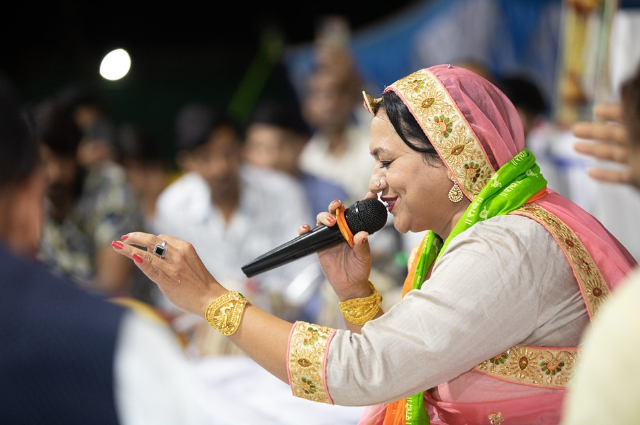
It is past ten o'clock on a Friday night in Mumbai. The venue is packed. The lighting is low, warm, and golden — saffron-hued lanterns. A harmonium hums. A mridangam kicks in. And within seconds, two thousand voices rise together in a chant — Hare Krishna, Hare Rama. There are no cocktails on the tables. No DJ drop. No smoke machine. Instead, there are tulsi-rose mocktails, prasad-inspired desserts, and on the dance floor, a nineteen-year-old software engineering student sways beside a sixty-five-year-old retired schoolteacher. They have never met. Tonight, it does not matter.
I was there that night. And I'll be honest, I went in not believing in it.
A friend had sent me the event link with the caption "trust me." I stared at it for a long time. Bhajan clubbing. Two words I understood on their own, but together, they didn't make sense to me. I grew up with bhajans. They were the sound of early Sunday mornings at my grandmother's house, the music playing softly from the puja room while the rest of us went about our day. They were never something you went out for. They just happened, the way rain happens — there, familiar, never questioned.
I went anyway. And somewhere between the first note of the harmonium and the moment I found myself chanting along with two thousand strangers, something changed in me. I'm still trying to find the right words for it.
This is bhajan clubbing, and it may be the most quietly powerful cultural shift happening in urban India right now.
What Exactly Is Bhajan Clubbing?
Bhajan clubbing, also called bhajan jamming, is a new kind of gathering. It mixes India's old tradition of devotional music with the energy of a modern live event. Imagine group chanting, but in a setting that feels like a club minus the alcohol, minus the chaos, and minus the empty feeling that often follows a regular night out.
It's hard to put this idea in a box. It is not a temple event dressed up for Instagram. It is not a fusion concert with a spiritual touch added on. It feels both old and brand new at the same time. Herbal teas replace alcohol. Tulsi-rose mocktails take the place of cocktails. Desserts inspired by prasad follow the songs. The dance floor becomes a place for shared feelings, which is calm, joyful, and completely sober.
A lot of care goes into how it looks and feels. Warm amber and saffron lights replace the harsh flashing lights of regular clubs. Traditional instruments like harmonium, mridangam, flute, and tabla mix with modern electronic sounds and proper concert-quality speakers. Some events use synced LED visuals. Others keep it simple, with everyone sitting close together on the floor, near the singers, in what's called a baithak style. I had expected something that felt stuck awkwardly between two worlds. Instead, I found a room that somehow made both worlds feel at home together.
The word "bhajan" carries meaning in its very roots. It comes from the Sanskrit word bhaj, which means devotion, connection, and surrender. A bhajan is not just a song; it is an offering, a way of simply being present. Kirtan, a close cousin of bhajan, follows a call-and-response style that goes back to ancient times: one person sings a line, the group sings it back, and the energy builds with each repeat until the room reaches what people describe as a feeling of being lifted out of themselves.
Before that Friday night, I would have called that phrase a bit much. I'm not so sure anymore.
Fifteen Centuries in the Making
Bhajan clubbing feels new. In a way, it is. But its roots go back much further than any 2025 trend report.
The Bhakti movement began in South India around the sixth century. It was its own kind of revolution, a pushback against the rigid rules of caste, priesthood, and Sanskrit scholarship that kept ordinary people away from religion. Poet-saints like Mirabai, Kabir, Tukaram, and Andal wrote devotional songs in the everyday languages people actually spoke, opening up spirituality to those who had been shut out of temples for generations. They sang in markets, in fields, in open courtyards. Their music was not performed; it was offered to God, and everyone was invited to join in, no matter who they were.
I thought about Mirabai that night, standing in that crowded Mumbai room. She sang in the streets because the temples wouldn't let her in. There's something in that. Devotion has always found a way around the walls put up to stop it.
What we now call bhajan clubbing or kirtan jamming has gone by many names over the years: satsang, bhajan mandali, nam sankirtan, kirtan seva. Families gathered in homes, neighbourhoods, and courtyards to sing together. The reason could be anything — a festival, a birth, someone returning safely from a trip, or just an evening when people wanted to feel something real. Kirtan's call-and-response style is found in devotional music across the world, from gospel to Sufi qawwali to Tibetan Buddhist chants. That's not a coincidence. It tells us something simple about people: we are drawn to singing together, to losing ourselves for a moment in something bigger than us.
So bhajan clubbing isn't really a new invention. It's the newest chapter of something that has always changed shape to fit its time.
From a Bakery Carpark to Sold-Out Arenas
The first signs of this movement were small and quiet. In 2023, in Gurugram, young devotees started gathering every Tuesday outside a bakery in Sector 22 to recite the Hanuman Chalisa. What began as a small group grew bigger every week, until it spilt out of the car park and into the bigger cultural conversation.
Before the term "bhajan clubbing" caught on, a singer named Nirvaan Birla started something called Sounds for the Soul. His concerts brought sacred music to the dance floor, mixing orchestral sounds with devotional lyrics and modern production.
Then came the Backstage Siblings, Prachi and Raghav, a brother and sister from Kolkata who left careers in finance to take up devotional music full-time. Their ticketed events, called Sumiran Satsang, sold out across cities. "Bhajan clubbing isn't new," they say. "It's just finally being recognised." They're now planning a tour across six to ten major cities, with each show expected to draw 2,500 to 3,000 people.
Radhika Das, a kirtan artist based in London, became another big name in this movement, performing in over 30 cities and drawing thousands of young people looking for spiritual connection without the strict rules of formal religion. His recent show in New Delhi drew 15,000 people. Then there's Keshav Amband, whose shows mix electronic beats with devotional chants and have filled spaces as iconic as the Ganga Ghat. By April 2026, these bhajan jamming events had become a regular part of nightlife in Mumbai, Delhi, and Bengaluru.
The singer at the event I attended was someone I'd never heard of before. Partway through her set, she stopped, looked at the crowd, and said quietly: "You don't need to know the words. The words will find you." She was right. By the time the night ended, I knew the words.
The numbers back up what the videos show. When Prime Minister Modi spoke about this trend on his programme Mann Ki Baat, it gained even more attention across the country, and it inspired bhajan clubbing events at places like Delhi University. According to the Kantar India in Search 2026 report, searches for the term surged dramatically over the previous year, making it one of the fastest-rising cultural search terms in India. A movement that didn't even have a name three years ago is now filling halls from Visakhapatnam to Ahmedabad.
The Generation That Was Supposed to Reject All This
To really understand why bhajan clubbing matters, you need to understand who's showing up and why so many people didn't see this coming.
Gen Z, roughly those born between 1997 and 2012, grew up being told they'd walk away from tradition. They were the first generation to grow up fully online, shaped by curated identities and the idea that personal freedom comes before everything else. Most people assumed they would drift away from religion, from community rituals, from the kind of shared experience that bhajans represent.
That assumption turned out to be wrong.
What people missed is that Gen Z never actually rejected tradition. What they rejected was the way it was handed to them, the obligation without any real invitation, the rules without explanation, the going-through-the-motions that felt more like duty than connection. They weren't against spirituality. They simply wanted a version of it that felt honest and like it was actually theirs.
I understood that feeling because I'd felt it too. I stopped going to temple in my mid-twenties, not because I made some big decision, just a slow drifting away. The rituals had started to feel like something I was doing out of habit, not something I truly meant. I missed something, even though I couldn't name what it was. That nameless thing, I think, is what filled that Mumbai room on a Friday night, two thousand people strong.
Bhajan clubbing didn't ask anyone to believe anything in particular or to sit a certain way. It simply said: come, chant, and see what happens when two thousand voices rise together. For a generation that is more connected than ever, yet often more lonely, that invitation was hard to resist. Some events even include short readings from poets like Kabir or Meera, followed by open talks about mental health, work stress, and finding purpose, a quiet way of saying that for many people, the spiritual and the emotional aren't really two separate things. They're the same ache, looking for the same comfort.
The Psychology Behind the Pull
India's young, urban population is under a lot of pressure, and the numbers show it clearly. The Kantar 2026 report found a sharp rise in searches for "occupational burnout" and job hugging in a single year and growing interest in the idea of taking a "micro-retirement." This is a generation quietly stepping back from the constant pressure to achieve, looking instead for things that actually leave them feeling better, not worse.
For Gen Z, bhajan clubbing isn't really about religion in the traditional sense. It's about the experience. The joy comes from singing together, the music, the shared energy, not from any substance. Prachi and Raghav from the Backstage Siblings explain it simply: "In today's world, everyone is busy, caught up in work, gadgets, and a hundred other things. We wanted to offer people a different kind of high minus the alcohol. A high that comes from music, from bhajans, from sitting together for an hour and feeling those vibrations in your body. That feeling is stronger than any substance, and in these tough times, this is the escape we want people to experience."
The science backs this up. Singing and chanting together lowers stress hormones in the body and releases oxytocin, often called the "bonding hormone." Breathing and singing in sync with others helps shift the body from a stressed state to a calmer one. Scientists call this "entrainment", when bodies near each other naturally start moving in sync. When two thousand people chant together, their heartbeats start to line up. Their breathing matches. The line between "me" and "the crowd" gets a little blurry.
Standing in that room, I felt this happen to me. Something tight that I usually carry behind my chest during a busy week slowly lets go. I hadn't expected that. I had gone in planning to just watch. Instead, without really deciding to, I joined in. And joining in, I realised, is really the whole point.
Dr Mayur Sejpal, a psychologist who has studied this trend, has called it "the best example youth cafés have set across India", noticing that what looks like entertainment on the surface is, underneath, a shared act of healing.
Cultural Reclamation, Not Nostalgia
It would be wrong to think of bhajan clubbing as simple nostalgia. The young people filling these venues aren't trying to copy their grandparents' satsangs. They're doing something more thoughtful, they're taking a tradition and making it their own, on their own time, in their own way.
A few things are coming together here. First, there's a bigger shift toward wellness — mental health awareness has changed what young people want from a night out, and a calm, meaningful evening is starting to feel more appealing than a typical loud night out.
Second, there's a reclaiming of culture — young Indians are embracing their roots without all the heaviness that often comes with tradition. The third reason is the most personal one.
I saw this clearly in the woman sitting next to me that night — a software developer from Pune, in her mid-twenties, who told me during a break that she hadn't heard these particular bhajans since her grandmother passed away three years ago. "It is not sad," she said, sounding a little surprised by her own words. "It just feels like she is nearby." She wasn't there to show her faith to anyone. She was there to feel something she had lost touch with. That, more than any number or report, is really what bhajan clubbing is about.
At a typical event, you'll see people aged nine to ninety-nine in the same room, a teenager next to a grandparent, young professionals beside their parents, couples on a first date, friend groups, and people who came alone. As the Backstage Siblings put it: "The magic isn't the music; it's two thousand people chanting as one." In a world where age groups often stay separate, even online, this mixing of generations is rare and worth more than it might seem at first.
Interestingly, even though many people go to these events to get away from their phones for a while, social media played a big role in making the trend grow. Videos of large crowds singing together have gone viral, introducing bhajans to people who might never have stepped into a traditional satsang. The same platforms that many blame for deepening loneliness are also, in a strange way, what helped this cure for loneliness reach so many people.
A Global Movement With Indian Roots
Bhajan clubbing has spread well beyond India. It's now found in London, New York, and Berlin, where it's sometimes called a "spiritual rave." On New Year's Eve 2025, many young people across India chose bhajan clubbing over typical alcohol-fuelled parties, ticketed devotional events sold out, and searches for terms like "modern kirtan" and "sober rave India" shot up. It felt like a clear sign, a whole generation quietly changing what celebration means to them.
In communities of Indians living abroad in places like the Bay Area, Toronto, and Leicester, this movement carries an extra meaning. For families who moved away and slowly lost touch with their devotional traditions over the years, these events offer a way back. Not back to a particular country, but back to something older that can travel anywhere: a simple practice of being present together.
This fits a bigger global pattern. Gen Z everywhere is drinking less than any generation before them. In India, the same shift is happening not because anyone is forcing it, but because people genuinely prefer experiences that leave them feeling good the next day. Bhajan clubbing fits perfectly into this bigger move toward what some call "sober socialising" — people wanting real connection without needing alcohol to get there.
A Movement With Its Critics
Like anything that touches faith, bhajan clubbing has its critics, and they deserve to be heard fairly.
Some traditional practitioners worry that turning devotional music into a ticketed, branded event risks reducing bhakti, which is devotion, one of the most personal things a person can feel, into something more like a performance or an aesthetic. "This is satsang, not a party," one widely shared comment said. In traditional satsangs, people remove their shoes, stay quiet between songs, and keep their phones away. Bhajan clubbing events don't always follow these same rules.
I understood this concern myself. I felt it when I noticed people filming the chanting on their phones instead of just being part of it. There's something about wanting to record a moment instead of simply living it that can take away from how connected a room feels. India's religious and spiritual market is worth an estimated $58.5 billion. When ticketing platforms and influencer marketing get involved in something this personal, it's fair to ask what's really driving it.
But there's no simple answer here. A kirtan can genuinely move someone to tears and still earn money for the people performing it. A tradition can be packaged for sale and still create a real, meaningful experience for the people taking part. The real question isn't whether money changes things; it always does. The real question is whether the heart of the practice survives all that packaging.
The Backstage Siblings respond to this honestly: "People are finally letting go of old stereotypes about bhajan sandhyas and realising that anything bringing them peace, even a bhajan, is worth embracing. That's what bhajan clubbing means to us. Choosing peace, in whatever form it comes." That feels true to me. It doesn't end the debate. But it asks the right question.
What I Carried Home
Step away from the saffron lights and the tulsi mocktails for a moment. What does bhajan clubbing actually tell us?
It tells us that loneliness is one of the biggest struggles of modern life and that a generation more connected than any before it is quietly searching for connection that actually feels real. It tells us that the old idea of "tradition versus modern life" was never really true. It tells us that the parts of our heritage that genuinely matter, such as singing together, simply showing up, letting a room full of strangers feel, for a while, like something bigger than themselves, those parts still work. They worked for fifteen centuries. They are working now.
I left that Friday night carrying something I hadn't walked in with. It wasn't some big realisation. It felt more like being reminded of something I already knew, but had stopped paying attention to a long time ago.
Social media gives us the feeling of being seen — likes, comments, attention. Bhajan clubbing gives us the real thing. Two thousand people in one room, voices rising together, breathing together, singing words that have been sung since the time of Mirabai. No app can copy that. No streaming platform can give you that. You actually have to show up.
People often call Gen Z disconnected, careless, glued to their screens, and incapable of going deep. The bhajan clubbing trend tells a very different story. This is a generation that looked at what was on offer — endless scrolling, loud nights out that left them feeling empty, traditions that felt more like obligations and quietly started building something of their own instead. What they've built isn't a rejection of the past. It's a conversation with it. They've kept the mridangam and the Hare Krishna chant. They've added the LED lights and the ticketed events. They welcome everyone, the nineteen-year-old and the sixty-five-year-old, the lifelong believer and the simply curious, the person who grew up surrounded by bhajans and somehow forgot what they meant. And they ask for just one thing in return: show up, chant, and see what happens.
What happens, it turns out, is connection. What happens is calm. What happens is something this generation, raised on screens and constant distraction, has been quietly searching for all along.
The temple and the dance floor were never as far apart as we thought. Somewhere between the harmonium and the LED light, between the prasad and the mocktail, between the old chant and the modern beat, a whole generation is discovering that the oldest ways of coming together still know something our technology hasn't figured out yet.
They know how to make strangers feel, for one shared hour, as if they belong to each other.