
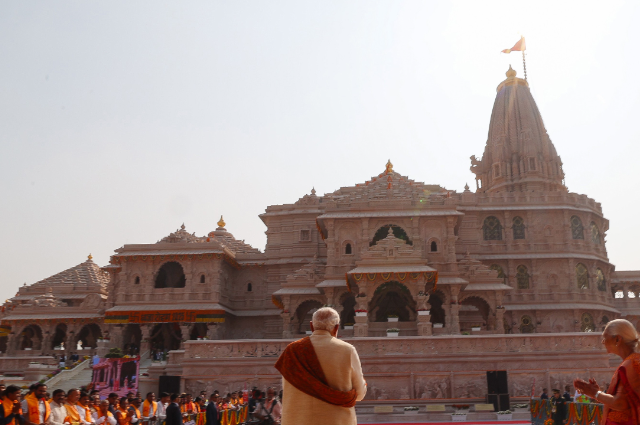
On January 22, 2024, the world watched as the grand Ram Mandir in Ayodhya was opened, with Prime Minister Narendra Modi as the chief host of the Pran Pratishtha ceremony. For millions of Hindus, it was the fulfilment of a decades-long dream. Many believed that after the temple was built, the focus would shift to the larger promise that had been made in Lord Ram's name, which was about good governance, or what is often called "Ram Rajya."
Two and a half years later, the news coming out of Ayodhya is not about devotion. It is about theft. Gold, silver, and crores of rupees offered by ordinary devotees appear to have gone missing from the very temple built to honour their faith. And the most uncomfortable part of this story is not the theft itself, but the silence, delay, and confusion that followed it.
How did the story get uncovered?
The controversy did not begin with a government announcement or an official audit. It began with a political allegation. Samajwadi Party leader and former Ayodhya MLA Pawan Pandey claimed that donations worth roughly seven to seven-and-a-half crore rupees had been misappropriated at the Ram Mandir. Former Uttar Pradesh Chief Minister Akhilesh Yadav then amplified the issue, calling the state of the temple trust "shameful" and demanding that courts take cognisance of this issue.
What followed was not a single complaint but a flood of them. A man who identified himself as the temple's accounts in-charge said on video that he had personally caught members of a bank team manipulating the cash-counting process. A former temple volunteer and a jewellers' association alleged that around a hundred kilograms each of gold and silver offerings had simply vanished. There were also claims that real gold, silver, and jewellery donated by devotees had quietly been swapped for cheap imitation pieces.
Then came individual stories that made the scale of the problem feel personal rather than abstract. A businessman from Mumbai said he had donated a three-kilogram silver necklace and a pair of silver sandals weighing a kilogram, but received no receipt and had no idea where they ended up. A trader said he had handed over two hundred kilograms of silver on behalf of an entire community, directly to a senior trust official, again without any paperwork. A jeweller from Lucknow described gifting a silver lamp that was never accounted for. Even sixty kilograms of silver bricks, presented by traders during the 2024 RAM LALA blessings ceremony, could not be traced by investigators six days into their inquiry; there was no record of where this material went or how it was used.
These were not isolated complaints from disgruntled outsiders. Many of the people raising questions were devotees, donors, and even individuals who had spent years fighting in courts or working on the ground for the temple's construction. That detail matters because it makes it much harder to dismiss this as a manufactured controversy.
The Scale of the Money Involved
To understand how something like this could happen, it helps to look at how much money actually flows through the temple. Daily offerings are estimated to range between eight and thirteen lakh rupees on an ordinary day, but employees working in the counting room have indicated that on busier days, donations can touch fifty to sixty lakh rupees. During the Maha Kumbh period between January and February 2025, when nearly ten lakh devotees were visiting daily, the donation boxes were said to fill up within hours. Investigators believe this high-traffic period is when the bulk of the irregularities may have taken place.
Internal checks reportedly found serious problems with how this cash was handled. There was supposed to be a dress code for staff working in the counting room, but it existed mostly on paper because employees often sat in ordinary clothes instead of uniforms that would make accountability easier. CCTV cameras were installed, but proper monitoring was not consistently carried out, and footage from several machines in the cash-sorting area was reportedly found to be deleted. People could apparently enter and leave the counting area without being checked. And crucially, there appears to have been no reliable system for recording gold, silver, and jewellery donations, and this is the kind of offering that is hardest to track once they leave a devotee's hands.
Once the allegations became impossible to ignore, money started turning up in unexpected places. Around two crore rupees were reportedly recovered from the homes of some temple employees after a Special Investigation Team was formed. In one case, cash was said to have been found hidden beneath cow dung cakes at an employee's home. Gold was also reportedly recovered from the residence of a person described as a close aide of a senior trust functionary.
A Trust With No Real Outsiders Watching
To understand why this could go unnoticed for so long, it's worth understanding how the temple is actually run. The Shri Ram Janmabhoomi Teerth Kshetra Trust, formed in February 2020, is a fifteen-member body responsible for everything from construction to finances. Officially, the state government insists it has no role in the trust's functioning, but questions about money should not be directed at the government, the argument goes, because the trust operates independently.
But that argument starts to look thin once you notice that twelve of the trust's fifteen members were appointed by the central government itself. The trust hired the State Bank of India to manage its funds, and the bank in turn outsourced the actual cash-counting to a private agency. In other words, several layers were created between the donor's offering and any single accountable authority, making it easy to pass blame down the chain, but very hard to fix responsibility at the top.
This was not really a structural accident, either. Earlier in this temple's history, a previous trust made up of saints, religious heads, and respected community elders was dissolved, and a new one made up largely of the ruling party's own people was constituted in its place. At the time, this raised eyebrows among some observers, who felt that installing a more trustworthy set of trustees would make it easier to act without scrutiny. The current controversy has, for many, validated that old concern.
It also doesn't help that the trust has been kept outside the scope of the Right to Information Act. State intervention into its affairs can only happen if there's a specific request, a court order, or public interest litigation, unlike other major temples in India, where government oversight of donations is far more direct and routine.
There were warnings, too. A private audit firm reviewed the trust's finances back in November 2020, just months after it was formed, and flagged that there was no systematic system for financial record-keeping. The auditors specifically recommended a formal standard operating procedure for handling transactions and asked for detailed records to be maintained for gold, silver, and jewellery donations. Since then, the trust has reportedly received more than three thousand five hundred crore rupees in cash donations alone, and according to available information, no such procedure was ever put in place.
Land Deals That Raise Their Own Questions
The donation scandal is not the only financial controversy surrounding the temple. There are also allegations involving land purchases made in Ayodhya in the years before and after the temple's construction, several of which appear to show land bought at prices far higher than their assessed market value.
In one case, a plot reportedly valued at around two crore rupees was sold to the trust for over eighteen crore rupees within minutes of being purchased by an intermediary. In another, a plot worth roughly one-and-a-half crore rupees was purchased on the trust's behalf for almost thirty crore rupees, which is a markup of well over a thousand percent. The trust has defended these transactions by saying that lower valuations reflected old agreements, while the higher payments reflected current market rates. That explanation has not satisfied critics, particularly because the same senior trust official's name reportedly appears across multiple such deals.
The Confusing Response From Authorities
Given the seriousness of these claims, you might expect swift, transparent action. What has happened instead is more complicated. The state government formed a three-member Special Investigation Team in mid-June, led by the Divisional Commissioner of Lucknow, to look into the matter. The SIT moved quickly and submitted an interim report within days, but that report was kept confidential, with officials saying its findings could not be made public until a final report was ready.
What we do know about the interim findings, largely through media reporting, suggests there were real and serious lapses in cash handling, missing dress codes, gaps in CCTV monitoring, and unclear records for valuable offerings. The interim report reportedly did not name any sitting trust members directly but pointed to six individuals involved in collecting and counting donations and raised pointed questions about an unofficial "manager" figure who appeared to control day-to-day decisions without holding any formal position. The SIT also recommended that a formal criminal complaint be registered and that a senior bureaucrat be appointed to oversee the trust's financial operations, similar to the arrangement at Varanasi's Kashi Vishwanath Temple.
One detail that troubled many observers was that the SIT initially worked without a First Information Report having been filed, even though FIRs are usually the starting point for a proper criminal investigation in India, not an afterthought. Critics pointed out that a body without an FIR can really only function as a fact-finding exercise, not a full criminal probe. That changed on June 25, when an FIR was finally registered under several sections of the Bharatiya Nyaya Sanhita, naming a handful of individuals connected to the trust's operations, following the original allegations raised by Pawan Pandey. Even so, questions remain about why it took so long, and why central agencies like the CBI, the Enforcement Directorate, or the Comptroller and Auditor General have largely stayed out of a case involving allegations running into hundreds or possibly thousands of crores of rupees, according to claims made by opposition leaders. There's also an awkward detail involving the CAG where a serving CAG officer is reportedly still listed as a member of the temple's own construction committee, which raises an obvious conflict-of-interest question about how independent any CAG audit could really be.
Politics, Outrage, and an Uncomfortable Question for Everyone
Unsurprisingly, opposition parties have seized on the controversy. Congress leader Mallikarjun Kharge has alleged that the scale of irregularities could run into thousands of crores and has demanded a thorough investigation. Shiv Sena (UBT) chief Uddhav Thackeray has accused the ruling party of betraying the very faith it claims to champion, framing the issue as a question of what genuine devotion to Hindu values should look like. Congress leader Rashid Alvi went further, comparing those accused in the case to historical invaders who looted temples, a comparison that, regardless of how one feels about it, captures just how strongly the allegations have resonated emotionally.
But what makes this controversy different from a routine political slugfest is that criticism has not come only from opposition parties. People from within the larger Hindu nationalist movement and temple-going residents of Ayodhya, former volunteers who fought for the temple's construction for decades, and even some leaders associated with organisations that championed the temple movement have openly said that something has gone badly wrong.
A former Babri demolition case co-accused has filed a police complaint over the donations. A founding figure of a prominent Hindu youth organisation has questioned how control over temple affairs ended up concentrated in the hands of people who, in his view, were not originally central to the movement. Even a senior leader from the ruling party itself has written to the Prime Minister demanding a full public investigation into the trust's finances, assets, and land deals.
This matters because it shows the unease here is not simply partisan. It reflects a deeper discomfort that a place built specifically to represent faith and sacrifice has become entangled in financial mismanagement, and that the people responsible for safeguarding it have, at the very least, failed to do so adequately.
What does this really come down to?
Let us remove the political noise, and the core issue is simple. Devotees gave what they could, including gold, silver, savings and out of belief, trusting that their offerings would be used to honour something they considered sacred. Whether through deliberate theft, gross negligence, or a structure designed to avoid accountability, that trust appears to have been broken. An internal audit warned about exactly this risk back in 2020. That warning was not acted upon, and years later, the predicted failure seems to have materialised.
There are still many open questions. Who exactly benefited from these deals and missing donations? Why was an FIR delayed when an SIT itself eventually recommended one? Will the final SIT report be made public, or will it stay tucked away in a way that lets a "lessons learned" narrative quietly close the matter without real consequences? Will independent agencies with stronger investigative powers be allowed to examine the trust's accounts without conflicts of interest?
None of these questions is only for one political party to answer. They are questions for anyone who cares about whether religious institutions, regardless of which faith they belong to, are run with the transparency and accountability that the people who fund them deserve. A temple's value isn't only in its architecture, but it lies in the trust people place in it. That trust, once broken, is far harder to rebuild than any structure.
References
- https://thenewsmill.com
- https://www.deccanherald.com
- https://tennews.in
- https://www.aninews.in
- https://www.freepressjournal.in