
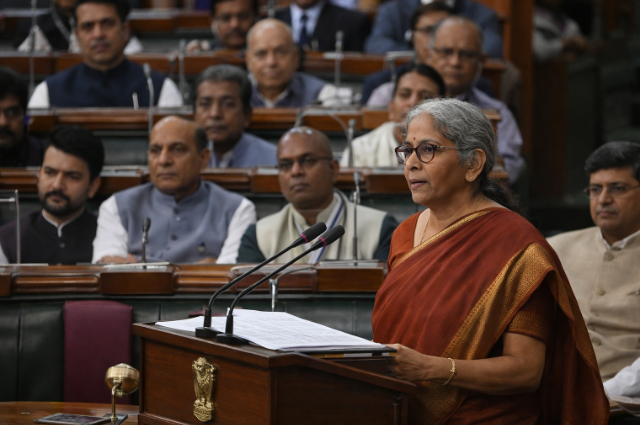
Every year, when the finance minister stands up in Parliament to present the Union Budget, there is a sense of theatre about it. Numbers are thrown around, schemes are announced, and by evening, everyone from economists to auto-rickshaw drivers has an opinion. This year was no different. On February 1, 2026, Finance Minister Nirmala Sitharaman presented the Union Budget 2026-27, and on the surface, it reads like an ambitious document. It talks about growth, it talks about the poor, and it talks about India's place in the world. But does it deliver? Let us break it down simply.
Big Picture and three duties the Government has set for itself
The government framed this entire budget around three duties, which they called the kartavyas. Think of them as three promises. The first promise is to keep the economy growing and make India more competitive. The second promise is to improve the lives of ordinary people by building their skills and capacity. The third promise is to make sure that no one is left behind and that every region, every community, and every family gets a fair chance.
These are not new ideas. Governments have made similar promises before. What matters is whether the money allocated actually flows to the right places. On that front, this budget makes some genuinely interesting moves and some that raise questions.
Building Roads, Railways, and More: The Infrastructure Push
The biggest headline number is the government's spending on infrastructure. The amount being set aside for building things like roads, railways, ports, and so on has gone up from roughly ₹11.2 lakh crore last year to ₹12.2 lakh crore this year. To put that in perspective, a lakh crore is one trillion rupees. This is a massive commitment.
Seven high-speed rail corridors are being planned, connecting major cities like Mumbai-Pune, Delhi-Varanasi, Chennai-Bengaluru, and others. The government is calling these "growth connectors," which is a fancy way of saying that faster travel between cities will help businesses, workers, and tourists move around more easily, which in turn creates economic activity. New cargo corridors, essentially those that are dedicated to railway lines just for moving goods, are being built to connect the east and west of the country. Twenty new waterways are also being developed over the next five years, starting with a route in Odisha that will connect mining areas to ports. This infrastructure spending is the kind of thing that genuinely creates jobs and builds long-term value. The concern, as always, is whether projects stay on time and on budget. India has a long history of ambitious infrastructure plans that take years longer than promised.
Small Businesses Get a Boost
One of the more welcome announcements is a dedicated ₹10,000 crore fund for small and medium businesses, referred to as MSMEs. These businesses, from small manufacturers to local service providers, are the backbone of India's economy and employ hundreds of millions of people. Yet, they have always struggled to get loans and support from the formal financial system. This new fund is designed to identify and build up businesses that have the potential to grow into much larger enterprises. It is an interesting idea, though the devil will be in the details. Which businesses qualify? Who decides? How quickly will the money actually reach them?
The Tax Man Gets Friendlier (Hopefully)
For ordinary taxpayers, this budget brings some genuinely good news. A new Income Tax Act, which was passed in 2025, will come into effect from April 2026. The government says the new rules and forms will be much simpler. This matters because filling out tax forms in India has historically been a confusing and time-consuming exercise for most people.
There are also some practical changes for small taxpayers. For example, if you have assets abroad, say, a bank account from when you studied or worked overseas, and the total value is below ₹20 lakh, you will no longer face prosecution if you had not declared it earlier. There is also a one-time, six-month window being opened for students, young professionals, and returning Indians living abroad to declare smaller foreign assets without facing heavy penalties.
The deadline for revising your tax return has been extended from December 31 to March 31. This gives people more time to correct mistakes. These are small but meaningful changes that reduce the stress of dealing with the tax system.
For people who invest in the stock market, there is a change worth noting. The government is raising the transaction tax on futures trading. This makes speculative trading slightly more expensive, which may discourage some of the more casino-like behaviour that has grown in derivative markets.
Budget 2026 and the Middle Class: A Promise Half-Kept
Every year, as February approaches, millions of salaried Indians look towards the Finance Ministry with one quiet hope that this time, the budget will actually feel like it was made for them. Budget 2026 arrived with announcements and a few genuine wins. But when you sit with the fine print, the picture for the middle class is more complicated than the headlines suggest.
The 2025 budget had already done something meaningful, which made income upto ₹12 lakh effectively tax-free under the new tax system. Budget 2026 built on that goodwill. But the middle class does not just want tax-free income up to a point. They want a system that does not punish them for earning a little more, saving a little more, or doing the right things like buying health insurance or paying off a home loan.
Experts had been calling for a reduction in tax rates for people earning up to ₹15 lakh a year, a higher basic exemption limit, and a lower top surcharge. Progress has been made, but the pace remains frustratingly slow. The new tax system, which was the government's preferred option, still lacks the deductions that made the old one feel rewarding. Adding basic deductions for health insurance and home loan interest into the new system would cost the government little while making it far more appealing to ordinary families.
Compliance: The Invisible Burden
Beyond tax rates, the paperwork burden on middle-class taxpayers remains unreasonable. When a buyer purchases property from a non-resident seller, they must register for a special tax number and file multiple returns for what is often a once-in-a-lifetime transaction. Simplifying this process would give ordinary buyers tremendous relief at almost no cost to the government.
The advance tax threshold and the point at which you must pay tax in quarterly instalments have been set at ₹10,000 for years. In a country where inflation has steadily eaten into the value of money, this number is outdated. Raising it to ₹50,000 would allow small taxpayers to focus on their finances rather than managing quarterly deadlines.
What the Middle Class Is Really Asking For?
The truth about Budget 2026 is that it has moved in the right direction, but the middle class remains in a state of managed disappointment. The cost of housing, healthcare, and education continues to rise faster than salaries. Tax savings help, but they cannot substitute for wages that actually keep pace with the cost of living. India's middle class is not asking for handouts. They are asking for fairness in a tax system that does not penalise ambition, a compliance process that does not require expert help for every decision, and a budget that treats them as partners in the country's growth rather than its most convenient source of revenue.
That is not too much to ask. But year after year, it remains just out of reach.
Making India Attractive for Global Companies
The budget is clearly trying to bring more foreign investment into India, and some of the proposals are clever. Foreign companies that provide cloud computing services to the world using data centres in India will not pay tax until 2047. That is a long tax holiday, and it is designed to convince global technology giants to set up data infrastructure here rather than in competing countries like Singapore or the UAE.
Similarly, foreign experts who come to work in India under government-approved programmes will not pay tax on income they earn outside India for up to five years. This is an attempt to make India more appealing to top global talent, who might otherwise choose to work in countries with more straightforward tax arrangements.
These are smart ideas in theory. The question is implementation. India's reputation for bureaucratic complexity and slow approvals has historically put off investors, even when policies on paper look attractive. The budget also promises to make customs approvals faster through a single digital window and to use scanning technology at ports to clear goods more quickly. If these actually work, it would be a significant improvement.
Spending on People: Health, Education, and Women
Beyond the economic machinery, the budget makes some meaningful commitments to people's well-being. In healthcare, the government wants India to become a destination for medical tourism. Five regional medical hubs are being planned, combining hospitals, research facilities, and rehabilitation centres. These would attract patients from other countries while also serving Indians who need quality care.
A new programme called Biopharma SHAKTI, with a budget of ₹10,000 crore, will focus on building India's capacity to make complex medicines called biologics and biosimilars, the kind used to treat cancer and other serious diseases. India already makes a lot of generic medicines for the world. This is an attempt to move into more advanced pharmaceutical territory.
For girls' students in science and technology colleges, the budget proposes building one girls' hostel in every district. This is a simple but potentially powerful intervention. Many families in India are reluctant to send their daughters to colleges far from home. Having proper, safe accommodation could change that calculation for thousands of families.
The animation, gaming, and creative technology sector is also getting attention. Labs to train students in content creation will be set up in 15,000 schools and 500 colleges. Given that this industry is expected to need 2 million professionals by 2030, starting early makes sense.
Farmers and the Northeast: Reaching the Last Mile
For farmers, the budget introduces an AI-based tool called Bharat-VISTAAR. It will bring together agricultural data and research in multiple languages to give farmers personalised advice about what to grow, when to plant, and how to manage risks. This is the kind of technology that could genuinely help farmers make better decisions if it is designed with rural realities in mind, where slow internet, multiple local languages, and varying levels of digital literacy are present.
The northeastern states and the economically weaker eastern states are getting specific attention through tourism development, industrial corridors, and cultural preservation programmes, including Buddhist heritage circuits. This is welcome, though the northeast has seen many promises over the years, and the follow-through has been uneven.
Is the Government Spending Within Its Means?
A responsible budget needs to balance ambition with financial discipline. On this front, the numbers are moving in the right direction. The fiscal deficit and the gap between what the government earns and what it spends are being brought down slightly from 4.4% of GDP last year to 4.3% this year. The total government debt as a share of the economy is also declining.
This is not dramatic fiscal tightening, but it signals that the government is not simply writing cheques it cannot cash. Total spending is estimated at ₹53.5 lakh crore, while government receipts are estimated at ₹36.5 lakh crore. The gap will be financed through market borrowings.
The Verdict: Was it satisfactory, or are improvements still required?
India's Union Budget 2026-27 is a document of genuine ambition. It addresses infrastructure, technology, health, education, and taxation in ways that, if properly implemented, could make a real difference to people's lives. The reduction in tax complexity, the support for small businesses, the push for global investment, and the focus on building skills are all steps in the right direction.
But budgets in India have always been better at promising than delivering. The schemes announced this year will need consistent monitoring, honest accountability, and genuine political will to translate into outcomes. The government's credibility ultimately rests not on the words of the budget speech, but on whether a farmer in Odisha gets better advice through an app, whether a girl in a small town gets a safe place to live while she studies engineering, and whether a small business owner in Tamil Nadu actually gets access to that growth fund. That is where the real test lies.
. . .
References: