
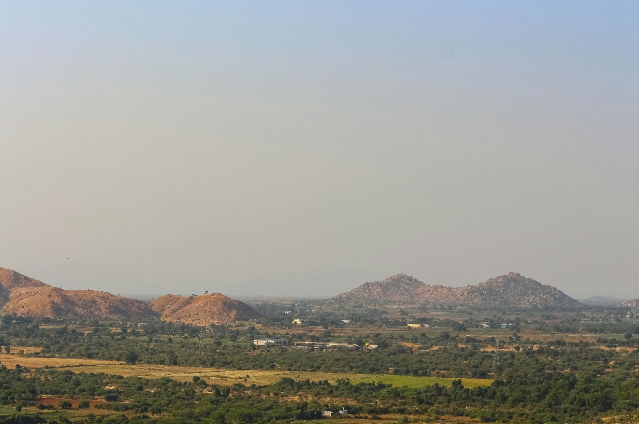
"A mountain is defined not by its height, but by its geological structure. A small rock is part of the same tectonic plate and mountain range as a towering peak." — Former Chief Minister Ashok Gehlot
In November 2025, the Supreme Court of India accepted a redefinition of the Aravalli Hills that has sent repercussions throughout the environmental circles across the nation. Under the new criteria proposed by a committee led by the Union Ministry of Environment, Forest and Climate Change, only landforms rising 100 meters or more above local terrain qualify as "Aravalli Hills." This adjustment represents far more than administrative housekeeping, it constitutes what many are calling the forceful removal of one of Earth's oldest mountain ranges.
The implications are devastating. According to Forest Survey of India data, approximately 90 percent of the Aravalli range will no longer qualify for legal protection. Out of 12,081 hills mapped across multiple states, only 1,048 meet the new 100-meter criterion. What was once protected as an ecologically integrated system spanning across 650-700 kilometres from Gujarat to Delhi now faces destruction through a definition that privileges elevation over ecological function.
The Geological and Ecological Significance of the Aravallis
To understand the gravity of this decision, one must first appreciate what the Aravalli range represents. At approximately 3.2 billion years old, it stands among the world's most ancient geological formations that can be pre-existing even the Himalayas by billions of years. This is not merely a collection of hills; it is a living geological infrastructure that has shaped the Indian subcontinent's climate, hydrology, and biodiversity for ages.
The range serves multiple critical ecological functions. As a natural climatic barrier, it prevents the eastward expansion of the Thar Desert, acting as a safeguard against desertification for Haryana, Rajasthan, and the Delhi-NCR region. Its hydrological significance cannot be overstated as the Aravallis serve as the source and recharge zone for major rivers, including the Chambal, Sabarmati, and Luni, sustaining both agriculture and drinking water security for millions.
The biodiversity value is equally remarkable. The range forms crucial environmental connections between protected areas like Sariska and Ranthambore, essential for tiger and wildlife movement. As the "green lungs" of North India, it moderates heat, traps dust, and reduces air pollution in what is already one of the world's most polluted metropolitan regions.
Technical Definition Versus Ecological Reality
The Supreme Court's November 20, 2025 judgment accepted recommendations from a central committee that defined the Aravalli Hills as landforms with an elevation of 100 meters or more from local relief. Furthermore, two or more such hills located within 500 meters of each other would constitute an "Aravalli Range." The Court emphasised administrative uniformity and "sustainable mining" as priorities, while imposing an interim moratorium on fresh mining leases pending detailed studies.
The government has defended this framework by arguing that it strengthens protection by providing clarity and objectivity. Officials point out that Rajasthan has been using this 100-meter definition since 2006, based on Richard Murphy's landform classification. The framework includes provisions to protect core areas which constitute protected areas of Tiger Reserves, Eco-Sensitive Zones, wetlands and mandates for the preparation of a Management Plan for Sustainable Mining.
However, this technical approach fundamentally misunderstands ecological systems. The Aravalli range is not defined solely by peak elevations but by its combined landscape and the slopes, valleys, low-lying points, and dominant terrain that together constitute a functioning ecosystem. Many of these features perform vital ecological roles despite not meeting the arbitrary 100-meter threshold.
The Violence of Categorisation
What we witness here is what environmental scholars call bureaucratic erasure, the disappearance of an ecological reality not through physical destruction, but through administrative reclassification. The Aravalli has not changed; our willingness to recognise it has. This represents a troubling shift from ecological to purely rational, where landscapes are valued based on administrative convenience rather than environmental significance.
This erasure follows a disturbing pattern. Similar to how wetlands become "vacant land," rivers are renamed "drains," and forests reclassified as "non-forest use," we now see an ancient mountain range being administratively decommissioned. The categorization itself becomes an act of violence and by determining what deserves protection based on narrow physical metrics rather than ecological function or cultural significance.
The societal treatment of older people is striking. Just as societies increasingly view the elderly as economically unproductive and therefore marginal, the damaged, eroded Aravallis are deemed less worthy of protection. This reveals a fundamental failure of imagination, where an inability to value flexibility, endurance, and the accumulated understanding of deep geological time.
Stark Reality of Evidence from the Ground
The consequences of mining in the Aravallis are not imaginary; they are devastatingly visible. The State of Haryana Aravallis Citizens' Report, submitted in May 2025, documented how licensed mining operations have already wiped out most of the two-billion-year-old ecological heritage in districts like Charkhi Dadri and Bhiwani. In Gurugram, Nuh, and Faridabad, hills were cut down before the Supreme Court's 2009 mining ban, and illegal mining continues openly despite legal restrictions.
In Mahendergarh district, where groundwater levels have fallen to depths of 1,500-2,000 feet, the joint illegal mining has caused immense destruction. A 2018 Supreme Court-appointed committee found that in Rajasthan, 31 of 128 Aravalli hills disappeared over 50 years due to illegal mining, opening 10-12 large gaps in which was once a continuous range. The construction industry particularly wants the Aravalli's granite deposits, which though comprising less than 3 percent of the terrain, are described as a literal goldmine for developers, fueling the Delhi-NCR construction boom.
Investigative reporting has exposed systematic corporate encroachment through networks of shell companies designed to acquire forestland and convert it into profitable real estate. Groups like Patanjali have been documented by holding over 123 acres through multiple entities in areas like Mangar village alone.
Constitutional and Legal Implications
The controversy raises fundamental questions about environmental protection under India's constitutional framework. Article 48A mandates the State to protect and improve the environment, while Article 51A imposes a corresponding duty upon citizens. These provisions have been reinforced through extensive judicial interpretation of Article 21, with the Supreme Court holding in Subhash Kumar v. State of Bihar (1991) that the right to life includes the right to enjoy pollution-free air and water.
Indian environmental jurisprudence has consistently rejected purely formalistic approaches to ecological protection. In M.C. Mehta v. Union of India cases dealing with Aravalli mining, the Court imposed restrictions based on ecological challenges and irreversible consequences, not merely because of elevation thresholds. Environmental systems are properly assessed based on function and impact, not arbitrary numerical benchmarks alone.
The new definition potentially undermines three decades of legal protection afforded by the Ministry's 1992 Aravalli notification and the National Capital Region Planning Board's 2021 declaration of Natural Conservation Zones. By prioritising administrative uniformity over ecological integrity, the judgment risks by disconnecting environmental law from ecological science, a concern repeatedly raised by constitutional courts and environmental advocates.
Political Responses and Public Outcry
The redefinition has sparked intense political debate and grassroots mobilisation. Limiting the Aravallis to a 100-meter scope will be, ‘equal to signing a death certificate for 90% of the state's Aravallis,’ noting that this would mean the Forest Conservation Act would no longer apply in excluded areas, thereby allowing unregulated mining.
Kumari Selja, former Union Minister, characterised the decision as, “an irresponsible attack on India's environment and the future of generations to come," arguing that it represents, “a dangerous step towards legalising illegal mining and destroying the environment.” She emphasised that the Aravalli is not merely a mountain range but "the ecological lifeline of North India", protecting the region from desertification.
The #SaveAravalli campaign has mobilised environmental activists, scientists, and concerned citizens. Amicus curiae K. Parameshwar argued before the Court that the earlier Forest Survey of India criteria based on slope, foothill barriers, and valley size are better than preserved ecological integrity. He warned that the 100-meter threshold would exclude smaller hill features, break range continuity, and potentially open vast new areas to mining.
Climate Vulnerability and Future Risks
The timing of this redefinition could not be worse from a climate perspective. As global temperatures rise and extreme weather events intensify, the protective functions of the Aravallis become more critical, not less. Degradation of this range will intensify heat waves, dust storms, flooding, and groundwater depletion, worsening climate stress across North India.
Without the Aravalli barrier, the Thar Desert's eastward expansion will accelerate, threatening agricultural productivity in the fertile Indo-Gangetic plains. Delhi-NCR, already grappling with some of the world's worst air quality, will lose a crucial pollution purifier. Rivers dependent on Aravalli recharge will face further stress, aggravating water scarcity in an already water-stressed region.
The fragmentation of habitat will severely impact biodiversity. Wildlife corridors connecting protected areas will be broken, threatening species like tigers that require large, connected territories.
The Path Forward and Reimagining Protection
If we are to prevent the complete degradation of the Aravallis, several interventions are urgently needed. First, the definition itself must be revisited through a more comprehensive scientific lens. Protection should be based on landscape-level ecological function, not arbitrary elevation thresholds. The Forest Survey of India's earlier criteria, incorporating slope, connectivity, and ecosystem integrity, provided a more sound basis for conservation.
Second, legal safeguards must be strengthened and rigorously enforced. Expanding eco-sensitive zones, implementing robust monitoring systems using technology like drones and satellite surveillance, and imposing meaningful penalties for violations are essential. The Management Plan for Sustainable Mining must genuinely prioritise ecological protection over extraction.
Third, restoration efforts should be hugely scaled up. The Aravalli Green Wall Initiative, a landscape restoration program covering the range across Gujarat, Rajasthan, Haryana, and Delhi, offers a promising framework. However, it requires adequate funding, coordination, and long-term commitment to succeed.
Fourth, public participation in environmental decision-making must be institutionalised. Transparent processes involving affected communities, scientists, and civil society organizations can help balance development needs with ecological imperatives. The current top-down approach that produced this redefinition demonstrates the perils of excluding diverse voices.
Finally, we must cultivate a cultural shift in how we value natural heritage. Educational curriculum should teach children about the Aravallis' significance. Artists, writers, and filmmakers should help us see and appreciate these ancient hills. Public discourse must elevate ecological function over economic extraction as the measure of a landscape's worth.
Mountains of Memory and Mountains of Hope
The Aravalli redefinition represents more than a legal or administrative dispute; it is a test of our civilisation's values and imagination. When we allow bureaucratic language to erase geological reality, when we prioritise short-term extraction over long-term sustainability, when we value height over function and spectacle over endurance, we diminish ourselves as much as we diminish the landscape.
These ancient mountains have survived tectonic shifts, climate changes, and geological disturbances across billions of years. They now face their greatest threat not from natural forces but from human indifference wrapped in administrative efficiency. The question before us is not whether the Aravallis can survive this redefinition; they will persist in some form but whether we can survive the loss of imagination, care, and ecological wisdom that this erasure represents.
Let the Aravallis remain, not just as landforms on a map, but as a living testament to resilience, as a teacher of deep time, as a reminder that not all value can be measured in meters or monetised in markets. Let us preserve not just their terrain but their name, their story, their place in our collective memory. To name is to remember, and to remember is to resist the forces of erasure.
In defending the Aravallis, we defend more than a mountain range. We defend the principle that ecological function matters more than administrative convenience, that deep time deserves respect and that flexibility. We defend the possibility of a relationship with the natural world based not on extraction and erasure, but on recognition and care.
The Aravallis have stood for billions of years. Whether they continue to stand in our laws, our consciousness, and our care now depends on the choices we make today. Let us choose wisely, with humility before deep time and responsibility towards the future generations. Let the ancient mountains endure not despite their age and erosion, but because of the wisdom and resilience these qualities represent.
References
- https://thewire.in
- https://www.outlookindia.com
- https://www.indiatoday.in
- https://timesofindia.indiatimes.com
- https://www.thehindu.com
- https://www.newindianexpress.com