
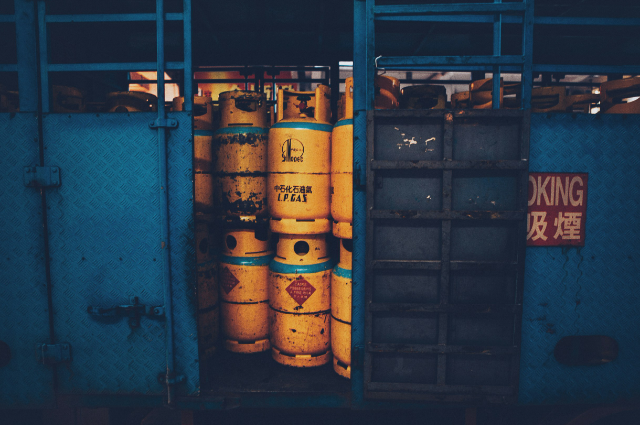
A Man Dies in a queue, and the Government says there is no queue. On the morning of 13th March 2026, a 66-year-old man named Bhushan Kumar Mittal stood in line at a gas agency in Barnala, Punjab. He was not protesting. He was not carrying a placard. He had not come to make a point. He just needed one cooking gas cylinder and the same cylinder that millions of Indian families depend on every single day to cook their meals. He stood there for hours under the open sky, waiting for his turn, and then his heart gave out. Bhushan Kumar Mittal died in that queue.
Around the same time he was collapsing, thousands of posts were flooding Instagram and Twitter. All of them said the same thing, word for word, "My cylinder was booked at 11:45 am and delivered at 1:30 pm." Same time. Same wording. Same script. Copy-pasted across hundreds of accounts. While a man lay dying in Punjab, a coordinated effort was underway on social media to convince the country that nothing was wrong. That the cylinders were arriving on time. That there was no crisis. Everything was, in fact, deeply wrong, and the government knew it.
How India Ended Up Here?
To understand how things got this bad, you need to know one number that is 33 kilometres. That is the width of the Strait of Hormuz, the narrow sea passage that sits between Iran and Oman. Through that 33-kilometre gap flows the lifeblood of India's cooking gas supply.
India consumes roughly 3.1 crore metric tons of LPG every year. Sixty percent of that is imported from abroad and ninety percent of those imports come through the Strait of Hormuz. In other words, more than half of all the cooking gas used in this country is the gas that lights stoves in 33 crore homes and depends on a single passage that is barely wider than a small town.
When the United States and Israel launched strikes on Iran in early March 2026, Iran did exactly what it had threatened to do. It shut the Strait of Hormuz. Mines were laid. Ships were warned off. And in the space of a few days, more than half of India's cooking gas supply simply stopped arriving. The result was not a manageable disruption. It was immediate, visible, and painful chaos.
The Crisis on the Ground
Long queues waited outside gas agencies across the country in Gorakhpur, Pune, Noida, Delhi, and Lucknow. In one video that spread rapidly online, a man in Lucknow lay down on the road directly in front of a truck loaded with LPG cylinders, blocking it out of sheer desperation. Online booking systems crashed in Madhya Pradesh and Gurgaon. WhatsApp booking services stopped responding. People gave up on digital channels and went to agencies in person, which only made the physical queues longer and more dangerous. A 75-year-old man named Mukhtar Ansari collapsed in a line in Farrukhabad, Uttar Pradesh. He died before he could reach a hospital. Just like Bhushan Kumar, he had come for one cylinder.
In cities like Bangalore and Mumbai, between 20 and 30 percent of restaurants shut their doors. On food delivery platforms like Swiggy and Zomato, orders dropped by 50 to 60 percent. The commercial cylinder, normally priced around Rs 3,000, was being sold in Bangalore's black market for Rs 6,000, which is double the price. In Delhi, the domestic cylinder, officially worth Rs 900 was going for Rs 2,000 to 3,000 in unofficial markets. Trucks carrying cylinders required police escorts in Maharashtra. In West Dehradun, a crowd stopped a delivery truck and began pulling cylinders off it. In Uttar Pradesh, more than 76 cylinders were stolen when people broke into a gas agency.
A survey conducted in the middle of that week found that more than half of Indian households had faced delays in getting their LPG refilled. Many of them had ended up paying well above the official price just to get gas at all. Even the Parliament canteen in Delhi reportedly ran out of tea and coffee, a detail that opposition members were quick to point out to a government insisting publicly that supplies were unaffected.
The Government said that there is no problem
On 12th March, Petroleum Minister Hardeep Singh Puri stood in the Lok Sabha and stated that domestic LPG supply was fully protected and that the delivery cycle was unchanged. Prime Minister Narendra Modi went further, suggesting that people who were worried about a shortage were causing damage to the country and that fear itself, not any actual gap in supply, was the real problem. But even as these statements were being made, the government's own actions told a completely different story.
On 7th March, the price of a domestic cylinder had already been raised by Rs 60. The commercial cylinder went up by Rs 115. On 8th March, an LPG control order was issued directing refineries to maximise production. The government later claimed output had risen by 28 percent over five days. Emergency supplies were ordered from the United States, Norway, Canada, and Russia. On 9th March, a separate natural gas control order capped commercial LPG supply at 20 percent of normal demand by meaning that hotels and restaurants could get only a fifth of what they usually receive. Booking intervals were stretched out by 25 days in cities, 45 days in villages. On 14th March, people with piped natural gas connections were banned from booking LPG cylinders at all. State pollution control boards began issuing one-month permits allowing restaurants to burn biomass, kerosene, and coal as alternatives. Now, you do not do any of those things if there is no shortage.
The Assam Police issued an official tweet warning that anyone spreading "rumours" about an LPG shortage would face strict action. The logic, apparently, was that silencing the conversation would somehow solve the underlying problem. It is the same reasoning that was used during COVID-19 and if you stop testing, the case numbers stop going up. The crisis does not end. You just stop counting it.
This Did Not Have to Happen
The most troubling part of this story is not the crisis itself. It is how avoidable it was. People who pay close attention to events in West Asia have been watching the situation build since January 2026. The signs that America and Israel were moving towards striking Iran were not hidden. They were discussed openly in policy circles, in the foreign press, and in geopolitical analysis. If Iran was hit, Iran would respond. And one of the most obvious responses Iran could take which it had threatened explicitly, was to close the Strait of Hormuz. This required no special intelligence. It required only that someone in government was paying attention.
That was the time to act. India could have placed emergency orders for LPG from countries outside the Gulf region. It could have begun diversifying its supply chain. It could have quietly increased domestic production and started filling whatever storage capacity it had. None of that happened.
What makes this harder to accept is what Prime Minister Modi was doing in those final days before the attack. He visited Israel on 25th and 26th of February. He had dinner with Prime Minister Netanyahu. He addressed the Israeli Parliament, the Knesset, and upgraded the relationship between the two countries to a "special strategic partnership." He reportedly called Israel a "Fatherland." Forty-eight hours after he returned home, Israel and America jointly struck Iran. Israeli defence officials later confirmed to reporters that the attack had been planned for weeks, and that the timing was chosen because the right operational window appeared after Modi's departure.
If the attack was planned weeks in advance, and if PM Modi was sitting across the table from Netanyahu just two days before it began, the question of what was discussed and what was not communicated back to New Delhi is one that deserves a clear answer. India came home from that visit with an upgraded diplomatic relationship and no plan for what was about to happen to its cooking gas supply. Even after the Strait closed, the government lost another week before taking any real steps, and when it finally did act, its first move was to deny that anything was wrong.
A Structural Failure Built Over Many Years
What this crisis has exposed is not just a policy failure in the moment. It is the consequence of choices or the absence of choices made over many years.
India has no meaningful strategic reserve for LPG. There are underground storage caves in Mangaluru and Visakhapatnam, but these exist to maintain the flow of supply, not to stockpile it. Their combined capacity is approximately 1.4 lakh tons. That is less than two days of national consumption. The broader operational supply chain holds around 18 days of LPG in total. Beyond that, there is nothing. Think about what that means for a country of 1.4 billion people. If supply is interrupted, India has roughly 48 hours of reserve gas. Not weeks. Not months. Forty-eight hours.
A government serious about energy security would have addressed this long ago. As the Ujjwala Yojana brought cooking gas to previously unconnected households across rural India, a genuinely worthwhile programme where LPG demand was rising steadily and predictably. The infrastructure to back that demand should have grown alongside it. Strategic reserves should have been built. Import sources should have been diversified so that 90 percent of the supply did not flow through one narrow sea passage.
On the diplomatic side, India could have cultivated a better relationship with Iran and one that gave India's ships a standing passage through the Strait, the way Chinese ships were granted. Instead, Foreign Minister Jaishankar was forced to confirm publicly that there was no blanket agreement for Indian ships. Every voyage had to be negotiated individually with Iranian authorities, one ship at a time. China's ships moved through. India did not.
These are not accidental oversights. They are the product of choices about where to focus diplomatic energy, which friendship to prioritise, and what kind of country India wanted to be in the region.
What Happens Next and What You Can Do Right Now?
The realistic outlook, based on where things stand, is that the crisis will last at a minimum of four to eight weeks. That timeline assumes the situation around the Strait of Hormuz begins to improve. There are no guarantees of that. Iran's new Supreme Leader, appointed on 9th March, has taken a harder line than his predecessor. Discussions about a ceasefire are ongoing, but Iran is demanding reparations and the withdrawal of US military bases from the region. None of that is close to resolution.
Two ships i.e. the Nanda Devi and the Shivalik brought in roughly 92,700 tons of emergency LPG from alternative suppliers. That number sounds substantial until you put it next to India's annual requirement of 3 crore metric tons. Those two ships delivered approximately one day of national supply. Emergency imports from the US, Norway, Canada, and Russia are continuing, but the combined volume remains a fraction of what the country needs.
If you are trying to manage at home right now, there are some practical options. An induction cooker available for around Rs. 2,000 to Rs. 3,000 is a workable alternative for those with stable electricity and flat-bottomed cookware. If your area has piped natural gas infrastructure, make sure you are registered, because PNG supply comes through pipelines on land and is completely unaffected by the Hormuz situation. If you encounter cylinders being sold above official prices, that is a criminal offence under the Essential Commodities Act. You can report it to the National Consumer Helpline at 1800-11-4000, or go directly to your District Magistrate's office and do not panic buy. Hoarding cylinders takes them out of circulation for people who need them more urgently and makes the shortage worse for everyone around you.
The harder truth, though, is that these workarounds do not help the people who need help most. In rural India, where electricity is unreliable and induction cooking is not a real option, people are returning to wood-burning stoves. Women who spent years cooking on smoky fires, who finally received a gas cylinder through a government scheme and believed their children would grow up without breathing smoke in the kitchen, are now going back to cooking over wood and coal. They are inhaling that smoke again. So are their children.
These are the people paying the real price for this crisis. Not because a war was impossible to predict. Not because the Strait of Hormuz closing was unforeseeable. But because the people entrusted with governing this country did not build the reserves, did not diversify the supply, did not maintain the relationships, and did not tell the truth when it mattered the most. Bhushan Kumar Mittal stood in the sun for hours. He was sixty-six years old. He needed one cylinder. He should have gone home with it.
The cylinders will return eventually, and life will resume at its normal shape when such wars will hopefully be over. But the question that should stay with us is, long after the queues are gone, a simple one that who decided that none of this preparation was necessary? And have we decided yet that we will not allow the answer to be forgotten?
References
- https://www.thehindu.com
- https://www.newindianexpress.com
- https://thewire.in
- https://www.deccanherald.com
- https://www.uniindia.com
- https://thewire.in
- https://m.thewire.in