
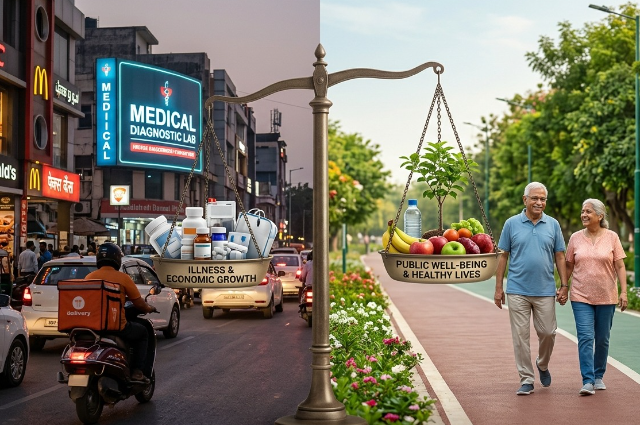
As a nation, we are renowned for our rich heritage and remarkable development achievements. Yet, we must ask a critical question: Is our economic progress truly keeping pace with our aspirations for human well-being, particularly in healthcare?
Hotels, restaurants, food-delivery services, and food-manufacturing businesses are expanding rapidly across the country. Today, we have unprecedented access to global cuisines at our doorstep. However, concerns remain about food adulteration, unhygienic preparation, and inadequate enforcement of food-safety regulations. As we adopt modern lifestyles and convenience-driven business practices, we must pay far greater attention to the safety and nutritional quality of the food we consume. As we adopt modern lifestyles and convenience-driven business practices, we must pay far greater attention to the safety and nutritional quality of the food we consume.
At the same time, multispecialty hospitals, diagnostic laboratories, pharmaceutical companies, marketing networks, and medicine distribution systems are experiencing exponential growth. These sectors generate vital employment, provide essential care, and contribute significantly to economic growth. Yet a fundamental question remains: Are we building an economy that helps people stay healthy, or one that relies on the consequences of ill health?
The Changing Pattern of Daily Life
Consider our evolving food habits. Long working hours, fast-paced routines, and the demand for convenience have made eating outside the home a cornerstone of modern life. Restaurant breakfasts, hotel lunches, bakery snacks, and home-delivered dinners are now everyday realities for many families. While dining out is often unavoidable—and restaurant food can certainly be wholesome—we must be mindful of the long-term nutritional consequences of what we consume.
Even at home, we frequently rely on highly processed, packaged, and canned foods without scrutinising their ingredients, nutritional profiles, or long-term health impacts. The regular consumption of foods high in sodium, added sugars, refined oils, and empty calories significantly elevates the risk of obesity, hypertension, type 2 diabetes, and cardiovascular disease.
Why, then, have lifestyle-related diseases become such a dominant concern in our society? Why are so many individuals affected by conditions inextricably linked to changing diets, physical inactivity, chronic stress, and modern living?
There is no single explanation. Ageing, genetics, environmental conditions, social circumstances, and access to healthcare all influence disease prevalence. We should never assume that every illness is caused by poor personal choices, nor that every condition can be prevented. Nevertheless, the heavy burden of chronic disease must compel us to evaluate whether our present way of life is genuinely serving our well-being.
The Economic and Human Cost of Illness
When a person develops high blood pressure, diabetes, or another chronic condition, the financial consequences reverberate for years. Regular doctor consultations, diagnostic tests, continuous medications, and long-term follow-up care become recurring household expenses. While these services are indispensable and often lifesaving, they place a persistent financial strain on families.
Lifestyle diseases are only one example of how illness imposes recurring financial burdens. Medical emergencies and acute health crises create similar hardship. The issue is not that hospitals, diagnostic centres, or pharmaceutical companies are unnecessary; on the contrary, their work is vital. The real question is whether we are doing enough to prevent avoidable illness and reduce the financial burden of treatment wherever possible.
Restaurants count their customers. Laboratories count their tests. Pharmacies count their prescriptions. Hospitals count their patients. Businesses celebrate expanding operations and rising revenues—but who measures the suffering of patients, the anxiety of their families, and the hard-earned money spent on illnesses that could have been prevented?
This is not an argument that businesses deliberately want people to fall ill. Pharmaceutical companies innovate lifesaving therapies, hospitals treat acute conditions, and healthcare professionals work tirelessly to protect lives. However, the growth of these service industries should not be our sole metric of progress. We must also evaluate whether our people are actually living healthier lives and whether maintaining good health is affordable.
The Imperative of Affordable Healthcare
The affordability of medicines is a crucial piece of this conversation. Consider a common scenario where a branded medicine costs substantially more than a comparable generic counterpart available through a Jan Aushadhi Kendra. When a patient requires daily medication over many years, even a modest difference in the price per tablet translates into life-changing savings for a household budget.
While exact savings vary depending on the drug, dosage, and market prices, the underlying question remains: why should patients spend more than necessary when an appropriate, quality-assured generic alternative is readily available?
Why do we not promote Jan Aushadhi medicines more vigorously while ensuring unwavering quality standards? For public adoption to succeed, people must have total confidence that affordable generic medicines meet rigorous quality benchmarks. Uncompromising quality control, dependable supply chains, convenient access, transparent information, and active public education are essential to building that trust.
The Pradhan Mantri Bhartiya Janaushadhi Pariyojana aims to make quality-assured generic medicines accessible and affordable. This initiative deserves widespread public support, alongside continuous quality monitoring and transparent oversight. Affordability must never come at the expense of quality.
Medical professionals and pharmacists have a key role to play in guiding patients toward safe, lower-cost alternatives. At the same time, patients should never discontinue essential medications or substitute prescriptions without consulting a qualified healthcare professional.
When patients can safely access affordable treatments, the collective savings are substantial. Money saved on chronic medication can be redirected toward nutritious food, education, housing, and overall family well-being. Affordable medicines, therefore, improve not only healthcare access but also household financial resilience.
Shifting from Disease Management to Prevention
Yet, reducing the cost of medicines addresses only one part of the problem. Even if essential drugs were completely free, the burden of disease would persist—along with physical pain, diminished quality of life, lost workdays, emotional strain, and the risk of severe complications.
This brings us to the core challenge: If we want to break this cycle, why do we not prioritise maintaining health in the first place?
The most sustainable strategy is to prevent avoidable disease wherever possible. A balanced diet rich in vegetables, fruits, pulses, and whole grains, combined with a conscious reduction in excessive salt, sugar, fried foods, and highly processed products, lays a strong foundation. Regular physical activity, adequate sleep, stress management, and avoiding tobacco and harmful alcohol consumption further protect health.
These practices offer no guarantees against illness, as factors beyond individual control drive many health conditions. Preventive healthcare also includes regular screenings, early diagnosis, vaccinations, and timely medical advice. Nevertheless, healthier daily habits significantly reduce the risk of chronic conditions and enhance overall vitality. Rather than waiting for illness to manifest and paying for long-term treatment, we must invest time, attention, and resources into preserving our health every day.
A Shared Responsibility for a Healthier Society
Crucially, this responsibility cannot rest solely on individual shoulders. Governments must rigorously enforce food-safety standards and make wholesome food accessible to all. Schools must instil healthy eating habits and physical activity early in life. Employers and community organisations must cultivate work environments that support mental well-being and active living. Healthcare professionals and the media must disseminate accurate, evidence-based guidance on disease prevention and affordable care.
Health consciousness must transcend occasional public campaigns and awareness days. It must become an enduring people's movement—embraced by families, educational institutions, businesses, healthcare providers, and policymakers alike.
We must fundamentally re-examine how we define economic development. An expanding network of restaurants, hospitals, diagnostic labs, and pharmacies signals high economic activity, but it does not automatically equate to a healthier population.
True progress must be measured by improvements in healthy life expectancy, reductions in preventable chronic conditions, equitable access to affordable treatments, and the elimination of health-induced financial distress.
Our goal is not to diminish the importance of healthcare institutions or medicines. We need world-class hospitals, skilled medical professionals, effective therapies, and reliable pharmaceuticals. But we also need a society in which far fewer people fall ill from preventable causes, more individuals enjoy sustained vitality, and those who require medical care can access it without falling into poverty.
A healthy population is not an obstacle to genuine economic development. Healthy individuals lead more fulfilling lives, work more productively, and contribute more dynamically to their communities. Businesses that align with public health—by providing safe food, wholesome products, affordable medicines, and ethical services—can thrive while serving the greater good.
Ultimately, our ambition should not be to escape the healthcare system, but to reduce our avoidable dependence on it. By supporting quality-assured generic medicines, strengthening food-safety systems, promoting active lifestyles, and prioritising preventive care, we can break the costly cycle of recurring illness.
Our ill health must never become the foundation of our economic growth. Instead, true economic progress must create the conditions that enable every citizen to live a healthier, longer, and more meaningful life.
Whenever we celebrate another milestone in economic development, let us ask ourselves one final question:
Are we progressing by helping people live healthier, better lives—or are we merely doing business with the consequences of their ill health?
Prevention remains better than cure. Affordable medicines are essential. Quality must never be compromised. And a healthy population is, and will always be, our greatest collective asset.
Let us promote healthy living, demand safe and nutritious food, support affordable and high-quality medicines, and champion responsible business practices. Let us make disease prevention a priority in our homes, schools, workplaces, and public policies.
Let health consciousness become a true people's movement—and let a healthier population be the ultimate measure of our progress.