
It was International Women’s Day, an occasion that honoured strength, resilience, and the indomitable spirit of women through the ages. In this context, the village library had announced a story writing competition in association with this day. The theme was: ‘A lady warrior who fought for the nation.’
For many, it was just another competition to be won, lost, or forgotten. But for Aswathy, it was as if fate was calling.
Aswathy, a woman with an unassuming charm who lived in a world surrounded by books, thoughts, and dreams, decided to take part in this competition. The tales of strength, bravery, and unwavering resolve had always evoked something within the deepest recesses of her soul, something that could be put into words only with great difficulty.
She sat in front of her window on that evening, with the declining sunlight lighting her pages, and started to write—no longer just with her pen, but with her heart.
Days went by.
When the announcement was made, there were many eager faces in the room. Then came her name, loud and clear, and unforgettable.
First Prize.
There was a moment when time seemed to stand still.
As soon as they announced it, her eyes sparkled with pride, although not loud or overwhelming, but full of meaning. It was a pride that came from a moment when her heart spoke, and the world listened.
Then, the secretary came forward and said warmly,
“Aswathy, your words are imbued with life. Please come forward and read your story for everyone?”
She slowly got up, her heart racing faster with every step she took. Yet, there was a calmness in her demeanour—a calmness that came from a quiet strength in her.
She stood before the audience.
She looked around.
Most of them were women—young girls with hopeful eyes, mothers with silent strength, and elders who carried stories within their hearts.
Taking a deep breath, she began.
The Queen Who Rode Into Immortality
In the ancient city of Varanasi, where temple bells echoed with devotion at dawn and the sacred Ganges flowed like an eternal prayer, a child was born in 1828 to Moropant Tambe and Bhagirathi Bai.
They named her Manikarnika.
But to the world that loved her, she was simply Manu.
From the very beginning, Manu was different from all the other children. There was something in her eyes, something restless, something radiant. It was not mischief, nor was it curiosity. It was fire, and fire was something that could never be contained, no matter how hard one tried.
One day, as the golden light of dusk descended upon the land, Manu’s mother spotted her daughter standing still, watching soldiers practice with swords.
“Manu,” called out her mother, with love and curiosity in her voice, “why do you stand out here every day, watching them with such intensity?”
Manu turned to face her mother, with eyes that glowed, not just with innocence, but with some strange, unspoken strength.
“They are brave, Amma… They're trying to protect those who cannot protect themselves.”
Her mother moved closer to her and felt her heart melt at the sincerity of such a simple reply. She placed her hand gently on top of Manu’s head and said,
“My child, remember this always… true bravery is not only in the sword you hold, but in the kindness you carry within your heart.”
Manu listened to her mother’s words—not casually, but as if her soul understood that these were the words that would guide her through the storms yet to come.
Days turned into weeks and weeks into months.
But the fire within her only grew stronger.
One afternoon, while other children played safely on the ground, Manu was climbing the tree she could find, reaching ever higher as if the sky itself was calling her.
Her mother, standing below, half-worried and half-amused, had called out,
“Manu! Why must you always chase danger?”
Manu had laughed—a free, fearless laugh that had echoed through the air. The wind had danced through her hair as she had said,
“I am not chasing danger, Amma… I am chasing high. From here, the world looks so vast… and I feel like I belong to all of it.”
Her mother had smiled, though her eyes had had a silent prayer in them.
“Then promise me, Manu… wherever life takes you, let your courage protect, not harm.”
“I promise, Amma,” Manu had said with sincerity—unaware of how deeply life would one day test that promise.
But life does not seek permission before it changes everything.
When Manu was still very young, her mother had fallen ill and passed away.
The laughter that had filled the home slowly disappeared and was replaced with a silence that was too much for a child to bear.
On one occasion, unable to keep the pain inside anymore, Manu asked her father, while weeping, “Baba… why did Amma leave me? Was it because of something we did?”
Her father's heart broke upon hearing this. Holding her close to him, he said, “No, my child… never think that. Some people are just too pure for the world to keep them for a long time. Such people are stars… shining upon us from above.”
Manu dried her tears and gazed upon the stars shining brightly in the sky. Her little heart was searching for solace amongst the stars. “Then I will be strong, Baba… so that Amma will be proud of me when she looks upon me from above.”
From that day forward, her father was no longer just a father to her. He was a teacher, a strength, and a guiding light to her.
He did not bring her up with restrictions.
He raised her with faith in herself.
While the world outside believed that a girl should always remain quiet, Moropant encouraged Manu to always speak in bold tones.
While the world outside tried to restrain her, he showed Manu that even the sky was limitless.
One day, he saw Manu struggling to lift a small wooden sword.
“Why do you wish to learn this, Manu?”
Manu looked at him unwaveringly.
“Because I do not wish to be protected for my entire life, Baba…I wish to become someone who could protect others.”
Moropant looked at Manu with pride in his eyes.
“Then learn, my child. Strength does not belong to men alone. Strength belongs to those who dare to carry it.”
These were not mere words for Manu. They were the pillars upon which her life was built.
Manu soon shifted to Bithoor, where her father was posted in the court of Peshwa Baji Rao II.
She was surrounded by princes and warriors and ambitions for power. Her closest friend was Nana Sahib.
Yet in such a setting, too, Manu refused to abide by what was laid out for her.
On one such day, she was watching a group of boys learning to ride horses.
Nana Sahib laughed playfully,
“Manu, this is not meant for you. These are skills for warriors.”
Manu stepped forward, her voice steady yet unshaken.
“And who decides who a warrior can be?”
Before anyone could say a word, she jumped on a horse and rode across the field with a natural ease—as if she was meant to be there all along.
Her father came running forward, concern reflected in his voice,
“Manu! Come back at once!”
Manu came back, her face glowing—but not with pride, more with a sense of confidence.
Looking at her, her father said in a soft tone,
“You were not born to follow paths… you were born to create them.”
Years went by like flowing water, and Manu grew into a strong and graceful woman.
Manu married Maharaja Gangadhar Rao of Jhansi and thus became Rani Lakshmibai.
As a queen, she didn’t just wear her crown on her head in pride—but in a sense of responsibility.
On one occasion, a poor farmer appeared before her, his voice shaking with anxiety.
“Maharani, my children have not eaten for days.”
At once, Lakshmibai descended from the throne and stood beside him, rather than above him.
“No one in Jhansi shall sleep with an empty stomach as long as I live.”
After these words of resolve, she continued,
“A ruler does not stand above her subjects. She lives because of them.”
But life had other plans, and sorrow struck once more.
Lakshmibai’s newborn son died, leaving behind a void that words could not fill.
The king, overcome with sorrow, had once said,
“Lakshmi, why does fate bestow us with happiness, only to take it all away?”
But Lakshmibai, despite being devastated, held the king’s hand firmly.
“If we let sorrow consume us, we have nothing. But if we stand up even from the depth of pain, then nothing in the world can beat us.”
The king’s strength had come from Lakshmibai.
After the king’s death, the British did not recognise Damodar Rao, the adopted son of the king, as the legitimate heir, as per the Doctrine of Lapse.
A British officer was standing in front of her and said coldly,
“Jhansi now belongs to the British Empire.”
There was complete silence in the palace.
Then Lakshmibai stood up.
Her voice was steady, yet it reflected the force of a thousand storms.
“I will not give up my Jhansi.”
These were not just words of defiance.
These were the words of destiny.
The battle was inevitable.
Lakshmibai was not behind her army; she was with them. She trained, guided, and motivated them. Brave women like Jhalkari Bai were with Lakshmibai, ready to face the battle.
She said to her army before the battle,
“Today, we do not fight for the land alone… today, we fight for our dignity, freedom, and the right to live with our heads held high.”
A soldier stepped forward, his voice trembling,
“Maharani… we are ready to give our lives.”
Lakshmibai looked at him with compassion and strength.
“No… first give your courage. Life is lost only once. But courage… courage lives forever.”
When the British forces surrounded Jhansi, the skies darkened with smoke and fire.
Yet Lakshmibai rode fearlessly through the chaos.
“If you feel fear, then look at me,” she called out.
“As long as I stand, Jhansi stands!”
But when defeat was inevitable, Lakshmibai decided to resist rather than to surrender.
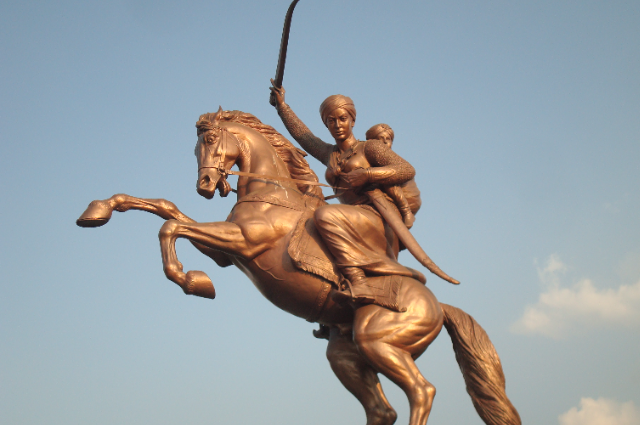
That night, with unwavering determination, she tied her young son to her back and mounted her loyal horse, Badal.
A soldier pleaded desperately,
“Maharani, you must live for Jhansi!”
She looked at him with calm resolve.
“I do not fight to live… I live to fight for what is right.”
And thus, she leapt off the fort walls—into legend, into history, into immortality.
Her last battle was at Gwalior. And in this battle, she fought like a storm that would not subside.
She did not take a step back even when wounded.
“Maharani! Please don’t leave us!” cried a soldier beside her.
She looked at him, her voice gentle but unyielding.
“Promise me… never bow before injustice. Not for fear. Not even for life.”
“I promise,” said the soldier, his eyes brimming with tears.
And thus, she closed her eyes—not in defeat, but in victory.
Aswathy paused.
The hall was silent, but it was not empty silence. It was filled with emotions and awe.
And then Aswathy spoke, but this time it was not just Aswathy speaking. It was Aswathy speaking to every heart in the hall.
“Rani Lakshmibai’s life is not just a chapter in history books.
It is a living reminder.”
“A reminder that courage knows no gender.
That strength can emerge even from the depths of sorrow.
That a woman is not meant to be limited—she is meant to be limitless.”
She looked around and spoke directly to every heart in the hall:
“Each one of us carries a fire within.
The world may try to dim it…
But history has already proven—it can never be extinguished.”
As Aswathy finished speaking, the hall was filled with applause—applause that was loud and heartfelt and endless.
During the Thanksgiving speech, the librarian spoke highly of her and ended by saying:
“Rani Lakshmibai did not simply fight a battle; she also evoked a spirit that lives within us. Rani Lakshmibai’s story is not in the past; it is alive in every girl who dares to dream beyond boundaries, in every voice that does not let itself be silenced, and in every heart that chooses courage over fear. Kingdoms may rise and fall, but the fire that Rani Lakshmibai evoked in us can never be extinguished. As long as injustice in this world continues, Rani Lakshmibai’s voice will echo across time, telling us that real immortality is not in living long, but in living fearlessly.”