
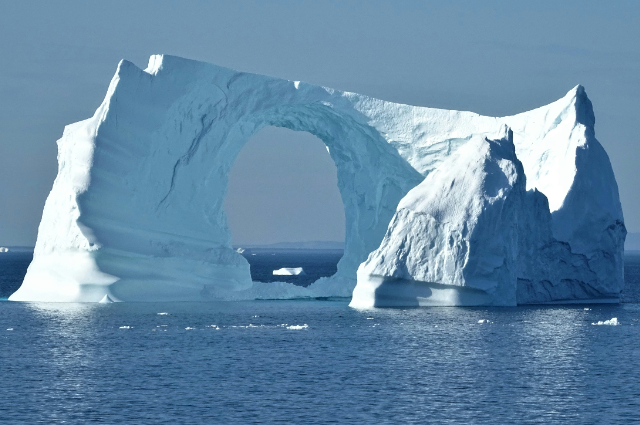
Photo by Huw Edwards on Unsplash
A true exploration of how icebergs form, survive, move, and shape Earth’s climate, oceans, history, and human understanding beyond what the eye can see.
When most people think of an “iceberg,” they picture a large white block of ice floating in a blue ocean, calm and far away, perhaps posing a danger only to ships that get too close. While this image isn’t wrong, it is quite incomplete. Icebergs are not just frozen sculptures drifting through polar waters; they are active, powerful, and closely tied to Earth’s climate system, oceans, ecosystems, and human history. The true nature of icebergs is much more complex than what is visible, and they symbolize how nature often hides its greatest forces beneath calm appearances.
An iceberg is a piece of freshwater ice that has broken off, or calved, from a glacier or ice shelf, starting to float in the ocean. Most icebergs come from Antarctica and Greenland, the two largest ice reserves on the planet. Over centuries or even thousands of years, snow accumulates and compresses into glacial ice. This ice flows downhill under its own massive weight, eventually reaching the ocean. When the ice extends too far over water, gravity and ocean movement cause large chunks to fracture and break off, forming icebergs.
One crucial fact about icebergs is that roughly 90 percent of their mass lies below the water’s surface. This isn’t just a saying but a physical fact driven by density. Ice is less dense than seawater, so it floats—yet only a small part stays visible above the waves. What seems like a towering frozen cliff is really just the tip of a much larger structure that extends deep into the ocean. Some icebergs can reach hundreds of meters below the surface, interacting with ocean currents, marine life, and even the seafloor in shallow areas.
Icebergs come in various shapes and sizes, much more diverse than popular images suggest. Some are flat-topped and large, particularly those that break off from Antarctic ice shelves. These are called tabular icebergs and can be as big as small countries. Others are tall and jagged, carved by wind, waves, and melting into arches, spires, and caves. As they melt, they are constantly reshaped, making icebergs unstable. A sudden change in balance can cause an iceberg to roll over unexpectedly, releasing huge amounts of energy and creating dangerous waves.
The movement of icebergs presents another hidden reality. While wind affects the visible top, ocean currents mainly control the submerged mass. Thus, icebergs may float in directions that seem to contradict surface winds. Their travels can last from weeks to several years, depending on size and conditions. During this time, they gradually melt, adding freshwater to salty oceans. This freshwater release impacts ocean circulation, subtly affecting temperature, salinity, and marine ecosystems.
Icebergs are not lifeless objects. As they melt, they release nutrients trapped in the ice for centuries. These nutrients, such as iron and other minerals, can spur the growth of phytoplankton—tiny plants that are the foundation of the marine food chain. In polar and subpolar areas, this process can create regions of heightened biological activity around icebergs, sometimes referred to as “iceberg gardens.” Fish, seabirds, and marine mammals often flock to these vibrant areas, turning melting ice into a source of life rather than destruction.
Throughout history, icebergs have played a significant role in human events. The most notable instance is the sinking of the RMS Titanic in 1912. The iceberg that hit the ship wasn’t particularly large compared to many others, but its submerged mass caused catastrophic damage. This disaster changed maritime safety forever, leading to better iceberg tracking, international cooperation, and new shipping rules. Today, organizations like the International Ice Patrol monitor icebergs to protect ships, showing how humanity has learned, often painfully, to respect the hidden power of ice.
In today’s world, icebergs serve as important indicators of climate change. Rising global temperatures are causing glaciers and ice shelves to thin and retreat more quickly. As a result, iceberg calving events are occurring more frequently in many areas. While icebergs themselves do not directly raise sea levels—since they are already floating—the glaciers and ice shelves they break off from do. Increasing iceberg production often signals that land-based ice is losing stability, which has serious consequences for global sea levels.
Satellite technology has changed our understanding of icebergs. Scientists can now track individual icebergs from space, accurately measuring their size, movement, and melting rates. These observations help researchers study ocean currents, climate patterns, and the health of polar ice sheets. Some icebergs even receive names or numbers and are monitored for years as they drift across oceans, slowly shrinking until they vanish entirely.
Despite their scientific significance, icebergs also evoke strong emotional reactions. Their quiet movement, enormous scale, and temporary nature inspire feelings of wonder and fragility. An iceberg can take thousands of years to form but only a few years to melt away. This contrast makes them powerful symbols of time, change, and impermanence. Artists, writers, and photographers often use icebergs to express hidden truths, lost worlds, or the consequences of human actions on nature.
The reality of icebergs challenges our perceptions of danger and stability. What looks solid may be fragile, and what seems calm may hide great power. Icebergs teach a lesson beyond science: understanding reality means looking beneath the surface. Whether in nature, history, or human behavior, the most influential factors are often unseen at first glance.
As we continue to investigate icebergs, their importance only increases. They are not isolated occurrences but parts of a huge interconnected system linking the atmosphere, oceans, land, and life. Their presence, movement, and melting tell a story about Earth’s past and provide clues about its future. In a warming world, icebergs act as drifting records of frozen history, slowly melting into the sea while reminding us that even the largest structures are not immune to change.
Beyond their visible beauty and symbolic meaning, icebergs have an internal reality that is often overlooked outside of scientific discussions. Inside an iceberg is not just solid ice but a complex structure shaped by pressure, age, and movement. Glacial ice forms from compressed snow, trapping tiny air bubbles from ancient atmospheres. These bubbles make icebergs valuable scientific records. By studying them, scientists can learn about Earth’s climate thousands of years ago, including past temperatures and atmospheric conditions. In this way, every iceberg holds a frozen memory of the planet’s history.
The internal cracks and layers within an iceberg also influence how it melts and breaks apart. Melting does not happen evenly. Warmer ocean water attacks the submerged base, while sunlight and air temperature erode the surface above. This uneven melting weakens the structure from below, often leading to sudden breaks. Large pieces can detach without warning, and entire icebergs can split or roll. These events pose serious dangers to nearby ships and researchers, as the rolling motion can displace massive volumes of water, creating powerful waves.
Below the surface, icebergs interact with the ocean in ways scientists are still trying to fully understand. As an iceberg moves, it drags cold freshwater with it, altering local water temperature and salinity. These changes can affect ocean circulation on a small scale, influencing how heat and nutrients are distributed. In some cases, the deep keels of large icebergs scrape the seafloor in shallow polar areas, creating grooves that can still be observed thousands of years later. These markings provide geological proof of ancient iceberg movement and assist scientists in reconstructing past ice ages.
The dangers posed by icebergs are not limited to historical shipwrecks. Modern vessels, oil platforms, and underwater cables face real risks in iceberg-heavy areas. In regions like the North Atlantic and Southern Ocean, icebergs may drift into busy shipping lanes or industrial zones. Engineers must create structures that can withstand potential collisions or be relocated away from the iceberg’s path. In extreme cases, controlled iceberg towing has been attempted to divert dangerous icebergs away from offshore facilities, showing how humans now actively manage their relationship with these natural giants.
Interestingly, icebergs have also been seen as potential resources. For decades, scientists and engineers have examined the idea of harvesting icebergs for freshwater. Since icebergs consist of pure freshwater, one large iceberg could theoretically supply drinking water to millions. Some experimental projects have suggested towing icebergs to dry areas, like parts of the Middle East or Africa. However, the technical challenges, environmental risks, and high costs have so far prevented this idea from becoming practical. Still, the concept highlights how icebergs are not just hazards but potential assets in a future where water is scarce.
Climate change has made icebergs a focal point of global concern. As temperatures rise, the balance between snowfall accumulation and ice loss in glaciers shifts. In Greenland, increased surface melting allows water to seep into cracks, speeding up glacier flow toward the sea and raising iceberg calving rates. In Antarctica, warming oceans thin ice shelves from below, weakening the barriers that hold back massive inland glaciers. When these ice shelves collapse, iceberg production rises dramatically, indicating deeper instability within the ice sheet.
Some of the largest icebergs ever recorded have calved in recent decades. These massive tabular icebergs, sometimes hundreds of kilometers long, gain global attention when they break away. While such events can happen naturally, scientists analyze their frequency and context to see if climate change is involved. In many cases, evidence suggests that warming temperatures and changing ocean conditions are speeding up processes that previously took much longer.
Icebergs also affect the weather and local climate. Their cold surfaces can cool the surrounding air, creating fog and changing wind patterns. In polar regions, large icebergs can serve as temporary islands, influencing sea ice formation around them. This can affect how much sunlight the ocean absorbs or reflects, impacting regional climate systems. These interactions show that icebergs are not passive but rather active contributors to Earth’s environmental processes.
Human encounters with icebergs are often described as deeply humbling. Scientists working near them report a constant awareness of risk along with profound respect. The sounds—cracking, groaning, and splashing—remind us that icebergs are always changing. Even from a distance, their immense size can distort perception, making it hard to judge scale and proximity. This has led to many navigation errors throughout history, reinforcing the idea that icebergs demand caution and humility.
Culturally, icebergs have become symbols of hidden truth, unseen danger, and misunderstood complexity. The phrase “the tip of the iceberg” is now widely understood to mean that the most important part of an issue lies beneath the surface. This saying is based on physical reality. The structure of an iceberg illustrates how appearances can be misleading, a lesson that applies to science, politics, psychology, and daily life.
Looking ahead, icebergs will play an important role in how scientists monitor the changing climate of Earth. Advances in satellite imaging, underwater drones, and computer modeling are helping researchers study icebergs with great detail. These tools help predict melting rates, track freshwater entering oceans, and improve climate models. As technology advances, icebergs may become even more valuable as natural signs of the planet's health.
There is a growing recognition that icebergs signify both loss and wonder. Each iceberg is a piece of a glacier that once rested on land. When it melts, that ice is lost forever, contributing to rising sea levels and changing ecosystems. For coastal communities worldwide, these changes are urgent. Rising seas threaten homes, cultures, and livelihoods, linking far-off polar ice to human futures.
However, icebergs do not just symbolize disaster. They also represent resilience and adjustment. Life thrives around them, and humans continue to learn from them. By studying icebergs, scientists gain insights that help communities prepare for environmental changes. By respecting their power, navigators and engineers can reduce risks. By understanding their significance, humanity can strengthen its connection to the natural world.
The true nature of icebergs lies in this balance: beauty and danger, history and change, silence and force. They are not fixed monuments but moving narratives shaped by time and temperature. As they drift, melt, and vanish, they leave behind lessons about interconnected systems and the price of ignoring what lies below the surface.
Some of the most revealing truths about icebergs emerge from extreme encounters—moments when people face their raw power directly. Modern research expeditions to polar regions often operate near icebergs, using ships, submarines, and autonomous drones. These missions show that even with advanced technology, icebergs remain unpredictable. Crews must constantly observe temperature, wind, currents, and ice movement. A single crack or unexpected roll can turn a stable research zone into a dangerous area within minutes.
One notable truth revealed in recent decades is how icebergs act underwater. For a long time, scientists focused mostly on what is visible from above. However, sonar and underwater vehicles have shown that the submerged parts of icebergs are often much more irregular than expected. Instead of smooth, symmetrical shapes, many have deep ridges, caves, and overhangs carved by warmer currents. These hidden features affect how icebergs melt and move, sometimes causing sudden shifts that seem random from the surface.
There have been recent case studies that changed scientific understanding. In Antarctica, researchers observed large icebergs getting stuck on the seafloor. While grounded, these icebergs acted as barriers, changing ocean currents and local ecosystems. When they finally broke free, the sudden release caused significant changes in water flow and sediment distribution. These observations confirmed that icebergs can have lasting environmental effects even after they stop drifting.
Another important finding involves the role of icebergs in deep-ocean mixing. As an iceberg melts, cold freshwater sinks and mixes with the surrounding seawater, creating vertical currents. This process can transport nutrients from deeper layers to the surface, supporting marine life far from the coast. In this way, icebergs act as moving engines of ocean productivity, connecting frozen poles with distant ecosystems. This reality challenges the old view that polar regions are biologically isolated or inactive.
The future of icebergs is closely linked to the future of Earth's ice sheets. Scientists warn that some glaciers may be nearing tipping points—thresholds beyond which retreat becomes rapid and irreversible. If these thresholds are crossed, iceberg production could increase significantly. This would not only impact sea level but also disrupt ocean circulation patterns that control global climate. Icebergs, then, are not just signs of change; they are active players in processes that could shape the planet for centuries.
Public views on icebergs are also changing. Once mostly seen as navigation hazards or curiosities, they now play a major role in climate communication. Images of massive icebergs breaking away from ice shelves circulate worldwide, often stirring concern and debate. While these images are powerful, scientists caution against oversimplification. Not every large iceberg indicates disaster; calving is a natural process. The key reality lies in long-term trends, not single events.
This distinction is vital because misunderstanding icebergs can lead to false conclusions. Some skeptics point to iceberg formation as proof that polar ice is stable, while others view every calving event as a catastrophe. The truth is more complex. Icebergs must be seen within the broader context of ice mass balance, temperature records, and ocean conditions. This complexity reveals a deeper lesson: reality is rarely simple, and surface observations alone are not enough.
Icebergs have also influenced law and international cooperation. Polar regions are governed by treaties and agreements that promote scientific collaboration and environmental protection. Monitoring icebergs requires shared data, satellite access, and coordinated response systems. This cooperation demonstrates how a natural phenomenon can encourage global partnership rather than conflict. In a world often divided by borders, icebergs drift freely, reminding humanity that Earth's systems are interconnected and shared.
From a geological standpoint, icebergs have shaped the planet for millions of years. During past ice ages, countless icebergs carried rocks and sediment far from land. When the ice melted, these materials settled on the ocean floor, creating distinctive layers known as ice-rafted debris. By studying these layers, scientists can identify ancient periods of cooling and warming. Icebergs thus act as time travelers, leaving behind records of climates long gone.
There is also a psychological aspect to our fascination with icebergs. Standing before one can create a sense of scale that challenges human-centered thinking. Their size, silence, and slow movement can make human concerns feel small and temporary. This experience often prompts reflections on time, responsibility, and the limits of control. In this way, icebergs influence not just science and the environment but also human perspective.
As technology progresses, new methods for studying icebergs are emerging. Artificial intelligence is now used to analyze satellite images and forecast iceberg behavior. Autonomous underwater vehicles can map submerged structures in detail previously unattainable. These tools help scientists tackle questions once out of reach, such as how quickly icebergs melt from below or how they respond to changing ocean temperatures. However, each answer reveals new layers of complexity.
One emerging concern is how melted iceberg water may impact major ocean circulation systems, like those that transport heat from the equator to the poles. Large amounts of freshwater can disrupt these systems by reducing water density, potentially slowing circulation. While this process is still being explored, it highlights how events in remote polar regions can affect weather patterns far away, influencing rainfall, storms, and temperatures across continents.
In the end, icebergs represent a blend of science, history, and meaning. They are physical objects governed by natural laws, historical actors that influence human decisions, and symbols that challenge perception. Their true nature cannot be captured by a single image or statistic. It requires patience, observation, and a willingness to look deeper—both literally and metaphorically.
As the planet continues to heat, icebergs will stay at the forefront of environmental monitoring. Some will continue their ancient journey from glacier to sea, while others will melt faster than ever before. Each iceberg tells a story of creation, movement, interaction, and loss. Together, these stories form a larger narrative about Earth's shifting systems and humanity's place within them.
Icebergs, in their silent drift across cold oceans, embody one of nature's critical lessons for humanity: reality is far deeper than what is immediately visible. What appears as a calm, floating mass of ice is actually a vast structure shaped by time, pressure, climate, and movement. Each iceberg reflects thousands of years of snowfall, compression, and glacial flow, followed by a fleeting and fragile existence in open water. Their lives are slow, but their impacts are profound.
Throughout history, icebergs have influenced human choices, altered ecosystems, and recorded the planet's climatic history. They have caused tragedy, inspired creativity, and driven scientific discovery. From ancient ice-rafted debris on the ocean floor to modern satellite tracking, icebergs have helped scientists learn about Earth's past and anticipate its future. They are not mere anomalies of nature but essential parts of the global system that connects ice, ocean, atmosphere, and life.
In today's world, icebergs have gained added significance. Their increasing numbers and changing behavior reflect shifts in global climate patterns affecting all regions. While an iceberg itself does not raise sea levels, its presence often signals deeper instability in the glaciers and ice sheets that do. Ignoring these signals risks misunderstanding the extent and speed of environmental changes already underway.
Still, icebergs do not solely symbolize loss. They also demonstrate resilience, balance, and interconnection. As they melt, they support ocean life. As they drift, they redistribute freshwater and nutrients. As they vanish, they leave behind data, insights, and lessons. They remind humanity that nature is not static and that adjustment, not denial, is key to survival.
Perhaps the most lasting impact of icebergs lies in their teachings beyond science. They challenge surface-level thinking and reward deeper understanding. They highlight that danger can be hidden beneath beauty, stability can mask vulnerability, and that the most influential forces often go unseen. In a world shaped by rapid change, this lesson is more relevant than ever.
As the last pieces of an iceberg melt into the sea, its story does not truly end. It becomes part of the ocean, part of the climate system, and part of Earth’s ongoing story. Icebergs may vanish from sight, but their influence remains—quietly shaping currents, ecosystems, and human awareness.
By recognizing the true nature of icebergs, humanity is invited to look beyond appearances, to respect the unseen, and to act with foresight. For beneath the surface, whether of ice, ocean, or global challenges—lies the truth that will shape the future.