
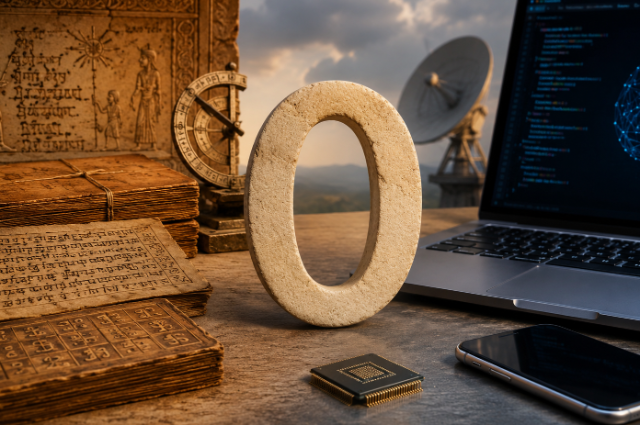
“Zero is the symbol of nothingness, but the existence of that symbol makes something”
At first glance, zero appears to be nothing. A hollow circle. A space. A symbol that seems to represent absence rather than presence. Yet among all numbers ever discovered, none has transformed human civilisation more profoundly than zero.
Zero is a paradox. It is nothing, yet it changes everything.
The symbol of zero represents nothingness, but the existence of that symbol creates something extraordinary. Historians often rank zero among humanity's greatest intellectual discoveries because it transformed mathematics from a simple tool of counting into a language capable of describing the universe.
Before zero, counting was possible, but advanced calculations were cumbersome. Then came one of humanity's greatest intellectual breakthroughs—the realisation that "nothing" could itself be represented by a symbol and treated as a mathematical idea.
Consider a simple example. Without zero, distinguishing between 1, 10, 100, and 1,000 becomes extremely difficult. The modern place-value system depends entirely on zero acting as a placeholder. The difference between a hundred rupees and a thousand rupees is, quite literally, a zero.
Ironically, the weakest-looking number can make other numbers immensely powerful. Place a zero after 1, and it becomes 10. Add another, and it becomes 100. More zeros multiply value exponentially. The number that represents nothing has the unique ability to magnify everything beside it.
The story of zero is deeply connected with India. Long before zero became a mathematical symbol, the idea of Shunya (emptiness or void) already existed in Indian philosophy. The concept appears in ancient Sanskrit literature and later became central to Buddhist thought through Shunyavada, the philosophy of emptiness. The word ‘shunya’ already existed in Sanskrit in Pāṇini Aṣṭādhyāyī but as a philosophical void (लोप:)or disappearance.
This raises an interesting question often discussed by traditional scholars: if the idea of Shunya existed centuries before Aryabhata, can the concept of zero truly be attributed to a single individual? Many argue that Aryabhata did not "invent" zero but rather inherited a mathematical tradition that had been developing for generations.
Evidence for the early use of zero was strengthened by the discovery of the ancient Bakhshali Manuscript, one of the oldest known Indian mathematical texts. Researchers at Oxford University dated portions of the manuscript to nearly 1,800 years ago. The manuscript contains a dot symbol used as a placeholder—an early form of zero employed to distinguish numbers such as 10, 100, and 1,000. At that stage, zero was not yet treated as an independent number but as a practical tool for writing large numbers.
The development continued over centuries. In 628 CE, the Indian astronomer and mathematician Brahmagupta became the first known scholar to formally describe arithmetic rules involving zero. He explained that a number minus itself equals zero, that adding zero leaves a number unchanged, and that multiplying any number by zero results in zero. These ideas, simple to us today, laid the foundation of modern mathematics.
Aryabhata also played a major role in developing the place-value system that made the practical use of zero possible. Thus, while the concept may have evolved gradually, Indian mathematicians transformed it into one of humanity's greatest intellectual tools.
The history of zero is still debated. Some traditional scholars believe its roots extend even deeper into Vedic knowledge. They point to the sophisticated numerical descriptions found in ancient Indian texts, including the Mahabharata's account of eighteen Akshauhini armies and detailed astronomical calculations found in ancient literature. According to this view, mathematical concepts related to zero may have existed long before their earliest surviving written records. While historians continue to debate these claims, they highlight the remarkable mathematical sophistication of ancient India.
Some researchers have also attempted to date events described in the Ramayana using astronomical references found in the text. Certain interpretations, when entered into modern planetarium software, have produced dates around 7000 BC. These findings remain subjects of discussion and are not universally accepted by historians or scientists, but they demonstrate the enduring fascination with ancient Indian astronomy.
Whatever its exact origins, zero eventually travelled from India to the Islamic world and later to Europe. In 1202, the Italian mathematician Fibonacci popularised the Hindu-Arabic numeral system, including zero, through his influential book Liber Abaci. This system gradually replaced the cumbersome Roman numerals used throughout Europe.
The impact of zero can be seen everywhere today.
Every digital payment, online transaction, and banking system relies on calculations involving zero. Modern sciences such as physics, engineering, astronomy, economics, and statistics use zero as a reference point for measurement and analysis. The global digital economy, worth trillions of dollars, depends on computing systems that would be impossible without zero.
A practical example sits in your pocket: your smartphone.
Every photograph you take, every message you send, every contact you save, and every video you watch is ultimately stored as combinations of zeros and ones. Remove zero from mathematics, and the modern digital world disappears.
Zero transformed mathematics, but it revolutionised technology.
Every computer on Earth, from the simplest calculator to the most powerful supercomputer, operates using binary code—a language built from only two symbols: 0 and 1. Everything a computer does, from displaying images to launching spacecraft, ultimately comes down to countless combinations of zeros and ones.
Artificial Intelligence takes this dependence on zero even further.
Modern AI systems analyse vast datasets, perform trillions of calculations, and learn patterns through mathematical operations executed entirely in binary. Whether it is a voice assistant understanding speech, a navigation app finding the fastest route, or an AI generating text and images, every decision is ultimately processed through streams of zeros and ones.
Thus, the symbol that represents nothing has become one of the most important building blocks of modern intelligence.
Zero and the Biggest Numbers We Can Imagine
Zero not only makes modern technology possible—it also allows us to express unimaginably large numbers.
Consider a googol, a number written as 1 followed by 100 zeros. To put this into perspective, a googol is vastly larger than the estimated number of grains of sand on Earth and far exceeds the number of stars in the observable universe.
Mathematicians went even further and imagined a googolplex, which is 1 followed by a googol zeros. A googolplex is so enormous that it cannot be fully written out in ordinary physical space. Even if every atom in the observable universe were turned into ink and paper, there would not be enough room to write all its zeros.
Interestingly, the search engine Google derived its name from the word googol, reflecting its mission to organize an immense amount of information.
These mind-bending numbers reveal an often-overlooked truth: zero is not merely a symbol for nothingness. By standing beside other numbers, it gives humanity the power to describe quantities ranging from the unimaginably small to the unimaginably large.
Yet zero's significance extends beyond mathematics and technology.
In life, zero teaches humility. Every expert once started with zero knowledge. Every successful person once stood at the starting line. Every masterpiece began as a blank page. What appears empty is often the birthplace of possibility.
Nature itself honors zero. A seed appears insignificant before it becomes a giant tree. Silence precedes music. Darkness precedes dawn. Emptiness is not always a lack; sometimes it is preparation.
Zero also reminds us of balance. In a world obsessed with accumulation—more money, more possessions, more achievements—zero whispers a different lesson. It tells us that value is not always found in what we add, but sometimes in what we remove: fear, ego, anger, and unnecessary burdens.
Perhaps that is why zero remains one of humanity's most beautiful discoveries. It proves that emptiness has meaning, that absence can create presence, and that what seems insignificant can alter the course of history.
Our family of numbers has a hero: Zero.
The greatest irony of all is that the symbol representing "nothing" became one of the most valuable ideas in human history.
Zero is not merely a number.
It is a reminder that from nothing, everything can begin.