
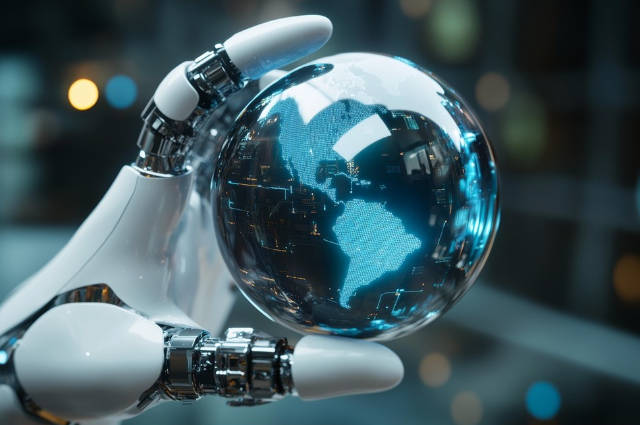
Image by Tung Lam from Pixabay
“We are not standing at the edge of the AI ocean anymore. Somewhere between yesterday’s search bar and today’s conversation, our feet left the ground.”
There was a time when Google was our first instinct.
A question crossed our mind, and we searched for it. A recipe, a medical term, a travel destination, a difficult concept, a piece of information—we Googled almost everything. We sifted through links, opened pages, compared information and found our way to an answer.
Then, quietly, the way we searched began to change.
We stopped only searching and started asking.
ChatGPT and other AI tools entered our lives, first as something interesting and experimental, and gradually as something almost ordinary. Today, AI can write our emails, explain our homework, analyse information, translate languages, create images, help us code, plan our journeys and generate ideas within seconds.
AI is no longer merely a technology sitting somewhere outside our lives.
It is becoming part of the environment in which we live.
Students are learning with it. Professionals are working with it. Businesses are incorporating it. Creators are building with it. People are taking courses, learning new skills and exploring new ways of earning through it. And there is a great deal to celebrate.
AI can make knowledge more accessible. It can help someone understand a difficult subject without fear of asking the same question ten times. It can help a small business owner perform tasks that once required an entire team. It can give a beginner access to tools that were once available only to specialists.
The possibilities are enormous.
But every powerful technology comes with a question that is more important than “What can it do?”
The question is:
“What should we continue doing for ourselves?”
Because there is a danger in making everything effortless.
If AI writes everything for us, will we continue developing our own voice?
If it answers every question, will we remain curious enough to search, investigate and think?
If it solves every problem, will we retain the patience to struggle through difficult problems ourselves?
If it becomes our first source of advice for every decision, will we gradually lose confidence in our own judgment?
The future should not be about rejecting AI.
It should be about using it without surrendering ourselves to it.
AI can calculate, analyse, organise and generate at extraordinary speed. But human beings possess something fundamentally different: instinct, conscience, lived experience, empathy, intuition, memory, emotional understanding and the ability to give meaning to an experience.
AI can describe grief.
But it cannot grieve.
It can write about love.
But it cannot live a lifetime of love.
It can offer suggestions about relationships, but it has never sat beside someone through years of shared memories, silence, disagreement, forgiveness and affection.
And this becomes especially important when we begin bringing our most personal lives into our conversations with machines.
Today, we can ask AI about our fears, relationships, loneliness, personal problems and even our medical reports. Sometimes that can be useful. But we should be careful about allowing convenience to replace human connection.
When something truly hurts, we still need a phone call from our mother.
We need a family conversation.
We need a friend who knows the story behind our silence.
We need someone whose voice can calm us—not because they have generated the perfect answer, but because they know us.
A machine can process our words.
A human being can feel the emotion behind them.
And perhaps that is one of the greatest paradoxes of the AI age: we have never had more ways to connect, yet we risk becoming increasingly comfortable confiding in machines instead of people.
No matter how intelligent AI becomes, a screen cannot replace the warmth of a family gathering, the laughter shared with friends, the reassuring touch of a loved one, or the inexplicable comfort of being understood without having to explain everything.
Information can come from a machine.
But human emotions are truly held by other human emotions.
That connection is not technological. It is deeply human.
So perhaps the answer is not to step away from the AI ocean.
The ocean is already here.
We should learn to swim in it.
Let AI help us learn, but let us continue to think.
Let it help us write, but let us preserve our own voice.
Let it help us work, but let us preserve our judgment.
Let it give us information, but let us verify it.
Let it make our lives easier, but let us not allow convenience to make our minds passive.
And when life becomes difficult, let us remember that not every problem requires an AI prompt.
Sometimes it requires a conversation.
Sometimes it requires a friend.
Sometimes it requires a family.
Sometimes it requires another human being simply sitting beside us.
AI will undoubtedly enter more and more areas of our lives. Some jobs will change. Some skills will become less valuable. New skills will emerge. The world will learn, adapt and reorganise itself around this extraordinary technology.
But our responsibility is to make sure that as machines become more capable, humans do not become less human.
We cannot stop the waves.
We cannot turn back the ocean.
But we can decide how we move through it.
Let AI be the tool in our hands, never the mind inside our heads. Let it extend our abilities, not replace our thinking; let it accelerate our lives, not distance us from one another. For the greatest achievement of the AI age will not be how much intelligence we create in machines, but how wisely we preserve the humanity that machines can never possess.
The ocean is here.
Now we must learn to swim—not simply allow the current to carry