
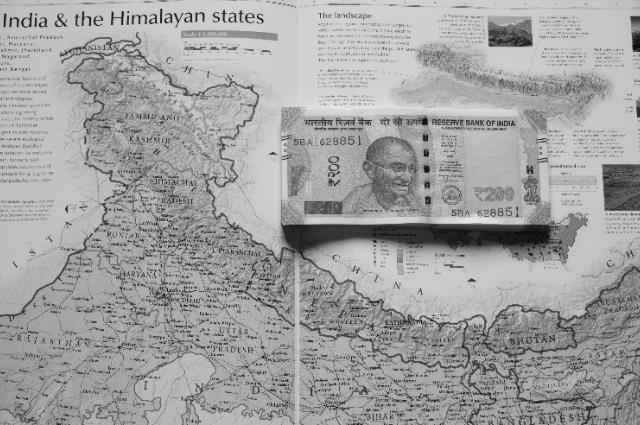
For almost fifty years after Independence, India kept Mahatma Gandhi off its everyday money. Then in 1996 his smile became unavoidable. It was not only reverence that put him there. It was forgery.
When the British left, the new republic had to decide what image would stand for sovereignty. The first Reserve Bank notes, issued in 1938, carried King George VI. After 1947, that was impossible. Officials debated using Gandhi, but the choice went the other way. The Lion Capital of Ashoka, the sandstone emblem from Sarnath, was adopted as the national emblem in 1950, and it was the lion that went on the notes. From 1949 onward, the Ashoka Pillar replaced the king, first as a watermark, then as the central design. The reasoning was deliberate. Ashoka belonged to no party, no region, no living memory. He signalled an ancient, secular state, not a personality cult. Gandhi’s portrait was set aside.
The image you see on every note today is not a drawing. It is a photograph, taken in 1946 when Gandhi was 77. It was shot at the Viceroy’s House in Delhi during talks with British politician Lord Pethick-Lawrence. Gandhi is turned slightly, head tilted, smiling. That candid warmth is why the RBI later chose it. The currency engraving is a mirrored, cropped adaptation of that frame, with the familiar soft focus around the collar. It is a real moment, not an idealized icon, which is part of why it is so hard to copy.
Gandhi did appear once, early. For his birth centenary in 1969, the RBI issued a commemorative hundred-rupee note with his portrait seated, with Sevagram Ashram in the background. It was a collector’s piece, not a series. After it circulated out, the notes went back to Ashoka. Gandhi would not return for another twenty-seven years.
By the mid-1990s photocopiers and scanners had made the old Ashoka notes easy to fake. The RBI needed a full security upgrade. That became the Mahatma Gandhi Series, launched in 1996. Every denomination from five rupees to one thousand was redesigned around a single large portrait of Gandhi based on that 1946 photo.
The security was the point. The new notes added a much sharper multi-tonal watermark of Gandhi visible against the light, a latent image where a hidden denomination numeral appears only when you tilt the note, micro-lettering with tiny RBI text that blurs on copies, optically variable and fluorescent ink on the number panels, and raised intaglio printing on Gandhi’s portrait, the RBI seal and the borders that gives the note its rough feel. By 2000 all RBI notes in circulation carried that portrait. The one-rupee note, which is issued by the Government of India and not the RBI, never did. It carries the coin motif and the Sagar Samrat oil rig.
The RBI chose a human face for a technical reason. Faces are uniquely hard to forge well. A lion capital is symmetrical and geometric and forgiving. A human face is not. Counterfeiters struggle with the fine gradients around the eyes, the texture of skin folds, the exact curve of a nose, the catchlight in a smile. Your brain notices when a face is even slightly wrong long before you notice a blurry Ashoka wheel. Gandhi’s portrait, with its glasses and wrinkles and asymmetrical smile, became India’s best watermark.
Once Gandhi was on every note, the question kept coming up about everyone else. Over the years there have been public campaigns and court petitions to add Bhagat Singh, Subhash Chandra Bose, B. R. Ambedkar, Patel and others. The RBI has consistently kept to one portrait for three practical reasons. First, global recognition. Gandhi is instantly identifiable in a way few other Indian leaders are, which matters for a currency handled by tourists, traders and banks worldwide. Second, symbolism. Non-violence and moral authority translate cleanly across regions, languages and politics in a way partisan figures do not. Third, security continuity. Changing the watermark portrait means retooling every printing plate, every ATM sensor and every counterfeit detection system in the country. One stable face keeps the anti-forgery chain intact. That does not end the debate, and petitions still surface every few years, but institutionally the answer has held since 1996.
Demonetization brought the Mahatma Gandhi New Series in 2016. The front stayed almost exactly the same. Gandhi’s 1946 smile, a little larger, a little sharper, with better color-shifting ink. What changed was the back. Instead of generic animals, each denomination got a distinct piece of Indian heritage in bright, high-contrast colours designed to help the visually impaired. The ten-rupee note carries the Konark Sun Temple, the twenty has the Ellora Caves, the fifty shows Hampi’s stone chariot, the hundred features Rani ki Vav, the two hundred has the Sanchi Stupa, and the five hundred carries the Red Fort with the national flag. The message was clear. The reverse could celebrate India’s diversity. The front would keep one face, because that face is still the best security feature in your wallet.
In 2026, thirty years after that decision, Gandhi remains the only person on every Indian banknote. Not because India lacked other heroes, and not only out of reverence. He got there because a seventy-seven-year-old’s smile, caught in a 1946 photograph, turned out to be harder to fake than a lion.
Reference:
- rbi.org.in
- india.gov.in
- gandhiheritageportal.org
- rbi.org.in
- https://m.economictimes.com
- https://theaidem.com