
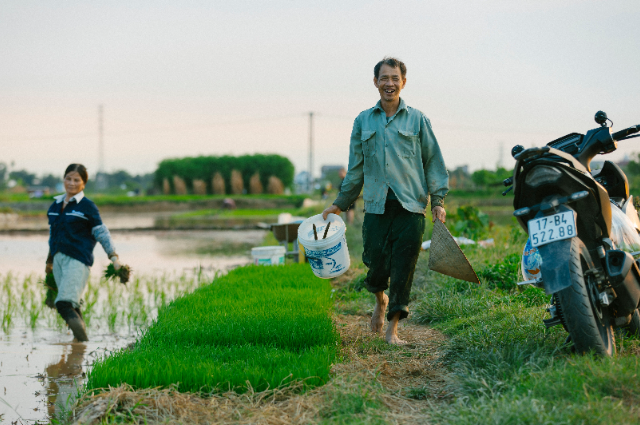
A luxury golf resort project worth roughly $1.5 billion is being developed in Hung Yen, carrying the familiar promises of economic growth, job creation, and a stronger tourism profile. On paper, it looks like a textbook image of a Vietnam that is opening wider to the world, seeking major investment, and pursuing internationally branded symbols of development. Yet behind that polished vision lies an unavoidable question: who is paying the price for what is called progress?
The project has been presented as a fresh boost for high-end resort infrastructure, services, commerce, and the local image. For many policymakers, developments of this kind are not merely economic ventures; they are also signals to the outside world that Vietnam is ready to welcome large-scale investment and integrate more deeply into global value chains. But the larger a project becomes, the wider its social impact. In this case, the consequences reach beyond land or material assets, touching family memory, spiritual belief, and the sense of justice felt by thousands of people.
More Than 4,000 Households and a Map Redrawn by Administrative Order
According to the information that has emerged, more than 4,000 households are being forced to move to make way for the project. In administrative language, that figure may read like a statistic about land clearance. In real life, however, it means thousands of homes, thousands of plots of farmland, thousands of livelihoods, and countless community ties being severed or compelled to reorganise.
Large-scale population displacement has never been simply a matter of compensation money and legal procedure. For many rural families, a home is not just an asset; it is the foundation of social life: a place to work, a network of kinship, a setting for rituals, a rhythm of daily existence, and a sense of belonging to a particular landscape. When an entire community is told to leave so that land can be repurposed for a project serving affluent consumers, the loss cannot be measured solely in square meters or compensation tables.
In Vietnam’s legal context, the issue becomes even more sensitive. Under the principle of “ownership by the entire people,” citizens hold land-use rights rather than absolute private ownership in the sense recognised in many other countries. In practice, this gives the state enormous power over land recovery, allocation, and conversion of land use. When the goals of development are defined from the top down, residents often find themselves in a weaker bargaining position, more vulnerable to coercive enforcement, and less able to protect their interests fully if compensation or resettlement plans fail to reflect the real value of the lives they are being asked to leave behind.
The Pain Lies Not Only in the Land, but in the Graves of Ancestors
If leaving one’s home is already a profound shock, being required to relocate ancestral graves cuts far deeper. Reports suggest that many families must move burial sites that have remained in place since before 1967, resting places that have stood undisturbed for decades on land tied to family lineage. In Vietnamese culture, ancestral graves are not merely burial sites for the deceased. They are spaces of memory, filial duty, intergenerational continuity, and the belief that descendants bear responsibility for safeguarding their roots.
For that reason, disturbing a grave is not only emotionally painful; it can also produce a severe spiritual rupture. Many people regard it as a disruption of the sacred order of the family, something that should occur only under truly unavoidable circumstances and only with the utmost consent, respect, and care. When the relocation of graves takes place under time pressure, under a sense of compulsion, or in an atmosphere where economic interests overshadow spiritual values, the wound becomes even harder to heal.
This is not merely a matter of custom. It is also a measure of how a society defines development. The more a project is praised as modern, the more it ought to be held to a high ethical standard—especially when it reaches into the most intimate layers of communal life.
Compensation: Numbers on Paper and a Lived Sense of Injustice
One major source of anger is concern over compensation levels. Some accounts claim that certain households were offered about $12 for every 10 square feet of land, roughly less than one square meter. While such figures should be carefully verified case by case, the mere existence of a widespread belief that compensation falls far below market value or the long-term value of a family’s livelihood already reveals a serious trust gap between citizens and the land-recovery system.
The issue is not simply about currency conversion or technical pricing. It is about a more fundamental question: is the amount offered enough for people to rebuild the lives they have lost? Agricultural land, a house, a garden, a modest commercial frontage, or a network of community relationships built over decades cannot easily be replaced by a fixed sum of money. If people are pushed out of their old homes but cannot buy an equivalent place to live, cannot continue their previous work, and must start over under more precarious conditions, then compensation may be complete in form while justice remains absent in substance.
In many land recovery disputes, what fuels public outrage is not only the loss of land itself but the feeling of being valued below the true worth of one’s life. When land that has sustained a family across generations is converted into a payment that the displaced themselves regard as inadequate, social conflict becomes all but inevitable.
When Politics, Diplomacy, and Business Converge
The project has also drawn attention because of its connection to the Trump Organisation, at a time when U.S.-Vietnam trade relations are being strengthened. That factor pushes the story beyond the boundaries of a single real estate or tourism development. It touches on a broader question: in deals that carry symbolic diplomatic and commercial weight, does the voice of the affected community carry enough force, or is it too easily overshadowed by larger calculations of state and business?
It cannot be denied that internationally branded projects are often seen as opportunities to elevate an investment climate, generate market momentum, and reinforce bilateral ties. Strategically, that appeal is obvious. Yet precisely because such projects carry significance beyond economics alone, they should demand greater transparency, greater caution, and greater sensitivity to the rights of residents.
Otherwise, they can easily come to symbolise a system in which political and commercial interests are placed above people’s right to stable lives, cultural respect, and fair treatment.
The Case Made by Supporters
Supporters of the project have their own arguments. A resort of this scale could create direct employment in construction, operations, hospitality, food service, maintenance, and transport. It could also attract infrastructure investment, raise local revenues, expand business opportunities for some residents, and place Hung Yen on the map of high-end tourism. Within today’s development logic, these are benefits that are not easily dismissed.
From a macroeconomic perspective, policymakers often argue that no country can modernise if it insists on preserving every existing land-use pattern indefinitely. The shift from agriculture to services, from village space to urbanised and tourism-oriented space, is seen in this view as an inevitable part of growth. The real question, then, is not whether development should happen, but what kind of development is pursued and who ultimately benefits from it.
The Core Rebuttal: Growth Cannot Be a License to Sacrifice the Vulnerable
The strongest criticism does not lie in rejecting development itself, but in rejecting a model of development that treats the sacrifice of local communities as natural or acceptable. An economy may grow, tourism may expand, and investors may profit; but if the price is demolished homes, ancestral graves moved in anguish, compensation widely viewed as unfair, and residents placed in a position where they feel they have no real choice, then the outcome is difficult to call whole or just.
Sustainable development cannot be measured only by investment capital, room numbers, or tourist arrivals. It must also be judged by the extent to which a project protects human dignity, respects cultural heritage, and distributes the burdens of transition fairly. If a “world-class” resort is built upon the grief, powerlessness, and resentment of thousands of residents, its glamour will always be shadowed by a moral darkness that cannot easily be erased.
A Question Not Only for Hung Yen, and Not Only for Vietnam
The story unfolding in Hung Yen reflects a universal challenge confronting many countries: how to balance the demands of economic development with the rights of local communities. There is no simple answer to that dilemma, but one principle is difficult to ignore: real progress does not merely create wealth; it must also protect people’s rights, traditions, and dignity.
If major projects were carried out with greater transparency, more meaningful consultation, fairer compensation, and a deeper respect for the cultural life of affected communities, conflict would not disappear entirely, but it could be reduced substantially. If, on the other hand, development continues to be interpreted as the right of the powerful to impose on the vulnerable, then every new grand project, no matter how impressive, risks becoming a symbol of division rather than prosperity.
In a world increasingly fixated on growth metrics, the most important question may still be the simplest one: by what means does a society wish to become richer, and what is it willing to trade away to achieve that goal? The answer will shape not only urban landscapes or tourism revenues, but the moral character of the development process itself.
References: