
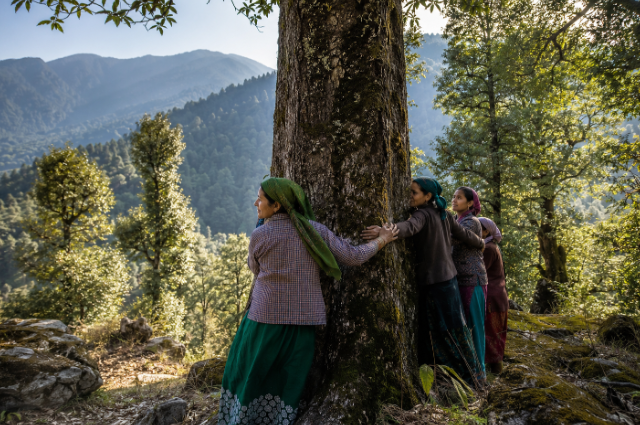
In 1974, a remarkable scene unfolded deep in the Garhwal Himalaya: peasant women and children pressed their arms around towering oak trunks, chanting and singing in the dim dawn. At Reni village, 65-year-old Gaura Devi stood chest-deep among the trees with 26 other women, facing down a team of armed loggers. “This forest is like our mother,” she declared as the contractors prepared to fell the ancient trees. “You will have to shoot me before you can cut it down.” These hillwives had already anticipated the worst: they had resolved that the loggers’ axes would fall on their backs first, protecting the wood and water of their homeland. Their peaceful defiance, “hugging” the trees in a ring of humanity, forced the intruders to withdraw. As one account notes, their “peaceful resistance forced the loggers to withdraw, marking a turning point in India’s environmental activism”. In that breathless moment, the Chipko movement was born: ordinary mountain villagers, led by courageous women, had literally clung to life itself.
The Himalayan Crisis Before Chipko
By the 1960s, the Himalayan villages were in crisis. Roads built after the 1962 Sino-Indian war had opened the high passes, and private logging companies, even foreign firms, descended on Uttarakhand’s oak and rhododendron forests. These trees, once carefully tended by generations of villagers, were being clear-cut for profit. Local people depended on every strand of forest for fuel, fodder, food and fodder grasses. But the state routinely denied them any control: forests that had sustained the hill economy were leased to industrial interests, while villagers watched from the sidelines.
The environmental consequences were swift and severe. Without tree roots to hold the rain-soaked earth, the monsoon turned into a calamity. The Alaknanda and Bhagirathi valleys flooded in 1970, sweeping away roads, bridges and fields. Villagers were bewildered by this sudden destruction; it took a local inquiry to connect the dots. As activist Chandi Prasad Bhatt later explained, “wherever the forests were cut, the impact of floods was severe”. The upside of the mountains gave way to a blood-red torrent. Soil fertility plummeted, yields fell, and springs dried up. Herds went hungry for fodder, and women walked ever farther for firewood and water. Villagers, especially women, felt the tragedy keenly: one commentator notes they saw forests not as timber reserves but as living providers of “springs and streams, food for their cattle, and fuel for their hearths.” In short, the intimate fabric of village life was unravelling.
Underlying this disaster was a bitter legacy: the exploitation of Uttarakhand’s natural wealth. As historian Shekhar Pathak observes, decades of “resource exploitation and ecological degradation” since colonial times have marginalised mountain communities. Successive governments focused on development projects and timber revenue, largely ignoring activists’ appeals. Villagers began to see that the very forests that sustained them were being treated as sacrificial lambs for downstream development. It was in this atmosphere of fear and injustice that a spark ignited.
Birth of the Movement
In early 1973, local leaders decided to fight back. The first “Chipko” action took place in March at Mandal village. Chandi Prasad Bhatt, head of the grassroots Dasholi Gram Swarajya Mandal (DGSM), had been agitating ever since his co-op was denied a few ash trees by a lumber permit. At a village meeting, he issued the now-famous challenge: “Let them know we will not allow the felling of a single tree. When their men raise their axes, we will embrace the trees to protect them.” He went further: “Our aim is not to destroy the trees but to preserve them. Why don’t we cling to the trees, and dare them to let their axes fall on our backs?” Thus, the strategy of Chipko was born to literally hug the trees in protest.
That day, Bhatt led about a hundred Sangh volunteers up to the Mandal forest with drums and folk songs. The loggers from the Simon company stood waiting to cut the ash trees that rightly belonged to the villagers. But surrounded by an animated crowd of men, women and children who linked arms around the trees, the crew panicked. The challengers later recalled, “When they reached Mandal, they were so unnerved, they abandoned their plans and withdrew, leaving the trees!” It was a stunning victory: without a single blow, villagers had protected the forest. Under pressure, the state promptly rescinded the contractor’s permit and allowed the villagers to keep their ash trees.
News of the success spread quickly through the hills. Other villages pledged to do the same. Chandi Bhatt and his DGSM continued teaching the tactic as a living forest satyagraha. By 1974, dozens of villages from Chamoli to Almora were staging Chipko protests and sit-ins by the trees, at first mostly organised by men’s sanghs. Soon, however, women took the lead. Sunderlal Bahuguna, a seasoned Gandhian in his 40s, joined the cause as a travelling messenger. Over the next decade, he walked thousands of miles (a 4,870 km padayatra in 1981–83) to rally villagers from valley to valley. But even he insisted he was only “the messenger of the movement, it was the ladies who hugged the trees,” as he modestly noted. The spark of Chipko had now become a prairie fire.
In March 1974 at Reni, Gaura Devi and the women stoically held the line, as we saw. The forest department finally convened a government committee to investigate. When officials reported back, the verdict was revolutionary: no tree would be cut in Reni (and much of the surrounding forest) for ten years. (A few years later, Prime Minister Indira Gandhi imposed a nationwide green felling ban on the high Himalayan forests.) Chipko villagers were vindicated; their tactic had won not just temporary success, but a new policy acknowledging forest fragility.
Women, Villages, and Resistance
Chipko was as much a social uprising as an environmental one. Its heroes were rural villagers, whose entire way of life was at stake, especially the women. In the Himalaya’s agrarian economy, women were the first to feel deforestation’s bite. With fields depleted, fodder scarce and springs running dry, the burden on women soared. As author Vandana Shiva, who grew up in the hills, later recounted: “logging had led to landslides and floods, and scarcity of water, fodder, and fuel, longer walks for collecting water and firewood and a heavier burden”. These women knew that a forest’s worth lay in living streams and healthy soil, not timber. So they “declared that they would hug the trees, and the loggers would have to kill them before killing the trees.” A Chipko folk song from that era reflects their ethos:
“These beautiful oaks and rhododendrons,
They give us cool water,
Don’t cut these trees, we have to keep them alive.”
In this context, Chipko became a women-led struggle for forest rights. Movement organisers intentionally mobilised women because they gathered fuelwood and water for cooking, and had a spiritual, practical bond with the forest. Wherever Chipko protests occurred, women often stood at the front: they tied sacred threads around trees, sang devotional hymns, and even fasted. The young and old together took turns guarding the trees. Their role wasn’t token, as Bahuguna put it; it was the women who did the actual tree-hugging. Indeed, many observers would later hail Chipko as India’s first ecofeminist movement, because it arose from women defending nature as life-givers.
Chipko’s ideology was inclusive: it married environmentalism to economic justice. Women and villagers insisted that forests exist to benefit their communities. Chandi Prasad Bhatt later explained that “the main goal of our movement is not saving trees, but the judicious use of trees”. In other words, Chipko was about communities having the right to sustain themselves from the forest, not about completely locking forests away. “The Chipko Movement stood for the basic right of a community to control and benefit from the resources of its own home,” he said. In Chipko villages, often the nearest forest was considered common property, and the fight against outsiders was framed as defending their “home”. Many villagers made it clear they were willing to share the forest bounty but only if they managed it. As one elder remarked, “We respect the needs of people in the plains,” but that respect meant letting the mountain people care for these ecosystems. Simply put, Chipko transformed the demand “save our forests” into “give us back our forests’ management.”
The movement also wove in cultural and ethical values. Many Chipko activists appealed to the sacredness of the Himalayan earth. They reminded officials that any cut in the forest disturbed the delicate balance keeping their world alive. Movement songs often ask, “What do the forests bear?” not profit or timber, but “soil, water and pure air, which sustain the Earth and all she bears.” This theme that forests literally carry the village’s life resonated deeply in Indian philosophy. Leaders invoked Gandhian ideals of trusteeship, arguing that the land must be used “for the needs of the people, and not for the profits of the few.” In Chipko’s worldview, ecology and society were inseparable: harming the forest was harming the people, especially the weakest.
Gandhian Philosophy and Environmental Ethics
Nonviolence was at Chipko’s core. The movement consciously revived Gandhi’s spirit of satyagraha (truth-force) in nature’s defence. Protests were strictly peaceful: there were no stone pelting or scuffles with police. Instead, Chipko tactics were moral and symbolic. Mothers and grandmothers used fasting, prayer, and symbolic folk theatre to awaken conscience. They physically turned into barriers against machinery. Slogans, like the one at Advani village, “What do the forests bear? Soil, water and pure air”, had the ring of a sacred hymn.
Chipko’s leaders were explicit about this lineage. Bahuguna, a lifelong Gandhian, helped frame the forest fight in those terms. In 1974, he fasted for two weeks to protest logging policy. Committees and inspections were treated with Gandhi-style constructive dialogue. When Woodcutters’ agents threatened, villagers simply held their ground, offering themselves instead of their woods. As researchers note, “the Chipko movement was inspired by the Gandhian philosophy and adopted non-violent modes of protest,” employing marches, tree-hugs and hunger strikes to dramatise their cause. One participant noted that Chipko was a modern echo of the 1930s forest satyagrahas under colonialism, now reborn to protect the environment. In this way, Chipko linked ecology to ethics: it posed the question, not of profit, but of conscience.
National and Global Impact
Chipko’s success soon rippled beyond the forests. Within India, it achieved concrete victories in policy. In 1980, the movement helped spur the creation of India’s Ministry of Environment and Forests, a sign the government finally took the hills’ warnings seriously. In the same year, the Forest Conservation Act banned all commercial felling above 1,000 meters in the Himalayas. These laws officially recognised that the Uttarakhand forests were too fragile to be treated as timber factories. Earlier, in 1975, the Uttar Pradesh Van Nigam (forest corporation) took over logging contracts, replacing private operators. While these measures had mixed enforcement, they marked a new era where ecology constrained policy.
Beyond policy, Chipko became a global environmental symbol. The movement’s name and imagery travelled worldwide as a message of grassroots resistance. In 1987, Chipko leaders won the Right Livelihood Award (the “Alternative Nobel Prize”) for conserving natural resources. Even international artists took notice: in 2008, a sculpture of twig “tree-huggers” was erected at a United Nations climate conference in Poland, a tribute to Chipko’s legacy. Over the next decades, eco-activists from Latin America to Africa cited Chipko as inspiration. Large sit-ins to save forests from the Tehri Dam protests to Save Silent Valley consciously followed Chipko’s Gandhian playbook. In recent years, social movements for environmental justice and climate action have explicitly echoed Chipko. As one analysis notes, Chipko’s tree-hugging protests highlighted how poor villagers bore the biggest burden of deforestation for others’ gains, a theme shared by today’s climate justice campaigns. In India today, even schoolchildren fondly invoke the term: in 2019, high-schoolers in Bengaluru blocked loggers by literally climbing and hugging trees, saying they were “inspired by the Chipko movement”.
Criticism, Challenges, and Legacy
No movement is without critics or complexity, and Chipko had its tensions. Its early triumphs were dramatic, but they also led to trade-offs. The bans on felling, while protecting mountains, sometimes barred villagers from forests they traditionally managed. As one Chipko activist lamented, “Chipko was essentially an economic campaign, a fight for local livelihood, and when this was not achieved, the people became disillusioned”. In plain terms, the movement saved the trees, but some poorer villagers found it harder to get needed wood and fodder, as forest management passed to government control. “Even their traditional rights have been taken away, and the forest guard is supreme,” another said, voicing the pain of a community that won protection but lost autonomy.
Some scholars argue that Chipko’s vision was limited by its time: it stayed focused on hill forests without directly challenging the state’s power or broader economic inequalities. It did not, for example, dismantle the planning regime that built dams and highways from the mountains. Yet advocates counter that Chipko’s real legacy was to force these questions onto the agenda. Its emphasis on who benefits from nature communities versus corporations became a guiding principle for later reforms (indeed, India’s 2006 Forest Rights Act would eventually recognise tribal stewardship of forests). Ultimately, Chipko revealed that environmental fights are also battles over livelihoods and justice, not just about trees alone.
Contemporary Relevance
Today, Chipko’s message rings louder than ever. The Himalayan ecosystem that Gaura Devi protected is again under threat from climate change, retreating glaciers, and shifting rain patterns, reminding us why those centuries-old forests matter. Globally, Chipko is cited as an early model of grassroots environmentalism. Researchers note that today’s climate activists, from Greta Thunberg’s school strikes to Extinction Rebellion civil disobedience, consciously mirror Chipko’s spirit by putting their bodies in the way of destruction. The parallel is telling: villagers then, like youth now, realised that powerless people can force the powerful to listen by nonviolent resistance.
Moreover, Chipko prefigured many modern concepts. Its demands anticipated sustainable development (trees used judiciously, not exploited) and environmental justice (the poor should not pay for others’ profits). It was an early statement of indigenous-style rights, asserting local control of homeland forests, a right now accepted in the UN’s Declaration on Indigenous Peoples. Vandana Shiva, who joined Chipko’s padayatra in 1974, credits the movement for teaching her that nature is our greatest teacher and that biodiversity must be cherished. Indeed, Chipko shows that women, villagers and communities have long led the way in climate action. In the words of one contemporary observer, “Chipko soon became a global inspiration and continues to inspire environmental activism”.
Half a century later, the image of a mountain mother protecting her forest still captivates our imagination. Chipko proved that one need not be a politician or expert to spark profound change; sometimes, love alone is enough to kindle a movement. The villagers of Uttarakhand taught us that natural resources are not inexhaustible commodities but sacred gifts of soil, water and life. If “tree-hugging” once drew scorn, today it may as well be called life-saving: as one writer quipped, we’re well past the time for calling environmentalists tree-huggers; it’s really about ‘life saving’. In our age of climate crisis, Chipko’s lessons endure: protect what sustains you, honour the bond between people and land, and never underestimate the power of peaceful resistance. Gaura Devi’s Forest still stands, and her rallying cry that we must guard our Mother Earth echoes louder than ever.
References:
- Vandana Shiva: Everything I Need to Know I Learned in the Forest - YES! Magazine Solutions Journalism https://www.yesmagazine.org
- On this day in 1974, India's Gaura Devi led a tree-hugging protest to stop deforestation - NADJA https://nadja.co
- "The Chipko Movement: Voices of Indian Women Heard" https://ecommons.udayton.edu
- jstor.org https://www.jstor.org
- Chipko movement | History, Causes, Leaders, Outcomes, & Facts | Britannica https://www.britannica.com
- 50 Years On: The Legacy of India's Chipko Movement | Earth.Org https://earth.org
- sites.middlebury.edu https://sites.middlebury.edu
- Satyagraha Foundation » Blog Archive » “Hug the Trees!” Chandi Prasad Bhatt, Gaura Devi, and the Chipko Movement https://www.satyagrahafoundation.org
- It was the Ladies Who Hugged the Trees Outside/In http://outsideinradio.org
- Radical movements as a call to climate action: a space-time connection | npj Climate Action https://www.nature.com
- We’re All a Little Bit “Tree Hugging” by Default | Truthout https://truthout.org
- From Chipko movement to global youth climate movement: Understanding it in the Indian context - Global Campus of Human Rights | Education & Research https://www.gchumanrights.org