
West Bengal’s rich Nawabi heritage, the remains of the eighteenth and nineteenth-century courts of the Nawabs of Bengal (Murshidabad) and Awadh (Metiabruz, Kolkata), is caught between preservation and oblivion. Once symbols of Bengal’s lavish Muslim-led courts and Indo-Islamic arts, these sites now serve as lieux de mémoire (sites of memory) in a complex postcolonial landscape. As Pierre Nora has noted, lieu de mémoire is any material or immaterial entity that by human will or the passage of time has become “a symbolic element of the memorial heritage of a community”. In West Bengal, former palaces, mosques, tombs and shrines tied to the Nawabs are indeed charged with collective memory, but that memory is contested, eroded, and often overshadowed by politics. Drawing on multidisciplinary theory, we argue that the preservation (or neglect) of Nawabi heritage is shaped by power relations and identity discourses. Foucault’s insights on how power defines what counts as knowledge or history remind us that official heritage can reflect dominant interests, while Laurajane Smith’s notion of heritage as a “subjective political negotiation of identity, place and memory” highlights that decisions about what to preserve are inherently political. In contemporary West Bengal, the state, local communities, and civil society each negotiate the fate of Nawabi monuments through competing narratives, some celebrating a plural history, others either indifferent or hostile to a Muslim past. This article examines these dynamics in two key locales, Murshidabad and Metiabruz, and analyses how memory and selective forgetting operate in the politics of heritage.
The Nawabs of Bengal and Their Heritage
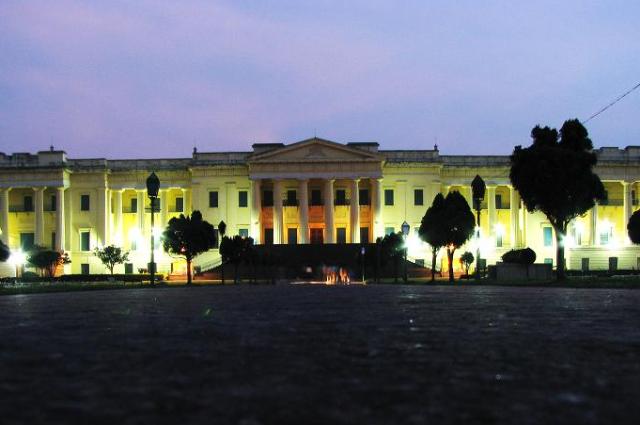
The Nawabs of Bengal (1717–1757; nominally thereafter under British) and the exiled Nawab of Awadh (Lucknow), who settled at Metiabruz (Garden Reach, Kolkata), left a rich architectural legacy in Bengal. Murshidabad, the capital of independent Bengal under Nawab Murshid Quli Khan and his successors, still houses grand complexes. These include Hazarduari Palace (built 1837, now a museum), Katra Masjid (1723, tomb of Murshid Quli Khan), Khosh Bagh (the Nawab cemetery), Nizamat Imambara, and numerous mosque-durbars and mansions. In Kolkata, the deposed Nawab Wajid Ali Shah (r.1847–57) established a mini-Awadh at Metiabruz: he built the Sibtainabad Imambara (his mausoleum), Imambaras, mansions, and gardens in the late 1850s and 1860s. These sites once anchored Nawabi court culture, their architecture blending Persianate, Mughal, Bengali, and European elements and served as loci of Shiʽa Muslim ritual (e.g. Muharram ceremonies) and Indo-Islamic learning. Together they embody a cosmopolitan past of Hindus, Muslims, Jains and Europeans in Bengal.
Yet much of this patrimony now exists more as “memory” than living tradition. Nora’s thesis that modern societies increasingly rely on such lieux de mémoire because real memory has withered is apt here. Nawabi monuments are mementoes of a bygone era; how they are remembered (or forgotten) depends on present-day forces. As Laurajane Smith observes, heritage is not an object but “a subjective political negotiation of identity, place and memory”. In other words, whether Hazarduari Palace or Sibtainabad Imambara is maintained, commemorated or allowed to decay is part of identity politics and power. We next trace how colonial and postcolonial regimes shaped these memories.
Colonial Legacies: Erasure and Remembrance
The British colonial government actively undermined Nawabi memory even as it sometimes preserved monuments. When Wajid Ali Shah died in 1887, the British dismantled his Metiabruz estate to prevent any future court from arising there. A contemporary official declared that “the late King’s premises and establishment at Garden Reach” should “be broken up as soon as possible” and any attempt by his heirs to maintain a semblance of a court should be “firmly repressed”. Indeed, within a year, the Wajid Ali Shah Estate was auctioned off: palaces, furniture, and even pigeons were dispersed, and houses demolished. The British feared that Nawabi sites served as potent symbols that could rally discontent; as the historian Rosie Llewellyn-Jones notes, colonial officials wished Nawabi memories to become “as amorphous as possible” so that the old empire would fade from mind.
At the same time, the British did allow some memorials to survive. Wajid Ali Shah himself received a state funeral (a British military escort and honors) and was buried in the Sibtainabad Imambara. His grave chapel still stands in Metiabruz, complete with the sword, chair, and tazia associated with him, and it has become a site of veneration during Shia rituals. By contrast, the last Mughal emperor, Bahadur Shah Zafar (who had similarly been a cultural figurehead), was exiled and buried in Rangoon without a marker, virtually erasing public memory of him. The difference illustrates how colonial power circumscribed which Islamic monuments would endure (often as a controlled museum-past) and which would be obliterated. In Bengal, the broad pattern was that of selective forgetting: certain Nawabi relics were inventoried and preserved (often for their utility or colonial curiosity), while others were allowed to crumble. For example, after 1765, the British stripped the city of Murshidabad of its official status, and many estates were taken away. The Nawabs’ personal tombs (e.g., in Khosh Bagh) remained, but the courtly life ended.
Thus, by Independence, much Nawabi heritage was in fragile hands. In 1931, the last Nawab of Bengal, Wasif Ali Mirza, had ceded his estates to the provincial government after bankruptcy, and after 1947, the Indian state “resumed” his properties. Hazarduari Palace and key mosques became government-run museums or centrally protected monuments, but many smaller sites became derelict. Crucially, the Nawabs themselves, once direct rulers, had no official descendants claiming authority. As a result, postcolonial West Bengal inherited these monuments with ambivalence: they were historically important, but also reminders of Muslim rule at a time of rising communal nationalism. Without a strong political constituency, Nawabi sites depended on institutional or local stewardship.
Murshidabad: Sites, Stewardship, and Revival Efforts
Murshidabad district, once the Nawabs’ capital, still contains the densest concentration of Nawabi architecture in Bengal. Hazarduari Palace, with its thousand doors, is a central tourist attraction and houses the Murshidabad Museum. The Katra Masjid (Nawab Murshid Quli Khan’s tomb-mosque), though damaged by the 1897 earthquake, remains a protected ruin. Many smaller mansions and gardens (Kathgola Rajbari, Bari Kothi, Khushbagh, etc.) testify to Nawabi patronage. These sites are now under the care of various bodies: the Archaeological Survey of India (ASI) maintains monuments like Haz and Katra, while others are private or local trusts.
Despite this heritage wealth, Murshidabad today is often described as neglected. Many monuments lie in disrepair, and local activists lament official indifference. A 2015 report found Murshidabad House (the Nawab’s Park Street mansion in Kolkata) “in tatters”, its wooden doors stolen and walls collapsed. Conservationists wrote repeatedly to the state government (then Trinamool Congress) to intervene, but to no avail. G.M. Kapoor of INTACH-Kolkata warned that “nothing was done” and that everyone seemed “waiting for the complete caving in of the building” so that developers could replace it. Likewise, the grand palace of the Darbhanga Maharaja (another heritage building in Kolkata) was delisted from protection and demolished for a high-rise. These examples illustrate a harsh reality: in West Bengal’s urban development, even nominally protected heritage can be sacrificed to modern construction, often with tacit official acquiescence. Nawabi sites, lacking a vocal patronage, are especially vulnerable.
At the same time, Murshidabad has seen notable grassroots revival efforts. In recent years, local enthusiasts and NGOs have tried to re-embed Nawabi memory in the landscape. The Murshidabad Heritage Society, a volunteer group of regional descendants and heritage lovers, has organised annual “Resurgence” festivals to showcase local history and sites. They actively engage the community in conservation seminars and promote heritage tourism. The society’s director explains that since 2010, they have “been holding a two-day festival each winter to showcase heritage sites and conduct seminars”. Private owners have restored and opened their ancestral homes: for example, the Roy family refurbished the sprawling Rajbari at Cossimbazar (an old Zamindar palace) and, in a heritage festival, “welcomed guests to the palace after 60 years”. Jain merchant families in Azimganj have refurbished haveli homes and temples with their own funds, inviting visitors to experience Nawabi-era culture. Even the Armenian Church at Gaighata (1758) has been carefully restored by the small Armenian community.
These initiatives show that civil society and local stakeholders can fill gaps left by the state. However, they typically lack scale. Unlike large state projects, they rely on volunteer energy and limited funds. The official attitude remains mixed: while some tourist promotion exists, conservation funding is scarce. A study by Paul and Roy (2017) finds that in Murshidabad, “the prevailing nature of the tourism conservation relationship upholds the criticality characteristically observed in developing countries, where governments focus primarily on the revenue-generating potential of built-heritage centric tourism, ignoring the conservation attention necessary to retain authenticity”. In other words, West Bengal’s heritage policy has often treated Nawabi monuments as commodities for visitor footfall rather than as fragile historical legacies. Indeed, as of 2025, no special central scheme (Swadesh Darshan or PRASHAD) has been earmarked for a “Nawabi circuit” in Murshidabad, underlining that official priorities lie elsewhere. Thus, Murshidabad’s Nawabi sites straddle a liminal space: they are marketed as attractions (Hazarduari being a “must-see”), yet their upkeep depends heavily on local activism and occasional ASI intervention, rather than a comprehensive heritage strategy.
Metiabruz: Exile, Memory, and Oblivion
Metiabruz, on Kolkata’s Garden Reach, was Wajid Ali Shah’s exile capital. There he sought to recreate an Awadhi milieu, building mosques, gardens, and a courtly community, even as his political power was gone. The most prominent surviving site is the Sibtainabad Imambara, a large Shiʽa shrine where Wajid Ali Shah and members of his family are interred. Inside it stands the Nawab’s tomb and personal effects (sword, chair, a Muharram tazia) preserved as relics. Every year, Shia processions gather here to commemorate Muharram, keeping alive the ritual memory of the Nawab.
Yet much of Metiabruz’s Nawabi architecture was lost. As historian Srinanda Ganguly documents, after the Nawab’s death, the British systematically auctioned off or demolished his Metiabruz palaces, gardens, and possessions. By 1887, when Viscount Cross insisted that no semblance of a court remain, nearly all the Nawabi-built environment at Garden Reach had been erased. Today, one finds few physical reminders: most mansion sites are built over by new development. Wajid Ali’s gravesite (now enclosed within the Imambara) is perhaps the only personal memorial kept intact. As the British feared, without tangible markers, the once-glorious Metiabruz court “gradually faded from memory”, surviving mainly in written records and folklore.
In contemporary Kolkata, Metiabruz’s Nawabi legacy is politically marginal. The area has become an industrial and working-class neighbourhood, and awareness of its history is confined to specialists and descendants. The grave of Wajid Ali Shah still draws pilgrims, but ironically is “a niche interest outside the Metiabruz area”. The once-iconic Imambaras and mosques survive because they remain active religious sites, managed by the Shia Wakf (charitable trusts). But beyond that, urban planners and politicians have shown little interest in restoring Nawabi Metiabruz. There are periodic grassroots calls to preserve these sites as heritage (e.g., petitions to the state archaeology department), but they struggle against land pressures. As one analyst notes, there exists “a disconnect between the civic population and the monuments… [and] a fear of criticising” state inaction. In short, the fate of Nawabi memory in Metiabruz exemplifies how communities here, a minority Muslim enclave, must keep memories alive largely on their own, often against the tide of development and indifference.
State, Community, and the Politics of Forgetting
At the state and national level, shifting politics heavily colour Nawabi heritage. The rise of Hindu nationalism (Hindutva) since 2014 has seen a renewed emphasis on the Sanskritization of history, celebrating Hindu kings and temples, while Muslim heritage is often downplayed or contested. The Ayodhya Ram temple case is instructive: prime ministers have declared the new temple a source of national pride, even though it was built on the razed Babri Masjid site. Commentators warn that under the BJP government, “several Islamic heritage sites in India have been under threat of destruction” and that little is said about it due to fear of political backlash. Though West Bengal has a non-BJP state government (TMC), these national currents still influence discourse. Critics of heritage neglect argue that Nawabi sites, being products of “Muslim rule,” may be regarded by some as less authentically “Indian” and thus receive less support in a climate of religious polarisation.
However, Bengal’s own political dynamics are complex. Chief Minister Mamata Banerjee’s government has generally presented itself as secular and protective of minority heritage. Yet in practice, heritage policy in West Bengal remains ad hoc. The state has improved some monuments (Hazarduari had ASI restoration in the 1970s) and declared heritage zones (e.g., in Murshidabad town). But civil society groups observe that bureaucratic inertia and development pressures often override heritage norms. For example, the West Bengal government’s heritage commission has listed some historic precincts (e.g., Nabadwip, Cooch Behar), but enforcement is weak in many older towns. In Murshidabad, the police (judicial) department nominally holds heritage buildings like Murshidabad House in trust, yet even its minister admitted that numerous trust properties are “encroached upon and in a very bad state”.
Local communities play a crucial counter-balancing role. For Muslims in Murshidabad and Kolkata, Nawabi monuments are part of their cultural heritage and identity. Processions at Imambaras, oral histories, and family memory keep the Nawabi past present in communal life. At the same time, other community stakeholders, notably the Bengali Hindu middle class and business families (e.g., Sheherwali Jains who built Kathgola Rajbari), also invest in this plural legacy for its tourism and cultural value. These groups have organised heritage walks, festivals, and mosque restoration projects irrespective of state action. Yet their voice can be overshadowed by dominant political narratives. Historian Syed Ali Nadeem Rezavi has lamented that few Indians prioritise architectural heritage: “There is a disconnect between the civic population and the monuments. If some tycoons were looking after heritage sites, they are least concerned”. This apathy is compounded when heritage is caught in identity politics: praising a Nawabi monument could be misconstrued as communal, while neglecting it erases part of Bengal’s syncretic history.
Challenges and Contradictions
The practical challenges of preserving Nawabi sites in West Bengal are manifold. Many of the structures suffer structural decay (age, earthquakes), neglect, and encroachment. As noted, squatters now occupy parts of Murshidabad House. Funding is scarce: restoration is slow and piecemeal. Even ASI projects (e.g., roof repairs at Katra Masjid) can lag behind tourism needs. Urban growth pressures apartments, industries, and ports, often in conflict with heritage zones (as Metiabruz illustrates).
Memory is also at risk. Younger generations may be indifferent to a precolonial Muslim dynasty. School textbooks rarely emphasise the Nawabs beyond the Battle of Plassey. Official commemorations, anniversaries, and plaques are rare. The political climate adds another layer: in some quarters, Nawabi heritage is labelled as “colonial slur” or “foreign” (despite being centuries old), echoing wider debates on national identity. At the same time, pockets of revival hope remain. Murshidabad’s resurgence festival and the slow return of tourism post-COVID suggest there is both interest and economic incentive in preserving these sites for heritage tourism.
This tension between remembering and forgetting is precisely what it means for a place to be a site of memory. Nawabi monuments in West Bengal vividly demonstrate Nora’s insight: they survive today only because people imbue them with meaning in the present. Yet that meaning is constantly renegotiated. As Smith reminds us, heritage is “what we do”, a set of actions and debates, not a static object. In this sense, the fate of Murshidabad House, Hazarduari Palace, Sibtainabad Imambara, and others will depend on this ongoing negotiation. Will they be restored and valorised as embodiments of Bengal’s plural past, or neglected until they vanish? So far, the answer is mixed: civil society and some officials strive to conserve Nawabi heritage, but powerful countervailing forces development pressures, political indifference, and communal bias, often threaten to consign these sites to oblivion.
The case of Nawabi heritage in West Bengal shows that memory and forgetting are not natural processes, but political ones. Colonial and nationalist regimes alike have shaped which Nawabi memories endure. In Murshidabad and Metiabruz, monuments stand as fragile memorials of a vanished era, protected unevenly by a patchwork of institutions and advocates. The current era’s heritage politics, from tourism schemes that sideline smaller monuments to identity-driven narratives that downplay Muslim contributions, continues to determine these outcomes. A Foucauldian reading would note that power circulates through heritage discourse: those who tell the story of the past control what is remembered. Acknowledging this, scholars and activists must challenge selective forgetting and strive for a more inclusive heritage discourse. Preserving the Nawabi sites of Bengal is not just about saving old buildings; it is about defending a multifaceted memory of the region. It requires critical engagement with history (per Nora’s “lieux de mémoire”), community participation and conscientious state policy, a process of negotiating what stories we choose to pass on, and which we let fade into silence.