
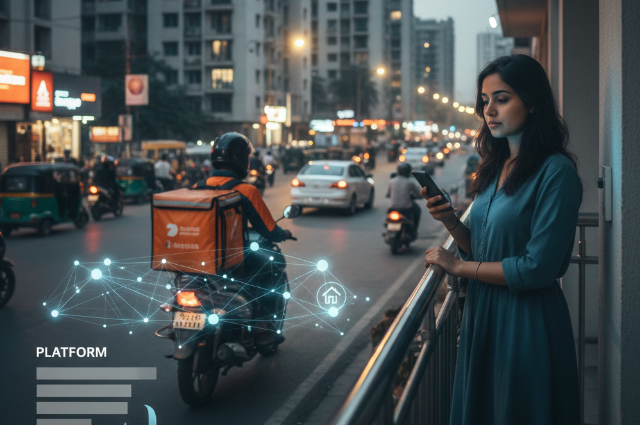
Cities no longer arrive through the streets. They arrive through screens. Vegetables are selected from photographs. Prices are fixed digitally. Payments happen silently. A delivery worker presses the bell, waits briefly, and moves on. What once required presence now requires only an application.
For millions, this shift has been genuinely beneficial. Time is saved. Travel is reduced. Daily routines become manageable in ways earlier generations could scarcely imagine. App-based services solved real problems, and they did so efficiently.
Yet beneath this convenience, something else has been quietly rearranged—without protest, without public debate, and largely without notice.
From Choosing in Person to Selecting Remotely
Not long ago, everyday buying involved participation. People examined produce, asked questions, compared quality, and spoke to the seller. Even disagreement over price required conversation. It demanded explanation, patience, and recognition.
This was never merely about bargaining.
It was about communication.
Today, selection replaces choice. Images replace inspection. Specifications replace judgment. Payment is instant. Interaction ends before it begins.
What disappears in this process is not efficiency, but visibility—of work, of effort, of the person on the other side of the transaction.
What Became of the Small Seller
The local vegetable vendor, fruit seller, and corner shopkeeper did not vanish overnight. There were no dramatic closures or public protests. Demand simply thinned.
Customers shifted online for convenience. Foot traffic reduced. Fewer daily transactions meant shrinking margins. Some sellers continued at reduce scale. Others joined platforms. Many slipped into informal or unstable work.
The street did not react. It adjusted.
What disappeared was not work, but independence.
When Malls Arrived, We Noticed. This Time, We Didn’t.
When malls entered Indian cities, the disruption was visible. Small shops closed. Neighbourhoods changed. There were debates, anxieties, and resistance. Society noticed what was being replaced, even if it eventually accepted the change.
This transformation has been different.
App-based platforms did not replace shops with buildings. They replaced relationships with systems. There were no shuttered storefronts to mourn, no symbols of loss to provoke discussion.
The change felt smooth because it happened inside homes, not on the street.
From Shopkeeper to “Partner”
Many small sellers did not stop working. They may now join the delivery workers, riders, or task-based earners. Their roles were redefined rather than eliminated. Physical interaction between buyers and sellers now become invisible.
The language softened the transition. “Employee” became “partner.” “Job” became “gig.” Risk moved quietly from organisations to individuals.
Earlier, sellers controlled time, space, and pace. Earnings were modest, but predictable. Today, work arrives in fragments—dependent on algorithms, incentives, and ratings that change without explanation.
Cities gained speed. Workers lost certainty.
Work That Exists, Employment That Doesn’t
Modern cities are not short of work. They are short of stable livelihoods.
Tasks are abundant, but assurance is scarce. Income is earned per delivery, per ride, per assignment—without continuity or protection. A slowdown, illness, or a single unfavourable rating can disrupt earnings instantly.
Small sellers once survived on familiarity and trust. Platform systems reward scale, speed, and uniformity. Fixed pricing and centralised control leave little room for informal resilience.
This is not unemployment in the classical sense. It is a rearrangement of work where security disappears first.
Where the Value Now Gathers
The strength of service aggregators lies in concentration. Control, data, and decision-making sit at the platform level. Below them is a vast workforce performing essential labour with limited influence over how value is distributed.
Platforms invest in technology and scale. The uncertainty of daily earnings, health, and continuity is borne almost entirely by those who deliver the service.
Money circulates through the system, but a disproportionate share accumulates at the top. Risk travels downward, where labour is physical and personal. The city functions smoothly because this imbalance remains largely invisible to users.
Convenience masks concentration. Efficiency obscures vulnerability.
When Efficiency Replaces Belonging
The disappearance of small businesses alters more than income; it reshapes neighbourhood life.
Local sellers once belonged to the streets. They were recognised, remembered, and relied upon. Informal support systems existed—credit during difficult times, flexibility during emergencies, familiarity that reduced the distance between people.
App-based systems serve efficiently, but they do not belong anywhere. They deliver, but they do not participate.
As efficiency increases, belonging recedes.
The New Urban Silence
Cities today are busy, yet quieter in unexpected ways. Transactions occur without conversation. Payments completed without exchange. Work finishes without being acknowledged beyond a digital notification.
This silence is functional. It saves time. But it also removes the small affirmations that once made work visible to the people and felt present.
The delivery worker moves quickly, often unnoticed. The customer receives what was ordered and moves on. The transaction ends, but a relationship never begins.
Why Society Did Not Resist
Society did not resist this transformation because it delivered immediate benefits. Daily life became easier. Friction reduced. Convenience increased.
The gains were personal and visible.
The losses were collective and abstract.
When interaction faded, the emotional connection weakened. When connections weakened, resistance became unlikely. Nothing appeared to break, so nothing demanded repair.
Living With the Rearrangement
This transformation is not a moral failure, nor a technological mistake. App-based services emerged in response to real needs and delivered genuine benefits. They reduced friction, saved time, and adapted quickly to the pace of modern life.
The question is not whether this shift should have happened, but whether its consequences have been fully understood.
What cities exchanged was not merely one mode of service for another. They exchanged visibility for convenience, continuity for speed, and participation for efficiency. In doing so, work remained plentiful, but its human anchors loosened.
The rearrangement is already complete. What remains is how society chooses to recognise and respond to what it has produced.
The invisible workforce behind the screen keeps the city moving with remarkable efficiency. Orders arrive on time. Payments clear instantly. Life flows with fewer interruptions.
Yet the cost of this smoothness is subtle. Work becomes quieter, relationships thinner, and labour easier to overlook. When effort is hidden, recognition weakens. When recognition weakens, belonging fades.
Cities do not need to reject convenience to address this imbalance. They need awareness of who carries the risk, who absorbs the uncertainty, and who remains unseen in the process.
Progress does not demand reversal.
It demands attention.
Without it, cities may continue to function flawlessly while slowly forgetting the human work that sustains them.