
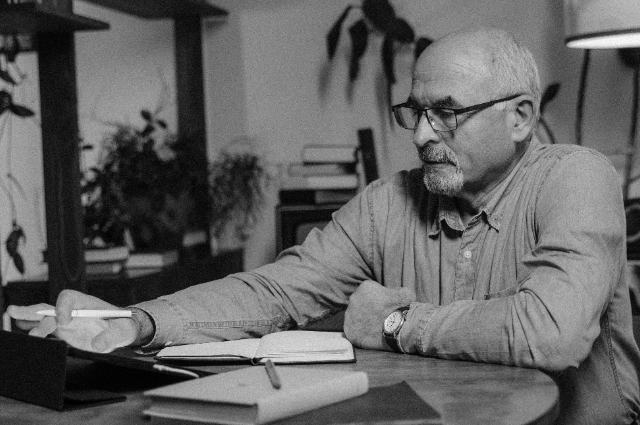
How an unexpected turn in life led an engineer to discover a writer within himself
I never planned to become a writer. For thirty-six years, I worked in the power sector, where projects, responsibilities, and decisions shaped my days and required practical thinking. When I retired in July 2022, I had other ideas about how I would spend my time. Literature was nowhere in my plans. In fact, I cannot remember writing anything literary before that unexpected chapter of my life began.
Today, looking back, I find it hard to pinpoint the exact moment my relationship with writing changed. There was no deliberate decision, no ambition to publish a book and no conscious attempt to discover a hidden talent. There was only a newspaper, a few lines scribbled in one of its corners, and an act by someone in my family whose identity remains a mystery to me.
Those forgotten lines became the beginning of a journey I could never have anticipated.
A Future That Had to Change
My professional life had given me a familiar rhythm. Working in power projects across Northeast India, including remote locations, had taught me that engineering involved much more than technical knowledge. Projects required people to work together, make difficult decisions and find solutions under challenging circumstances. The finished structure or the electricity generated might be the visible result, but the effort behind it belonged to many individuals.
For decades, I had lived within that world. There was always something to attend to, a responsibility to discharge or a task that needed to move forward. Even when one assignment ended, another usually followed. I rarely had to wonder how I would occupy my working day.
Retirement offered the prospect of a different life. I could finally decide how to spend my time without organising it around professional commitments. One of my plans was to settle in my ancestral home. After a long career, the thought of returning to familiar surroundings and living at a gentler pace appealed to me.
But life had already intervened in my plans.
In 2019, I suffered heart failure and underwent a major operation. I recovered, but physical weakness remained a consideration, and regular visits to my cardiologist continued to be necessary. My ancestral home did not have the cardiac facilities I needed, so settling there was no longer a practical option. I had to remain in a city where appropriate medical care was accessible.
It was a decision dictated by necessity rather than preference.
I do not recall treating it as a dramatic turning point at the time. It was a practical adjustment I had to make. Nevertheless, the experience had altered the circumstances in which I would eventually approach retirement. I could no longer assume that every activity I wished to pursue would be possible in the way I had imagined.
When I retired in July 2022, I was reasonably well, but I had to remain conscious of my physical limitations. I wanted to live meaningfully without placing unnecessary demands on my body. What I did not know was that an entirely unexpected activity would eventually fit those circumstances.
When Doing Nothing Was No Longer Enough
The first few months of retirement were enjoyable. After decades of professional responsibilities, I appreciated the freedom of having no immediate task waiting for me. I could read, rest, spend time with family or simply let the day pass without feeling that something had been left unfinished.
For a while, that freedom was enough.
Gradually, however, I began to feel the need for something that would keep my mind occupied. I did not want to return to the pressures of professional life, nor was I looking for another career. I simply wanted an activity that could give my days some structure and engage my mind while allowing me to work at my own pace.
I had no idea what that activity might be.
Writing certainly did not occur to me. During my working years, I had written when my profession required it, but those documents served practical purposes. They communicated information, explained problems and recorded decisions. I had never considered literary writing a possibility for myself.
There was no particular dissatisfaction with retirement that I was trying to overcome. I was simply discovering that the freedom to do nothing, pleasant as it was initially, did not necessarily provide a lasting sense of engagement.
Then came an ordinary day that I would probably have forgotten altogether had events not taken an unexpected turn.
I was reading a newspaper when I began scribbling a few lines in one of its corners. I believe they were romantic in nature, but I cannot recall their subject or wording. I was not composing a poem for publication, and I had no particular reader in mind. The lines came without a plan, and once I had written them, I forgot about them.
As far as I knew, nothing more would come of that little exercise.
I was wrong.
The Publication I Never Expected
Someone in my family noticed the writing. It may have been my wife or one of my children, but I have never established who it was. Without telling me, that person had the lines typed and sent to a well-known regional newspaper.
I knew nothing about the submission.
There had been no discussion about whether the writing was worth publishing. Nobody had asked for my permission or suggested that I should send it somewhere. I had not even preserved the original lines. They were no longer in my thoughts.
Then I discovered that they had appeared in print.
My first reaction was disbelief. I had forgotten what I had scribbled, so seeing the piece published seemed almost unreal. I could hardly connect the printed words with the casual act that had produced them. Until that moment, I had never thought of myself as someone who might write for readers.
I did not suddenly conclude that I was a gifted writer. One publication could not establish that, and I had no literary experience against which to judge my work. What it did was introduce a possibility I had never seriously considered.
Perhaps I could try writing again.
The mystery of who submitted the lines remains unresolved. I have sometimes wondered what prompted the person to do it. Was it an attempt to encourage me? Did the writing appear interesting to someone who knew me? Or was it simply an affectionate gesture, made without any expectation of what might follow?
I cannot answer those questions, and I do not want to turn speculation into fact.
I know only that someone took those forgotten lines seriously enough to give them an audience. That small intervention brought my writing into the public world before I had even begun to imagine myself as a writer.
It was a beginning I had not chosen, but one I could choose to follow.
Learning Without a Road Map
I did not become a writer overnight. After that first publication, I began writing occasionally and sending contributions to various anthologies when their themes interested me. One invitation might prompt an idea; another might lead me to revisit an experience or express a thought that had been waiting for an outlet.
There was no grand strategy. I was exploring an unfamiliar activity and learning through the process.
Over time, I noticed that the desire to write was becoming stronger. What had started as an occasional exercise began to feel like something I wanted to pursue. I cannot say exactly when that change occurred. There was no formal declaration to myself that I had entered the literary world.
The creative mind I had never consciously recognised seemed to be finding its own way out.
Perhaps my years in engineering had left me with more material than I had realised. Working in projects had brought me into contact with people, difficult situations and experiences that went beyond technical assignments. During my career, I had dealt with these matters as part of the work that needed to be done. I had rarely paused to consider how they might be expressed in a literary form.
Now I was looking at them differently.
I was not discovering an entirely new past. I was discovering another way of understanding the past I already possessed.
My professional background had taught me the importance of clarity and precision. In engineering, a document must communicate its purpose accurately. A misunderstanding can have practical consequences, and there is little value in language that obscures what needs to be done.
Literary writing presented a different challenge. Accuracy remained important, but so did the choice of words, the movement of a thought and the ability to convey something beyond bare information. An experience might be familiar to me, yet I still had to find a way to make it meaningful to someone who had not lived through it.
I learned that having something to say and knowing how to say it were not the same thing.
There was no shortcut. Each piece offered another opportunity to understand the work. The initial publication had opened a door, but I had to do the writing myself. Whatever had prompted my unknown family member to submit those first lines, that person could not decide what I would write next or how seriously I would pursue it.
That responsibility belonged to me.
My First Book was a story about the People Behind the Projects
My first book, A Sanguine Tale: Unfolding the Life of a Project Engineer, grew naturally out of the professional world I had known for thirty-six years. It gave me an opportunity to revisit that experience, but I did not want to produce a technical account of engineering projects.
I was more interested in their human dimensions.
A power project can be described through its capacity, machinery, construction and eventual output. Those details matter, but they cannot fully convey what it means to bring a project to completion. Behind the technical specifications are people with different responsibilities, temperaments and personal circumstances. They work together, face difficulties and contribute in ways that may not always be visible in the finished result.
I had seen this throughout my career. Technical competence was essential, but cooperation, patience, judgement and an understanding of people also played important roles. The human experience of a project was often as revealing as its engineering achievements.
That was the aspect I wanted to explore in my book. The engineering provided the setting; the people gave the story its substance.
Writing the book brought my two seemingly different lives together. The engineer drew upon years of professional experience, while the emerging writer tried to understand what those experiences might mean beyond their immediate context.
I discovered that familiarity with a subject does not automatically make it easy to write about. A long career provides a great deal of material, but a book requires selection, structure and a clear sense of what the reader needs to know. Memories must be examined rather than simply recorded. Details that seem important to the person who lived through an event may not necessarily be important to the person reading about it.
I had much to learn.
Yet the work was rewarding because it allowed me to return to experiences that had shaped a substantial part of my life. What had once belonged entirely to my professional past could now contribute to something new.
I had never planned to write an engineering book, much less one that gave greater attention to human experience than to technical detail. But once I began, that seemed to be the direction in which my interest naturally led me.
The book was not the culmination of my literary education. It was another stage in it.
A Different Kind of Purpose
As writing became a more regular activity, it gave my days a rhythm that suited my circumstances. My health continued to require attention, and I had to be sensible about my physical limitations. Writing allowed me to remain mentally engaged without demanding the kind of physical activity that might not always be convenient for me.
I could decide when to begin, when to stop and when to return to a piece. I could think through an idea without needing to be somewhere at a particular time. The activity fitted around my life rather than requiring me to organise my life around it.
This was important, but its value extended beyond convenience.
During my professional career, much of my time had been directed towards responsibilities assigned by a project, a position or an organisation. Retirement removed that familiar structure. Writing gave me an activity I could pursue from my own initiative, one that depended on my willingness to continue rather than on an external obligation.
It also gave me a reason to remain curious.
An experience that once seemed ordinary could invite a second look. A thought might develop into a piece of writing. An anthology theme could encourage me to consider a subject from an unfamiliar perspective. I found myself engaging with ideas in ways that had not formed part of my earlier routine.
Writing did not erase the physical consequences of my medical experience, nor did it replace the need for continuing care. It offered something more modest and, for me, genuinely valuable: a way to use my time and abilities constructively within the circumstances in which I lived.
I had retired from engineering, but I had not exhausted my capacity to learn or to begin something new.
The Journey Beyond the Beginning
As the years passed, my occasional writing developed into a sustained literary pursuit. I continued contributing to anthologies and took on larger projects. Books followed, and my work began reaching readers beyond the immediate circles in which I had lived and worked.
The journey brought opportunities and recognition I could never have anticipated when I wrote those first forgotten lines. I am grateful for the encouragement that has come along the way, and it has strengthened my desire to continue.
But I do not measure the significance of this journey only through publications or recognition.
What matters more is the discovery that I could undertake something I had never imagined doing. For most of my life, I had understood my abilities through the work I performed. Engineering was my profession, and it gave me a clear sense of what I knew and what I could contribute.
Literature challenged the assumption that my identity had already been fully defined.
I had not been waiting throughout my career to become a writer. I had not secretly nurtured a literary ambition that retirement finally allowed me to pursue. The desire emerged gradually, through an experience that I had not even considered important at first.
That is what makes the journey unusual to me. It was not the fulfilment of a long-held dream. It was the discovery of a possibility I had never thought to dream about.
I sometimes wonder what would have happened if those lines had never reached the newspaper. Perhaps I would have found another way to occupy my time. Perhaps writing would never have become part of my life. There is no honest answer to either question.
I can only look at what actually happened and recognise how much followed from an incident that seemed insignificant when it occurred.
What Remains Unwritten
There is one part of this story that I cannot resolve, and perhaps it is the part I remember most clearly.
I still do not know who sent my first writing to the newspaper.
The person may have forgotten the incident long ago. Perhaps it seemed like a small gesture, hardly worth remembering. I cannot know whether the person expected me to continue writing or imagined that the publication would lead anywhere.
Yet that unknown act became the starting point of a literary life.
I had spent thirty-six years in engineering without imagining that I would one day write books. After retirement, I was looking for something to occupy my mind while adapting to the physical limitations that had altered my plans. A few romantic lines, scribbled in a newspaper margin and forgotten, unexpectedly opened another possibility.
The rest required time, effort and a willingness to keep going. The first publication did not make me a writer by itself. It gave me the chance to discover whether writing could become part of my life. I took that chance, initially without much certainty, and gradually found a direction I had never anticipated.
I sometimes think of the person who submitted those lines. I have no name to attach to the memory, no conversation to recall and no explanation to preserve. There is only the fact that someone saw value in words I had already forgotten.
Perhaps that person understood something about me that I had not yet discovered. Perhaps there was no such insight at all, only a simple act of encouragement. I will never know.
But I have come to understand that the significance of a gesture does not depend entirely on the intention behind it. An act can travel further than the person who performs it expects. Its consequences can unfold slowly, in directions that nobody could have predicted.
The person who sent my scribble to the newspaper could not have known that I would go on to write books. I could not have known it either. At that moment, there was no literary journey to speak of—only a few lines, a publication and my astonishment at seeing them in print.
Today, when I sit down to write, I sometimes think of that forgotten piece. I cannot recover its words, and I no longer feel the need to do so. The lines themselves have disappeared, but the possibility they opened has remained.
For most of my life, I believed I knew the boundaries of my abilities. I had trained as an engineer, worked in the power sector and spent decades fulfilling responsibilities that were familiar to me. Retirement brought changes I had not expected, and my search for a way to remain engaged led me towards an activity I had never considered my own.
I did not set out to find a writer within myself. I found one while trying to find something to do.
And perhaps that is the part of the story I value most. Not that a few lines became a book, or that an unexpected beginning led to recognition, but that I discovered, late in life, how little we may know about the possibilities still waiting within us.
I began with a scribble I could not remember.
I am still writing.
And somewhere, in the pages of a newspaper I can no longer recall, the first words of this life remain lost—while the life they began continues to unfold.